

A humanoid robot is built around the human body plan: head, torso, two arms and, usually, two legs. Humanoid robot design is the work of making that body actually function in places made for people, like factories, warehouses, and homes.
The look is the easy part. The hard calls are about joints, motors, sensors, batteries, and the software that keeps a two-legged machine from tipping over. Designers even have to decide how the robot should fall.
And every decision costs something somewhere else. Add joints, and you add weight, plus more things that can break. Add a battery and the legs work harder. Below, we go through those trade-offs, the process engineers follow, and how 2026 machines like Atlas, Unitree’s G1, Figure 03, and 1X’s NEO deal with them.
What does humanoid robot design mean?
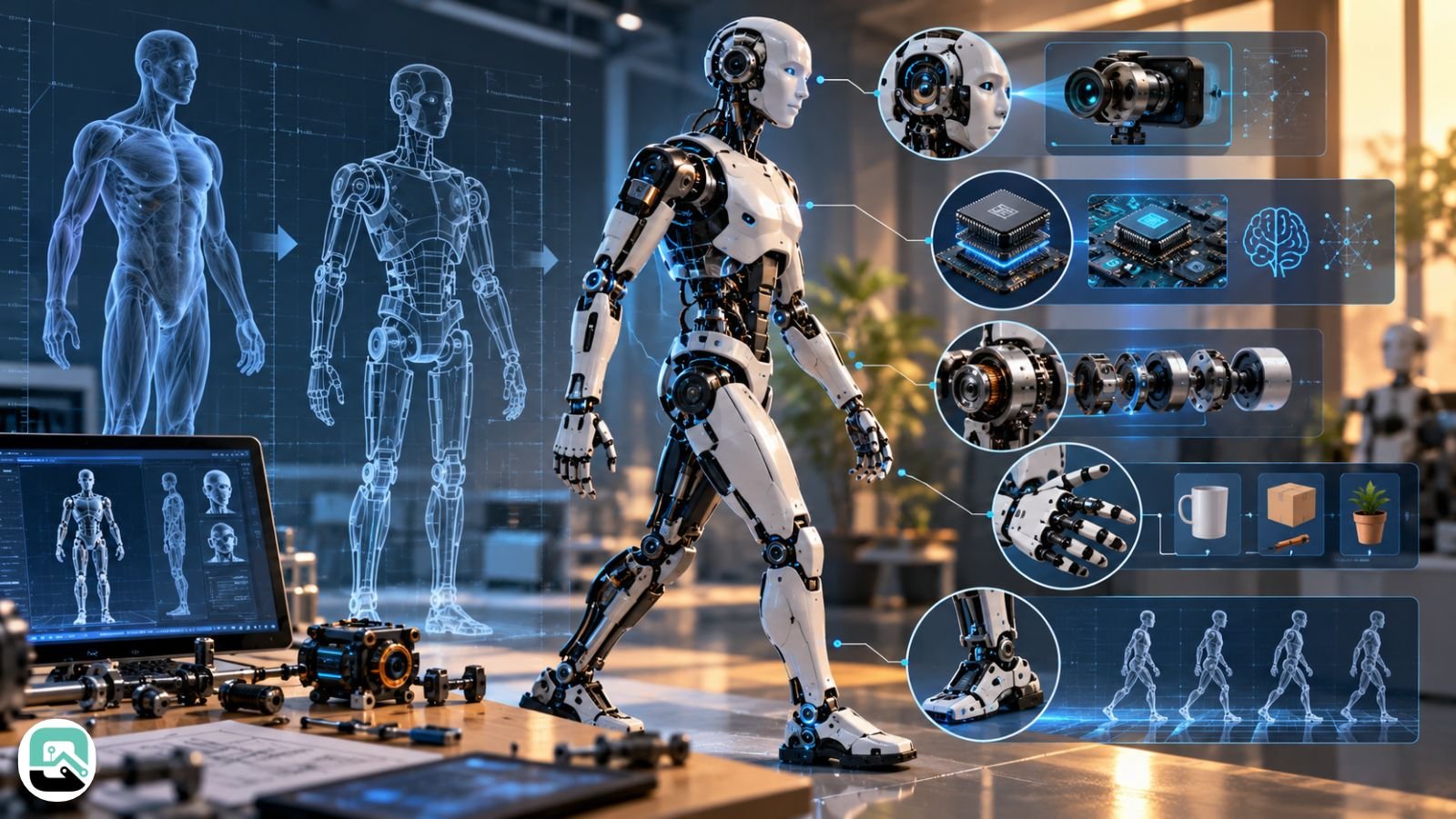
It means picking the body, joints, motors, sensors, power, and software for a person-shaped robot, then tuning them against each other so the robot can move, grab things, and stay safe near people. The human shape sets the rules. Design is how well you play within them.
Think of it as a chain. Heavier hands need stronger shoulders. Stronger shoulders need a sturdier torso, and all that extra mass eats battery.
Not every humanoid is chasing the same goal, either. The main types of humanoid robots split along a fairly simple line. Work-first machines like Atlas, Tesla’s Optimus and Figure 03 care about payload, uptime and unit cost. Social robots like Hanson Robotics’ Sophia care about faces, eye contact and conversation.
A few companies go further and bolt a human upper body onto wheels. They still call the result a humanoid.
Why do engineers give robots a human shape?
Because the world is already built for people. Stairs, door handles, shelves, workstations, hand tools: all of it assumes two arms, a certain reach, and a body that fits through a hallway. A robot with the same shape can, at least in theory, walk in and start working without anyone rebuilding the place.
That access isn’t free. Legs are among the hardest parts to get right (hands are the other big one), and balancing on two of them never stops being work.
Wheels are usually cheaper and run longer per charge. A wheeled base with brakes also stays put when the power dies. A self-balancing wheeled robot won’t.
So on a flat, open factory floor, wheels often win. Legs pay off on stairs, rough ground, cluttered homes, and stations designed for a standing worker. My take: a humanoid body is a bet on doing many jobs reasonably well, not on being the best tool for any single one.
How do engineers design a humanoid robot step by step?
They start from the job and work backward. Requirements come first, then the body layout, joint sizing, and simulation. Last come prototypes that get pushed until something breaks, and whatever breaks sends the team back a few steps.
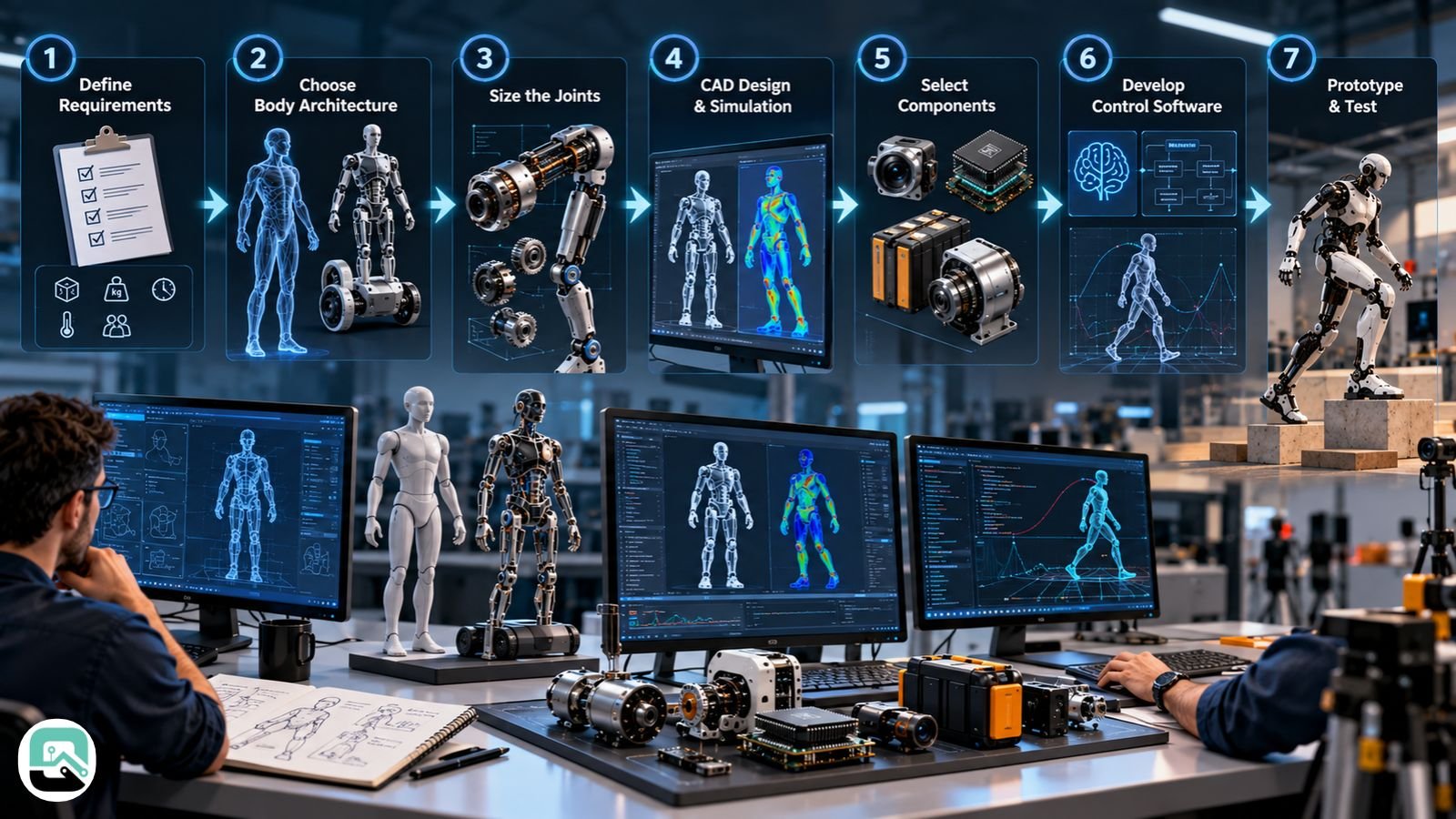
- Pin down the requirements. What tasks, what payload, how long per charge, how hot or cold, and who’ll be standing nearby? A parts-sorting robot and a laundry-folding robot end up with very different specs.
- Pick the body architecture. Legs or wheels, height, reach, hand type, joint layout. Once this is settled, so is the robot’s degree-of-freedom count.
- Size each joint. Work out the torque, speed, and range of motion for the toughest planned move, then leave margin for bumps and falls.
- Build it in CAD, then in simulation. The mechanical design gets exported as a robot description, often a URDF file, and tested in physics simulators like MuJoCo, Gazebo, or NVIDIA Isaac Sim. ROS 2 frequently ties the pieces together.
- Choose the components. Actuators, sensors, batteries, and computers have to hit the targets without blowing the weight or cost budget.
- Write the controllers. That covers balance, walking, and grasping. More and more teams train AI policies in simulation first and move them onto hardware later.
- Prototype and test. Repeat motions over and over, drop the robot on purpose, push the battery and thermal limits, and check every safety function.
Skipping step one is the expensive mistake. A robot without a clearly defined job tends to look great on stage and disappoint on the floor.
What are the main parts of a humanoid robot?
Seven subsystems make up a humanoid: the frame, joint actuators, hands, sensors, power, onboard computing, and safety functions. The frame carries the load, actuators move it, sensors report back, and software runs the show. A weak link anywhere caps the whole machine.
| Subsystem | What it does | Core design question |
|---|---|---|
| Frame and shell | Carries loads and protects internal parts | How stiff can the frame get without adding weight? Soft covers for homes or hard shells for factories? |
| Actuators (joint modules) | Turn electricity into joint motion and force | Rotary or linear output? Which gear ratio? |
| Hands | Grasp and manipulate objects | How many fingers and joints before durability suffers? |
| Sensors | See, feel, and track balance | Which mix of cameras, depth sensors, IMU, joint encoders, force sensors, and touch sensors, and where? |
| Power | Battery and power electronics | Runtime versus weight; swap, plug in or charge wirelessly? |
| Compute and control | Balance, planning, and AI decisions | What runs onboard versus in the cloud, and how fast? |
| Safety functions | Stops, limits and fall behavior | What does the robot do when something fails? |
Unitree’s G1 specifications show what this looks like on paper. The base G1 has 6 degrees of freedom per leg, 5 per arm, and 1 at the waist. EDU versions add optional dexterous hands plus extra waist and wrist joints.
How many degrees of freedom does a humanoid robot need?
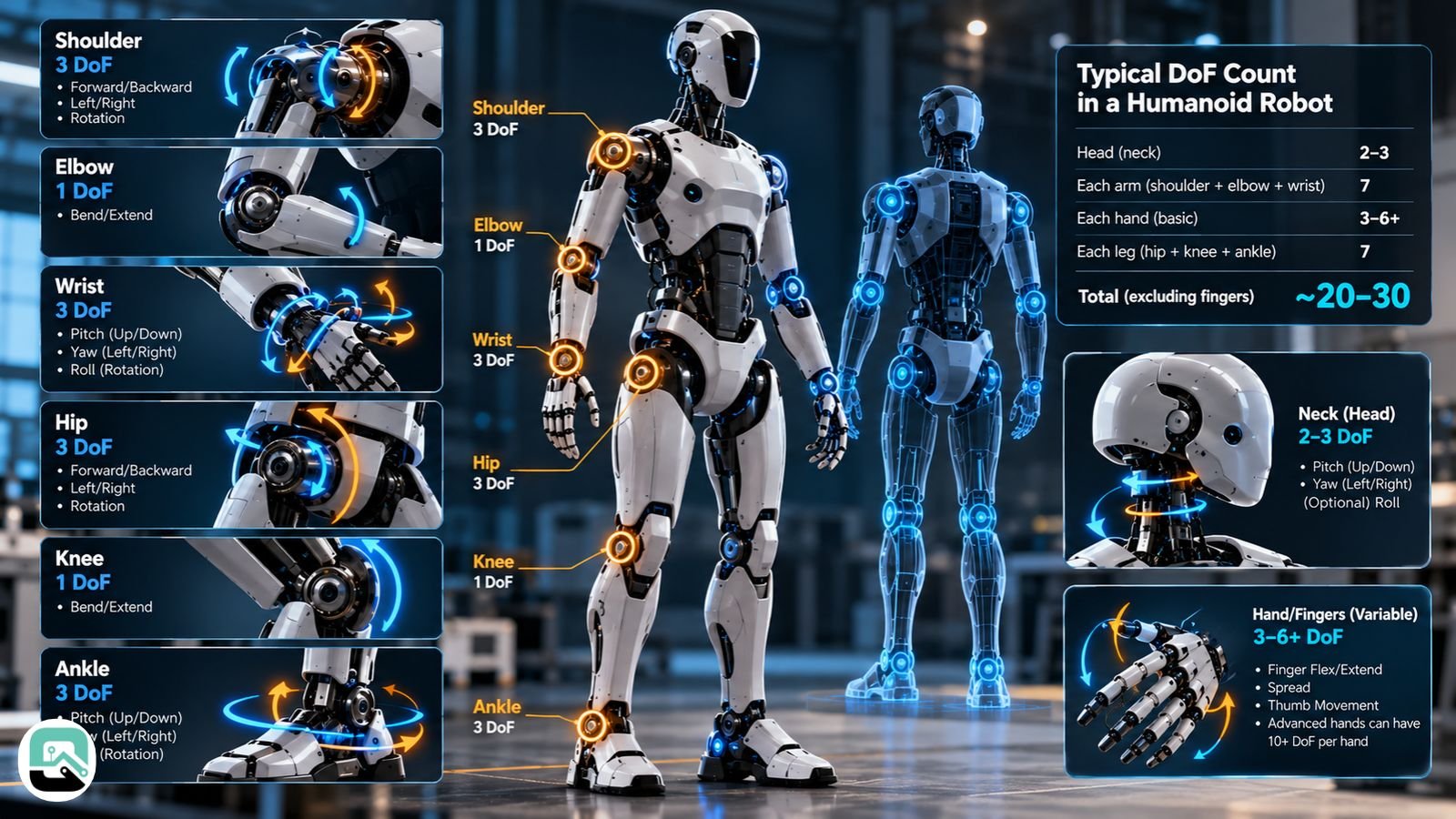
A degree of freedom (DoF) is one independent way a joint can move. Today’s humanoids list body totals anywhere from the low 20s to past 40, and dexterous hands push that much higher. How many a robot needs depends on its work, not on spec-sheet bragging rights.
A few reference points help. An arm needs six DoF to put a hand at any spot, at any angle: three for position, three for orientation. A seventh lets the elbow swing around obstacles, the way yours does. A typical leg gets three at the hip, one at the knee, and two at the ankle, and the G1 follows that pattern.
Hands are where the numbers balloon. Tesla’s latest Optimus hand reportedly has 22 DoF per hand, with its actuators packed into the forearm and tendons running down to the fingers.
That’s why comparing humanoid DoF counts gets tricky. One maker includes hand joints in the headline figure, another lists them separately, and optional add-ons inflate the “up to” numbers. Check what’s being counted before you compare.
More isn’t automatically better, either. Each active joint usually means another motor, another sensor, and one more thing to fail. Some designs get around that with coupled, passive, or underactuated joints, where one motor drives several links. Plenty of robot fingers work this way.
Which actuators move a humanoid robot’s joints?
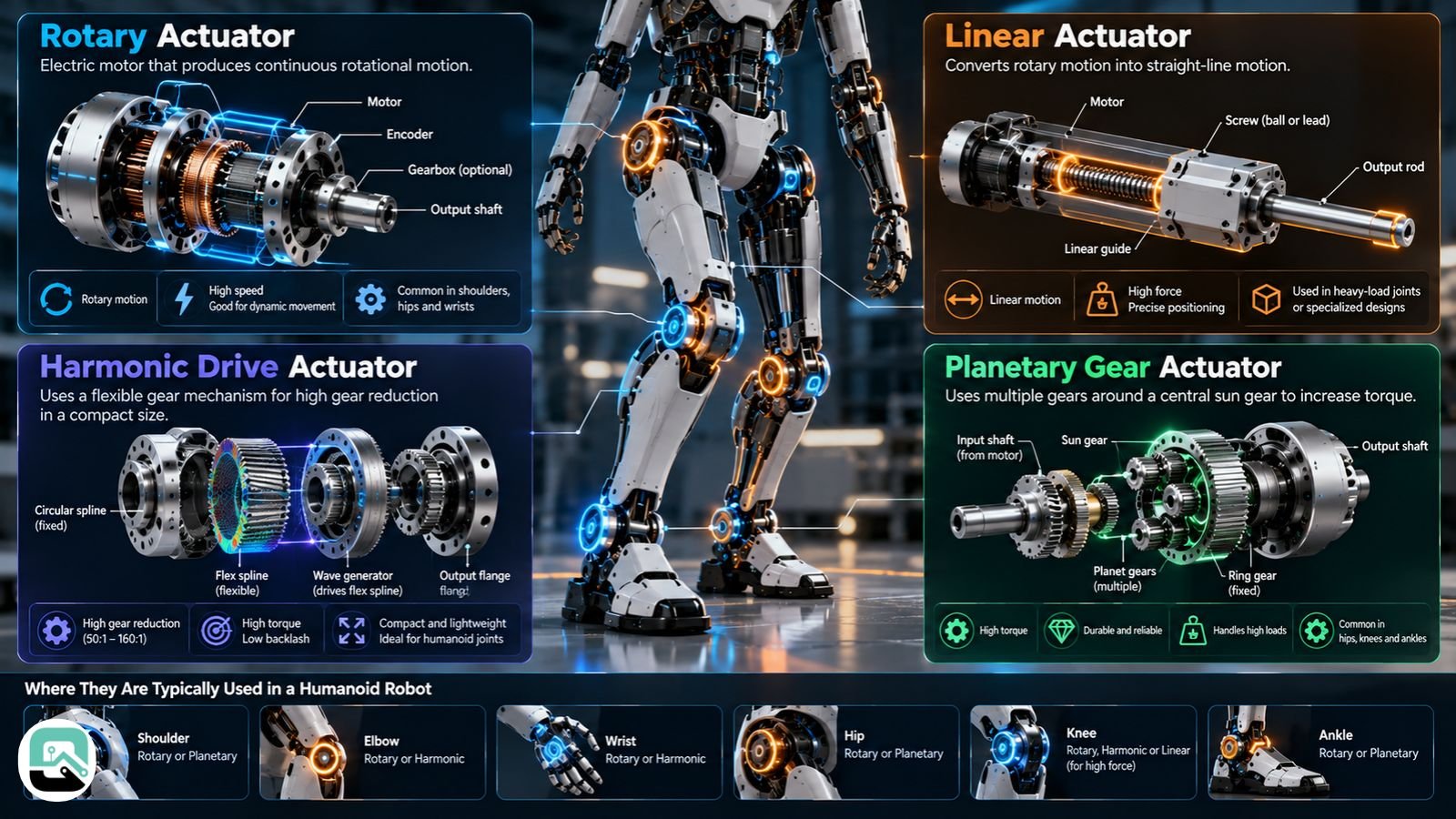
An actuator turns electricity into joint motion. Each one is really three decisions stacked together: a transmission that trades speed for torque, an architecture that sets how stiff or springy the joint feels, and an output that either spins or pushes in a straight line. Get the mix right, and the joint is strong, survives impacts, and gives way safely when someone bumps into it.
The industry has mostly left hydraulics behind. Boston Dynamics retired its hydraulic Atlas in April 2024 and replaced it with an all-electric model. Electric joints are quieter, have no fluid lines to leak and are far easier to mass-produce.
How do the main actuator types compare?
| Design choice | Option | How it works | Strength | Weakness | Common placement |
|---|---|---|---|---|---|
| Transmission | Harmonic (strain-wave) | A flexing thin-steel cup gives very high reduction, often 100:1 or more | Compact, precise, almost no backlash | The thin flexing part can crack under hard impacts | Arms, wrists, torso |
| Transmission | Planetary | Gears orbit a central sun gear | Efficient and tougher under shock | Bulkier at high ratios | Hips, shoulders |
| Transmission | Cycloidal | A lobed disc rolls inside a ring of pins | Handles shock well in a compact package | Harder to manufacture | High-load rotary joints |
| Architecture | Quasi-direct drive (QDD) | A large motor with a small reduction, roughly 5:1 to 20:1 | The controller feels contact through motor current, and the joint yields when pushed | Runs hotter; needs a heavier motor for the same torque | Legs on agile, learning-based robots |
| Architecture | Series-elastic | A spring sits between the gearbox and the limb; spring deflection measures force | Absorbs shocks and allows fine force control | Less stiff, so precise positioning gets harder | Research robots, joints that touch people |
| Output | Rotary | The output flange turns the next limb segment | Wide range of motion, compact | The gearbox takes impacts directly | Shoulders, hips, waist |
| Output | Linear (planetary roller screw) | Threaded rollers turn motor rotation into a push | Spreads impact across many thread contacts | Expensive, hard to make, limited stroke | Knees, ankles, elbows |
How do engineers combine and place actuators?
In practice, most humanoids mix and match. Industry analysis of Tesla’s Optimus describes harmonic-type rotary joints in three sizes, with linear roller-screw actuators handling the heaviest loads. One cost breakdown puts the roller screw alone at about two-thirds of a linear actuator’s price, which goes a long way toward explaining why actuators dominate a humanoid’s build cost.
Where the actuator sits matters too. The RH5 humanoid research paper describes driving leg joints through parallel actuators to cut limb inertia, and the NING humanoid uses linkages for the same reason. Lighter shins swing faster and burn less energy per step.
Why do actuators decide who can build humanoids?
There’s a business angle as well. When Boston Dynamics launched the production Atlas, it named Hyundai Mobis as its actuator supplier. Picking an actuator is partly an engineering call and partly a bet on who can build it at volume.
How does a humanoid robot sense its surroundings and decide what to do?
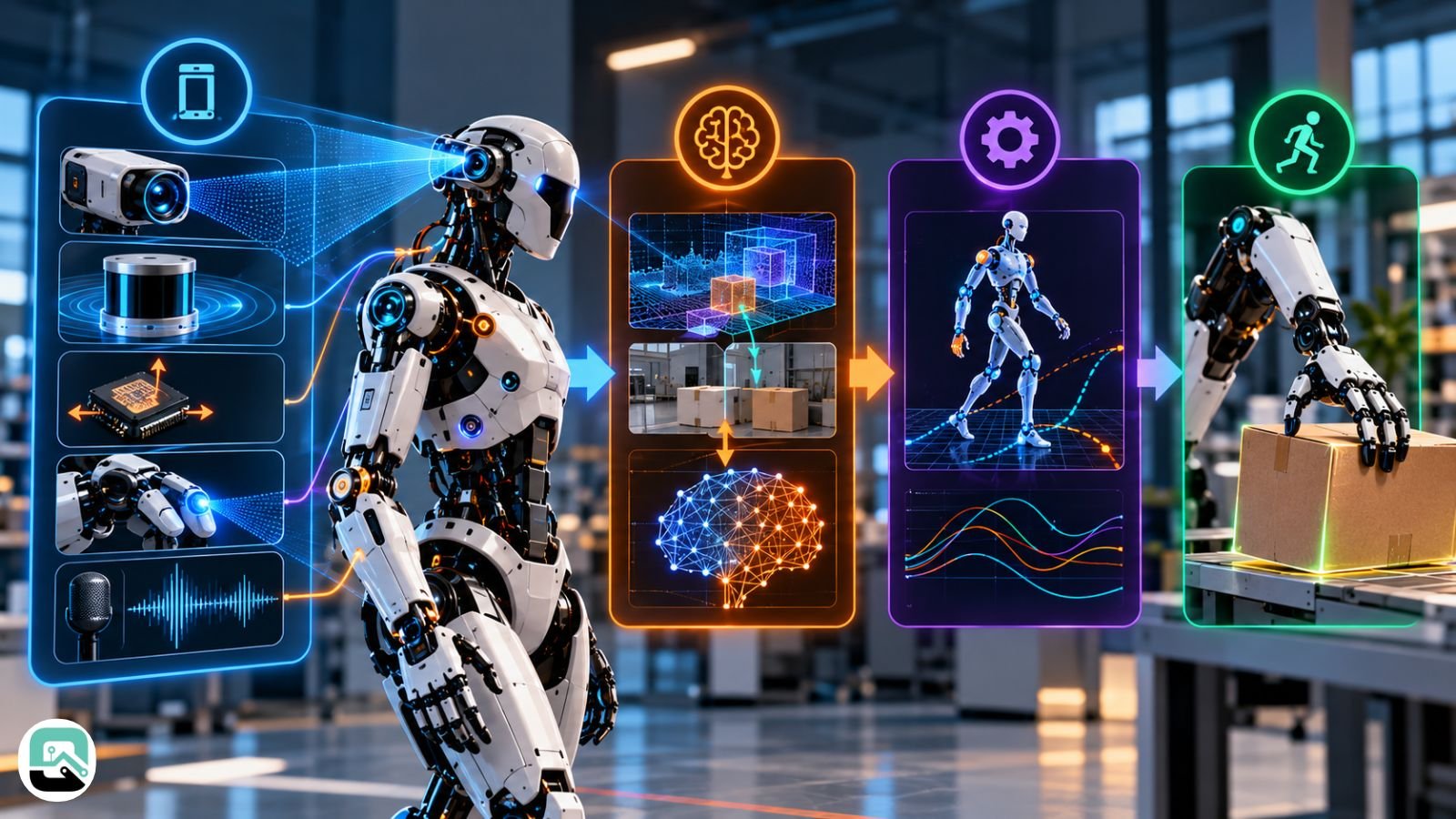
Sensors feed a layered control system. Fast loops at the bottom keep each joint steady and the robot balanced, many times a second. Slower AI models at the top decide what to do next: pick up the box, open the door. For tasks the AI can’t handle yet, some robots still call in a human operator.
The usual sensor kit includes head cameras and depth sensors for vision, an inertial measurement unit (IMU) for balance, and encoders in every joint. Force or torque sensors tend to sit at the wrists and ankles. Hands are getting their own senses now. Figure AI put a camera in each palm of Figure 03’s hands, along with in-house fingertip sensors that the company says can pick up about 3 grams of pressure.
Control typically runs in three layers:
- Joints. Motor drivers hold position and torque, often in loops running around a thousand times a second.
- Whole body. Controllers coordinate arms and legs, manage momentum and decide where the next foot goes.
- Tasks. AI policies, often vision-language-action models, turn a camera image and an instruction into movement. Figure AI’s Helix model works this way, and Google DeepMind plans to bring its Gemini Robotics models to Atlas.
How do humanoid robots learn new tasks?
Usually through some mix of three methods. Imitation learning trains a policy on demonstrations, often recorded while a person teleoperates the robot. Reinforcement learning lets a policy practice an enormous number of attempts in simulation, and it’s especially good for walking and for recovering from shoves. Vision-language-action models then connect what the cameras see, and what a person asks for, to the motions that get it done.
The weak spot is the move from simulation to the real world. Friction, sensor noise and worn parts never quite match the simulator, so teams randomize conditions during training and keep fine-tuning on real hardware. That gap is a big reason teleoperation hasn’t gone away.
How autonomous are humanoid robots today?
It varies a lot, and human operators still fill gaps. 1X lets NEO owners book a remote operator to walk the robot through chores it hasn’t learned. The company says nobody can take control without the owner’s approval, and 1X’s CEO has admitted NEO’s autonomous performance may lag at first.
That’s a sensible bridge while the AI catches up. Buyers just deserve to know when a person is in the loop.
Should a humanoid robot look human?
Only partly. Lifelike features pay off mainly when the robot’s job is social. Robots built for conversation and research into human-robot interaction, like Hanson Robotics’ Sophia, put a lot into faces and expressions. Work robots usually skip the realistic face because synthetic skin and facial motors add cost and break easily.
A readable head still helps, though. People nearby can tell where the robot is looking and which way it’s about to move.
Sophia is the expressive extreme. Her face uses Frubber, Hanson Robotics’ patented skin material, made to mimic how human muscle and skin move. She was the first robot granted citizenship by Saudi Arabia, and she still appears at tech events in 2026. Her role is research and entertainment, not general-purpose work.
Get too close to human, and you hit the “uncanny valley,” roboticist Masahiro Mori’s idea that something almost-but-not-quite human feels creepy. Home robots are taking a middle road. Figure 03 wears soft textile coverings, and NEO comes in a knitted suit in muted colors. Soft outsides look friendlier, and they cushion accidental bumps.
Why is humanoid robot design so hard?
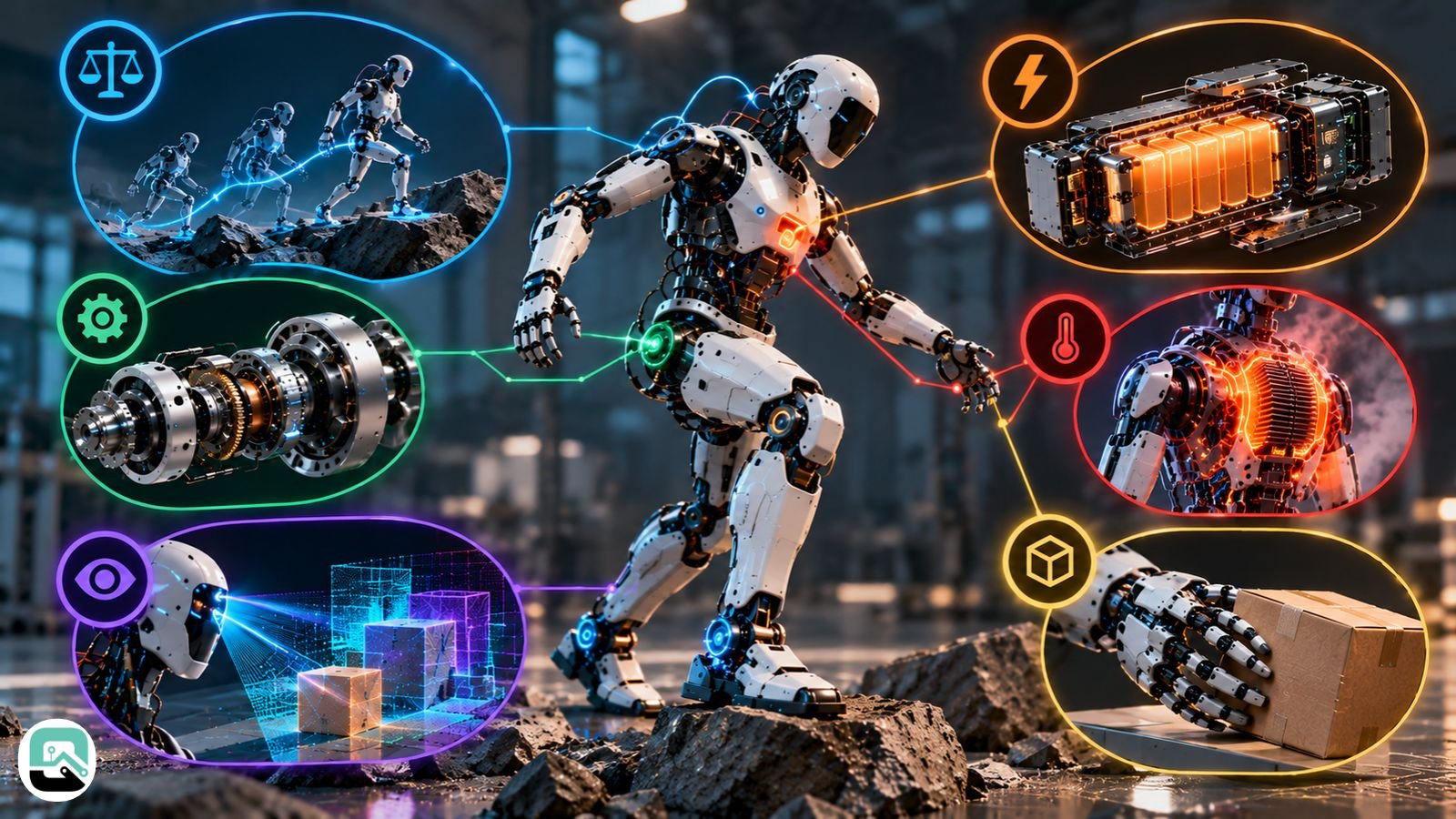
Four problems fight over the same weight and budget: balance, energy, durability, and manufacturing. One control error can put a legged robot on the floor. Batteries limit shift length, and knees and ankles take a beating with every step. Building thousands of reliable units is also a very different problem from building one great prototype.
Balance. Standing still, a humanoid keeps its center of mass over its support polygon, the area its feet cover. Walking is different. On every step, the center of mass moves outside that area, and the robot stays up by managing momentum and getting the next foot down in time. If power or software fails, that loop breaks, so designers plan how the robot falls, too. RoboPulse covers how bipedal locomotion works in more detail.
Energy. Unitree rates the G1 at about two hours per battery. Figure AI went another way and gave Figure 03 wireless inductive charging, so it can top up without anyone plugging it in.
Durability. Landings and footsteps hammer the knees and ankles. That’s why many designers move high-impact leg joints away from delicate harmonic gears and toward roller screws or tougher planetary units.
Heat. Low-ratio, back-drivable joints feel contact well, but they turn more energy into heat. That limits how long they can keep up heavy work.
Manufacturing. Elon Musk has said Optimus needs more than 10,000 unique parts, and he called the early production rate impossible to predict. Boston Dynamics calls the new Atlas its most production-friendly design yet. Figure AI says it built Figure 03 for high-volume manufacturing from day one.
Agility still matters in 2026. Manufacturability and uptime now matter just as much.
Which safety standards apply to humanoid robots?
Older safety standards assume robots that are bolted down or roll on stable wheels. Humanoids walk around and can fall, so ISO is writing a new one: ISO 25785-1, for industrial mobile robots that actively control their balance, legged ones included. Until it’s published, manufacturers lean on existing industrial standards and their own risk assessments.
The ISO/CD 25785-1 catalog entry shows it as a committee draft that has passed the close of its comment period. It’s aimed at industrial workplaces where the public is kept out or restricted. For robots outside industry, the draft points to other standards, such as ISO 13482.
In the US, ANSI/A3 R15.06-2025 came out in September 2025. The updated industrial robot standard now treats cybersecurity weaknesses as potential physical hazards.
In practice, safety rules push designers toward a few concrete features:
- a controlled, predictable fall when power or control drops
- limits on contact force and speed around people
- certified battery packs (Figure 03’s battery carries UN38.3 and UL 2271 certifications)
- privacy controls on camera-heavy home robots, like NEO blurring people in its camera feed and letting owners block off rooms
Homes are murkier. ISO 13482:2014 already covers safety for personal care robots, including physical contact with people, and an updated edition is working its way through ISO’s approval process. Nothing yet targets home humanoids specifically, though, which is one reason most makers start in factories and warehouses.
Where did humanoid robot design come from?
Today’s humanoids sit on top of roughly fifty years of research. Each era cracked one big problem. First it was walking at all, then walking smoothly, then rough terrain. Now it’s manufacturing at scale.
- 1973: Waseda University builds WABOT-1, widely cited as the first full-scale humanoid robot.
- 1996 to 2000: Honda’s P2, then ASIMO, show smooth, self-contained two-legged walking.
- 2013: Boston Dynamics unveils the hydraulic Atlas for the DARPA Robotics Challenge.
- 2024: The hydraulic Atlas retires, replaced by an all-electric version.
- 2026: Electric humanoids, Atlas among them, go into production for industrial customers.
What do humanoid robots look like in 2026?
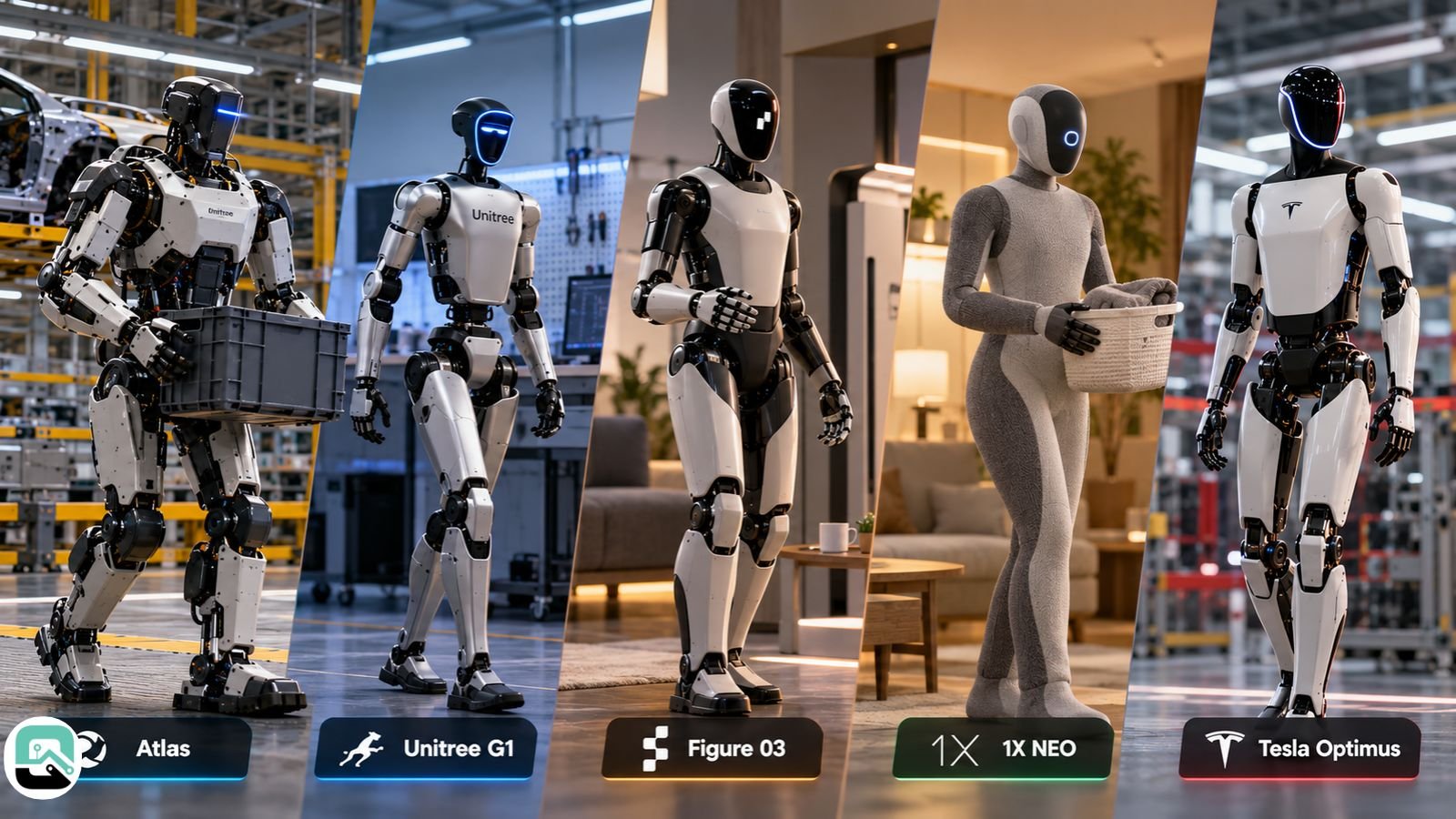
The 2026 leaders fall into three rough groups: factory workers, research platforms, and home helpers. Atlas is headed for car plants. Unitree’s G1 mostly serves researchers and developers, while Figure 03 and NEO are aimed at homes. Each strikes its own balance between strength, cost, softness, and autonomy.
| Robot | Maker | Built for | Standout design choices | Availability (October 2026) |
|---|---|---|---|---|
| Atlas (electric) | Boston Dynamics | Factory work | All-electric; reach up to 7.5 ft; lifts 110 lb; rated for -4°F to 104°F; actuators from Hyundai Mobis | Production started January 2026; all 2026 units committed to Hyundai and Google DeepMind; enterprise only, with Hyundai car-plant work planned from 2028 |
| Unitree G1 | Unitree | Research, education, development | About 35 kg; 23 DoF base, up to 43 in EDU builds; about 2 hours per battery; folds for transport | Publicly orderable; Unitree pages list it from $13,500 or $16,000 depending on page and region |
| Figure 03 | Figure AI | Homes and commercial sites | Palm cameras, tactile fingertips, wireless charging, soft textile cover, in-house actuators and batteries | Unveiled October 2025; no public retail price or consumer orders announced |
| 1X NEO | 1X | Homes | Tendon-driven motion for a soft gait; knitted suit; remote-operator mode with owner approval | Consumer pre-orders at $20,000 or $499/month; 1X says US deliveries start in 2026 |
| Tesla Optimus | Tesla | Factories first, homes later | More than 10,000 unique parts (per Musk); harmonic-type rotary joints plus roller-screw linear units (per industry analysis) | Tesla targeted a mid-2026 production start at Fremont; output volume unconfirmed |
For Atlas, Boston Dynamics’ production Atlas announcement lays out the deployment plan, and Engadget’s CES 2026 report has the reach, lift and temperature figures. The Robot Report covers NEO’s pricing and 1X’s US-first delivery plan.
These five aren’t the whole field. Chinese makers such as UBTECH, Fourier and AgiBot build commercial humanoids too. Prices and ship dates move fast here, so read the table as a snapshot from October 2026.
How can you tell a good humanoid robot design from a good demo?
Set the demo video aside and look at the job. Do the joints, hands, runtime, and autonomy actually fit the task? What happens when the robot falls or loses power? Does the maker say how much was teleoperated? A modest robot that fits its job beats a flashy one that doesn’t.
Eight questions do most of the work:
- Task fit. Does the job really need legs and five-finger hands, or would wheels and grippers do?
- Degrees of freedom. What does the headline DoF number include, and are those joints where the task needs them?
- Runtime. Does the battery last a full shift? Does charging need a person?
- Failure behavior. What happens on a slip, a power cut or a software crash?
- Autonomy. How much of the demo was AI and how much was a teleoperator?
- Serviceability. Can a technician swap a joint module? Can the maker supply parts at volume?
- Safety and privacy. Which standards and certifications apply, and where does the camera data go?
- Total cost. Once you add maintenance and downtime, how do buying and subscribing compare?
So what makes a humanoid design good? Fit. The human shape opens up spaces built for people, but legs, hands, and active balance cost money, energy, and reliability. The strongest 2026 designs match their joints, actuators, and autonomy to a clearly defined job, plan for falls and failures, and can actually be built in volume. Progress is fast. Still, treat any single demo as the start of your questions, not the answer to them.
FAQs
Q. What exactly is a humanoid robot?
A humanoid robot is a machine designed to resemble the human body, typically featuring a head, torso, two arms, and two legs. Humanoid robot design combines mechanical engineering, sensors, AI, and motion control to help robots perform tasks in human environments. Some humanoids use wheels instead of legs.
Q. What are some real-world examples of humanoid robots?
Popular humanoid robots include Boston Dynamics’ Atlas, Tesla Optimus, Unitree G1, Figure 03, and 1X NEO. These robots are developed for industrial work, research, or household assistance. Hanson Robotics’ Sophia is another well-known example, primarily designed for human interaction and conversation.
Q. What is the difference between a robot and a humanoid robot?
A robot is any programmable machine capable of performing tasks automatically or semi-autonomously. A humanoid robot is a specific type designed with human-like physical features and movements. Unlike traditional industrial robots or robotic vacuums, humanoids aim to operate in environments originally built for people.
Q. What are the main components of a humanoid robot?
The main components of a humanoid robot include a structural frame, actuators, joints, hands, cameras, motion sensors, batteries, and onboard computers. AI software and control systems coordinate these components to support walking, object manipulation, balance, and safe interaction with people.
Q. How much does a humanoid robot cost in 2026?
Humanoid robot prices vary by manufacturer, capabilities, and intended use. Unitree G1 is listed at approximately $13,500–$16,000, while 1X NEO has been offered for $20,000 or $499 per month. Tesla has projected Optimus production costs of $20,000–$25,000 at large scale, but this is not a confirmed retail price.
Q. How do humanoid robots walk and maintain balance?
Humanoid robots maintain balance using inertial measurement units (IMUs), joint sensors, actuators, and real-time control algorithms. These systems continuously adjust joint forces, body posture, and foot placement while walking. Advanced designs also use AI-based motion control to handle uneven surfaces and recover from disturbances.
Q. Does Sophia the humanoid robot still exist in 2026?
Yes. Hanson Robotics’ Sophia remains an active humanoid robotics platform in 2026, primarily used for research, demonstrations, and public events. Unlike industrial humanoids such as Atlas or Optimus, Sophia focuses on facial expressions, conversation, and human-robot interaction rather than physical labor.
Q. Can beginners build a humanoid robot?
Yes. Beginners can build small humanoid robots using servo motors, microcontrollers, sensors, and programmable components. These projects help teach basic humanoid robot design, movement, and balance. However, building a full-size autonomous humanoid requires advanced mechanical engineering, electronics, AI programming, and substantial development resources.
Related: Rizzbot Price: How Much Does the Viral Cowboy Robot Cost?
| Disclaimer: This article is for informational and educational purposes only. Humanoid robot specifications, prices, availability, and capabilities reflect information available as of October 2026 and may change. Readers should verify details with official manufacturers before making purchasing or technical decisions. |