
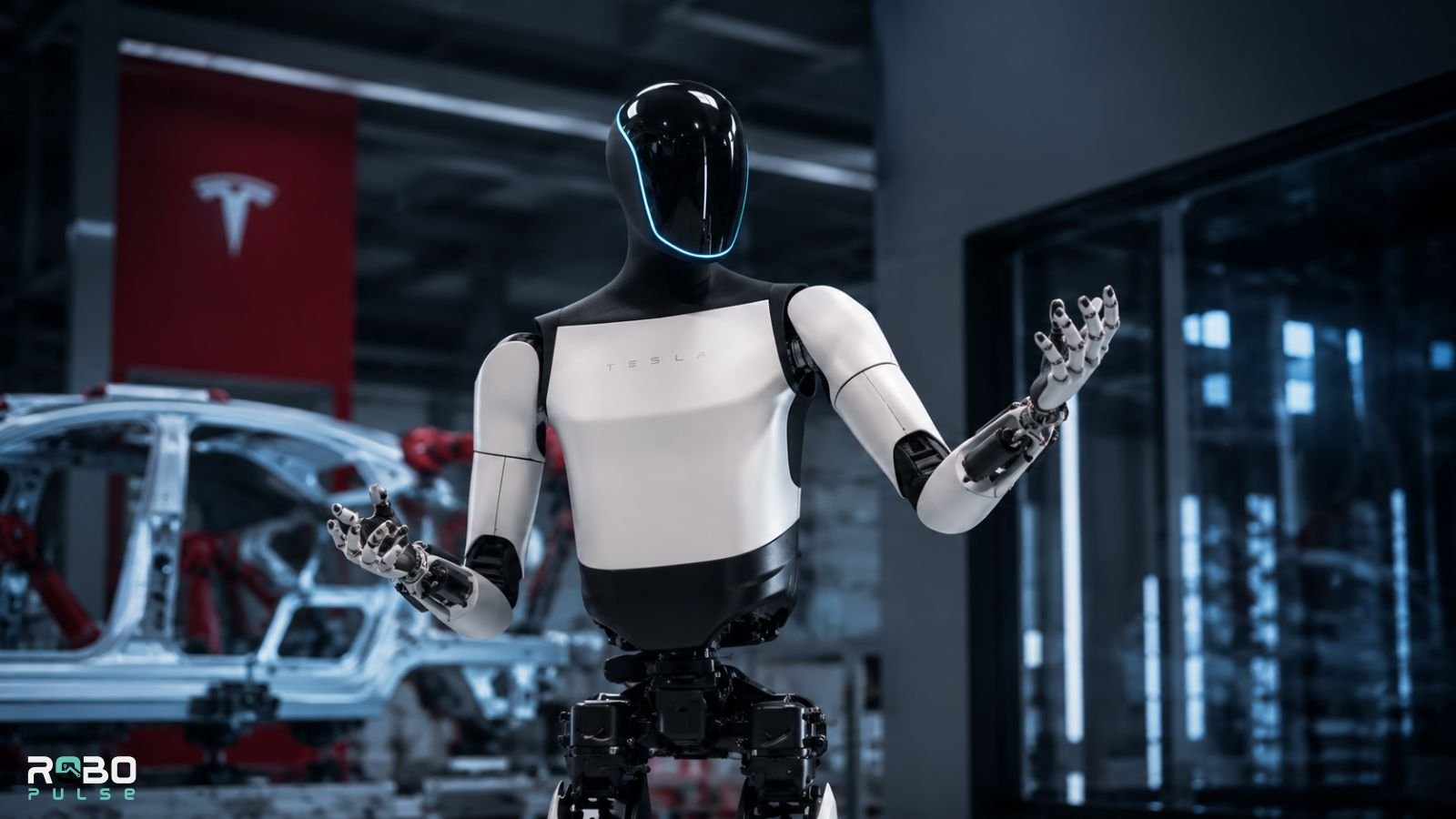
Not a demo line. An actual factory line.
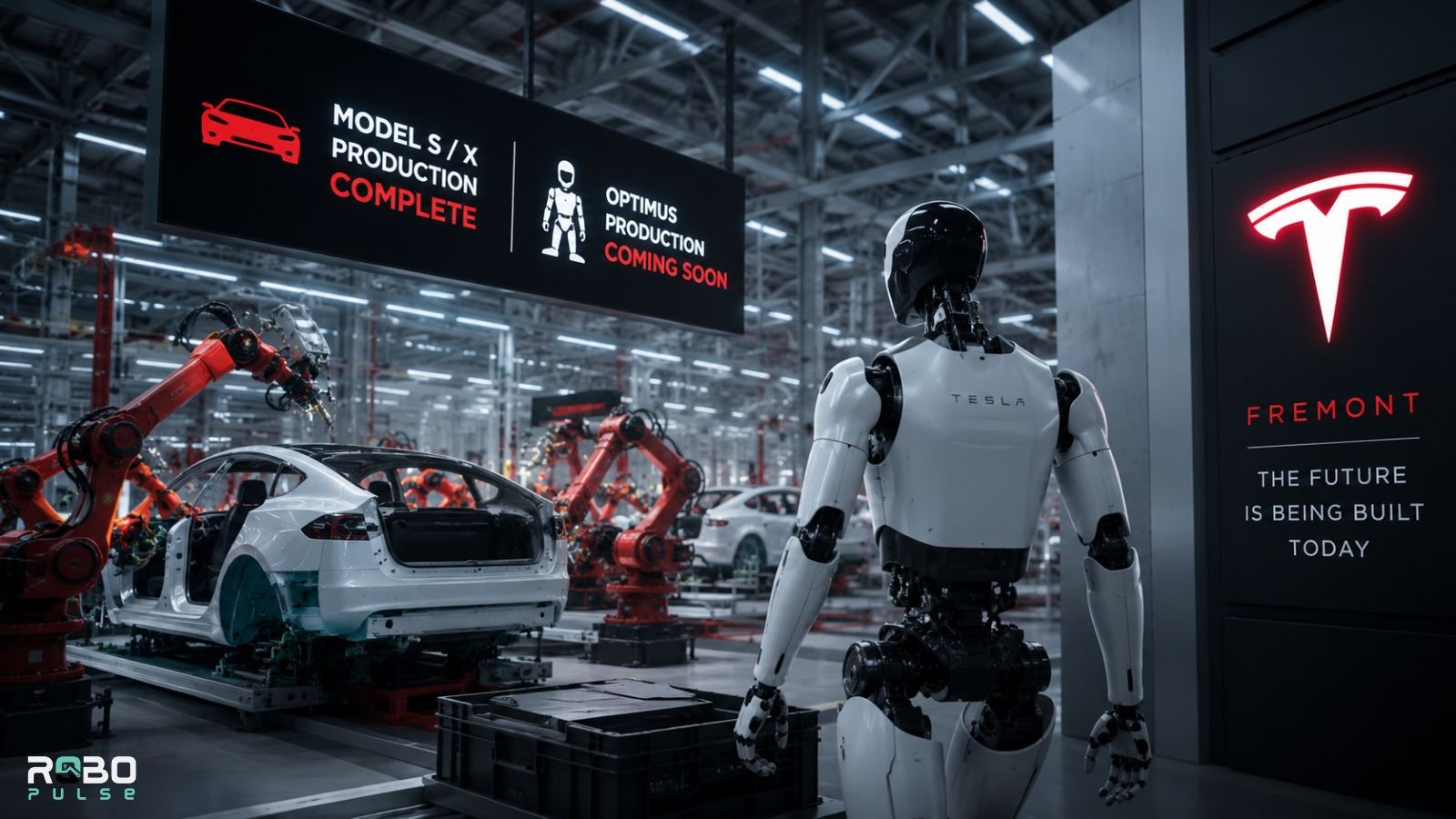
On May 9, 2026, the last Model S and the last Model X rolled off Tesla’s Fremont assembly line. Musk had announced the wind-down back on Tesla’s Q4 2025 earnings call in late January, calling it an “honorable discharge” for two cars that had defined Tesla since 2012 and 2015. That floor space is now being converted to build Optimus. That single decision tells you more about where this project stands than any keynote ever could.
But the internet still can’t agree on what “Gen 3” even means. Some articles treat it as a brand-new robot. Others still call it vaporware. Neither is right. Here’s the clear version, built on what Tesla has actually confirmed — not what’s been repeated so many times it started sounding true.
“Gen 3” Isn’t a New Robot. It’s New Hands.
Here’s the part almost every article gets muddled: Gen 3 refers to the hands, not the whole robot.
The hardware upgrade
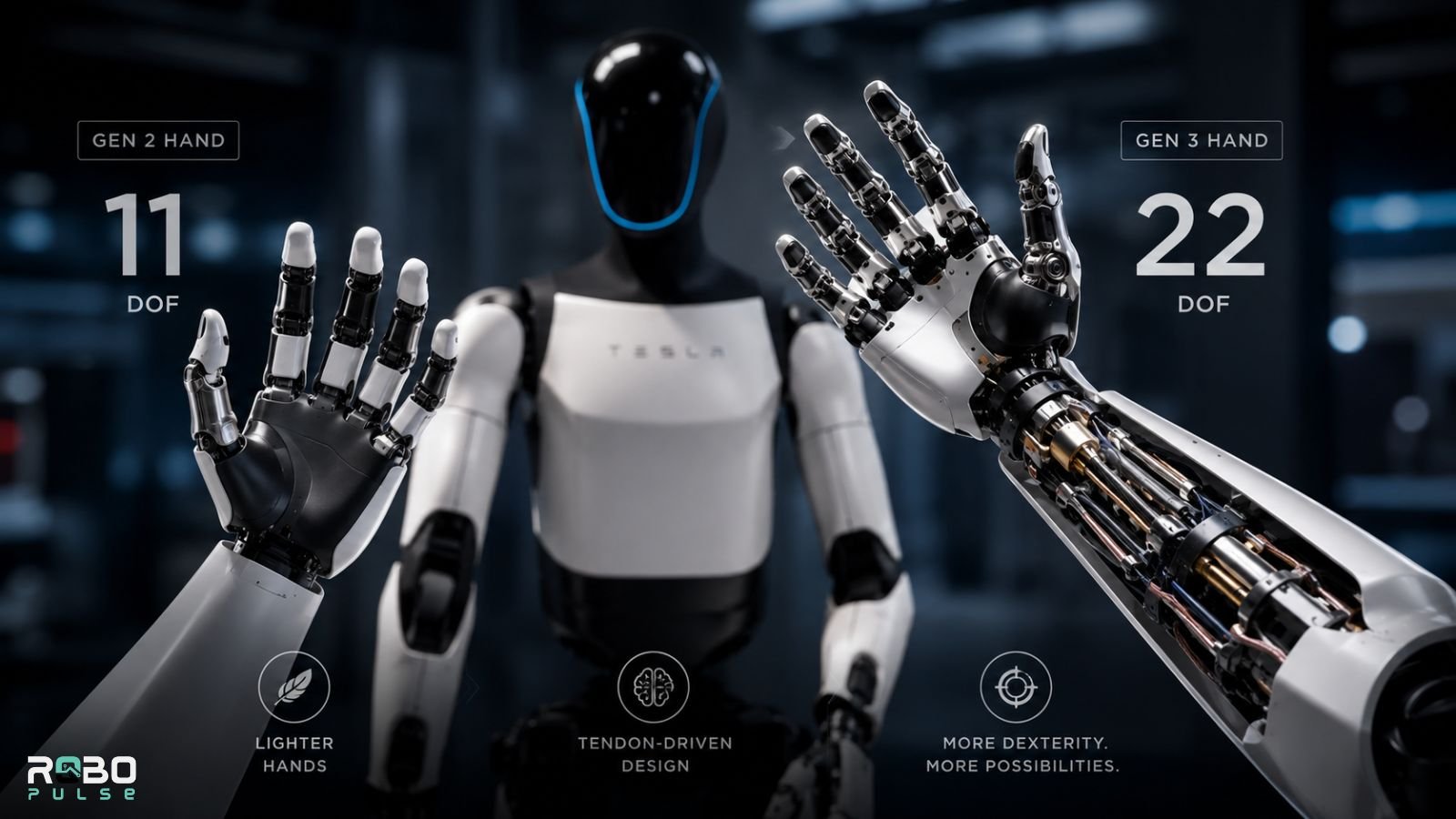
Tesla’s Gen 2 body stands 173 cm tall and weighs about 57 kg. Its original hands had 11 degrees of freedom — enough to grip, pinch, and hold a raw egg without crushing it, respectable for 2023.
The Gen 3 hand system doubles that number: 22 degrees of freedom per hand, powered by 50 actuators split across both hands. Tesla moved every actuator out of the hand and into the forearm, using a tendon-driven design closer to how human hands actually work. That’s a tradeoff — it trims weight and heat out of the hand itself, at the cost of routing tendons and cables further to reach the fingers. The payoff: a hand that stays light, fast, and cheaper to build at scale.
Musk confirmed the hands were production-ready with a two-word post on X on February 17, 2026: “This bot got hands.” No press release. Just that.
The full robot built around these new hands has its own name: Optimus V3. Gen 3 hands, V3 body — same robot, arriving together this year.
The Brain Got an Upgrade Too
A nimble pair of fingers wired up to sluggish processing silicon just produces expensive, high-fidelity fumbles. So Tesla upgraded the brain as well.
AI5: built for Optimus first
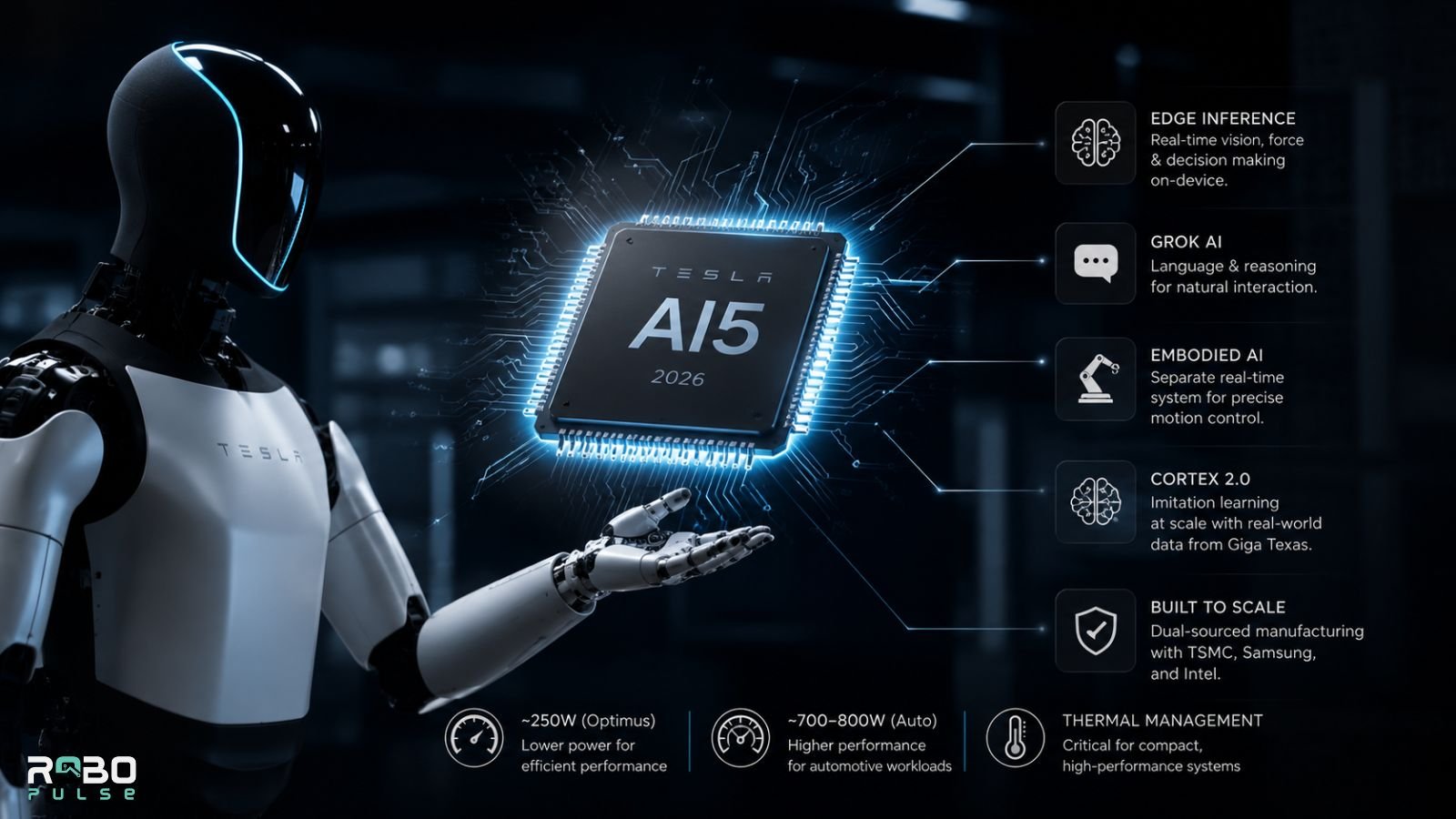
Tesla taped out its AI5 chip on April 15, 2026 — the design step that locks a chip’s blueprint before it goes to manufacturing. As Electrek reported around the tape-out, Musk made an unusual call here: AI5 goes into Optimus and Tesla’s compute clusters first, ahead of Tesla’s own cars. The Cybercab is launching on the older AI4 chip in the meantime.
AI5 is edge inference silicon — it processes vision and force-torque data locally, on the robot, instead of waiting on a round-trip to the cloud. That local processing is what lets Optimus run Grok, xAI’s language model trained on the Colossus supercomputer cluster, as its voice and reasoning layer, while a separate real-time system handles physical movement. One network for language and reasoning, another translating that into motor commands — this split is what the robotics industry has started calling embodied AI: intelligence that has to act in physical space, not just answer questions on a screen.
Underneath it, Tesla trains the movement side through imitation learning. Cortex 2.0, Tesla’s supercomputer cluster at Giga Texas, ingests huge volumes of real-world footage so the neural network learns to convert what it sees into motor commands, rather than being explicitly programmed move by move.
Power draw: the numbers don’t fully agree yet
Reported power draw for AI5 varies depending on the source. Musk said in a November 2025 X post that Tesla had brought consumption down to around 250 watts for the Optimus-focused version — a number he called “a big deal” given the robot’s small battery pack. Other outlets, citing different technical briefings, have put peak draw for the automotive variant closer to 700–800 watts. Those numbers likely describe different configurations (Optimus-tuned versus vehicle-tuned silicon), but the reporting hasn’t fully converged. Either way, thermal management is a real constraint for a robot running on a battery pack measured in single-digit kilowatt-hours.
Software is still catching up
Early demos have shown lag between a spoken instruction and the robot acting on it. The hardware is ready before the software has fully caught up. That’s normal for a system this new — it’s also why “Optimus understands you” headlines are running a bit ahead of what people experience in person.
The supply chain behind the chip
Tesla is dual-sourcing AI5 production across both TSMC and Samsung’s US facilities, partly to avoid depending on a single foundry. Tesla is also building a much larger bet alongside this: Terafab, a $25 billion-plus joint venture with SpaceX and xAI, announced March 21, 2026, aimed at producing more than a terawatt of AI compute capacity a year at a campus near Giga Texas. Intel joined as a manufacturing partner in April 2026, contributing its 18A process node and advanced packaging. About 20% of Terafab’s planned output is earmarked for Tesla’s “terrestrial” chips — AI5 and its successor AI6 — with the rest going toward SpaceX’s orbital compute plans.
Even with that build-out, Tesla’s own timeline points to AI5 volume production landing sometime in 2027, over a year after tape-out. That gap between “designed” and “actually running the fleet” is normal for custom silicon, but it’s easy to miss if you only read the tape-out headline.
Fremont Isn’t Making Model S Anymore. It’s Making Robots.
Announcements are cheap. Handing over an actual assembly line is not — and that’s exactly what Tesla did. It’s a shift echoed across the wider industry too, where the conversation at events like Automate 2026 has increasingly moved from robot demos toward the harder question of factory-floor deployment at volume.
The conversion, precisely dated
Ending vehicle production and starting robot production aren’t the same moment. Custom Model S/X orders closed at the end of March 2026. Regular production ended in early April. The final 350 vehicles — a 250-unit Model S Plaid and 100-unit Model X Plaid Signature Edition run — rolled out after that, with the very last cars built on May 9, 2026. Tesla spent the following months physically converting that floor space. Musk confirmed on the April 22, 2026 Q1 earnings call that actual Optimus assembly begins in late July or August 2026.
Any Gen 3 hands running inside Tesla’s factories before then are mounted on the older Gen 2 body, simply because the new V3 body isn’t in production yet to put them on. Tesla has had a few hundred to roughly 1,000 Optimus units — mostly Gen 2 bodies — doing internal work at Fremont and Giga Texas since mid-2024: sorting 4680 battery cells, moving parts between stations, and running quality inspection. Musk has been direct that this deployment is still primarily about data collection, not commercial output.
Musk pushed back on the hype himself
When Musk posted photos from inside the converted Fremont line on July 1, 2026, some online speculation jumped straight to a hidden, larger-than-disclosed robot fleet already at work. Musk shut that down directly the next day, replying on X that output would be “extremely slow at first, as everything is new” and explicitly not comparable to building a car. That’s a useful real-time gut check: even Tesla’s own CEO is actively pushing back on the idea that Fremont is quietly running at scale already.
A new supply chain, from scratch
Optimus needs almost nothing from car manufacturing — Musk described it as a brand-new supply chain built from zero. Each robot needs around 10,000 unique custom parts, and Tesla’s long-term target for that single factory is up to one million Optimus units a year. A second, larger Optimus plant — roughly 5.2 million square feet — is under construction at Giga Texas, aimed at even higher volume once it comes online.
Leadership shift worth knowing about
Milan Kovac, who had led Optimus engineering since 2022, departed Tesla in June 2025. Ashok Elluswamy — Tesla’s VP of AI Software and the architect of Autopilot and FSD — took over. It’s a signal that Tesla wants Optimus and its self-driving software running on the same underlying AI stack, not built as separate efforts.
Compare that manufacturing bet to how Boston Dynamics has approached its electric Atlas — incredible engineering, but built for research and select industrial partners, not a million-unit-a-year assembly line. That’s the real fight in humanoid robotics right now: capability versus the ability to actually build the thing at scale. It’s also worth watching how that calculus shifts now that Hyundai owns Boston Dynamics and has its own reasons to push Atlas toward real production lines rather than research demos.
How Optimus Stacks Up Against the Competition
Tesla isn’t running this race alone, and it isn’t automatically winning it either.
| Robot | Primary Focus | Hand Dexterity (DoF) | Silicon | Deployment Scale (Mid-2026) |
|---|---|---|---|---|
| Tesla Optimus V3 | General-purpose manufacturing | 22 DoF, tendon-driven | Custom Tesla AI5 (edge inference) | Internal pilot, ~1,000 units, Fremont/Giga Texas |
| Figure 03 | Commercial logistics & assembly | 24+ DoF, fine manipulation | Custom hardware | Commercial pilots (BMW plant) |
| Boston Dynamics Atlas | Dynamic mobility & research | High-performance control | Proprietary compute | Research labs & industrial demos |
| Agility Robotics Digit | Logistics and warehousing | Task-specific | Onboard architecture | Commercial logistics pilots |
| Apptronik Apollo | Manufacturing & industrial deployment | Task-specific | Onboard architecture | Industrial pilots |
| Unitree G1 | Low-cost mass deployment | High-speed joints | Onboard architecture | Mass retail / global shipments |
Nobody has the whole stack except Tesla
Figure’s hands currently edge out Tesla’s on raw dexterity. Boston Dynamics still leads on dynamic movement, full stop — nobody else has Atlas doing backflips. Agility’s Digit, by contrast, was never built to chase raw dexterity numbers at all — it’s tuned narrowly for warehouse totes and logistics work, a reminder that these robots aren’t all competing on the same axis. But manufacturing scale is where Tesla’s bet is different from everyone else’s: no other humanoid robotics company — not even Apptronik with its Apollo platform — also builds its own batteries, motors, AI chips, and car-sized factories.
Worth a caveat on that DoF comparison, though: more degrees of freedom doesn’t automatically mean a better hand. Figure built its latest hand around the fine manipulation tasks its commercial partner’s assembly line actually needs — small fasteners, cable routing, tight-space positioning. Tesla went a different direction, moving every actuator into the forearm specifically so the hand stays light, cool, and cheap to build a million times over. Different problems, different tradeoffs.
China is not sitting this out
Firms like Unitree already ship humanoid robots at aggressive price points, and rental models for humanoid robots are already gaining traction there — though that same reporting points to real limits on how autonomously these rented units can actually operate today. Tesla’s advantage on paper is scale, but China currently ships the overwhelming majority of humanoid robots sold worldwide, so “who wins” is far from decided.
Reality check: Unitree’s revenue growth decelerated sharply to roughly 68% year-over-year in early 2026, down from over 330% the year before, and its profit dropped by more than half over the same stretch. The company itself pointed to cooling hype and tougher competition as the cause. Even the world’s most commercially advanced humanoid robot maker is finding this harder to scale profitably than the headlines suggest — useful context for judging Tesla’s own timeline too.
What Optimus Can Actually Do Right Now
Strip away the hype, and here’s what’s actually demonstrated, not promised:
- It walks with real balance, including recovering from small stumbles rather than toppling over.
- It can pick up and carry objects — even fragile ones — without crushing them.
- Inside Tesla’s own factories, it’s sorting parts and moving materials on a repeat basis.
- Its hands can now coordinate together for two-handed tasks that need both sides working in sync.
- Through Grok, it can respond to basic spoken instructions, though with a noticeable lag between request and action.
What it still can’t do reliably
Fully independent decision-making in messy, unpredictable spaces like a home isn’t there yet, at least not outside a controlled setting. Tesla has used its Hollywood diner as a public test site since 2025, giving ordinary customers a chance to interact with different Optimus versions in an unscripted environment. That’s smart data-gathering, but it’s testing, not proof of a finished product.
Not every demo has been autonomous
Tesla has confirmed some demonstrations — an October 2025 kung fu routine and a December 2025 running clip — were AI-driven. But the robot serving popcorn at the diner in mid-2025 was openly remote-controlled, and a robot that fell during a December 2025 Miami event made a hand motion that looked a lot like someone pulling off a VR headset. Tesla hasn’t always been clear about which demos are which. That’s not necessarily deception — remote assistance is a normal part of how robotics companies collect training data early on — but it’s a distinction worth keeping in mind whenever you see a viral Optimus clip.
Gen 2 vs. V3: What Actually Changed
| Spec | Gen 2 | Optimus V3 |
|---|---|---|
| Hand DoF | 11 per hand | 22 per hand |
| Hand actuators | Housed in the hand | 50 total, relocated to forearm (tendon-driven) |
| AI chip | AI4 | AI5 (edge inference) |
| Voice/reasoning layer | Limited | Grok (xAI), with real-time motor control handled separately |
| Status | Prototype-to-limited-factory-use | Designed for mass production |
| Factory role | Data collection, narrow tasks | Dedicated production line, target 1M units/year at Fremont |
Tesla Optimus V3: Quick Specs
| Specification | Tesla Optimus V3 |
|---|---|
| Height | 173 cm |
| Weight | ~57 kg |
| Hand DoF | 22 per hand |
| Total hand actuators | 50 (25 per side) |
| Walking speed | ~1.2–2.2 m/s (reported figures vary) |
| Battery | 2.3 kWh, ~52V lithium-ion pack |
| Runtime | ~8 hours light-duty; less under continuous heavy load |
| AI chip | Tesla AI5 (edge inference) |
| Vision | Cameras + neural network (no lidar) |
| Voice/reasoning | Grok (xAI) |
| Price target (long-term) | $20,000–$30,000 |
| Current manufacturing cost | Estimated $50,000–$100,000 per unit |
| Enterprise availability | Targeted late 2026 |
Note: Tesla has not published a single authoritative spec sheet for V3; figures above are drawn from earnings-call statements and consistent third-party reporting, and some (like top walking speed) still carry a range rather than one confirmed number.
Timeline: Optimus, Start to Now
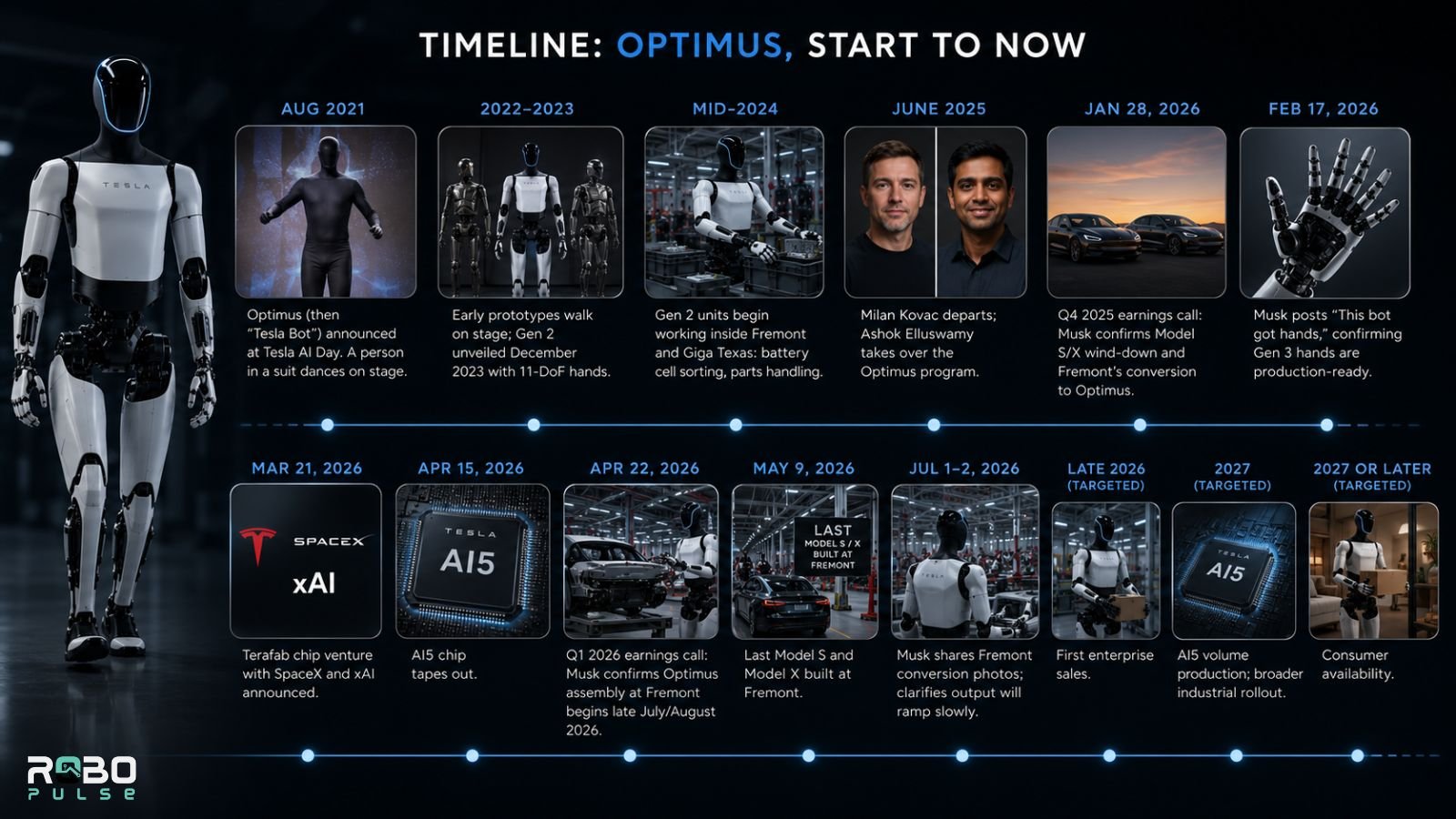
- Aug 2021 — Optimus (then “Tesla Bot”) announced at Tesla AI Day. A person in a suit dances on stage.
- 2022–2023 — Early prototypes walk on stage; Gen 2 unveiled December 2023 with 11-DoF hands.
- Mid-2024 — Gen 2 units begin working inside Fremont and Giga Texas: battery cell sorting, parts handling.
- June 2025 — Milan Kovac departs; Ashok Elluswamy takes over the Optimus program.
- Jan 28, 2026 — Q4 2025 earnings call: Musk confirms Model S/X wind-down and Fremont’s conversion to Optimus.
- Feb 17, 2026 — Musk posts “This bot got hands,” confirming Gen 3 hands are production-ready.
- Mar 21, 2026 — Terafab chip venture with SpaceX and xAI announced.
- Apr 15, 2026 — AI5 chip tapes out.
- Apr 22, 2026 — Q1 2026 earnings call: Musk confirms Optimus assembly at Fremont begins late July/August 2026.
- May 9, 2026 — Last Model S and Model X built at Fremont.
- Jul 1–2, 2026 — Musk shares Fremont conversion photos; clarifies output will ramp slowly.
- Late 2026 (targeted) — First enterprise sales.
- 2027 (targeted) — AI5 volume production; broader industrial rollout.
- 2027 or later (targeted) — Consumer availability.
Price: The $20,000 Number Everyone Quotes (and Why It’s Not Today’s Price)
Musk has repeated a long-term target of $20,000 to $30,000 for a consumer Optimus, most recently at Davos in January 2026.
That number describes where Tesla wants to land once it’s building at massive scale — not what a robot costs today. Current estimates put Tesla’s actual manufacturing cost per unit somewhere between $50,000 and $100,000. Early commercial buyers, expected late in 2026, will pay a premium well above the eventual consumer target.
This follows a pattern Tesla knows well from cars: expensive first, cheap only after volume kicks in. Model S launched north of $100,000; volume and battery improvements brought the Model 3 down from there. Optimus is expected to follow the same curve, just earlier in the process.
When Can You Actually Buy One?
Short answer: not yet, and not this year. Tesla’s own rollout plan looks staged:
- Internal use inside Tesla’s own factories (happening now)
- Pilot programs with industrial partners
- Limited sales to enterprise customers, targeted for late 2026
- Broader industrial rollout as Fremont and Texas scale up
- Consumer availability — realistically 2027 at the earliest, with Tesla’s own history of delays suggesting later is more likely
If you see a website taking “pre-orders” for Optimus, that’s not official. Tesla hasn’t opened any public ordering system.
The Real Bottleneck Isn’t Ambition — It’s Building Millions of the Same Thing
Everyone assumes the hard part of humanoid robots is the AI, or the walking, or the hands. Those are hard, but they’re not the bottleneck anymore.
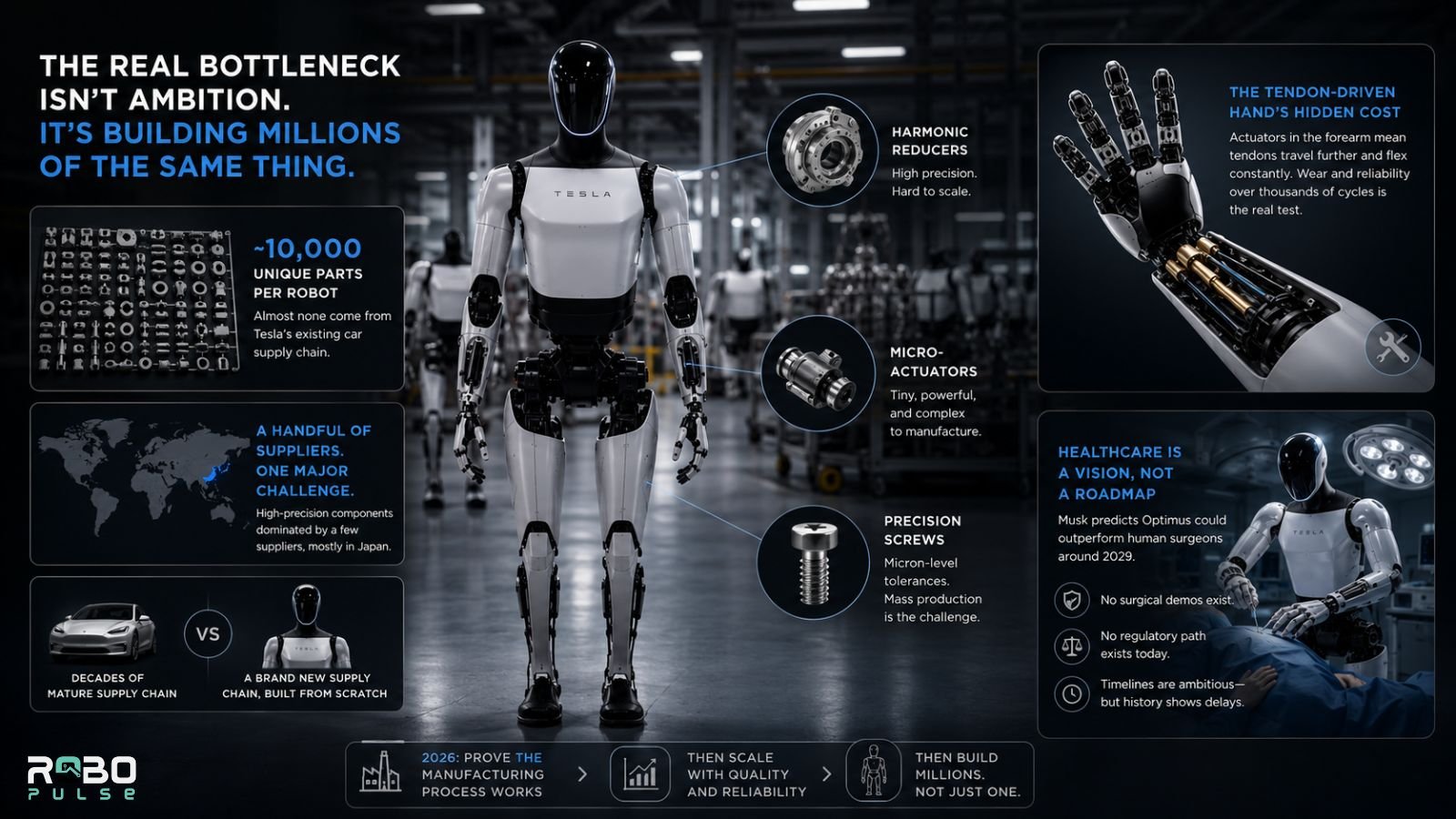
10,000 parts, no existing playbook
An Optimus unit needs roughly 10,000 unique custom parts, almost none of which come from Tesla’s existing car supply chain. Building one impressive robot is an engineering win. Building a million identical, reliable ones a year is an entirely different kind of problem — one closer to what made Tesla’s car business work in the first place.
The hard part isn’t the flashy stuff. It’s tiny, unglamorous components: high-precision harmonic reducers, micro-actuators, and precision screws that need micron-level tolerances. A handful of established suppliers, mostly in Japan, have historically dominated this space. Mass-producing millions of these parts a year — reliably, cheaply — has no existing playbook. Tesla’s car supply chain, for comparison, is decades old and mature. Its robot supply chain is being built from scratch, part by part.
That’s why Musk keeps framing 2026 production as deliberately slow. Tesla isn’t trying to flood the market; it’s trying to prove the manufacturing process works before scaling it.
The tendon-driven hand’s hidden cost
Moving all 50 actuators into the forearm means the tendons connecting them to the fingers have to travel further and flex constantly. Over thousands of open-close cycles a day, cable tension and wear become a real maintenance question — the same challenge prosthetics engineers have wrestled with for years in tendon-driven hands. Tesla hasn’t published reliability data on this yet, but it’s the kind of unglamorous durability problem that determines whether a hand survives a factory floor for years, not just a keynote demo.
Optimus Gen 3: Misconceptions vs. Factory Realities
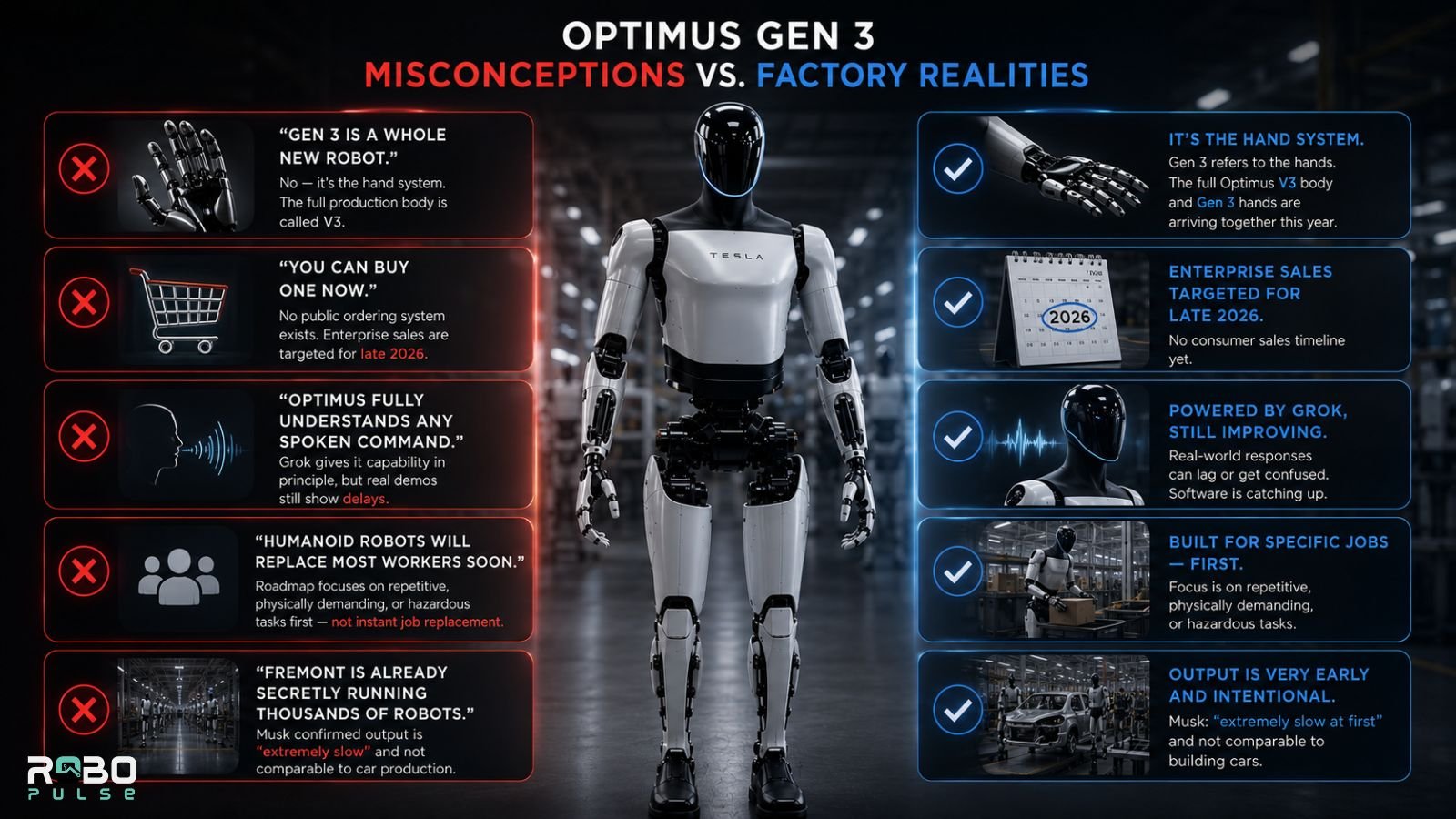
“Gen 3 is a whole new robot.” No — it’s the hand system. The full production body is called V3, and both are arriving together this year.
“You can buy one now.” No public ordering system exists. Enterprise sales are targeted for late 2026 at the earliest.
“Optimus fully understands and responds to any spoken command.” Grok gives it that capability in principle, but real demos still show delays and occasional confusion. The software is catching up to the hardware, not the other way around.
“Humanoid robots will replace most workers soon.” Tesla’s own roadmap points at repetitive, physically demanding, or hazardous tasks first — a pattern showing up across the industry, not instant mass replacement of human jobs, and one that broader reporting on the cost and job impact of humanoid robots suggests is still years from playing out at scale.
“Fremont is already secretly running thousands of robots.” Musk himself pushed back on this directly on X in July 2026, describing early output as “extremely slow” and not comparable to car production.
“Optimus will be doing surgery soon.” Musk has talked about Optimus eventually working in healthcare, even suggesting it could outperform human surgeons around 2029. That’s a founder’s long-range vision, not a funded roadmap — no surgical demonstrations exist, and the regulatory path for autonomous medical procedures doesn’t currently exist either.
The Bottom Line
Optimus stopped being a concept the day Tesla handed Fremont’s assembly lines over to it. That’s a bigger signal than any spec sheet.
But “in production” and “in your home” are still years apart. The hands are real. The AI5 chip is real. The factory conversion is real. What’s still ahead is the hard part every robotics company eventually hits: building the same reliable machine ten thousand times, then a million times, without the whole thing falling apart on cost or quality.
If you’re a consumer, treat home delivery as a 2027-or-later story, not a this-year story. If you’re a business, now’s the time to understand what humanoid automation could mean for your operations, even if you’re years from deploying one. And if you’re watching purely out of curiosity, ignore the headlines chasing “is Gen 3 real” — watch production numbers out of Fremont, reliability data, and how fast Tesla scales past its first slow batch. Those numbers will tell you far more than any keynote.
Frequently Asked Questions
Q. Is Tesla Optimus Gen 3 real?
Yes. “Gen 3” refers specifically to Tesla’s production-ready 22-DoF hand system, not an entirely new robot — the complete production robot is called Optimus V3. AI5 taped out in April 2026; V3 volume production begins at Fremont in late July/August 2026.
Q. How much will Tesla Optimus cost?
Long-term target is $20,000–$30,000, but current manufacturing costs are estimated at $50,000–$100,000 per unit. Early enterprise customers will pay well above the long-term target.
Q. Can you buy Tesla Optimus Gen 3?
Not yet. No public ordering system exists. Enterprise sales are targeted for late 2026; consumer availability is more likely 2027 or later.
Q. What can Tesla Optimus Gen 3 actually do today?
Walk with dynamic balance, carry and handle fragile objects, sort parts inside Tesla factories, perform coordinated two-handed manipulation, and respond to basic spoken commands via Grok — but not reliably operate autonomously in unpredictable environments like homes.
Q. What is the Tesla AI5 chip?
Tesla’s next-generation edge AI inference processor, built for Optimus and future AI infrastructure. It processes camera, vision, force, and motion data on the robot itself. Taped out April 15, 2026; volume production expected in 2027.
Q. Why are Tesla’s Gen 3 hands important?
They double dexterity from 11 to 22 degrees of freedom, moving all 50 actuators into the forearms with a tendon-driven design — reducing weight, improving cooling, lowering cost, and enabling more human-like finger movement.
Q. Is Tesla Optimus replacing human workers?
Not in the near future. Tesla is positioning Optimus for repetitive, physically demanding, and hazardous industrial tasks. Most industry analysts expect gradual adoption over many years rather than rapid workforce replacement.
Q. Who are Tesla Optimus’ biggest competitors?
Figure AI (advanced industrial robots with major enterprise partnerships), Boston Dynamics Atlas (industry-leading mobility), Agility Robotics Digit (warehouse/logistics), Apptronik Apollo (manufacturing/industrial), and Unitree Robotics (affordable, rapidly growing production, particularly in China).
Related: Synthetic Humanoids Explained: Can Artificial Muscles Beat Traditional Robots?