

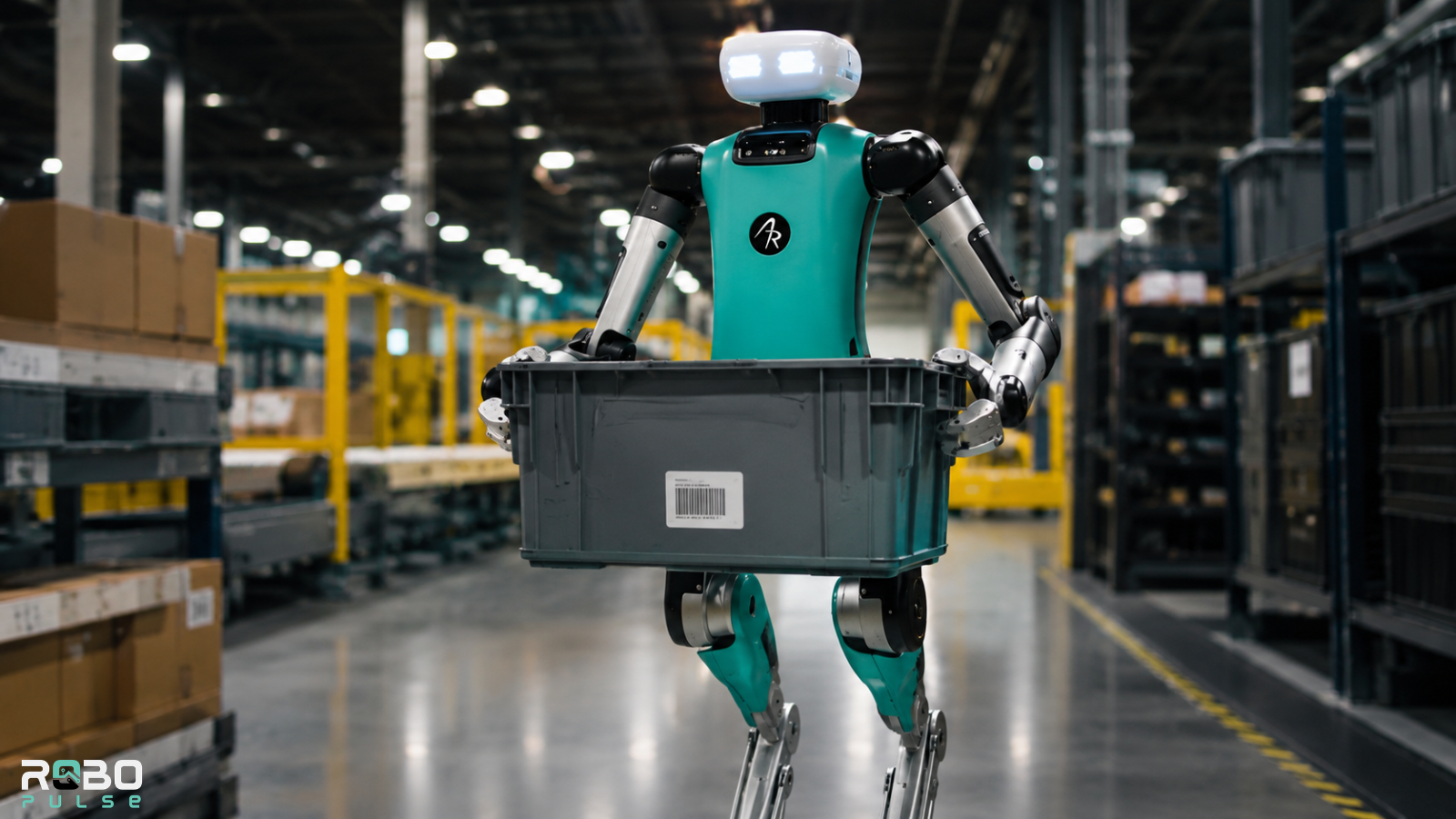
Most people judge humanoid robots by how human they look. Warehouse operators judge them by a harder question: can it finish an eight-hour shift, recover from a bad step, and get fixed in twenty minutes when something breaks?
Digit is Agility Robotics’ commercial humanoid, built specifically for warehouse and logistics material handling rather than general-purpose use. It’s already working in paid deployments at GXO, Toyota, Schaeffler, and Mercado Libre, and its maker just agreed to go public in a $2.5 billion SPAC deal. This review covers what Digit actually does well, where it still struggles, what it costs, and how it stacks up against Optimus, Figure, Apollo, and Atlas.
Hardware Built for a Shift, Not a Stage
Four Systems, One Job
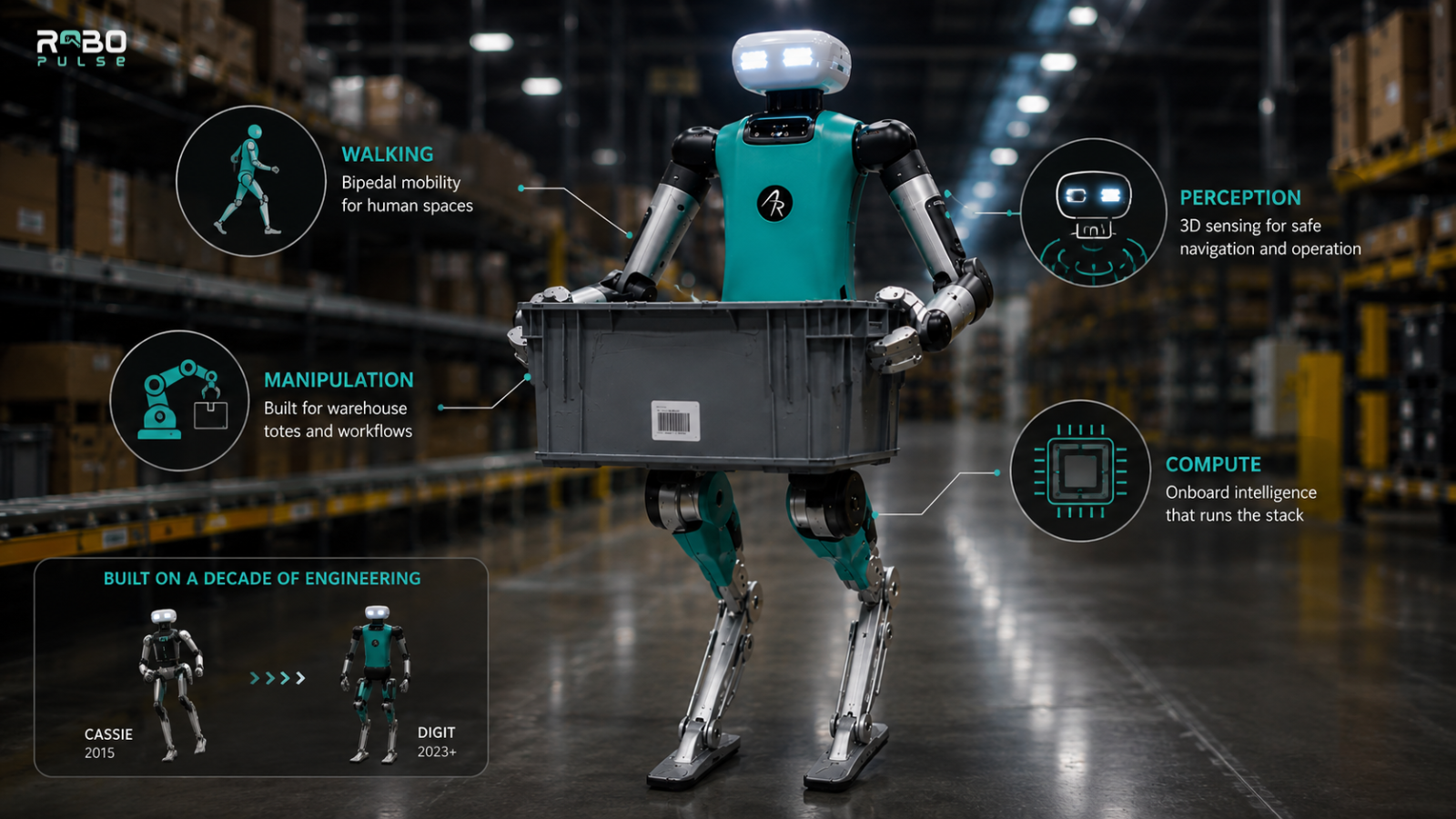
Digit’s hardware answers the reliability question first and worries about appearance second. Agility Robotics stripped away the expressive face and lifelike gestures you see on consumer-facing companion humanoids. What’s left are four systems that only exist because they earn their keep: a walking system, a manipulation system built around warehouse totes, a perception stack, and onboard computing that ties it all together.
Built on a Decade of Testing
Each system carries forward lessons from Cassie, Agility’s earlier research platform. Digit isn’t starting from zero — it’s the fourth or fifth draft of an idea the company has been testing since 2015. It isn’t the flashiest humanoid on the market. It’s one of the most purpose-built.
Walking Is the Whole Point
Reverse-Jointed Legs, By Design
If Digit has one defining skill, it’s walking on two legs through spaces built for people — no dedicated lanes, no flat-floor requirement, no QR-coded waypoints. Look closely at its legs, and you’ll notice they bend backward, like a bird’s. That geometry isn’t cosmetic. It lets Digit crouch low to lift a heavy tote, drop its center of gravity for stability, and recover its footing after a stumble — something a straight-legged design handles far more clumsily. It’s the same underlying physics behind why legged robots balance the way they do more broadly — joint direction matters almost as much as joint count.
Why Walking Beats Rebuilding
That flexibility solves a real cost problem. Installing conveyor belts or redesigning a warehouse layout can take months and a serious capital outlay. A robot that walks existing aisles, using existing ramps and existing shelving, skips that bill entirely.
Manipulation: Built for One Job, Not Every Job
Why Digit Skips the Dexterous Hand
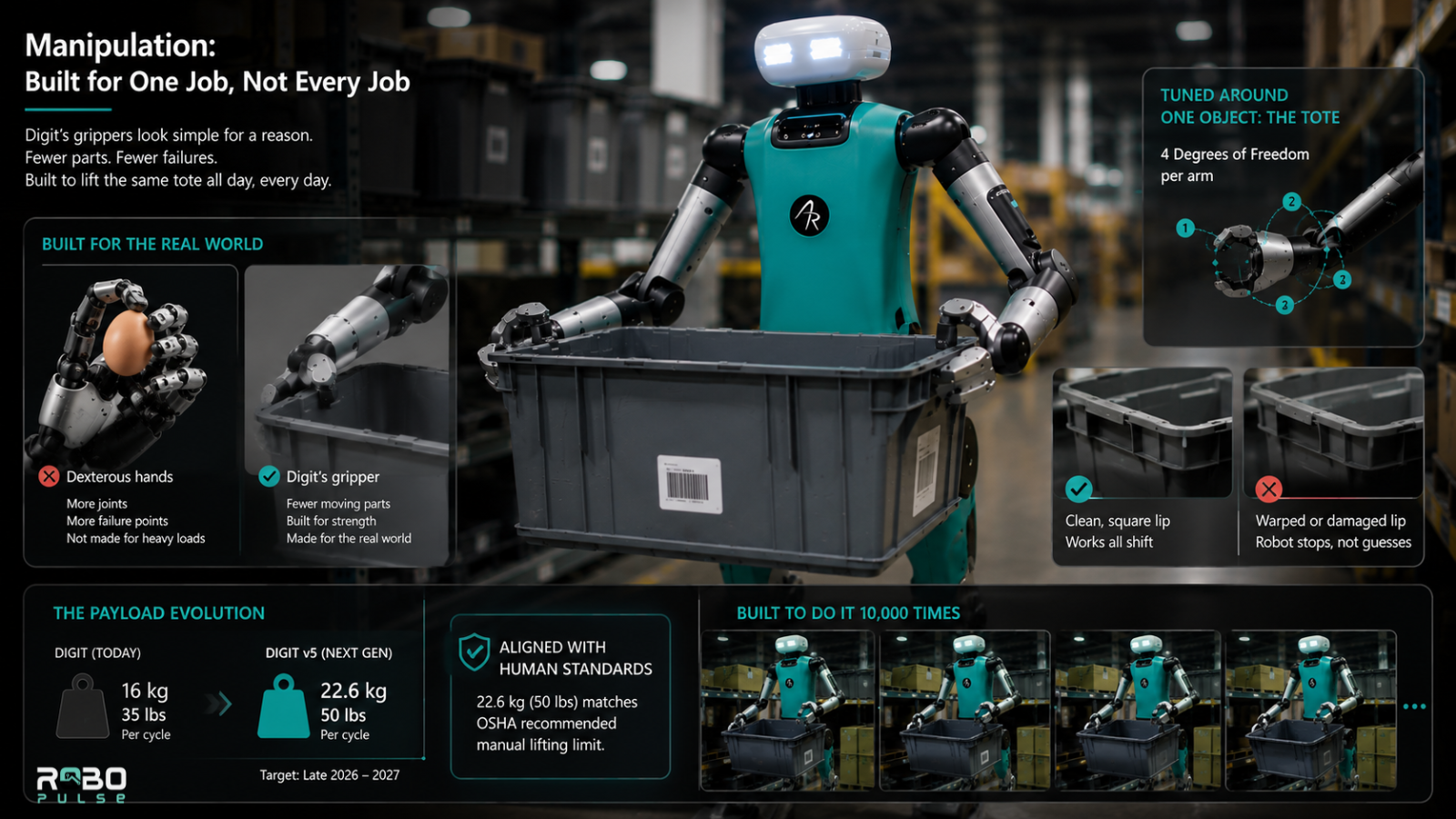
Forget the demo videos of five-fingered robot hands delicate enough to pick up an egg. On a real warehouse floor, that kind of dexterity is mostly a liability — more joints, more failure points, more things that snap under a heavy load. Digit’s grippers look almost crude next to a humanlike hand, and that’s the point.
Tuned Around One Object: The Tote
Each arm carries four degrees of freedom, a modest number by robotics standards — degrees of freedom is worth understanding if the spec sheets get confusing — and every one of them is tuned around the standardized tote. Agility didn’t build a gripper that can pick up anything. It built one that can pick up the same tote ten thousand times without dropping it. Feed it a tote with a clean, square lip, and it works all shift without complaint. Feed it one warped a few centimeters out of shape by years of forklift abuse, and the grasp margin gets thin enough that the robot will stop rather than guess.
The Coming Payload Jump: Digit v5
Digit currently lifts to 16 kg (35 lbs) per cycle. The next-generation hardware — internally called Digit v5, and the platform much of Agility’s new SPAC capital is earmarked to scale — targets 22.6 kg (50 lbs) through late 2026 and into 2027. That number lines up with OSHA’s own recommended limit for manual human lifting, a deliberate signal that Digit is built to fit inside human workplace rules, not around them.
Seeing the Warehouse Without Overthinking It
Walking is only half the job. Digit also has to know where it is, what’s nearby, and how to avoid a forklift or a coworker without slowing down. Its perception stack — LiDAR, depth cameras, an inertial measurement unit for balance — doesn’t try to build a rich photographic model of the world. It builds just enough of one to walk a path, avoid a collision, and line itself up with a workstation. Less computation spent on a perfect picture, more spent on making the next step correctly.
The AI Underneath: Two Very Different Layers
The Physical Layer Stays Narrow on Purpose
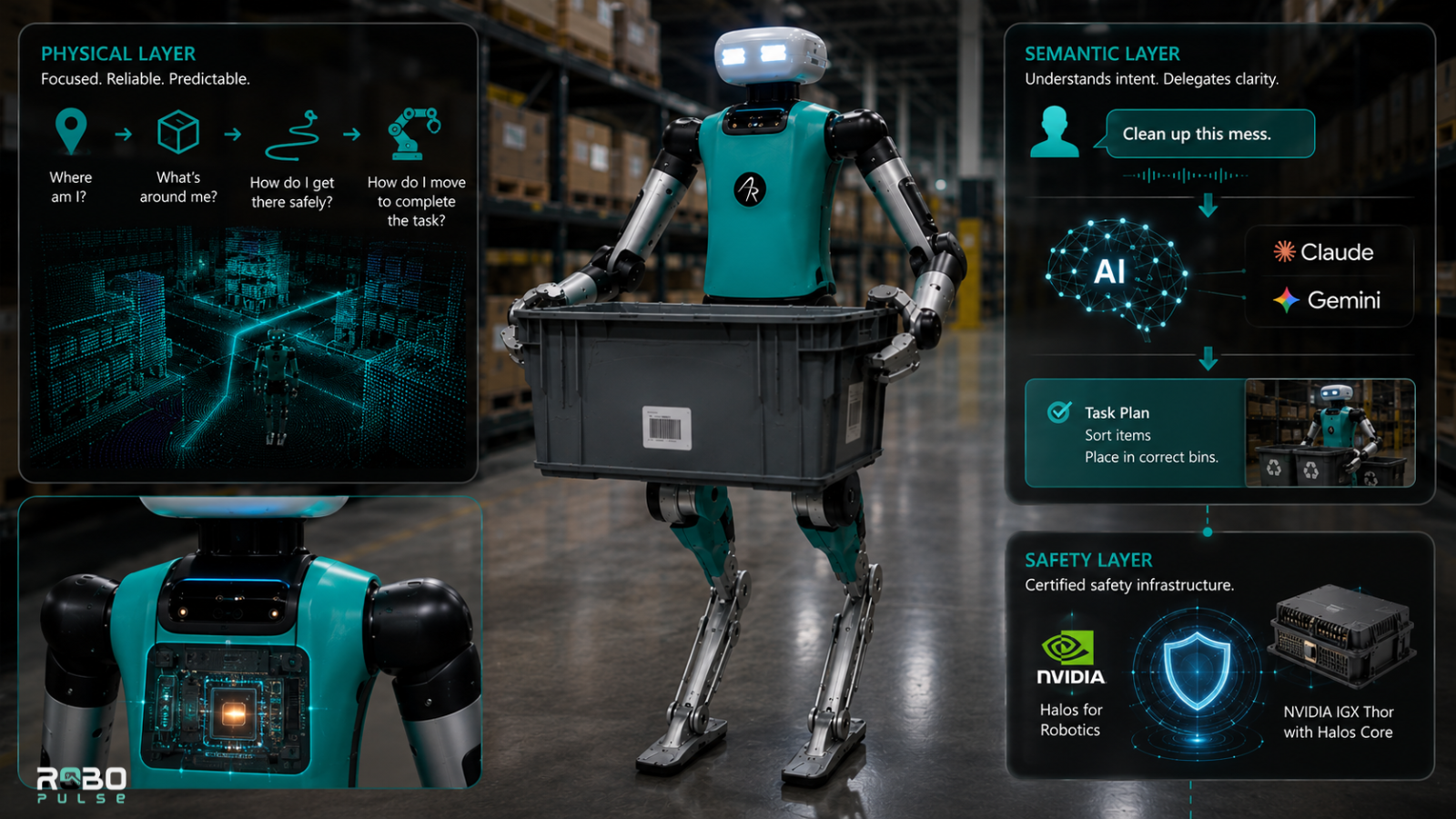
Digit’s core software solves four problems on a loop: where am I, what’s around me, how do I get there safely, and how do I coordinate my legs and arms to finish the task. That layer doesn’t reason about open-ended questions or generate language, and that’s a feature, not a gap — narrower intelligence is easier to make reliable and predictable, which is exactly what a warehouse floor demands.
The Semantic Layer Runs on Claude and Gemini
Sitting above that is a second layer Agility has recently started discussing more openly. CEO Peggy Johnson describes the company as “LLM-agnostic,” meaning Digit’s fleet software can draw on large language models — including Claude and Gemini — to translate a supervisor’s plain-language instruction into a concrete task assignment, rather than requiring every command to be hand-coded. In one demonstration Johnson has cited, engineers scattered mixed trash across the floor and simply told Digit to “clean up this mess”; the robot sorted the items correctly, including recognizing that bubble wrap shouldn’t go in recycling. The physical skills remain Agility’s proprietary core; the language layer sits on top as infrastructure.
NVIDIA Halos Adds a Safety Layer
The newest addition to the stack is safety compute, not task intelligence. At Automate 2026 in Chicago, NVIDIA introduced Halos for Robotics — a full-stack safety architecture built on years of self-driving-car safety engineering — and named Digit as its first industrial launch partner. Digit now runs on NVIDIA’s IGX Thor hardware with Halos Core handling safety-related software, giving regulators a standardized way to check a legged robot’s collision detection and human-proximity behavior instead of every company inventing its own. It’s a meaningful step toward the proximity certification covered below, though still a step, not a finish line. Automate 2026 covered a lot more ground than this one announcement.
The Battery Question Nobody Puts on the Spec Sheet
Real Runtime vs. Marketing Runtime
Digit doesn’t run a full eight-hour shift on one battery. Agility’s own published figure is up to four hours of runtime per charge under typical use, and independent trade reporting suggests that under sustained heavy lifting, real runtime often lands closer to two or three hours. Separately, Agility cites a higher figure—up to 16 to 20 hours of total daily operating availability—but that measures how long the robot remains productive across a full day after autonomous charging extends its uptime, not how long it runs on a single charge.
How Fleets Cover a Full Shift Anyway
That gap is a fact of current battery chemistry every humanoid platform is wrestling with, not a flaw unique to Digit. Agility’s answer is autonomous charging: Digit walks itself to a dock when it needs power, and fleet operators stagger charging across units so at least part of the fleet is always working. Agility talks about pushing toward a 4:1 or even 10:1 ratio of working time to charging time as batteries improve — run enough robots in rotation and the fleet covers a full shift even though no single robot does.
Scaling Past One Robot
Agility Arc Manages the Fleet
A single Digit can automate a task. A real deployment means dozens of robots running at once, and that’s a fleet-management problem, not a robotics problem. Agility Arc is the cloud layer that handles it — tracking battery status, task assignment, software versions, and maintenance schedules across every unit, and it’s also where those LLM-driven instructions get turned into task assignments. Without something like Arc, scaling past a handful of robots gets messy fast.
RoboFab Handles Manufacturing at Scale
Plenty of robotics startups can build one impressive robot. Far fewer can build the three-hundredth one at the same quality. Agility built RoboFab, its manufacturing facility in Salem, Oregon, specifically to close that gap — repeatable production, consistent quality, and delivery timelines enterprise buyers can plan around.
What Digit Actually Costs
No Catalog Price, Two Ways to Buy
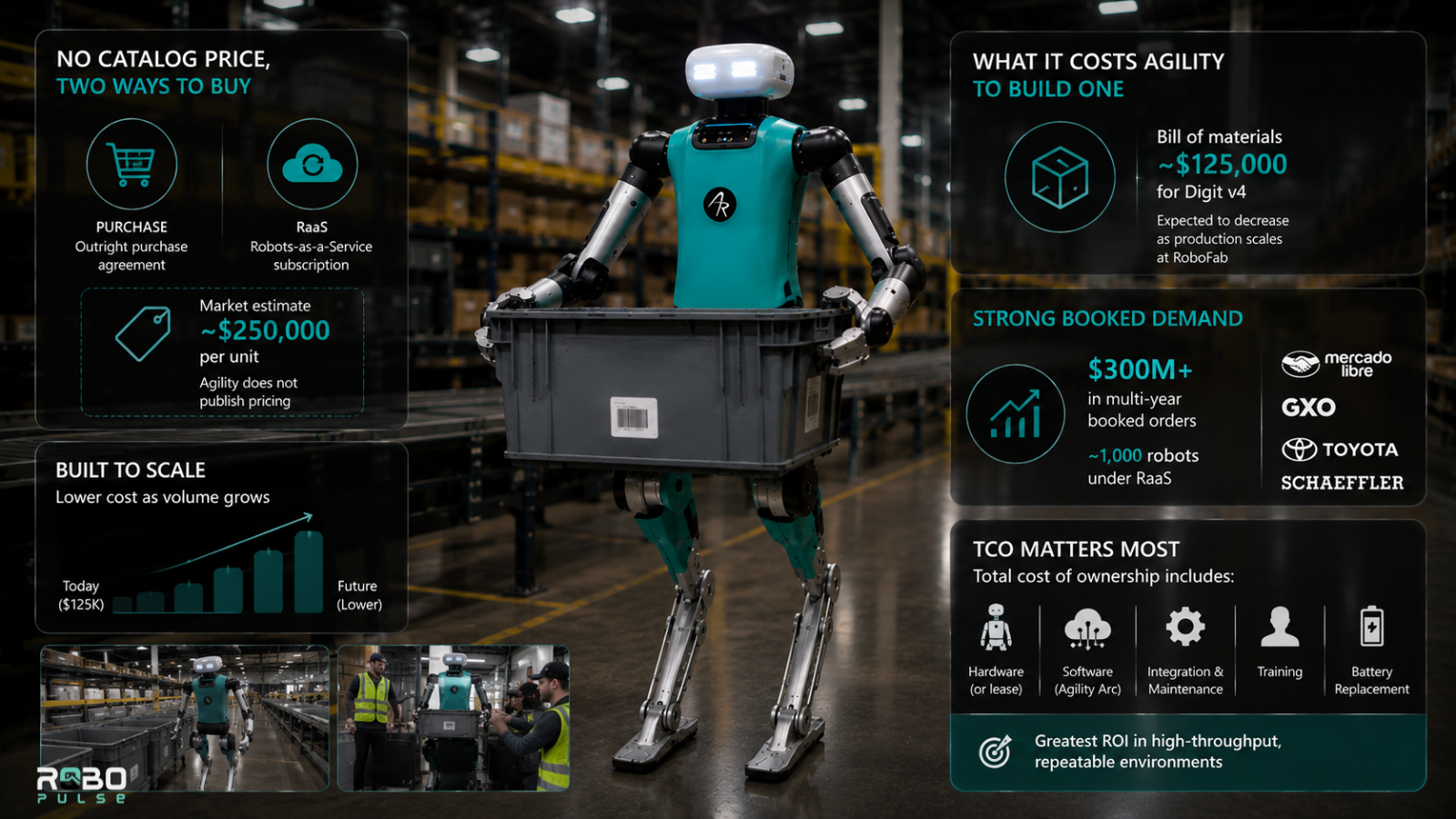
There’s no catalog price for Digit. Agility sells through custom commercial agreements — sometimes an outright purchase, more often Robots-as-a-Service (RaaS), where a company pays a subscription instead of a lump sum. Industry estimates place the market price of a unit around $250,000, though Agility doesn’t publish that figure officially, and RaaS terms vary by contract.
What It Costs Agility to Build One
Separate from the sale price: what it costs Agility to build one. In investor materials tied to the June 2026 SPAC filing, the company’s CFO put the bill of materials for the current Digit v4 at roughly $125,000, with that number expected to keep falling as production volume climbs at RoboFab. That’s manufacturing cost, not the price a customer pays — the gap covers software, support, integration, and margin.
A $300 Million Order Book
There’s now a clearer sense of scale on the demand side. As part of the SPAC disclosures, CEO Peggy Johnson told TechCrunch that Agility has more than $300 million in booked, multi-year orders spanning roughly 1,000 robots under the RaaS model. That’s contracted backlog, not recognized cash flow — some analysts have noted it still depends on manufacturing scale-up rather than revenue already collected. Even so, it’s one of the larger order books any humanoid company has published, naming real customers including Mercado Libre’s Latin American fulfillment operations alongside the GXO, Toyota, and Schaeffler deployments below.
TCO Matters More Than Sticker Price
The more useful question isn’t “what does it cost?” — it’s “what’s the total cost of ownership, and how fast does it pay for itself?” TCO includes the hardware or lease payment, Agility Arc software, integration with warehouse systems, maintenance, training, and battery replacement. The business case gets strongest fast in facilities moving the same tote thousands of times a day; it takes longer to justify in smaller, more variable operations.
Where Digit Is Already Working
GXO: The First Commercial Deployment
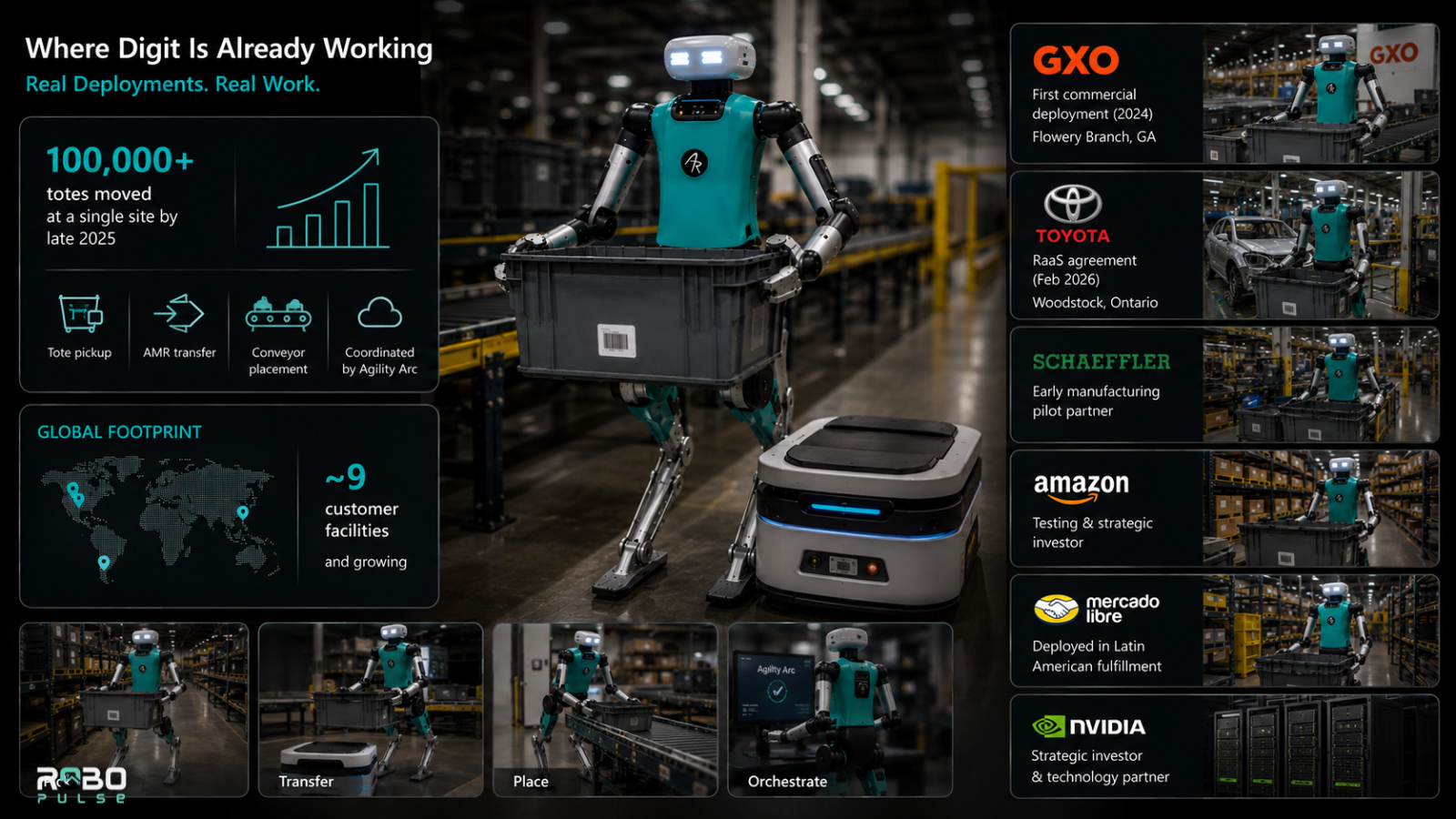
Digit’s biggest advantage over most competing humanoids isn’t a spec — it’s time on the floor. GXO Logistics, the world’s largest pure-play contract logistics provider, ran a proof-of-concept pilot with Digit in late 2023 at a SPANX fulfillment facility in Flowery Branch, Georgia. That pilot turned into a multi-year commercial RaaS agreement in 2024 — the industry’s first formal commercial humanoid deployment, according to both companies — with Digit robots pulling totes off autonomous mobile robots and placing them onto conveyors, all coordinated through Agility Arc. By late 2025, Digit had moved more than 100,000 totes at that single site.
Toyota, Schaeffler, Amazon, and Mercado Libre
Amazon has also tested Digit, and both Amazon and NVIDIA are named strategic backers of Agility. Toyota Motor Manufacturing Canada signed its own RaaS agreement in February 2026 to run Digit units at its Woodstock, Ontario plant. Schaeffler, the German industrial supplier, was among the earliest to pilot Digit in a manufacturing setting. Mercado Libre has brought Digit into its Latin American fulfillment network as well, extending the customer list beyond North American logistics and manufacturing. As of mid-2026, Digit is working across roughly nine customer facilities — modest next to traditional industrial automation, but more real-world commercial hours than nearly any other humanoid platform can claim.
Safety: Real Progress, With an Honest Caveat
It’s worth being precise here, because this is an area where marketing tends to get ahead of the facts. Digit is not yet working freely alongside people the way a human coworker would. In early 2026, it passed what’s recognized as the first OSHA-related safety field inspection for a commercial humanoid in a live warehouse — a genuine milestone. But full proximity certification, the kind that lets Digit work directly next to workers without a partition, is still going through ISO functional-safety review, expected to close out later in 2026. Today, most deployments run in segregated or partitioned zones inside otherwise live facilities. A robot that’s honest about “we’re not there yet” is a better sign than one claiming full collaboration before the certification backs it up.
The Story Everyone in the Industry Is Watching Right Now
In late June 2026, Agility Robotics agreed to go public through a $2.5 billion SPAC merger with Churchill Capital Corp XI, with the combined company expected to trade under the ticker AGLT. The deal includes a $200 million PIPE investment led by Foxconn, alongside existing strategic backers NVIDIA, Amazon, and SoftBank Vision Fund 2. Agility is positioning itself as the first pure-play, U.S.-listed humanoid robotics company with actual commercial deployments behind it, backed by that $300 million order book rather than projections alone. For enterprise buyers, this matters beyond the stock ticker: it signals capital to fund the manufacturing scale-up, safety certification, and fleet expansion that turns a pilot into a plant-wide rollout.
Where Digit Still Struggles
No platform is finished. Digit performs best in structured, repeatable workflows and gets noticeably less confident when the environment turns unpredictable — a bent tote, a misplaced pallet, an oddly shaped product nobody planned for. Its grippers are tuned for logistics containers, not arbitrary objects, so anything outside that lane still needs a human hand.
Digit vs. the Competition
Digit vs. Tesla Optimus
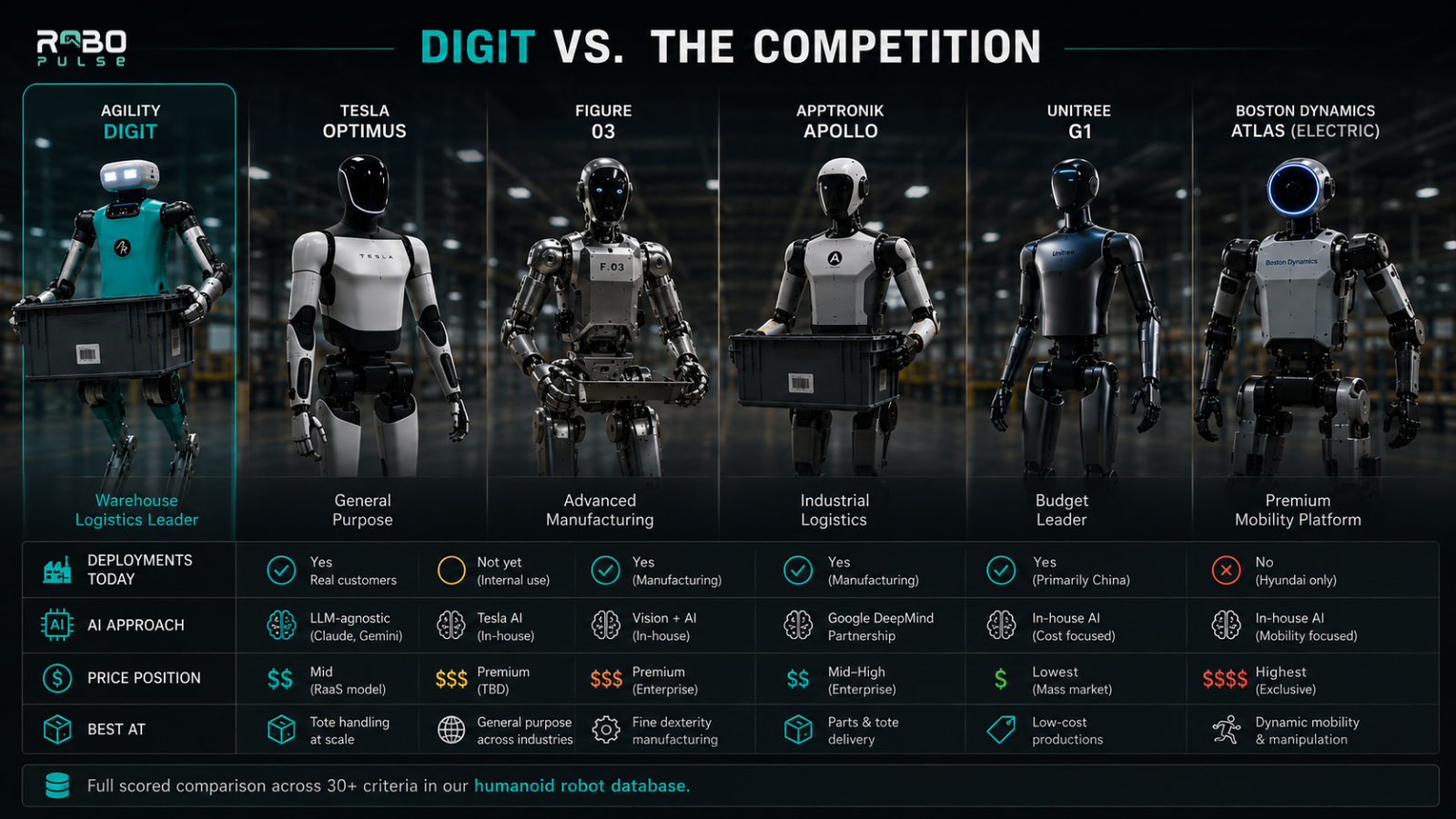
Optimus carries Tesla’s manufacturing scale and AI ambition, aiming for a genuinely general-purpose humanoid. But most of its public demonstrations still happen inside Tesla’s own facilities, with third-party commercial deployment yet to arrive. Digit took the opposite bet: one workflow, done well, sold to outside customers today. If you’re deploying this year, Digit is the safer, proven choice; if you’re betting on a multi-industry robot five years out, Optimus is the more ambitious wager.
Digit vs. Figure
Figure’s newest platform, Figure 03, just took over a sequencing job at BMW’s Spartanburg plant — sorting unsorted parts into trolleys for just-in-time delivery to the assembly line, after its predecessor spent ten months handling sheet-metal welding on the same floor. That’s genuinely dexterous, fine-grained manufacturing work. Digit doesn’t compete there and doesn’t try to. It wins on years of focused logistics deployment and a deeper commercial track record specifically inside warehouses.
Digit vs. Apptronik Apollo
Apollo is doing something closer to Digit’s job at Mercedes-Benz’s Berlin plant — delivering kitted parts and totes between workstations rather than assembling anything itself — backed by a Google DeepMind AI partnership and a Jabil manufacturing deal to scale production. Apollo’s approach is broken down in more detail here. Digit’s edge over Apollo right now isn’t the hardware; it’s simply more hours logged in more warehouses.
Where Unitree and Boston Dynamics Fit In
China’s Unitree is undercutting nearly everyone on price and has filed for its own Shanghai listing — its G1 platform shows what that trade-off actually looks like, and it’s worth understanding how China’s humanoid rental boom is running ahead of its own autonomy claims before assuming cheaper means comparable. Boston Dynamics’ electric Atlas sits at the other extreme: its entire near-term production run is committed to Hyundai, which effectively takes it off the table for anyone outside that supply chain.
If you want the numbers side by side rather than just the narrative, the compare tool pulls actual scored data across every platform mentioned here.
Who Should Actually Buy This
Digit makes sense for large distribution centers, third-party logistics providers, manufacturing plants, and e-commerce fulfillment operations running high-volume, repetitive material handling. Digit suits large distribution centers, third-party logistics providers, manufacturing plants, and e-commerce fulfillment operations that handle high-volume, repetitive material movement. It doesn’t suit small businesses, restaurants, or operations where workflows change too often to justify the investment. Retail presents a different opportunity. As the Hong Kong convenience-store deployments above show, humanoids have started taking on customer-facing roles—but Agility designed Digit for structured warehouse work, not open-ended public interaction.
Strengths and Weaknesses
Strengths
Digit’s warehouse mobility remains its clearest edge — it walks spaces built for people without asking anyone to rebuild them. Its engineering stays focused: every hardware and software decision serves one goal, reliable warehouse automation, rather than chasing a broader “do everything” pitch. Agility’s manufacturing investment through RoboFab and its fleet software through Agility Arc both point to a company building for scale, not just for a demo reel, and the $300 million order book gives that scale-up a real financial backbone. Because Digit fits into existing layouts, implementation costs stay lower than most competing automation systems.
Weaknesses
The narrow task focus that makes Digit reliable also limits it — it’s not built for highly varied manual work. Enterprise-only pricing puts it out of reach for small operators. It performs best in structured, predictable settings, and its grippers, while excellent for totes, can’t match a human hand on irregular objects.
FAQs
Q. Is Digit available for consumers?
No. Agility Robotics sells Digit exclusively to enterprise customers in logistics, manufacturing, and warehouse automation. Consumers cannot purchase the robot.
Q. How much does Digit cost?
Agility doesn’t publish an official list price. Industry estimates place Digit between $100,000 and $250,000 per robot, while many customers deploy it through a Robots-as-a-Service (RaaS) subscription instead of buying it outright.
Q. What can Digit do?
Digit transports totes, moves materials between workstations, loads and unloads conveyors, and navigates warehouses built for people. It specializes in repetitive material-handling tasks rather than general-purpose work.
Q. Can Digit replace warehouse workers?
No. Digit automates repetitive material movement, while people continue to handle quality checks, exceptions, problem-solving, and complex tasks.
Q. What makes Digit different from traditional warehouse robots?
Unlike wheeled robots, Digit walks on two legs, climbs ramps, and navigates spaces designed for people without requiring fixed paths or major warehouse modifications.
Q. Does Digit use generative AI?
Partly. Digit’s walking, balance, and manipulation rely on dedicated robotics software. Its fleet platform can use large language models, including Claude and Gemini, to translate natural-language instructions into warehouse tasks.
Q. How long does Digit’s battery last?
Digit typically operates for up to four hours per charge under normal workloads before automatically returning to a charging dock. Fleet operators stagger charging so robots can cover full-day operations.
Q. Is Digit certified to work directly alongside people?
Not yet. Digit passed an OSHA-recognized warehouse safety inspection in 2026, but full ISO proximity certification for unrestricted human collaboration remains in progress.
Q. Is Digit better than Tesla Optimus?
It depends on the use case. Digit leads in commercial warehouse deployments and enterprise readiness, while Tesla Optimus focuses on broader long-term capabilities and currently operates primarily inside Tesla’s own facilities.
Q. Who uses Digit today?
Digit is deployed by companies including Amazon, GXO Logistics, Toyota, Schaeffler, and Mercado Libre for warehouse and manufacturing workflows.
Q. Will humanoid robots become common in warehouses?
Yes. As costs decline, battery technology improves, and safety certifications mature, humanoid robots are expected to complement existing warehouse automation by taking over repetitive material-handling tasks.
Final Verdict
Digit’s real achievement isn’t being the fastest, strongest, or most human-looking robot on the market—it’s becoming one of the very few humanoids to move beyond research demos into paid commercial deployments, backed by a public order book. Rather than chasing general-purpose robotics, Agility focused on solving one costly warehouse problem exceptionally well without forcing companies to redesign existing facilities.
Competition from Tesla, Figure, and Apptronik will only intensify. Even so, Digit enters that race with an advantage most rivals still lack: years of real deployment data, established enterprise customers, mature fleet management software, and manufacturing capacity that continues to scale. For organizations looking to automate repetitive warehouse material handling today rather than wait for future promises, Digit remains one of the strongest enterprise humanoid robots available.
Overall Rating
| Category | Rating |
|---|---|
| Design | ★★★★★ |
| Build Quality | ★★★★★ |
| Mobility | ★★★★★ |
| AI & Navigation | ★★★★☆ |
| Warehouse Readiness | ★★★★★ |
| Commercial Maturity | ★★★★★ |
| Value for Enterprise | ★★★★☆ |
| Overall | 4.5/5 (89/100) |
Related: Synthetic Humanoids Explained: Can Artificial Muscles Beat Traditional Robots?