

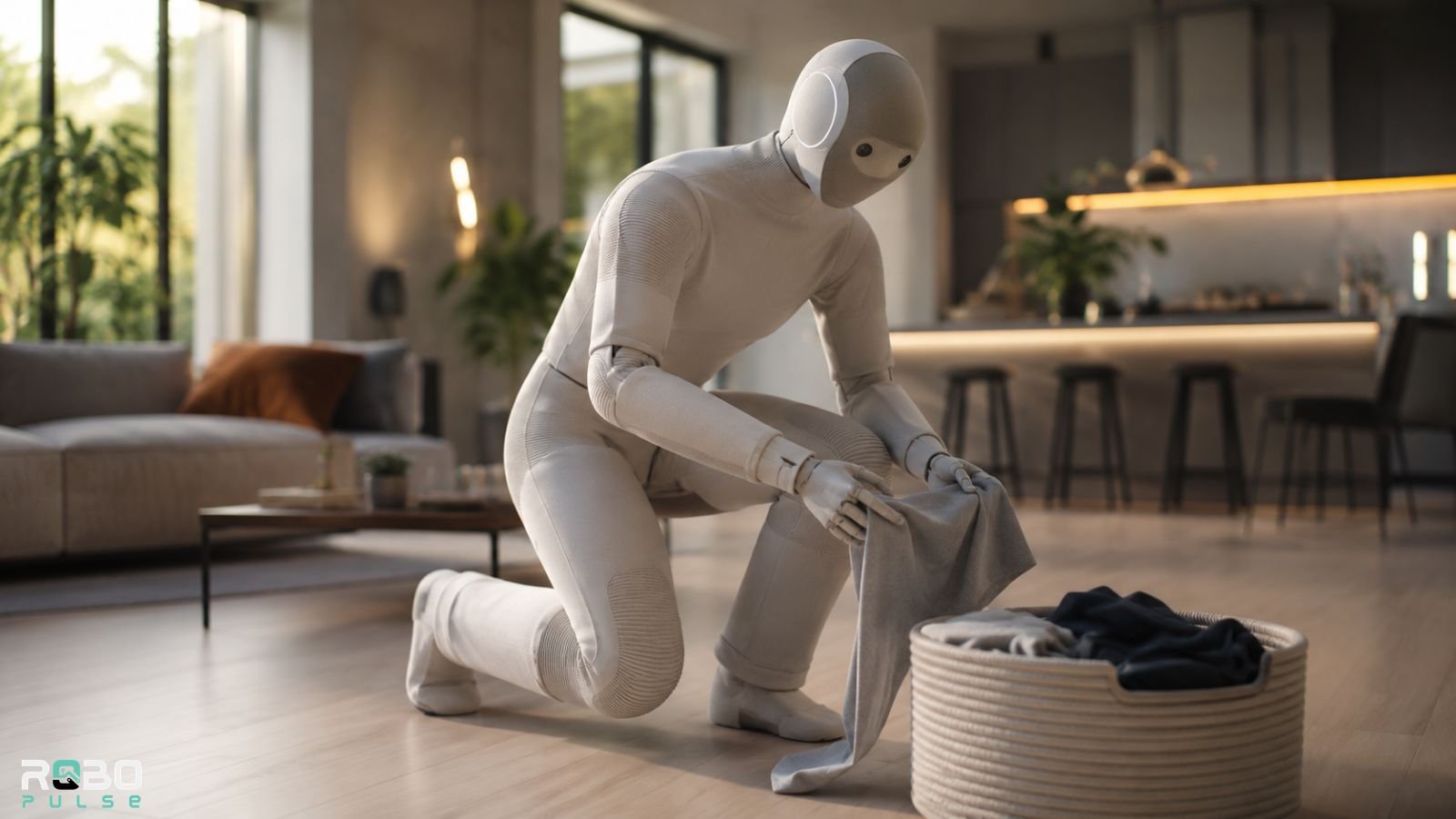
For decades, a robot that folds your laundry and greets your guests lived only in movies. In 2026, you can put down a $200 deposit and get in line for one.
1X Technologies calls NEO the first consumer-ready humanoid robot built for homes instead of warehouses. That claim mostly holds up. But the fuller story runs deeper than the launch video lets on: a brand-new hand design, a running factory, and a private-equity deal quietly subsidizing your purchase.
This review covers what NEO can genuinely do today, where it still falls short, and how the pricing actually works. It also covers one detail every buyer should understand before handing over that deposit: a human being can watch through the robot’s cameras while it works in your home.
What Is the 1X NEO Robot?
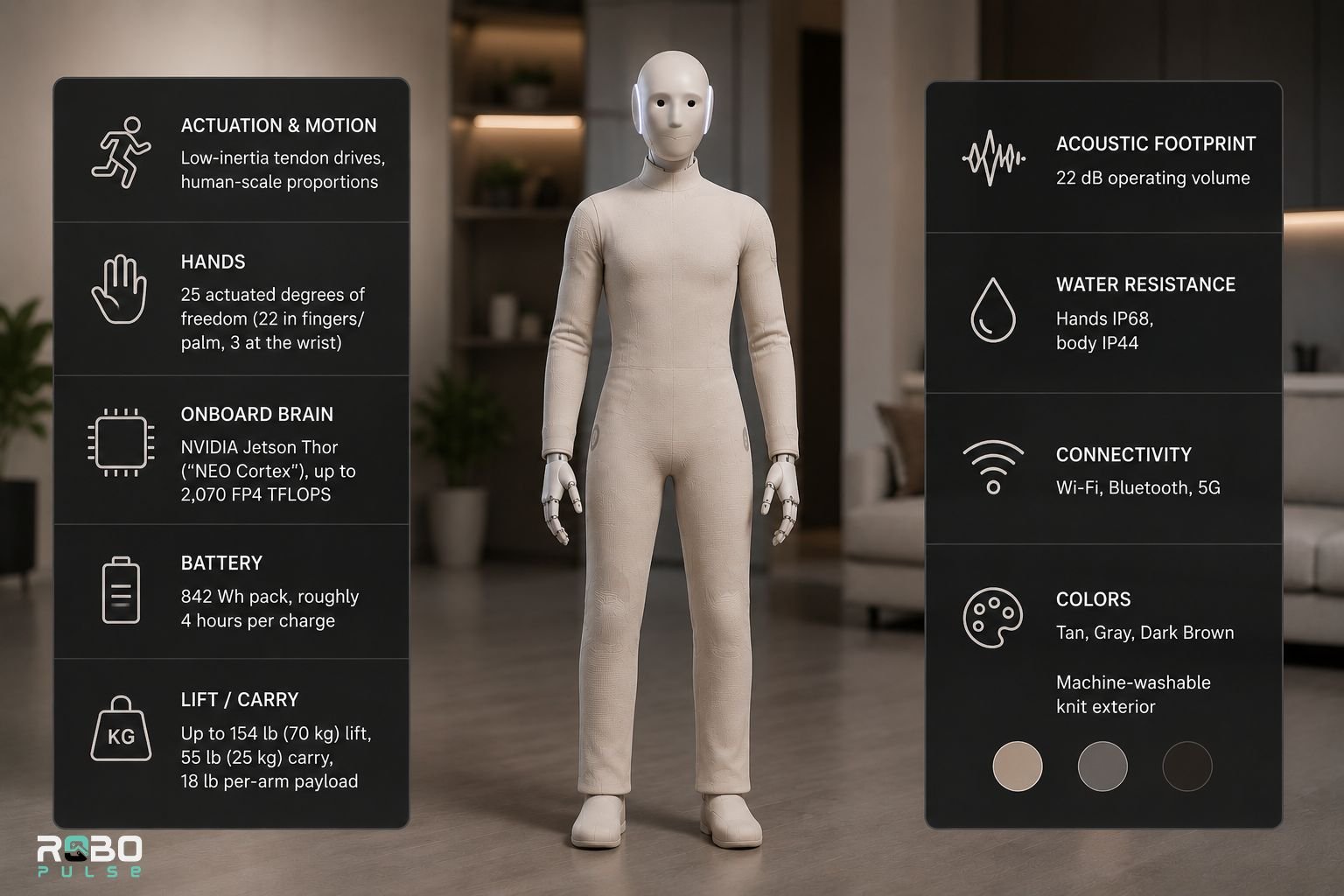
NEO is a 5’6″, 66-pound bipedal humanoid robot. It moves on a soft, tendon-driven body instead of rigid metal joints, with an onboard NVIDIA Jetson Thor chip running its AI locally.
Tesla Optimus and Figure’s robots both started on factory floors. NEO didn’t — it was built home-first from day one. That single decision shapes almost everything about how it looks, moves, and behaves, right down to how bipedal humanoid robots actually stay upright on a cluttered kitchen floor.
Who Builds NEO?
1X Technologies started life in Norway as Halodi Robotics in 2014. It rebranded in 2023 and moved its operating headquarters to Palo Alto, California. OpenAI made its first-ever robotics investment in the company — a signal that carries real weight given how selective OpenAI has been about hardware bets.
Before NEO, 1X built EVE, a wheeled robot for security and facility work. That gave the team real operating experience before tackling something harder: a robot meant for someone’s living room.
How 1X got here:
| Date | Milestone |
|---|---|
| 2014 | Founded in Norway as Halodi Robotics |
| 2018 | EVE, the company’s first robot, ships for security and logistics work |
| March 2023 | Rebrands to 1X Technologies; OpenAI Startup Fund leads a $23.5M round |
| January 2024 | $100M Series B, led by EQT Ventures |
| October 2025 | NEO opens for pre-order; first-year production sells out in five days |
| April 2026 | Hayward factory begins full-scale production |
| July 2026 | The 25-DOF hand redesign ships |
Three trends made this decade of progress possible, and NEO is what happens when they land in one product at once: foundation models that teach a robot “pick up the mug” through language instead of hand-coded rules, chips like Jetson Thor cheap enough to run that intelligence onboard, and compliant actuators that finally made a home-safe body practical.
NEO’s Specs, at a Glance
| Technical System | Specification | Practical Home Impact |
|---|---|---|
| Actuation & motion | Low-inertia tendon drives, human-scale proportions | Fluid, quiet movement instead of jerky hydraulic motion |
| Hands | 25 actuated DOF (22 in fingers/palm, 3 at the wrist) | Force-controlled grip that can pick a grape without crushing it |
| Onboard brain | NVIDIA Jetson Thor (“NEO Cortex”), up to 2,070 FP4 TFLOPS | Runs perception and safety-critical decisions locally, no cloud lag |
| Battery | 842 Wh pack, ~4 hours per charge | Self-docks and fast-charges around 6 minutes per hour of runtime |
| Lift / carry | Up to 154 lb (70 kg) lift, 55 lb (25 kg) carry, 18 lb per-arm payload | Handles groceries, furniture, and full laundry baskets |
| Acoustic footprint | 22 dB operating volume | Quieter than a running refrigerator |
| Water resistance | Hands IP68, body IP44 | Hands submerge fully; body handles splashes |
| Connectivity | Wi-Fi, Bluetooth, 5G | Stays connected for updates and remote-assist sessions |
| Colors | Tan, Gray, Dark Brown | Machine-washable knit exterior |
Every one of these figures sits side by side with other humanoids in the full humanoid comparison database, if you want to run your own comparison.
Worth knowing upfront: despite this hardware, NEO still depends on remote human assistance for complex tasks, and long-term reliability hasn’t been proven yet. Both points are covered in full below.
Two numbers are easy to skim past. The 842 Wh battery draws less electricity per charge than running a clothes dryer for an hour. And 22 dB isn’t just “quieter than a fridge” — it’s closer to a library reading room than anything most people would call a machine.
Stand next to NEO and the knit suit over soft 3D-lattice polymer skin is the first thing you notice. It reads more like a heavy-duty plush toy than a factory machine. Minor collisions deform that outer shell instead of denting your kitchen table.
How NEO Compares to Other Humanoids
- Tesla Optimus weighs around 125 lb and stays focused on factory deployment inside Tesla’s own facilities.
- NEO, at roughly half that weight, was designed from day one for home environments and is already taking consumer reservations.
- Unitree G1 prioritizes athletic movement and research flexibility over 1X’s strict home-safety design philosophy.
- Agility’s Digit stays firmly on the warehouse floor, built for logistics work rather than a living room.
For a fuller side-by-side across every dimension, the compare tool lets you set NEO against any humanoid on the site.
Hardware only tells part of the story. Whether NEO’s design edge holds up depends on the hands doing the actual work — and that’s where the July redesign comes in.
NEO’s New 25-DOF Hands
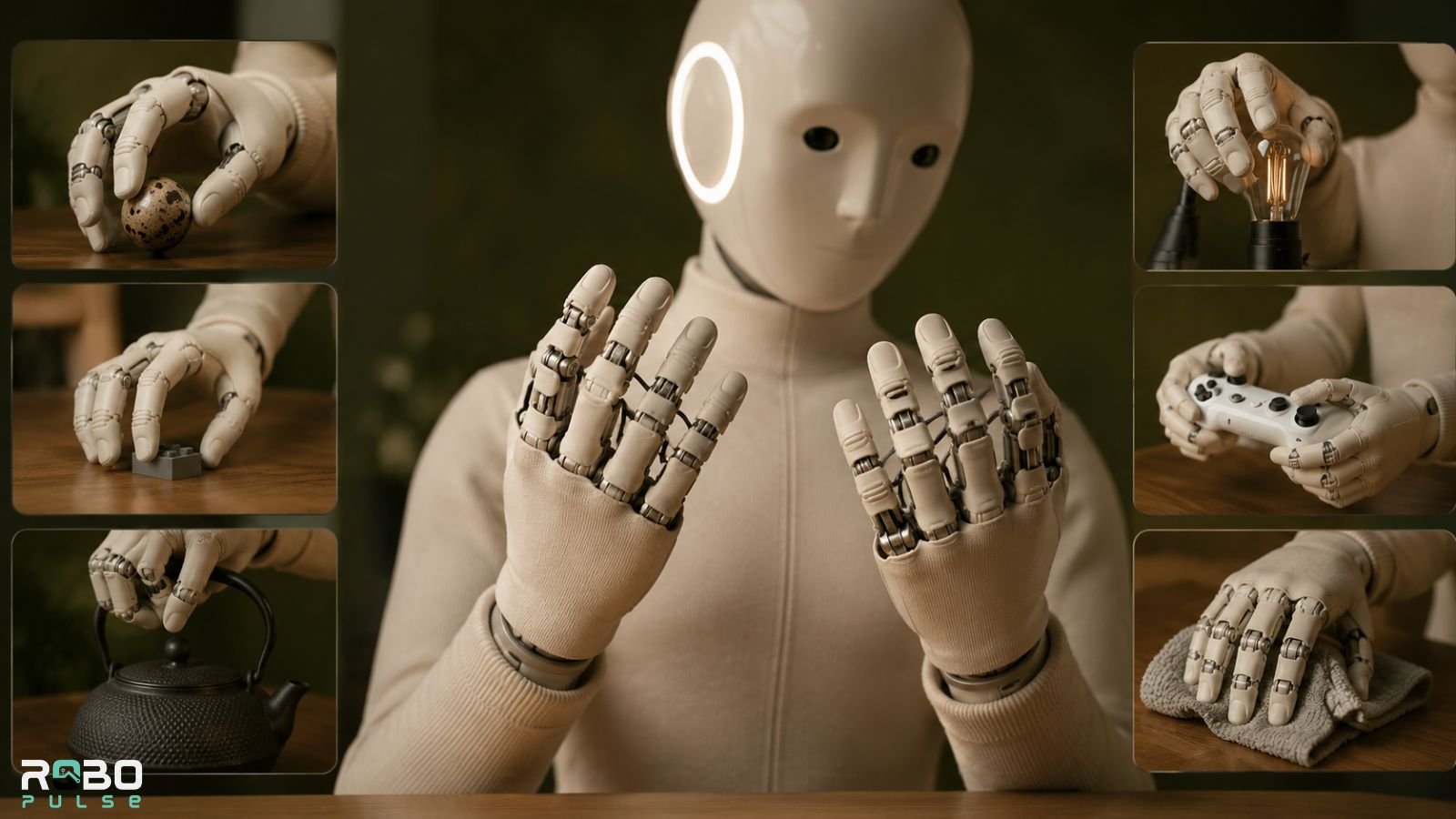
On July 9, 2026, 1X unveiled a redesigned hand for NEO, and it matters more than the “degrees of freedom” number suggests. If you want the mechanics of DOF spelled out, here’s the five-minute version — this hand is where the whole home-robot pitch either works or doesn’t.
Traditional robot hands trade touch sensitivity for power, using gear ratios up to 200:1. NEO’s new hand goes the other way, with a 5:1 to 15:1 ratio and tendons driven by forearm-mounted motors instead of springs. That low ratio makes all 25 joints backdrivable — direct force feedback with no extra compliant hardware needed.
Push on a finger, and it yields while reporting exactly how much force was applied. 1X calls this force transparency — the mechanical reason NEO can pick up a raw egg and a cast-iron pan with the same hand.
Precision over pure strength:
- Peak torque: 3.5 Nm at the thumb, 2.6 Nm at the finger joints
- Fingertip flexion force: up to 45 N
- Positioning accuracy: ±0.2 mm
- Tactile sensors detect pressure, contact location, and shear, so the robot can sense a slipping object and adjust grip before it falls
- Hands are IP68-rated and food-safe
- 1X’s dedicated hand line is already producing up to 10,000 units this year
The biggest open question is durability. Tendon-driven hands have historically stretched and worn down over time. 1X says its components have survived millions of test cycles, with wrist joints validated beyond 2 million. Company demos show the hands surviving slaps, hammer taps, and drawer pinches undamaged. That’s promising on paper. Real-world reliability can only be judged once these hands have spent months in actual homes, not lab rigs — NEO’s 2026 shipments will provide the first real answer.
What Can NEO Actually Do Right Now?
| Task | Current Status |
|---|---|
| Opening doors, fetching items | Autonomous |
| Tidying, wiping surfaces, watering plants | Autonomous |
| Climbing stairs, sitting, kneeling | Autonomous, via the Redwood Mobility controller |
| Folding laundry, loading a dishwasher | Expert Mode-assisted, not yet reliably autonomous |
| Carrying groceries or furniture | Autonomous, within 154 lb lift / 55 lb carry limits |
| Cooking, vacuuming | No public demonstration — NEO isn’t built with onboard vacuum hardware |
If a task hasn’t been shown publicly, the honest answer is that it isn’t confirmed. Not that it’s coming soon.
Watch NEO work for more than a minute and the small stuff stands out more than the chore list. Its arm settles into a slightly different tension picking up a full mug versus an empty one. The knit-suited fingers close around a door handle with a hesitation that reads less like a script and more like an actual grip check.
Hardware and mobility are one thing. What’s actually running the show underneath is a different question.
Two AI Systems, Not One
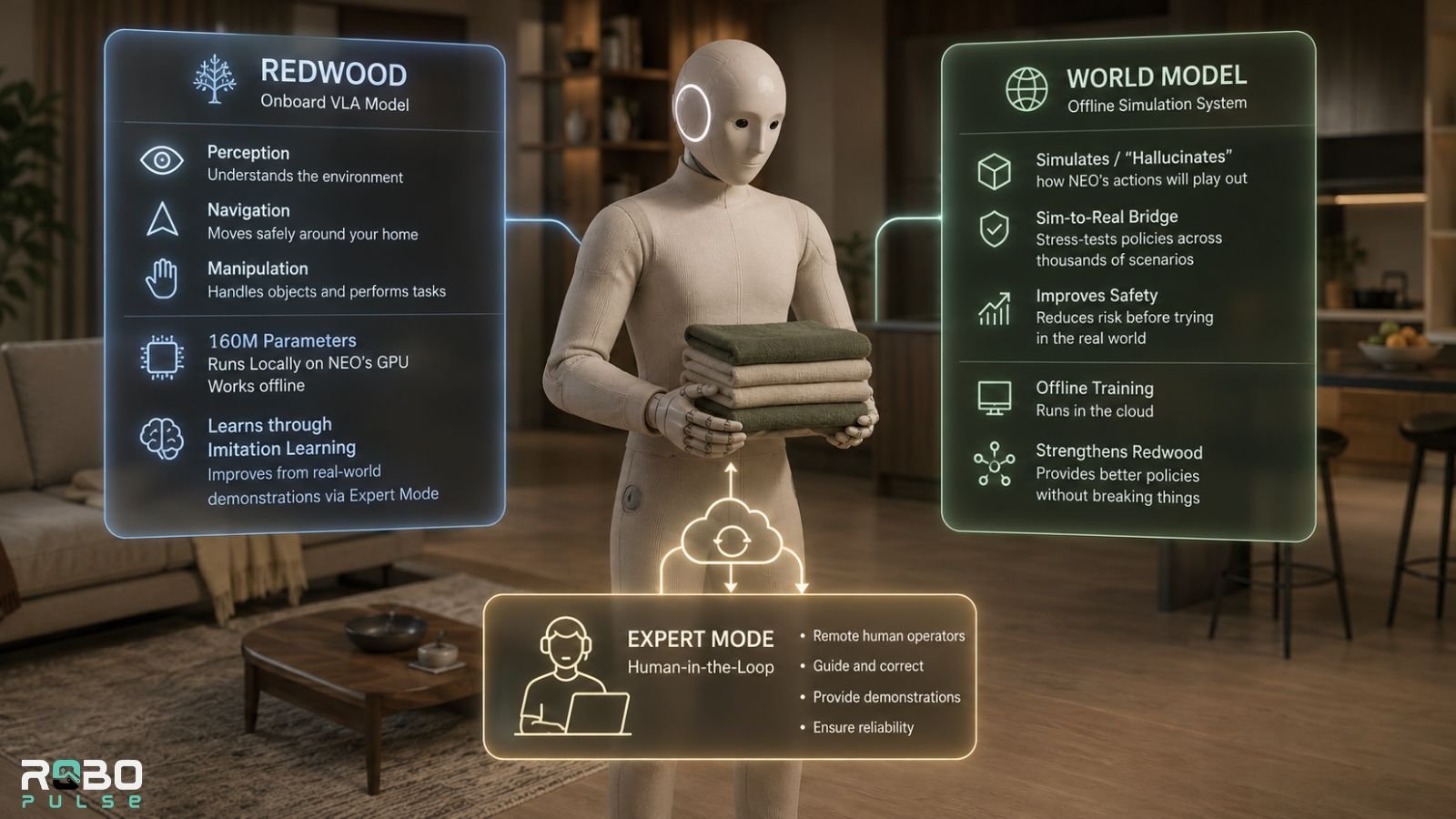
1X runs two separate AI systems, and conflating them is where a lot of coverage goes wrong.
Redwood drives NEO’s day-to-day behavior. It’s a 160-million-parameter model handling perception, navigation, and manipulation together, running locally on the robot’s GPU so it keeps working offline. It improves mainly through imitation learning, training on the demonstrations Expert Mode operators generate inside real homes.
The World Model is a separate, offline system — a flight simulator for chores. It lets 1X test how NEO’s actions will play out in simulation before the robot tries them in your kitchen, stress-testing Redwood’s manipulation policy across thousands of scenarios without breaking a real dish.
Figure takes a different route with its Helix models, leaning almost entirely on imitation learning at scale. 1X leans harder on live human correction — which is where Expert Mode comes in.
Expert Mode Explained
When Redwood hits a task it hasn’t mastered, you can request Expert Mode. A remote 1X employee puts on a VR headset, takes control through the robot’s cameras, and completes the task while the AI watches and learns.
This isn’t a minor footnote. When WSJ reporter Joanna Stern tested NEO in her own home, every complex task she filmed ran through a human operator, not the robot’s own intelligence.
1X hasn’t denied this. CEO Bernt Børnich has openly framed teleoperation as a deliberate strategy: collect real household data so Redwood improves faster, rather than wait years for autonomy to catch up in a lab. It’s an industry pattern, not just a 1X one — teleoperation is quietly propping up autonomy claims well beyond the US, too.
Bottom line: NEO isn’t fully autonomous today. Complex tasks still rely on trained human operators while the AI learns from each session.
NEO in mid-2026 is a hybrid product, part autonomous and part remotely operated, with the balance shifting as Redwood and the new hands mature. Anyone buying now is buying into that trajectory, not a finished product.
Ownership Experience
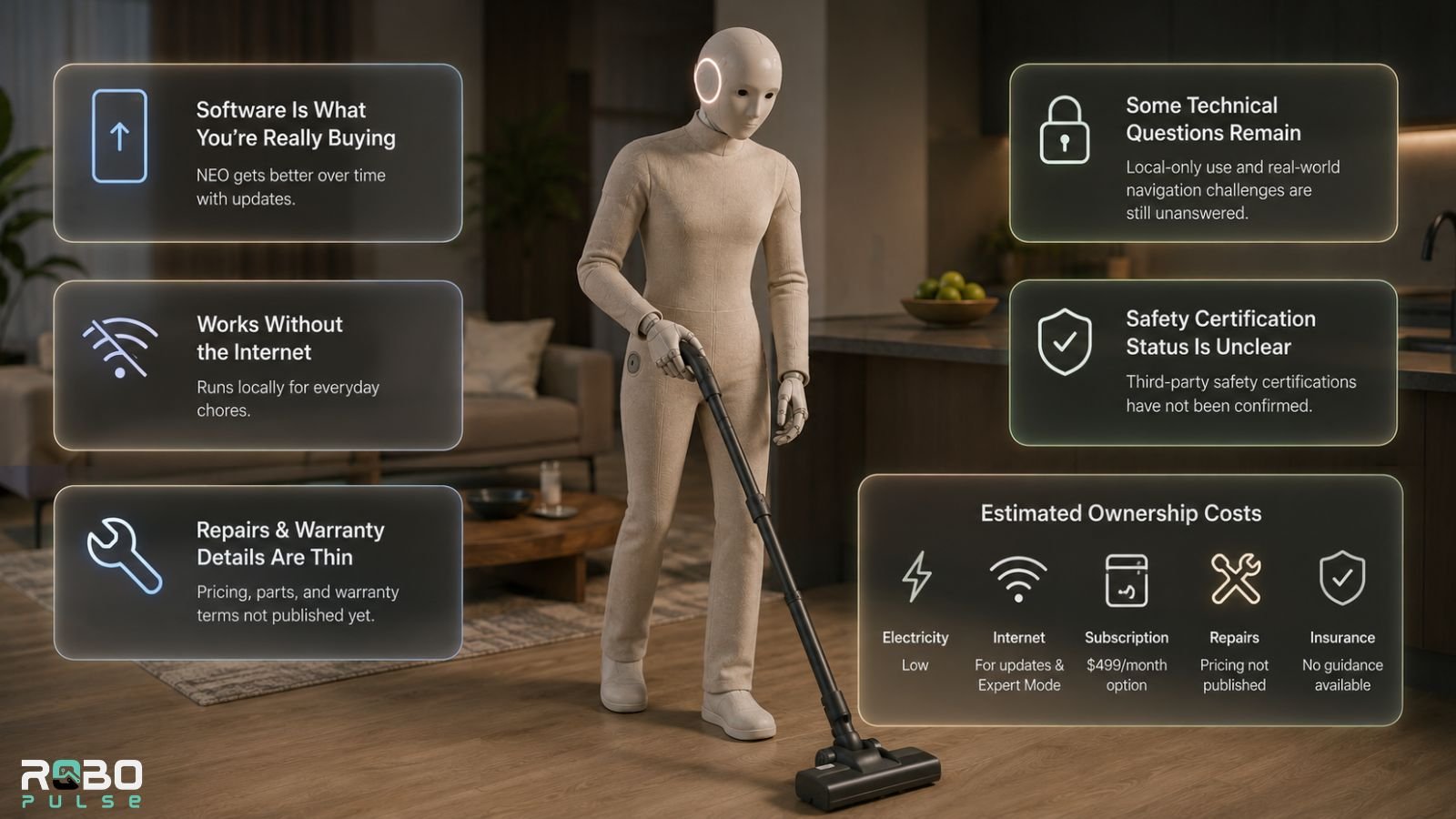
- Software is most of what you’re buying. Like a smartphone, NEO’s value compounds through updates over time, not just the hardware you unbox.
- It doesn’t need the internet for basic chores. Redwood runs locally, so routine autonomous tasks keep working offline. Only remote-assist sessions need a connection.
- Repair and warranty details are thin so far. No published repair pricing, part modularity, or warranty term yet. Worth asking directly if you’re close to ordering.
- A few technical questions remain open: whether NEO can run fully isolated on a local network with zero cloud dependency, and how its feet handle deep-pile carpet, thresholds, or slick tile in real living rooms. Neither has a public answer.
- Formal safety certification status is unclear. 1X publishes its own safety figures — HIC under 250, pinch-proof joint housings — but hasn’t detailed third-party certifications like a UL listing or ISO 13482, the standard written for personal care robots.
- Liability and insurance are open questions too. 1X hasn’t published guidance on what happens if the robot damages property or injures someone, and no standard home-insurance product for humanoids exists yet. Worth raising with your insurer directly before ordering, since this isn’t something we can answer on 1X’s behalf.
Costs beyond the sticker price: electricity is modest (less than an hour of clothes-dryer use per charge); repairs, battery replacement, and spare hands aren’t priced yet; and insurance has no standard offering in the market.
The Privacy Question Every Buyer Should Ask
Expert Mode means a stranger can, in principle, see inside your home through NEO’s cameras. That’s not a hypothetical critics invented. It’s how the feature works, and 1X has been upfront about it.
The safeguards: every remote operator passes a background check, a supervisor monitors operators in real time at roughly one manager per eight teleoperators, and video feeds during sessions are encrypted.
That manager-to-operator ratio isn’t the number that matters most, though. The real bottleneck is how many robots one operator can supervise at once. As software shifts from manual control toward autonomous validation, that’s what determines whether Expert Mode scales or becomes a permanent staffing cost — and 1X hasn’t published that figure.
Owners keep some control too. You can mark rooms or times off-limits to teleoperation. You can enable audio masking and face blurring, or opt out of AI-training data use entirely — though opting out may leave your unit more limited during this early phase.
Whether that trade-off feels acceptable is a personal call worth making before committing $20,000. Børnich has compared it to hiring a cleaning service. That holds up in some ways. It falls apart in others — a cleaner doesn’t operate through a company-controlled camera feed.
Pricing and Business Model
NEO is priced two ways: $20,000 outright, or $499/month on subscription. Both require a $200 deposit, fully refundable if you change your mind before delivery.
Here’s the context most coverage skips: 1X isn’t funding this price purely on hardware margins. In December 2025, the company signed a deal with private equity firm EQT to deploy up to 10,000 NEOs into commercial settings — logistics, healthcare, facility work — between 2026 and 2030. That enterprise revenue helps 1X hold the consumer line at $20,000, the same subsidy playbook electric vehicles ran for years.
Manufacturing: Inside the Hayward Factory
Production began in April 2026 at a new 58,000-square-foot factory in Hayward, California, with a second facility in San Carlos coming online later this year. The Hayward plant builds NEO’s proprietary Revo2 motors from raw copper spools instead of buying off-the-shelf components. 1X also manufactures its batteries, tendons, and new 25-DOF hands in-house.
That vertical integration is deliberate. Rivals like Boston Dynamics’ Atlas Electric or Apptronik’s Apollo can shop for better actuators. They can’t shop for 1X’s entire in-house supply chain.
Production Timeline
- Capacity today: 10,000 units a year at Hayward, targeting 100,000+ annually once automation and San Carlos ramp by end of 2027
- Demand: ~10,000 reservations booked in the first five days after pre-orders opened, October 2025
- Where units are going right now: mostly 1X’s own internal testing, not customer doorsteps, as of mid-2026
- Delivery target: US customers before end of 2026, Canada and international in 2027 — a target, not a guarantee, as with most robotics timelines
Should You Buy NEO?
If you want a finished product that works flawlessly on day one, NEO isn’t that yet. Waiting for a second-generation model is a reasonable call. If you’re comfortable being an early adopter, the way early Tesla or first-generation iPhone buyers were, NEO offers something genuinely new: a real target ship date, transparent pricing, and a robot actively improving through use instead of sitting in a lab.
The honest downsides:
- Real reliance on Expert Mode for anything complex
- $20,000 price tag (or an ongoing subscription)
- Roughly 4 hours of runtime per charge
- No published repair, warranty, or insurance terms yet
- Still pre-order only — deliveries haven’t started, and international is further out
Skip it for now if: you’re expecting a robot that’s fully hands-off from day one; a camera-based privacy trade-off is a dealbreaker regardless of the safeguards; you need industrial-grade lifting rather than household-scale help; or a recurring subscription model doesn’t fit how you want to buy hardware.
Frequently Asked Questions
Q. Is the 1X NEO robot shipping now?
No. It’s in pre-order. A $200 fully refundable deposit reserves a spot in line, with US deliveries targeted before the end of 2026.
Q. Is the 1X NEO robot fully autonomous?
No. NEO handles many everyday tasks autonomously through Redwood. Complex tasks still lean on Expert Mode, where a remote operator assists while the AI learns.
Q. How much does the 1X NEO robot cost?
$20,000 to purchase, or $499/month through a subscription, both requiring a fully refundable $200 deposit.
Q. What makes the 1X NEO’s new hands different?
A 5:1 to 15:1 gear ratio versus the 100:1 to 200:1 common in most robot hands, making all 25 joints backdrivable and force-sensitive.
Q. Can someone watch through the 1X NEO’s cameras?
Yes, but only during Expert Mode sessions with a vetted, supervised operator. Owners can restrict access with no-go zones, face blurring, and data controls.
Q. Can NEO climb stairs?
es, via its Redwood Mobility controller, which also handles sitting, kneeling, and getting back up using stereo vision.
Q. Does NEO work without Wi-Fi?
Mostly. Redwood runs locally, so autonomous chores keep working offline. Wi-Fi or 5G is only needed for Expert Mode and updates.
Q. Does NEO support voice commands?
Yes — interaction is voice-first, with Audio Intelligence recognizing when it’s being addressed and a built-in LLM handling conversation.
Q. Can NEO recognize people or multiple family members?
1X hasn’t published details on individual face recognition or multi-user profiles. Its Memory feature personalizes interactions, but how it distinguishes between household members isn’t documented yet.
Q. Is NEO safe around pets?
1X hasn’t published pet-specific data. The soft, force-controlled build is designed to be gentle on contact, but several early reviewers note 1X’s own guidance to supervise NEO around pets during this early phase.
Q. Is the 1X NEO suitable for elderly or disabled people?
Not specifically. 1X hasn’t marketed it as a medical or caregiving robot and hasn’t announced healthcare or accessibility certifications.
The Bottom Line
NEO isn’t the first humanoid robot, but it may be the first one ordinary consumers can realistically reserve today. It already handles repetitive tasks — tidying, fetching, watering plants — and Expert Mode extends that reach with a human in the loop. Deep cleaning and judgment-heavy work still belong to people, and will for a while yet.
The hardware, hand engineering, and manufacturing strategy can already be judged with confidence. Long-term reliability can’t — consumer deliveries haven’t started yet, and the $200 refundable deposit exists precisely so buyers can hold a place in line while that picture fills in.
RoboPulse Verdict: NEO is the most compelling consumer humanoid on the table today, even ahead of its own deliveries. Its hand design and transparent development strategy put it ahead of most rivals. Whether it earns wider adoption depends entirely on 1X proving greater autonomy and reliability once units actually reach real homes.
Related: Why a $375,000 Robot Can’t Replace a $42,000 Worker