


DOF (degrees of freedom) is the number of independent ways a robot’s joints can move. More DOF means more ways the body can bend, twist, and reach. It does not automatically mean a better robot.
That’s the part most spec sheets skip. A robot with 43 DOF and weak control software will move worse than a robot with 23 DOF and sharp motion planning. DOF is the ceiling on what a robot’s body can do. It says nothing about how well the robot uses that ceiling.
Here’s what the number actually means, where it comes from, and how the top humanoid robots compare in 2026.
What Is DOF (Degrees of Freedom) in Humanoid Robots?
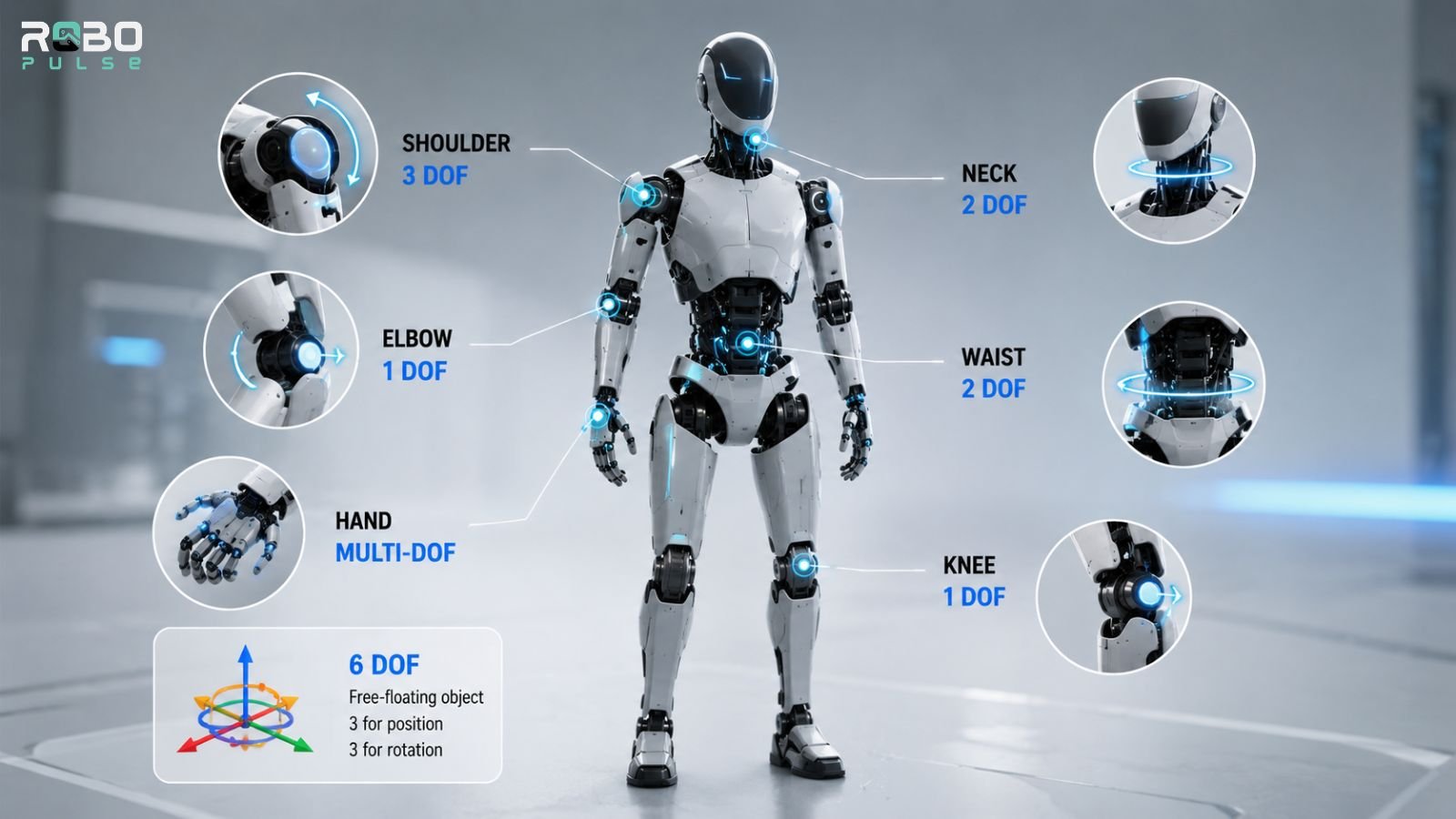
DOF is the total count of independent joint motions across a robot’s whole body — legs, arms, waist, neck, hands.
Each degree of freedom is one axis a single joint can move along:
- An elbow that only bends has 1 DOF.
- A shoulder that bends, rotates, and swings out has 3 DOF.
- A free-floating object already has 6 DOF on its own — three for position, three for rotation.
Most humanoid robots land somewhere between 20 and 45 total DOF. Where those axes sit matters more than the total.
How Is DOF Calculated in a Humanoid Robot?
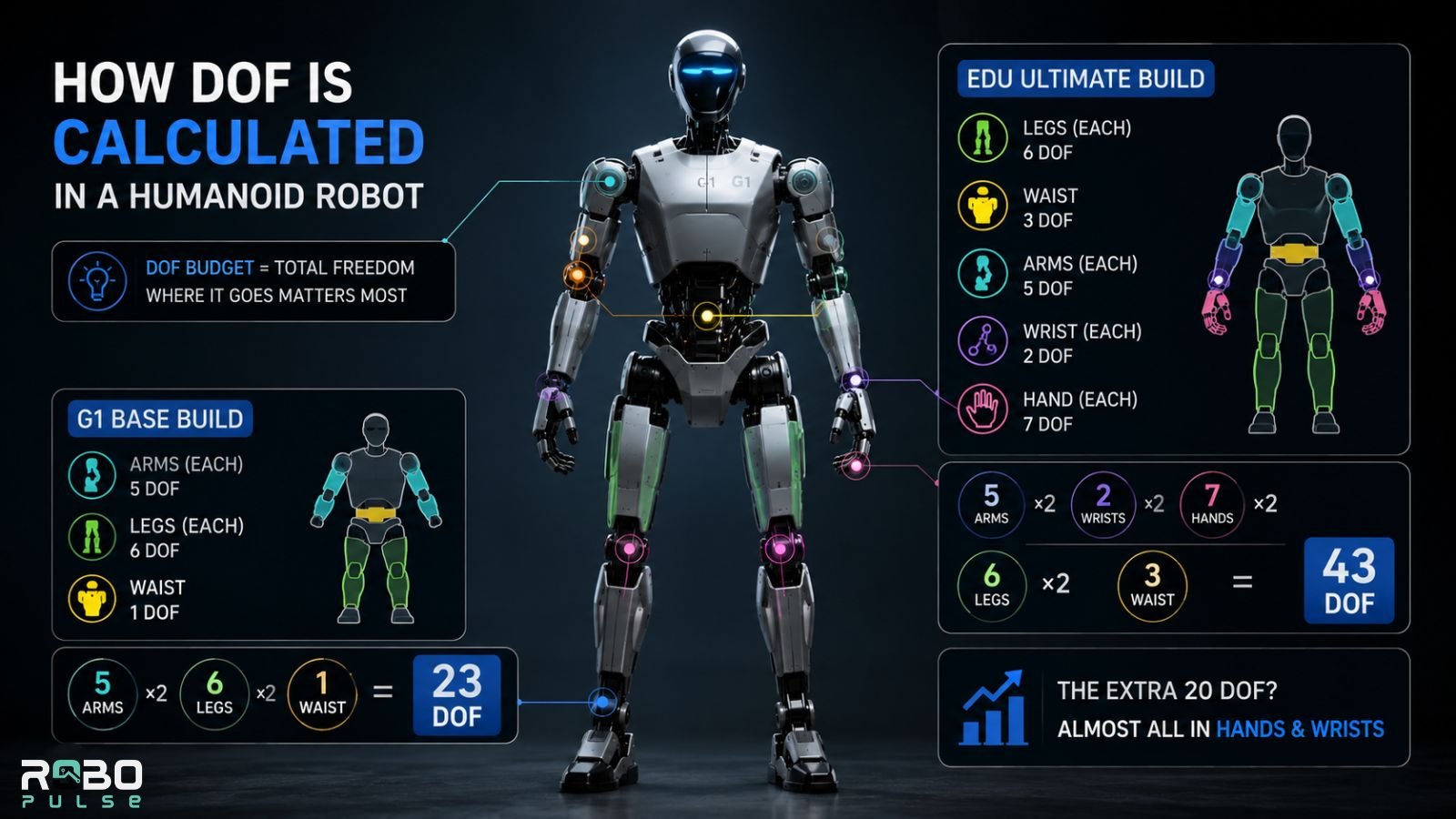
Think of a robot’s DOF budget like a company’s headcount. The total tells you less than which department got the hires.
Unitree’s G1 shows this clearly:
- Each arm: 5 DOF (shoulder, upper arm, elbow)
- Each leg: 6 DOF (hip, leg, knee, ankle)
- Waist: 1 DOF
Add it up — two arms, two legs, one waist — and you get 23 DOF, the base G1 spec.
Push into the higher-end EDU Ultimate build and the number jumps:
- Each leg: still 6 DOF
- Waist: gains 2 more axes, for 3 DOF total
- Each arm: gains a 2-axis wrist plus a 7-DOF dexterous hand
Total: roughly 43 DOF. Notice where the extra 20 went — almost entirely into hands and wrists. That’s the pattern across the whole industry.
Why Hands Eat Up So Much DOF
Fingers need to curl, splay, and oppose the thumb almost independently. That’s mechanically expensive.
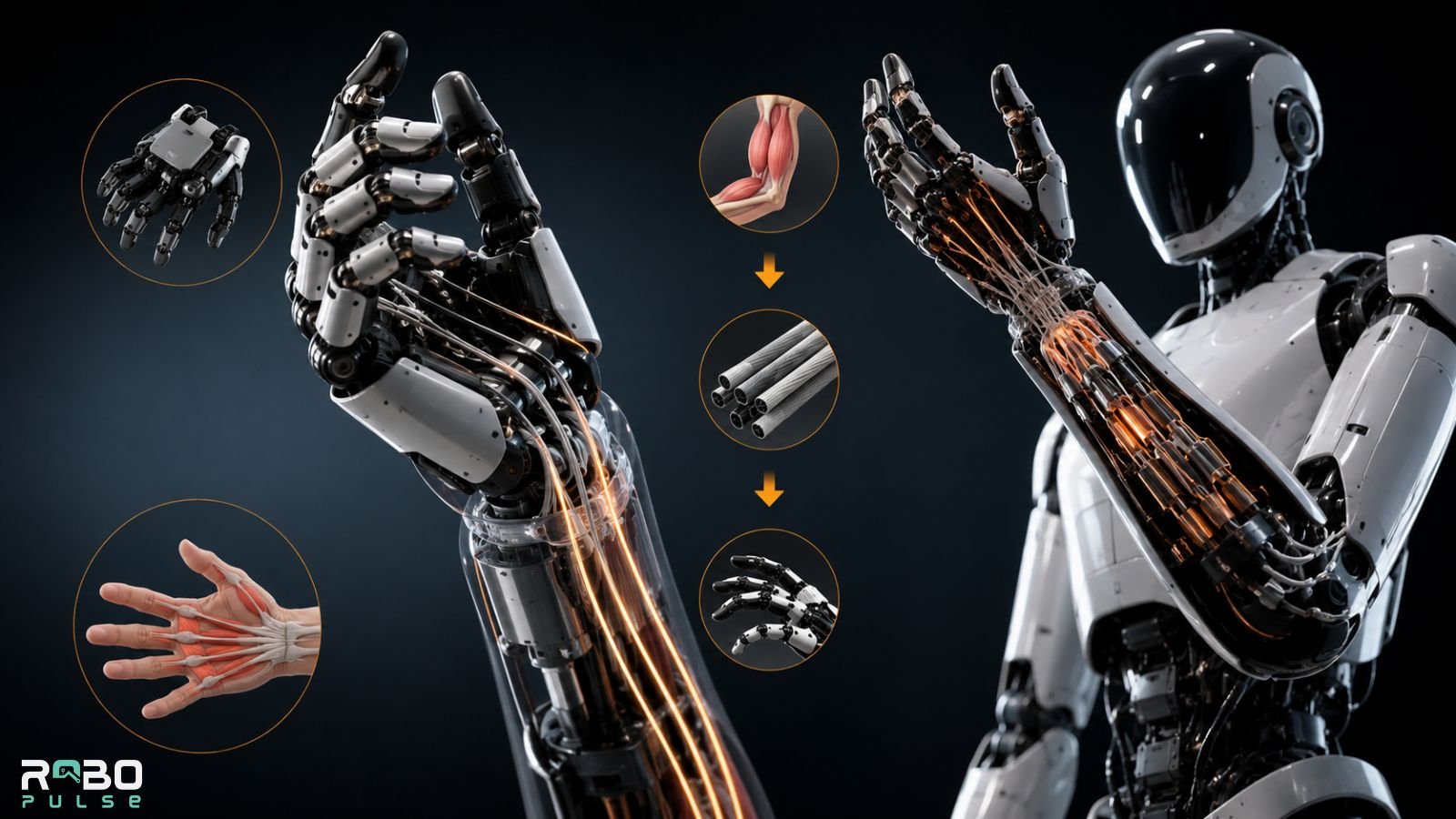
- A single Unitree Dex3-1 hand: 7 DOF on its own.
- Unitree’s Inspire-made alternative: 6 DOF across a 12-joint design, in one hand.
- Multiply either by two hands, and you can see why a “43 DOF” headline is really a story about manipulation, not walking.
Tesla’s newest hand design pushes this further. Optimus engineer Milan Kovac says the Gen 3 hand and forearm doubles dexterity over the previous generation:
- 22 DOF on the hand
- 3 DOF on the wrist
- Up from just 11 DOF on the earlier hand
The trick isn’t more motors crammed into the hand. It’s moving them out of it.
Tesla’s patents describe a tendon-driven system: actuators sit in the forearm, cables pull the fingers. Same basic wiring as your own hand — forearm muscle does the work, tendons carry it down to the fingertips.
Why it matters: stuff 22 DOF worth of motors into a hand-sized shell, and you get something heavy, hot, and slow. Move the motors upstream, and the hand stays light and fast while still hitting a high DOF count.
Robot Hands vs. Human Hands
The human body carries over 200 skeletal degrees of freedom in total. Only about 80 are used in everyday whole-body motion. The hand alone contributes more than 20.
No commercial humanoid gets close to that. It isn’t trying to. Engineers aren’t chasing a 1:1 match with human anatomy — they’re chasing just enough DOF, in exactly the right joints, to do a specific job.
How Many DOF Does a Humanoid Robot Need?
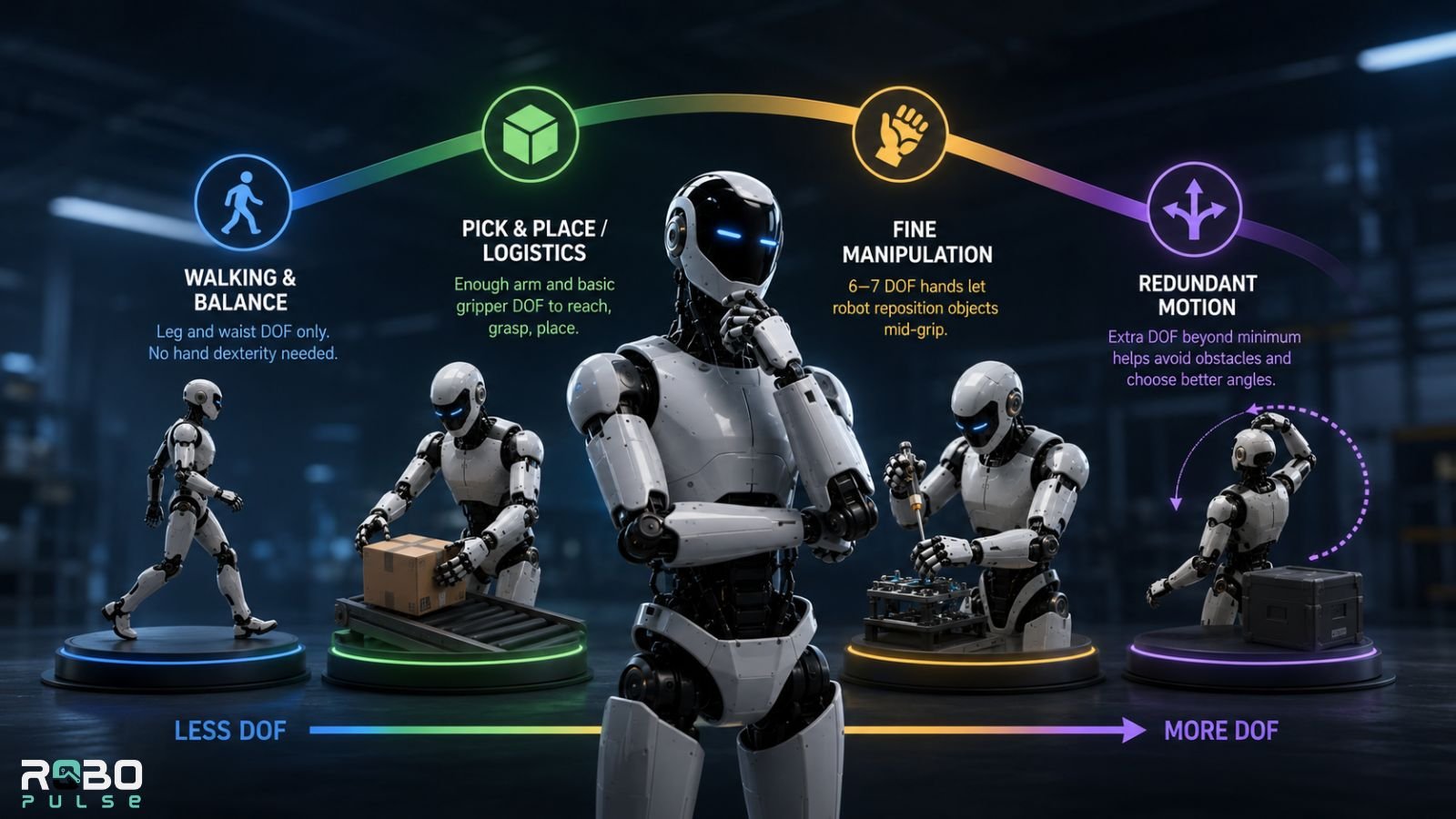
Depends entirely on the job. Standard Bots’ engineering guide puts the typical baseline at 30+ DOF: roughly 6 per arm, 5–6 per leg, and the rest spread across torso and neck.
From there, it scales with the task:
- Walking and balance only — leg and waist DOF alone. No hand dexterity needed.
- Pick-and-place / logistics — enough arm and basic gripper DOF to reach, grasp, place. Fine finger control not required.
- Fine manipulation — assembly, cooking, tool use. This is where 6–7 DOF hands earn their keep, letting a robot reposition an object mid-grip instead of just clamping it.
- Redundant motion — extra DOF beyond the geometric minimum. A 7th DOF in an arm lets it dodge an obstacle or avoid an awkward angle, the way your own elbow shifts without moving your hand at all.
What High DOF Actually Costs
A DOF number is really the output of two harder problems: the math that controls it, and the hardware that moves it.
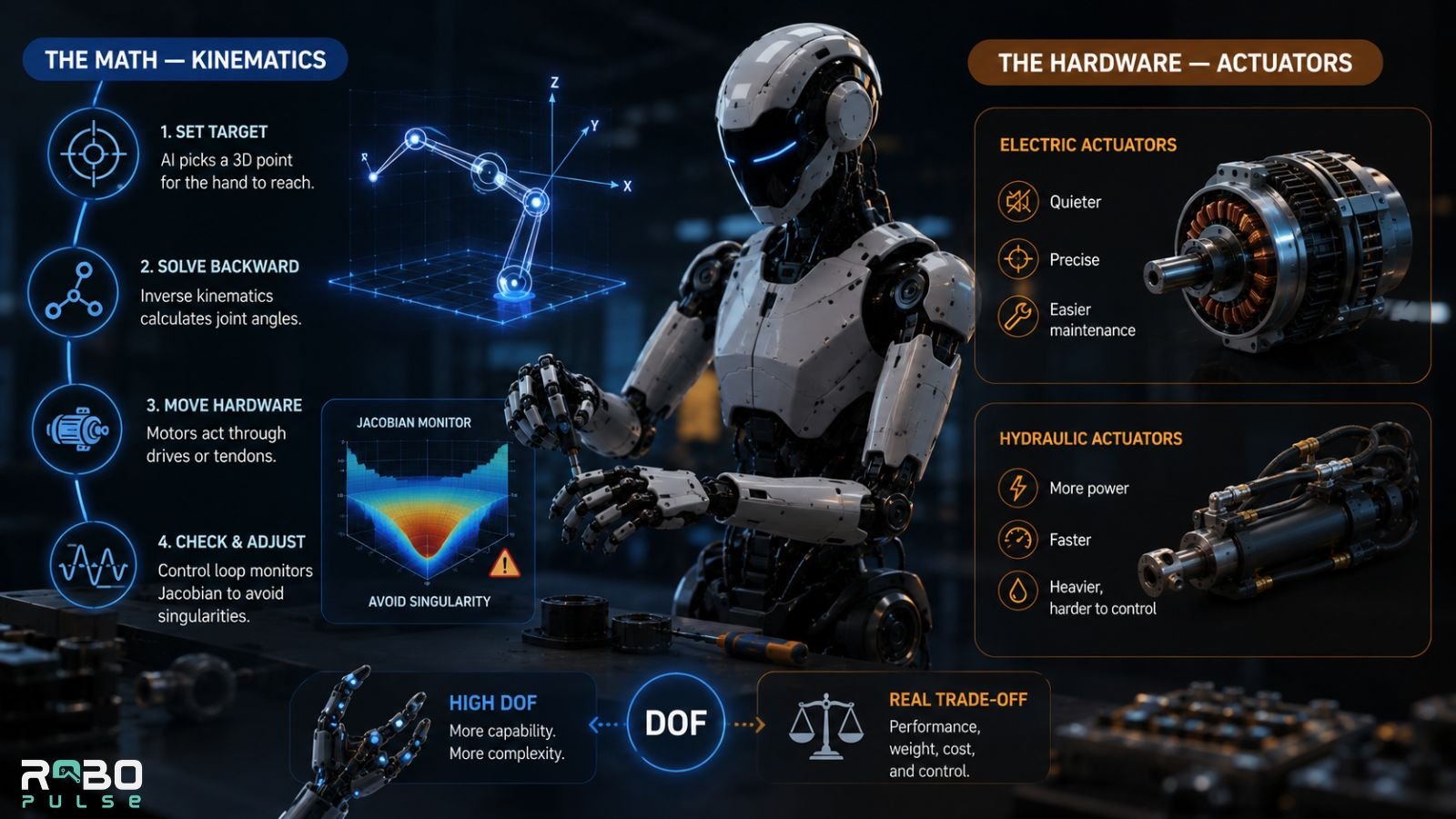
The math — kinematics:
- Set the target. The robot’s AI model (Figure’s Helix, Tesla’s FSD-derived stack) picks a 3D point for the hand to reach.
- Solve backward. Onboard compute runs inverse kinematics — working from the target back through every joint to calculate the angles needed.
- Move the hardware. Torque motors fire, spinning harmonic drives or pulling tendons.
- Check for trouble. The control loop watches the Jacobian matrix — the math that maps joint speed to hand speed. If its determinant heads toward zero, two joint axes are lining up into a kinematic singularity, and the path gets recalculated before it causes a velocity spike.
Forward kinematics (angles → position) is basic geometry. Inverse kinematics (position → angles) gets exponentially harder as DOF climbs — which is why high-DOF hands lean on AI-trained control loops instead of classical code alone.
The hardware — actuators:
- Electric actuators (frameless torque motors + harmonic drives): quieter, more precise, easier to maintain. Unitree and Tesla both use this setup.
- Hydraulic actuators: more raw power, faster explosive movement — why the old Boston Dynamics Atlas could backflip years before electric humanoids could. But heavier, leak-prone, harder to control precisely.
- Boston Dynamics’ 2024 move to a fully electric Atlas mirrors where the whole field has landed: electric wins for fine manipulation, not raw athletic power. That shift matters more once a robot leaves the demo stage and heads into genuinely risky industrial work, where precision and repeatability count for more than a single flashy movement.
DOF isn’t just a lab spec, either. On real factory floors, hand DOF translates directly into what a robot can physically pick up and how fast — the difference between flipping identical totes and handling irregular, non-rigid parts on an assembly line without dropping or crushing them.
One more distinction: not every joint gets its own motor. A hand can flex 22 joints on fewer than 22 actuators if some joints are under-actuated — coupled by springs or shared tendons, so one motor drives two or three knuckles. Fully actuated hands give every joint its own motor: more precise, but heavier, pricier, and harder to keep cool. This is the real trade-off behind a lot of hand designs: a 22-joint hand running on 12 active motors saves real weight in the forearm, at the cost of moving each knuckle independently.
Active vs. passive DOF
- Active DOF — powered directly by its own actuator. This is what most spec sheets count.
- Passive DOF — moves freely without a motor, often via a spring or mechanical linkage. These absorb impact and add compliance, especially in feet and ankles, but they don’t show up in a headline DOF number even though they’re doing real mechanical work.
Joint space vs. task space matters here too. A robot’s raw joint angles (θ₁, θ₂, θ₃…) are its joint space — the actual motor positions. Where the hand ends up in the room — X, Y, Z plus orientation — is task space. Inverse kinematics is the translation step between the two: task space in, joint space out.
For anyone who wants the actual math behind a DOF count, mechanism designers use the Grübler-Kutzbach formula:
DOF = 6(N − 1) − Σcᵢ
N is the number of rigid links in the mechanism, and each cᵢ is the constraint imposed by one joint. It’s the formal version of what the G1 breakdown above does by hand — count the links, subtract what each joint locks down, and what’s left is your DOF.
DOF Comparison Table (2026)
| Platform | Total Body DOF | Hand DOF | Confidence |
|---|---|---|---|
| Unitree G1 (base) | 23 | 0 (fixed gripper) | High |
| Unitree G1 EDU Ultimate | Up to 43 | 7 per hand | High |
| Tesla Optimus Gen 2 | 28 | 11 per hand | Moderate |
| Tesla Optimus Gen 3 hands | 28 (body unchanged) | 22 per hand + 3 wrist | High |
| Figure 03 | Disputed (see below) | Disputed | Low |
| Human hand/arm, for scale | — | ~27 per hand | Reference only |
Figure 03: What We Actually Know
Public numbers for Figure 03’s DOF don’t agree. You’ll see 44 total DOF with 16 per hand, 30 total with 20 in the hands, or 35 DOF across the upper body alone — depending which site you land on.
None of it comes from Figure AI directly. Their own site — launch page, company page, news archive — publishes no DOF figure at all.
That inconsistency might be a signal, not just sloppy reporting. As hands go tendon-driven and software-coordinated, the line between a “physical” DOF and a “virtual” one blurs. A control system can treat two tendon-coupled joints as one commanded axis, even though the hardware has two.
RoboPulse Take
Treat a DOF spec like horsepower on a car listing: it tells you the ceiling, not the driving experience.
When you’re comparing two humanoid robots, don’t stop at the total. Ask where the DOF lives.
- 43 DOF from two fully articulated hands → manipulation-first machine.
- 23 DOF with no hand articulation → built for locomotion and demos.
Neither wins on its own. It comes down to whether you need the robot to walk, wave, or actually pick something up and set it down without dropping it.
If you want to check where a specific robot’s DOF actually sits, RoboPulse’s compare tool breaks it down side by side, pulled from the full robot database.