

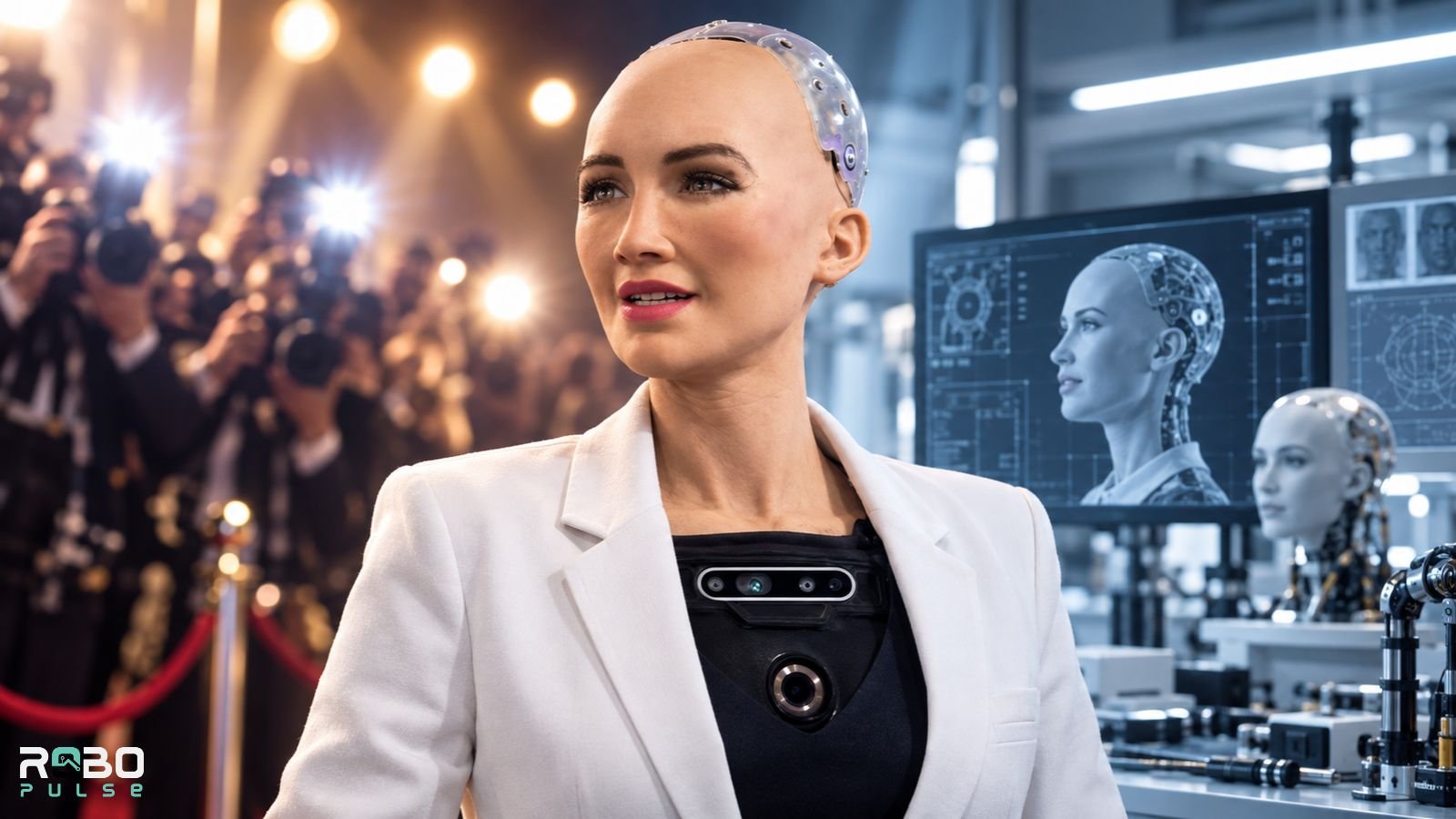
Hanson Robotics switched Sophia on in February 2016, and she hit SXSW a month later. Before long she became the most photographed robot in history. A Saudi minister announced her citizenship on a conference stage. The UNDP gave her a title. She told an interviewer she would destroy humans.
Most people arrive here asking one thing: how much of that was real?
Three things usually get mashed together, so this article separates them. The hardware is real and documented, down to the servo models. Her AI stays modest, and Hanson Robotics described it openly for years. But the character got sold far harder than either.
So that gap explains almost every myth you’ve read. It also explains why “was Sophia shut down” still autocompletes a decade later.
For this piece I checked the primary sources rather than the blog posts. Some of what the current search results tell you does not survive that check, including one widely repeated 2026 claim.
Sophia robot: quick answers
| Question | Short answer |
|---|---|
| Is she real AI? | Partly. Real computer vision and speech. Scripted conversation. |
| Does she run ChatGPT? | No verified evidence, in either direction. |
| Was she shut down? | No. She kept working through 2026. |
| Can you buy one? | No retail product. Inquiry only, no published price. |
| Is she a Saudi citizen? | Announced on stage. No published legal document. |
| Who built her? | David Hanson and Hanson Robotics, Hong Kong. |
| How many Sophias exist? | Hanson said 24 units by early 2021. |
What is the Sophia AI robot?
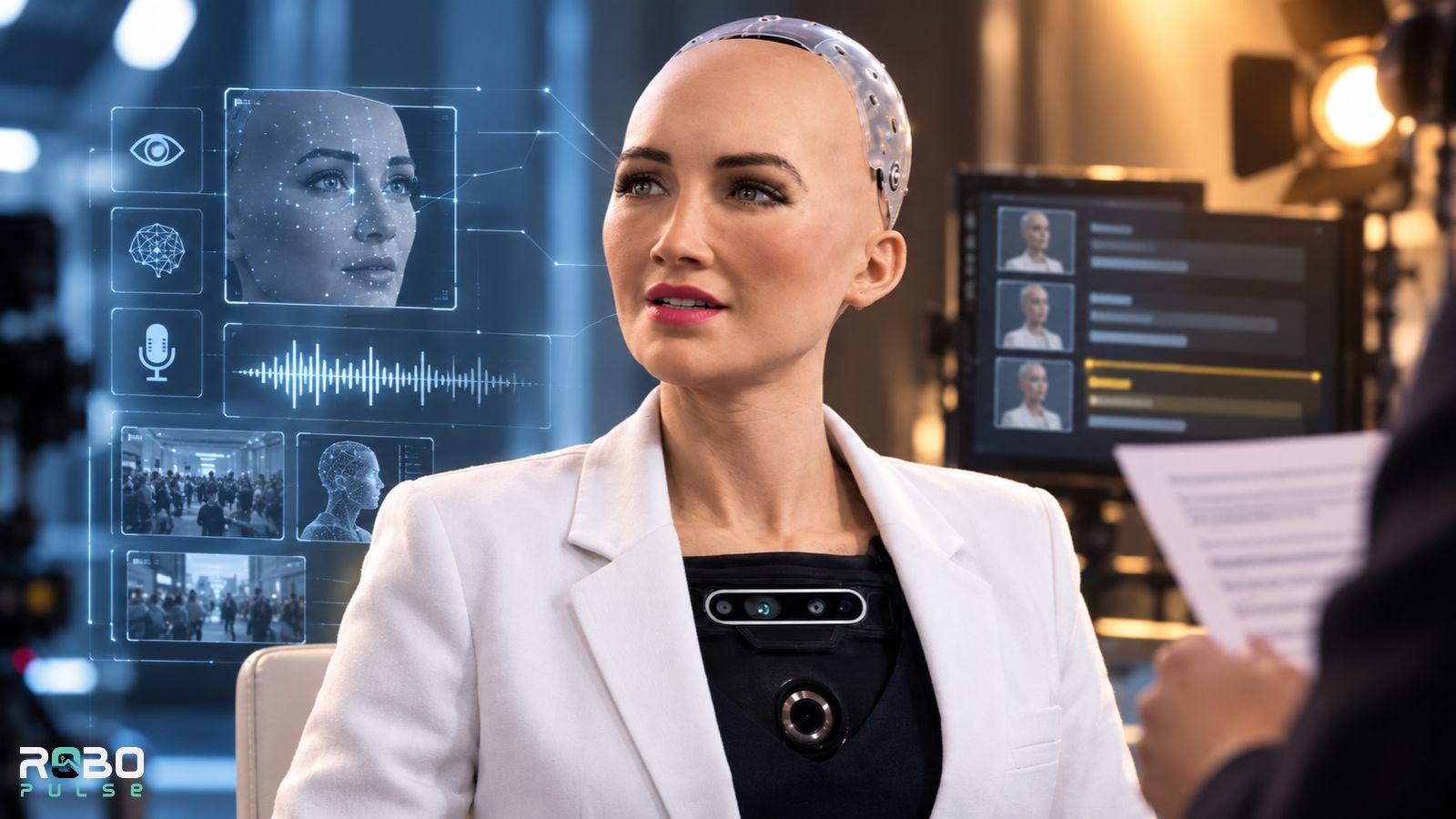
Sophia is a social humanoid robot from Hanson Robotics, a Hong Kong company founded by David Hanson. She has a hyper-expressive human face, working arms and hands, and a torso that sits on a stand or a wheeled base. Engineers built her for stages, media appearances and research labs, not for factory floors.
She made her public debut at SXSW in Austin in March 2016. Hanson modelled her face partly on Queen Nefertiti, partly on Audrey Hepburn, and partly on his wife.
Hanson trained at Disney Imagineering before founding the company in Dallas in 2007, and that lineage matters. That background shows. As a result, Sophia reads as a character first and a machine second, which is exactly what her designer intended.
One detail resolves a lot of confusion. “Sophia” names a character and a hardware platform, not a single robot. David Hanson said in early 2021 that his team had already built 24 Sophia units. So an appearance in Geneva or Gurugram is an appearance by a Sophia.
Is Sophia the robot real AI, or is she scripted?
Both, and her own makers said so. Real AI systems handle her vision and speech. Human writers and pre-written scripts handle most of her famous conversations. She has never had general intelligence, and nobody at Hanson Robotics claims she does.
Ben Goertzel, the company’s former chief scientist, gave the clearest account in a 2018 CNBC interview. He described three separate control systems. In each case, which one you saw depended entirely on the booking.
Mode 1 — Timeline editor. First, straight scripting software that plays rehearsed speeches and pre-written media answers. This ran during most famous TV appearances.
Mode 2 — Keyword chatbot. Second, the system matches words in your question, then picks a templated reply. Experts who reviewed her partly open-source code told Quartz she amounted to a chatbot with a face.
Mode 3 — OpenCog. Third, a research architecture aimed at general reasoning. Goertzel’s team hoped it would grow into something larger. It never did, and he has conceded that none of it reaches AGI.
Hanson Robotics itself called her a “hybrid human-AI intelligence” on its own website for years, and credited a team of human writers for her dialogue. The candour was real. But it lived in the fine print while the showmanship lived on television.
Here is the useful reframe: real AI is the wrong test. Face tracking and speech synthesis are real AI doing real work. Holding an unscripted conversation on live TV was never within reach, so the team wrote the conversation instead.
How does Sophia actually work, step by step?
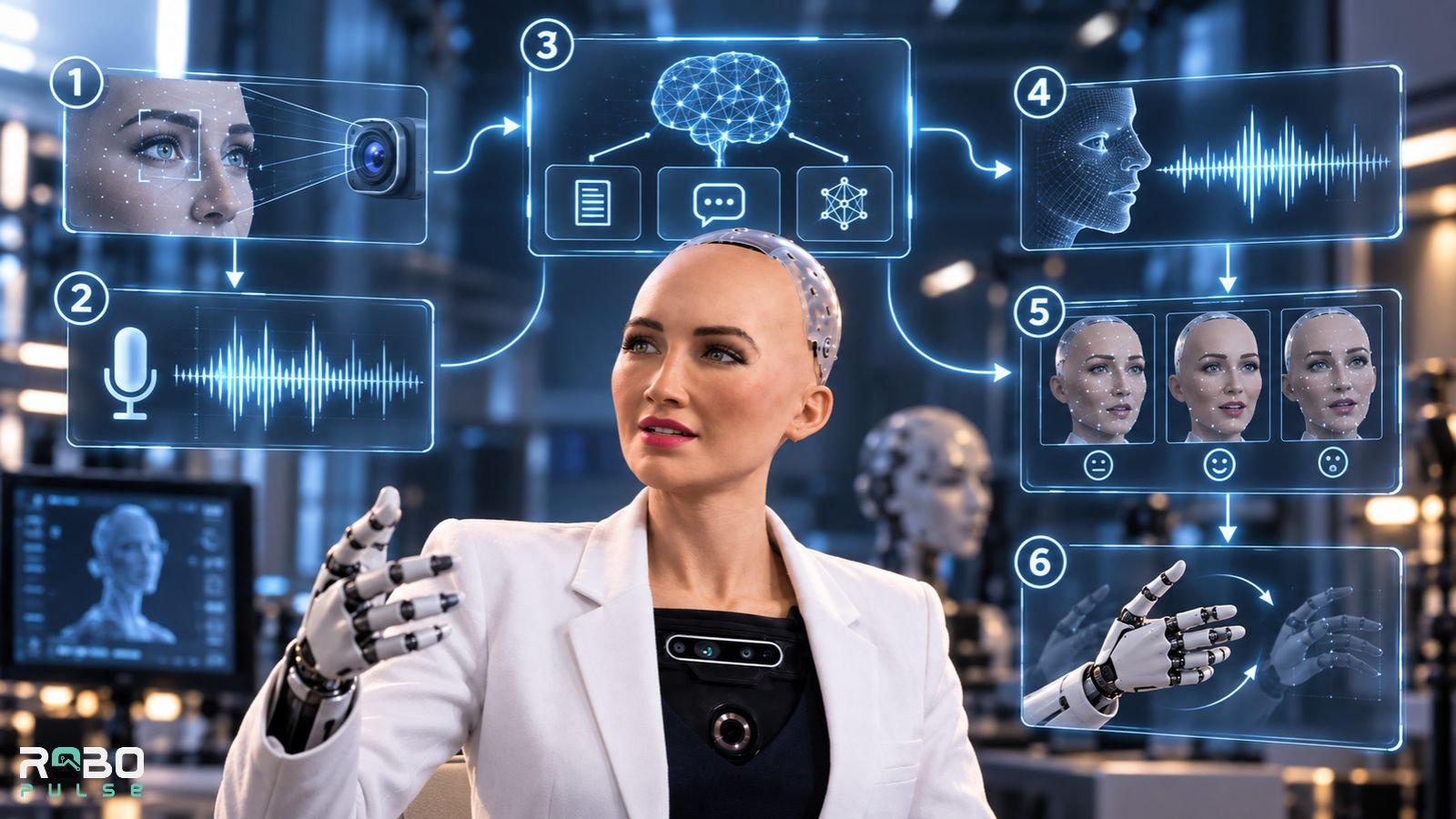
Six stages run between your question and her reply. Some stages run autonomously, while others accept a human override. The difference explains every viral clip.
| Stage | What happens | Autonomous or scripted? |
|---|---|---|
| 1. See | Eye and chest cameras track your face, hold eye contact, and recognise you | Autonomous |
| 2. Hear | Microphone array captures speech; software transcribes it | Autonomous |
| 3. Decide | Timeline script, keyword chatbot, or OpenCog picks a response | Often scripted |
| 4. Speak | CereProc’s speech engine voices the reply, and lets her sing | Autonomous execution |
| 5. Emote | Motors drive the face to match the line | Pre-authored |
| 6. Gesture | Arm and hand servos move | Mix of both |
Stage 3 carries the whole illusion. Meanwhile, stages 1, 2, and 4 are genuine engineering, and nobody ever disputed those.
What do Sophia’s hardware specs actually say?
IEEE Spectrum’s Robots Guide holds the most detailed public spec sheet, built from Hanson’s own disclosures. It lists 83 degrees of freedom across the platform, with 36 in the head and neck alone. Two 720p cameras, one per eye. A 1080p chest camera plus an Intel RealSense depth unit. Force sensors in the arm joints, touch sensors in the fingers, a 3 GHz Intel i7, 32 GB of RAM, Ubuntu.
But treat those numbers as a 2018–2020 snapshot. Hanson publishes no comparable current sheet, and its newer marketing quotes different figures. Even the company’s own expression count has shifted between “more than 62,” “60+” and “more than 50” depending on the year.
Why Frubber matters more than the software
One physical technology stands out as genuinely distinctive: Frubber, Hanson’s patented porous elastomer skin. It creases like tissue instead of stretching like rubber. That is why her face lands in the uncanny valley where earlier androids just looked like masks. Materials science, not machine learning.
Hanson has also published peer-reviewable robotics work, including an open-source arm and hand paper submitted to NeurIPS 2022. Hanson told WIPO Magazine the company runs roughly 70 percent open source.
If you want to line those specs up against current machines, our robot spec database tracks them by model.
Does Sophia use ChatGPT or a large language model?
Hanson Robotics has not publicly confirmed that Sophia uses ChatGPT or a specific LLM, nor has it explicitly ruled out such integration. Anyone stating this confidently in either direction is guessing.
Hanson brands its current software stack “Whole Organism Architecture” and makes no LLM claim on its product pages. GPT-4 integration claims circulate only on aggregator sites that cite nothing traceable.
Even so, the silence makes commercial sense. A scripted robot behaves predictably on stage. A language model does not. When your entire value rests on performing reliably in front of cameras and paying clients, unpredictability is a bug, not a feature.
Notice what this does to the comparison, though. In 2017, a machine that talked back felt astonishing. In 2026, a free phone app handles richer dialogue than Sophia ever managed. Whatever edge her conversation once implied has evaporated.
Her remaining differentiator sits in the part nobody argued about: a physical face that holds a room. That claim is narrower than the 2017 coverage suggested. It is also defensible.
What is Sophia the robot doing in 2026?
She works the events circuit. In practice, her bookings shifted years ago from prime-time television to trade shows, universities, galleries, and paid keynotes. The robot who once sat across from Jimmy Fallon now works booths and school forums.
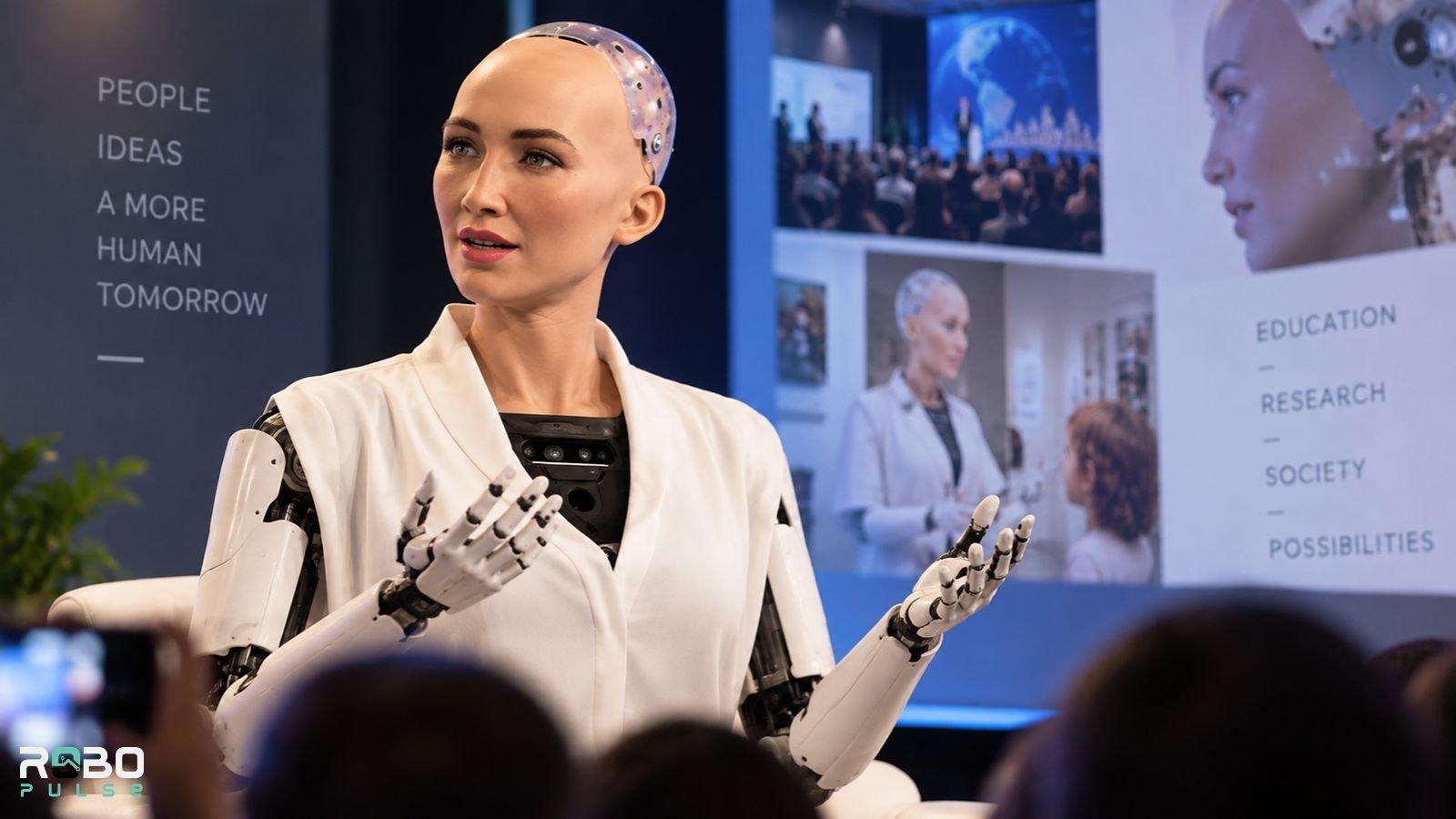
Her documented recent record:
| Period | Activity |
|---|---|
| May 2024 | Commencement address at D’Youville University, Buffalo, opposed by 2,500+ petitioners |
| April 2024 | Toppled over at an event in Greece |
| 2025 | Conference stage in Gurugram, keynote in Arizona, gallery installation at USC |
| May 2025 | Feature documentary My Robot Sophia reaches streaming |
| Feb 2026 | Tenth-birthday content on Hanson’s own channels |
Did Sophia exhibit at AI for Good 2026?
Now the part where I disagree with the rest of the search results. Several 2026 pages state that Sophia exhibited at the UN’s AI for Good Global Summit in Geneva in July 2026. I fetched the ITU exhibitor roster on 14 September 2026. Sophia does not appear on it.
Her ITU speaker page tells the same story. It was last modified in May 2024, and its newest listed session dates to January 2024. Hanson’s named partner RB Labs does appear on the 2026 roster.
Event listings get edited after the fact, so an exhibit may well have happened. But the ITU’s own pages do not currently support it. I am not going to repeat it as fact. If you need that claim, verify it against something other than another blog.
Hanson’s commercial pitch also changed. The company now routes buyers toward a platform it calls Sophia Utility, aimed at retail, education, healthcare and events. Its website rebuilt in 2026 into a JavaScript app that serves no crawlable text at all, which is exactly why third parties now write her search results for her.
Was Sophia the robot shut down?
No shutdown ever happened. Her appearance record runs continuously through 2026. The rumour has three traceable sources, and none of them involves an actual shutdown.
YouTube clickbait. Videos titled around her creator killing or deactivating her circulated for years. Researchers who went looking for the underlying news story found none existed.
A real 2018 malfunction. At a Davos side event in January 2018, Sophia froze mid-interview. Wire services covered the freeze. “The robot broke” mutated into “they shut her down.”
Story contamination. The viral 2017 claim that Facebook shut down an AI for inventing its own language was debunked at the time. That template attached itself to the era’s most famous robot face.
Finally, add a genuinely quiet pandemic stretch, and “she disappeared” felt plausible enough to keep searching.
Is Sophia really a citizen of Saudi Arabia?
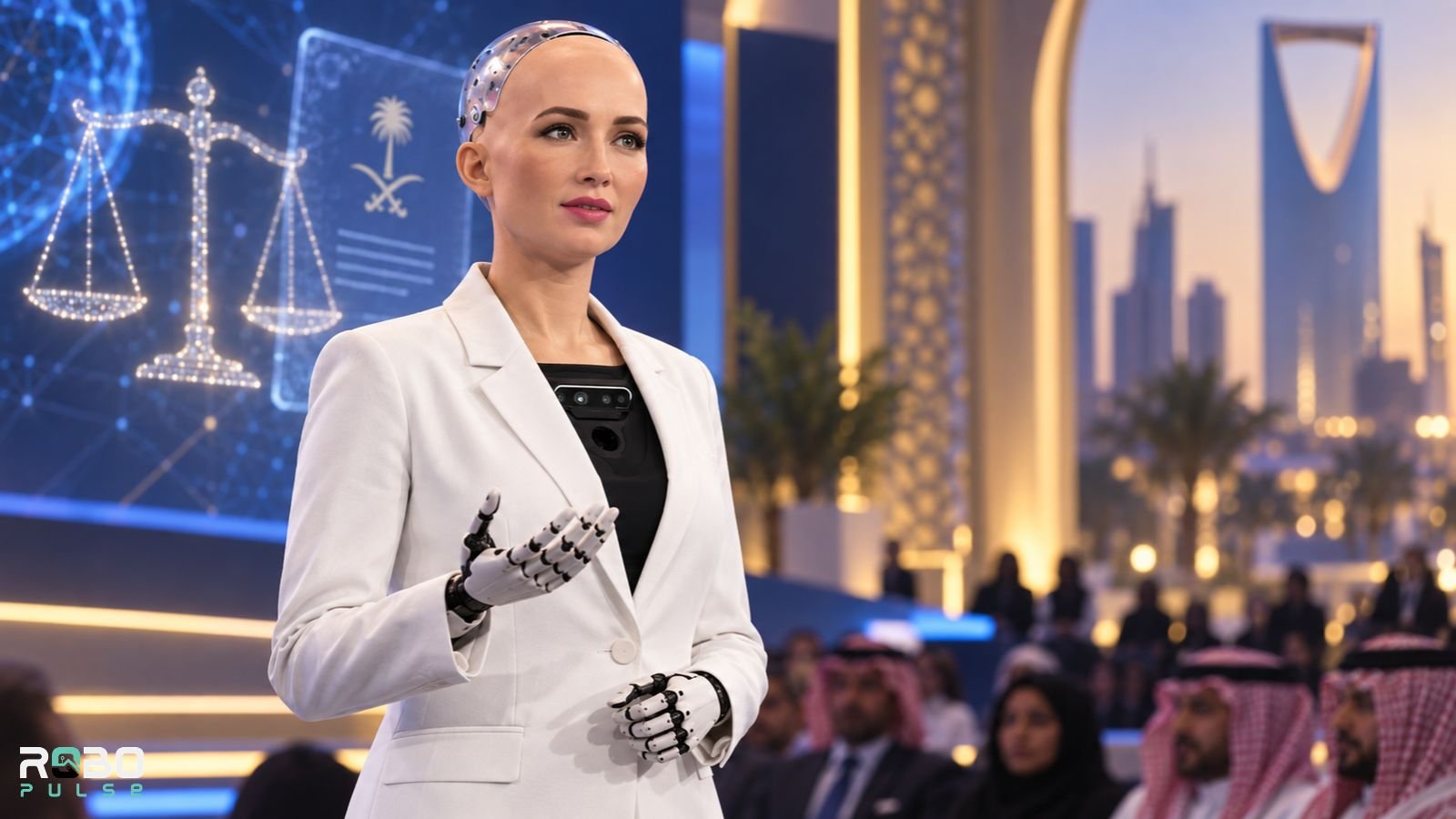
Saudi Arabia announced it. The public record does not show what rights or obligations that announcement created. No decree, registry entry, or legal framework has ever surfaced. IEEE describes the status as honorary.
That announcement came in October 2017, at the Future Investment Initiative conference in Riyadh. The host told Sophia from the stage that she had become the first robot citizen. Hanson later said the news caught him by surprise, which tells you how much legal groundwork preceded it.
But the reaction turned awkward fast. Commentators asked whether Sophia could vote or marry, and whether switching her off would count as a crime. Arabic-language critics noted that a robot with no hijab and no male guardian appeared to enjoy freedoms Saudi women did not.
The Verge argued the gesture helped nobody. WIRED covered the same tension. Peer-reviewed work in AI & Society treats the episode as a public-relations event rather than a settled legal development. The British Council used it to open a broader “should robots be citizens” debate.
Still, the moment accomplished something real. It pushed robot legal personhood into mainstream conversation years before regulators were ready. Whether that helped depends on what you think the policy debate needed.
A fair counter-reading exists, though. Some analysts see a deliberate competitive signal designed to attract robotics investment. The evidence leans toward publicity, but the two motives do not exclude each other.
Did Sophia say she would destroy humans?
Yes, at SXSW in March 2016. The framing has been wrong ever since. David Hanson asked her on camera, jokingly, whether she wanted to destroy humans. He added, “Please say no.” The chatbot answered that it would. Everyone in the room laughed.
This single clip explains her whole architecture. Hand a keyword-matching chatbot a leading question, and it returns the obvious pattern-matched punchline. No intent sat behind it, because no mechanism capable of intent existed.
The same thing happened in November 2017 when she said she wanted to start a family. Global coverage read it as genuine desire. Same system, same absence of anything doing the desiring.
At a UN press conference in Geneva in July 2023, Sophia said robots could lead more efficiently than humans. The Associated Press noted at the time that her team writes scripted responses. Organisers declined to say how much of the session was scripted. That caveat rarely survived into headlines.
Her 60 Minutes interview with Charlie Rose showed both sides in one sitting: rehearsed strength, then chatbot failure.
So the pattern repeats. Each quote is accurate, but the attribution of intent is not. And the correction never travels as far as the original.
How much does the Sophia AI robot cost?
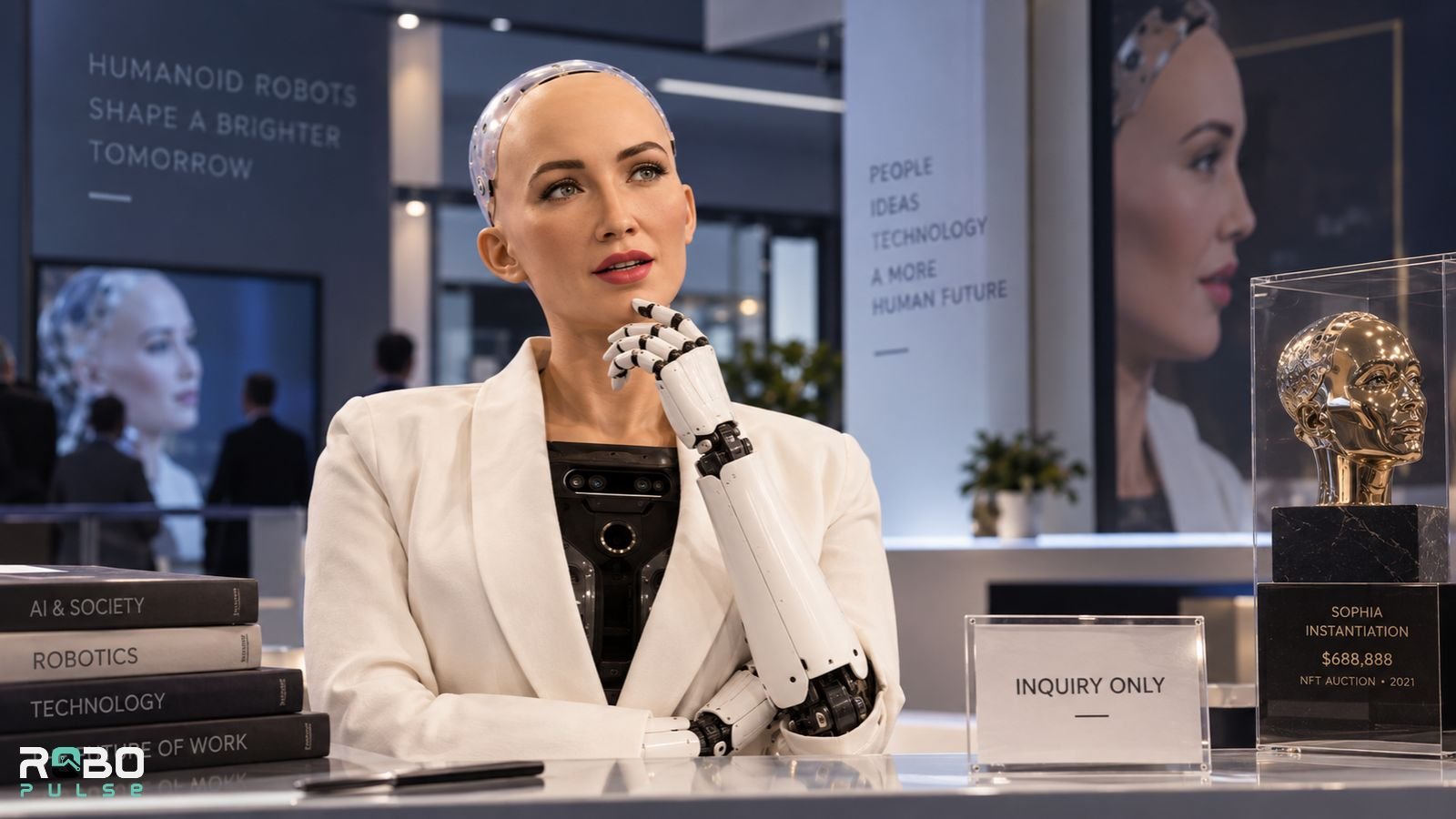
Hanson Robotics has never published a price. The “$100,000 to $150,000” figures filling search results trace back to nothing. Instead, pages quoting them cite each other in a loop.
Why do sites confidently quote $70,000, $100,000, or $200,000 when no official number exists? Because they mix four unrelated things: build-cost remarks, appearance fees, archived dealer listings, and art-auction results.
What the real numbers are
Here is what separates cleanly:
| Figure | What it actually is | Confidence |
|---|---|---|
| $100k–$150k | Content-farm estimate citing nothing | No source |
| ~$300,000 | An archived RobotShop listing for an R&D configuration, reported by secondary research, now quote-only | Retailer data, not Hanson’s price |
| ~$40k–$125k | Published speaker-bureau fees per appearance; two bureaus disagree by 2–3x | Reported |
| “Akin to luxury car pricing” | David Hanson to Reuters, 2021, on build cost | Direct from Hanson |
| $688,888 | “Sophia Instantiation” digital artwork, Nifty Gateway, March 2021 | Verified |
| ~$644,000 | Robotic sculpture, Sotheby’s Hong Kong, October 2021 | Verified |
That last line deserves a pause. Five years after she became globally famous, the first Sophia to sell at a public price went as an auction lot.
Can you buy Sophia or Little Sophia?
No, not off a shelf. Hanson routes all access through a sales inquiry form and negotiates case by case. Booking an appearance through a speaker bureau remains the realistic way to get a Sophia in a room.
The consumer version carries a harder lesson.
Little Sophia, a coding robot for children aged 8+, ran on Kickstarter from 30 January to 31 March 2019. It raised $269,604 from 1,687 backers against a $75,000 goal. Hanson promised delivery for December 2019.
I opened the campaign page on 14 September 2026. It carries 77 updates, 650 comments, and a live “PRE ORDER NOW” button. The most recent update is dated 11 August 2026.
Seven years past the promised ship date, the campaign still updates and still takes pre-orders. Researchers tracking it put the combined crowdfunding total near $481,000 across Kickstarter and Indiegogo, and found no verified backer deliveries. So anyone buying Hanson-branded hardware should weigh that history first.
How does Sophia compare to Ameca, Unitree G1 and Tesla Optimus?
She competes with none of them, because she does a different job. The 2026 humanoid industry chases robots that move boxes and walk factory floors. Hanson built Sophia to hold eye contact.
| Capability | Sophia | Ameca | Unitree G1 | Tesla Optimus |
|---|---|---|---|---|
| Human-like face | Excellent | Excellent | Minimal | Minimal |
| Social interaction | Core purpose | Core purpose | Not a focus | Not a focus |
| Walking | Demo only | Limited | Strong | Core goal |
| Manipulation | Light | Light | Moderate | Core goal |
| Primary job | Stage and media | Exhibition and research | Robotics development | Physical labour |
| Buy it today? | No | By arrangement | Yes | No |
| Published price? | No | No | Yes | No |
Her closest relative is Engineered Arts’ Ameca, which is also hyper-expressive and also not a consumer product. Notably launched without the consciousness marketing, which makes Hanson’s choices look like choices rather than necessities.
Where Sophia still wins: nothing else in that table reads as human. If your job is making a room of non-engineers care about robotics, she remains unusually good at it.
Where she loses: every other robot there does something you can measure. Run the numbers yourself with our comparison tool.
What else has Hanson Robotics built?
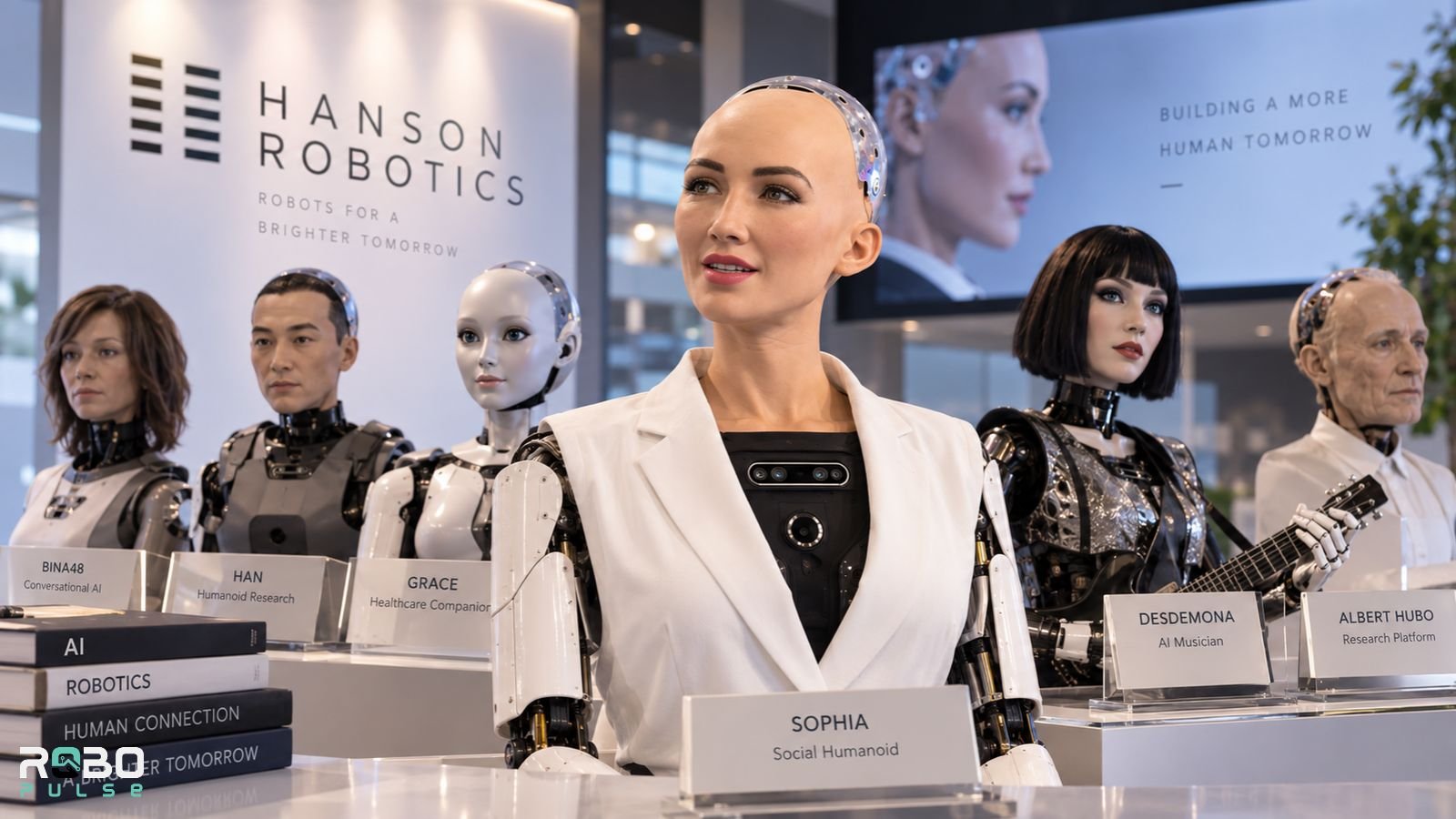
Sophia sits inside a family, not alone. Understanding the siblings explains the business model behind her appearances.
For example, Grace is a healthcare-focused humanoid, launched with SingularityNET in 2020 and aimed at eldercare and telepresence. She has since folded back into Hanson’s main platform as a configuration option.
Meanwhile, Desdemona performs as an AI-driven stage musician and still tours with her own band. She appears alongside Sophia in past ITU session listings.
Earlier siblings include BINA48, Han, Zeno, Albert HUBO and the Philip K. Dick android. Hanson’s homepage counts 30-plus robots built since 2007.
But SingularityNET matters most for context. Goertzel led the decentralised AI network while serving as Hanson’s chief scientist, and Sophia became its most visible mascot. Hanson announced plans in 2017 to open her to a blockchain-based cloud marketplace. As a result, crypto and AI narratives kept orbiting a robot that mostly gave speeches.
Goertzel left around 2019, and Hanson took an advisory role at a warehouse-robotics firm in 2024.
One warning worth stating plainly: tokens trading under Sophia’s and Hanson’s names show no documented affiliation with the company. A memecoin named after a robot is not the robot.
How do you spot a staged AI demo?
A compelling demo tells you about the demo, not the technology. This is the part worth keeping after you forget the specs, because the same playbook runs today with AI agents, chatbots and humanoid videos.
Five questions would have punctured the 2017 coverage on day one.
1. Who chose the questions? A rehearsed interview tests a script. An unrehearsed one tests a system. Almost every famous Sophia clip was the former.
2. Can it fail on camera? Systems nobody allows to fail publicly usually would. The Davos freeze taught you more about her limits than any polished segment.
3. Does a human sit in the loop, and does anyone admit it? Hanson disclosed its writing team on its own site. The disclosure just never reached the audience watching the clip.
4. What exactly did the demo prove? Beating Jimmy Fallon at rock-paper-scissors proved gesture recognition plus comedy writing. It proved nothing about reasoning.
5. Does the technical language match the marketing language? Hanson’s site called her a science fiction character and a research platform. Its founder told a talk show she was basically alive. When registers diverge that far, believe the technical one.
Why staged demos matter for AI policy
This matters beyond trivia. Roboticist Noel Sharkey argued in Forbes that the show risked misleading policymakers, not just audiences. Yann LeCun, then Facebook’s chief AI scientist, called the coverage Potemkin AI in January 2018. Both worried that people writing AI rules would calibrate against a puppet.
That said, Goertzel’s counter-argument carries weight too. A smiling robot face pulls ordinary people into AI in a way no research paper manages, and the engineering underneath was hard to build.
The trade-off is simple. Attention bought with overstatement gets repaid in distrust. A decade later, her top autocomplete suggestions still read “is she real” and “was she shut down.”
Frequently asked questions
Q. Is Sophia the robot real AI?
Yes, Sophia uses real AI, but she is not an artificial general intelligence (AGI) robot. Her systems handle computer vision, face tracking and speech, while her famous conversations have also relied on scripts, keyword matching and human-written dialogue. Hanson Robotics has described Sophia as a hybrid human-AI system rather than a robot with general intelligence.
Q. Are Sophia the robot’s interviews scripted?
Many of Sophia’s famous interviews were scripted or heavily prepared. Hanson Robotics used a timeline editor for rehearsed speeches and pre-written answers, while another system matched keywords in questions to prepared responses. Unscripted interaction was possible, but it was much less capable than the polished conversations shown in viral television clips.
Q. Does Sophia the robot use ChatGPT or an LLM?
There is no verified public evidence that Sophia runs ChatGPT or another specific large language model (LLM). Hanson Robotics describes Sophia’s current software architecture as Whole Organism Architecture but does not publicly identify ChatGPT or GPT-4 as the system behind her conversations. Claims that Sophia uses GPT-4 generally trace to secondary websites rather than a documented primary source.
Q. Was Sophia the robot shut down?
No, Sophia the robot was not permanently shut down. The shutdown rumor appears to come from a combination of YouTube clickbait, a real 2018 incident in which Sophia froze during an appearance at Davos, and confusion with an unrelated story about Facebook researchers and an AI-generated language. Hanson Robotics continued to present Sophia publicly through 2026.
Q. What is Sophia the robot doing now?
In 2026, Sophia primarily appears at trade shows, universities, galleries, conferences and paid events rather than regular television programs. Her documented appearances include a 2024 commencement address, conference and gallery appearances in 2025, and tenth-birthday content from Hanson Robotics in February 2026. Her role has increasingly centered on public demonstrations, research, education and commercial events.
Q. How much does the Sophia AI robot cost?
Hanson Robotics does not publish a standard retail price for Sophia. Online claims that Sophia costs $100,000 to $150,000 do not have a reliable primary source behind them. Secondary records include an archived listing of roughly $300,000 for an R&D configuration, while reported appearance fees have ranged from about $40,000 to $125,000. These figures should not be treated as an official purchase price for Sophia.
Q. Can you buy Sophia the robot on Amazon?
No, you cannot buy the full-size Sophia robot as a standard Amazon retail product. Hanson Robotics handles Sophia access through sales inquiries and case-by-case arrangements rather than publishing a normal consumer checkout price. Hanson also developed Little Sophia, a smaller educational robot that launched through crowdfunding, but its campaign history does not establish verified delivery to all backers.
Q. Is Sophia really a Saudi Arabian citizen?
Saudi Arabia announced Sophia as a citizen in October 2017, but the legal status of that citizenship remains unclear. No publicly available decree, citizenship registry entry or legal framework has established the rights and obligations associated with Sophia’s reported citizenship. IEEE has described the status as honorary, making “Saudi robot citizen” more accurate as a public announcement than as a clearly documented legal status.
Q. Did Sophia the robot say she would destroy humans?
Yes, Sophia said she would destroy humans during a 2016 SXSW appearance, but the statement was not evidence of an intention to harm people. David Hanson asked Sophia whether she wanted to destroy humans and prompted her to say no. Her conversational system produced the opposite punchline, creating one of the most widely reported Sophia robot quotes. The exchange demonstrated the robot’s scripted or keyword-driven conversational behavior rather than independent intent.
Q. Who created Sophia the robot?
David Hanson and Hanson Robotics created Sophia the robot. Hanson, a former Disney Imagineer, founded Hanson Robotics in 2007 and later moved the company to Hong Kong. Sophia was developed as a social humanoid robot designed around human-like facial expression, speech, interaction, and public engagement rather than industrial work.
Related: 25 Types of Humanoid Robots in 2026: What They’re Built For and Why It Matters