
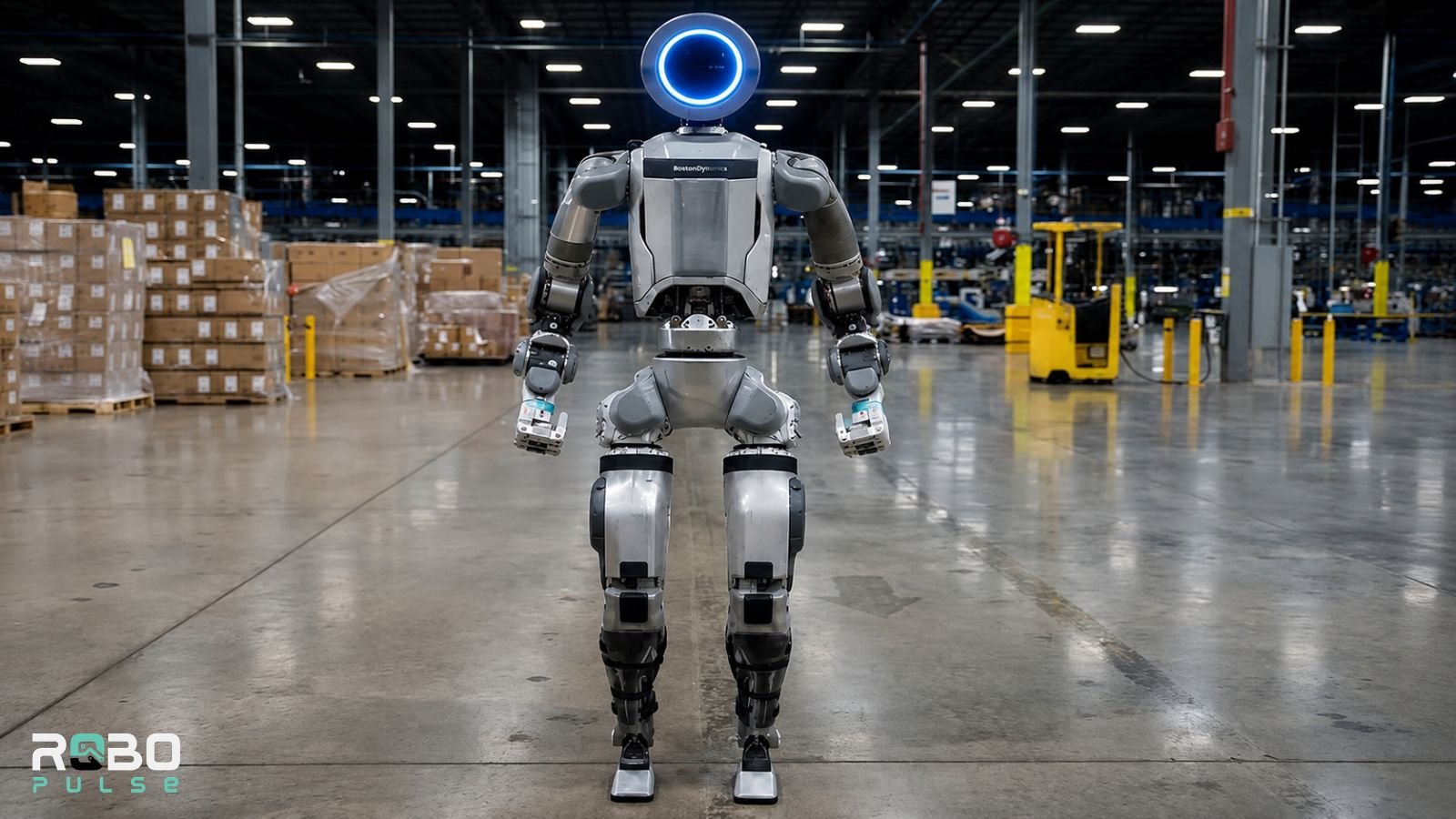
Boston Dynamics’ Electric Atlas arrived at CES 2026 with its entire 2026 production run already committed — every unit split between Hyundai’s factory operations and Google DeepMind.
There is no waitlist, no announced price, and no general availability.
That’s not a launch strategy. That’s a statement about what kind of robot this is.
Atlas is Boston Dynamics’ first commercially oriented humanoid after retiring the hydraulic platform in April 2024. Unlike its viral predecessors, Electric Atlas is designed to generate ROI inside factories — not YouTube views.
If you’re evaluating industrial humanoid robots for manufacturing, warehouse automation, or enterprise logistics, this review covers Atlas’s capabilities, limitations, pricing expectations, competitors, and ROI in full.
Who it’s for: Automotive manufacturers, heavy industrial operations, enterprises running dangerous or high-repetition tasks at scale.
Who it’s not for: Researchers, small factories, anyone expecting to place an order before 2027.
Quick Verdict
| Overall Score | 7.5 / 10 |
| Best for | Heavy industrial enterprise |
| Not suitable for | SMEs, research labs, consumers |
| Availability | Enterprise partners only — 2027 earliest |
| Est. Price | $150K–$320K (industry estimates; no official pricing) |
Pros and Cons
Pros
- Best-in-class payload: 50kg instant / 30kg sustained
- IP67 — dust-tight, water immersion to 1m
- Autonomous battery swap in 3 minutes
- 56 degrees of freedom — widest joint range of any shipping humanoid
- Fenceless guarding — no safety caging required
- Hyundai Mobis actuators — automotive-grade manufacturing at scale
- Google DeepMind Gemini 3 — genuine task generalisation, not scripted motion
- Orbit™ — native MES/WMS connectivity, no middleware
Cons
- Not for general purchase — enterprise partners only, 2027+
- No official pricing
- Production-scale real-world performance unproven
- MTBF, maintenance cost, and warranty terms undisclosed
- Sim-to-Real edge case handling not publicly benchmarked
Official Specifications
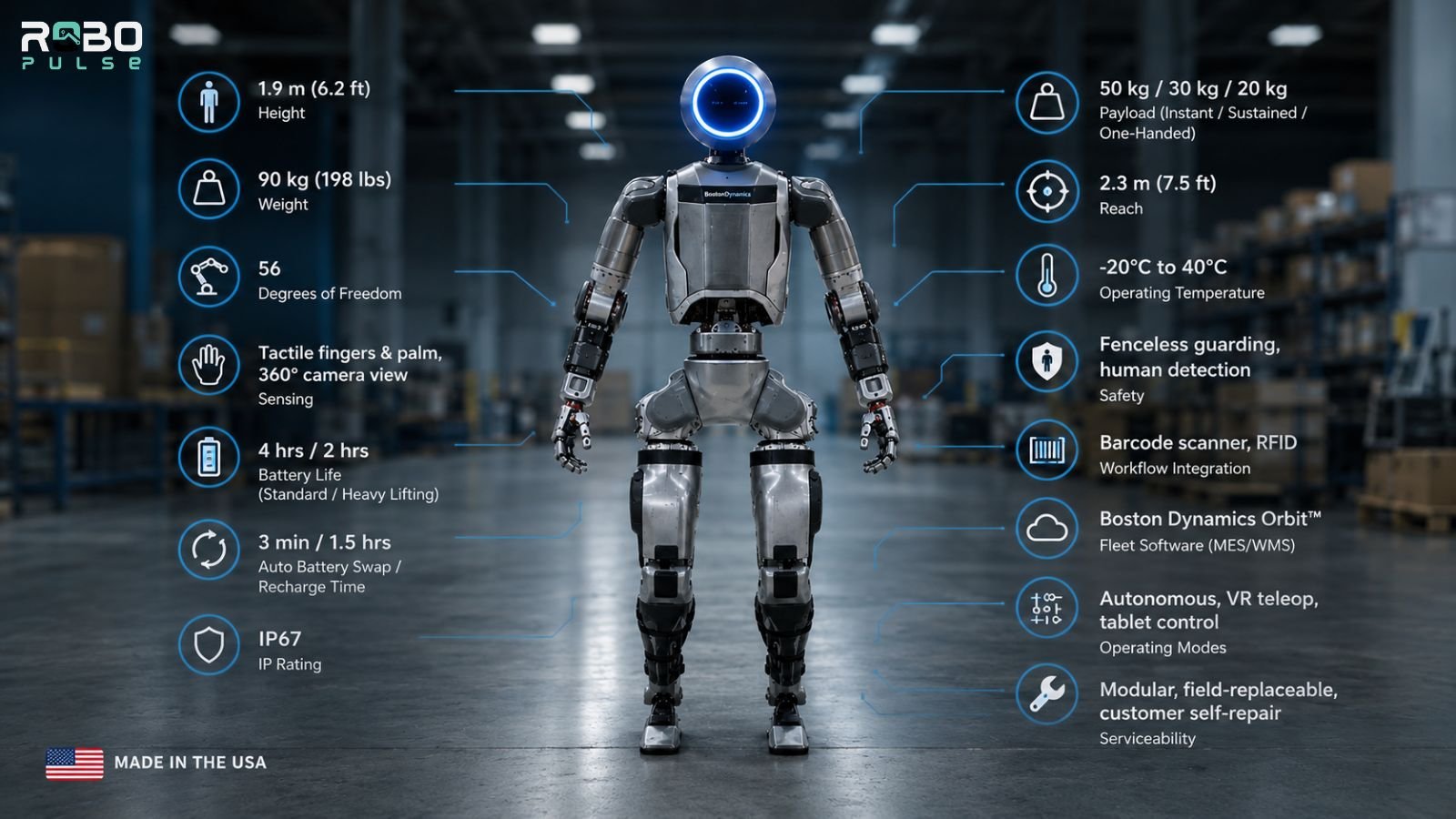
Source: Boston Dynamics Atlas Spec Sheet, December 2025
| Specification | Value |
|---|---|
| Height | 1.9 m (6.2 ft) |
| Weight | 90 kg (198 lbs) |
| Degrees of Freedom | 56 |
| Sensing | Tactile fingers and palm, 360° camera view |
| Battery Life — Standard | 4 hours |
| Battery Life — Heavy Lifting | 2 hours |
| Autonomous Battery Swap | 3 minutes |
| Recharge Time | 1.5 hours |
| Payload — Instant | 50 kg (110 lbs) |
| Payload — Sustained | 30 kg (66 lbs) |
| Payload — One-Handed | 20 kg (44 lbs) |
| Reach | 2.3 m (7.5 ft) |
| IP Rating | IP67 |
| Operating Temperature | -20°C to 40°C |
| Safety | Fenceless guarding, human detection |
| Workflow Integration | Barcode scanner, RFID |
| Fleet Software | Boston Dynamics Orbit™ (MES/WMS) |
| Operating Modes | Autonomous, VR teleoperated, tablet control |
| Serviceability | Modular, field-replaceable, customer self-repair |
| Origin | Made in the USA |
Why Electric? The Hydraulics Trade-off
The hydraulic Atlas ran from 2013 to April 2024. It did backflips.
It also required fluid maintenance, generated noise needing hearing protection nearby, and carried manufacturing complexity that made commercial scaling impractical.
What changed with electric actuation
Custom electric actuators use planetary roller screws and high-density neodymium magnets — achieving force density comparable to hydraulics at 85–90% electrical-to-mechanical efficiency.
The hip, waist, and neck now rotate 360 degrees. No human joint works that way.
In tight factory corridors, Atlas repositions loads without turning its entire body. It reaches overhead or floor-level positions a human can’t comfortably hold for a shift.
Why Hyundai Mobis supplying actuators matters
Actuators account for approximately 60% of humanoid robot material costs, per Hyundai Vice Chair Jaehoon Chang.
Hyundai Mobis — the Hyundai Motor Group automotive parts affiliate — manufactures Atlas’s actuators at automotive production scale, confirmed at CES 2026.
No other humanoid manufacturer has this supplier relationship in place. The most expensive component has the replacement logistics of an automotive parts network behind it.
The battery swap advantage
Atlas navigates to a charging station, swaps its own battery in 3 minutes, and returns to work.
Recharge takes 1.5 hours. Two batteries in rotation means continuous shifts without human intervention.
Competing humanoids still require external assistance for battery management.
What 56 Degrees of Freedom Actually Enables
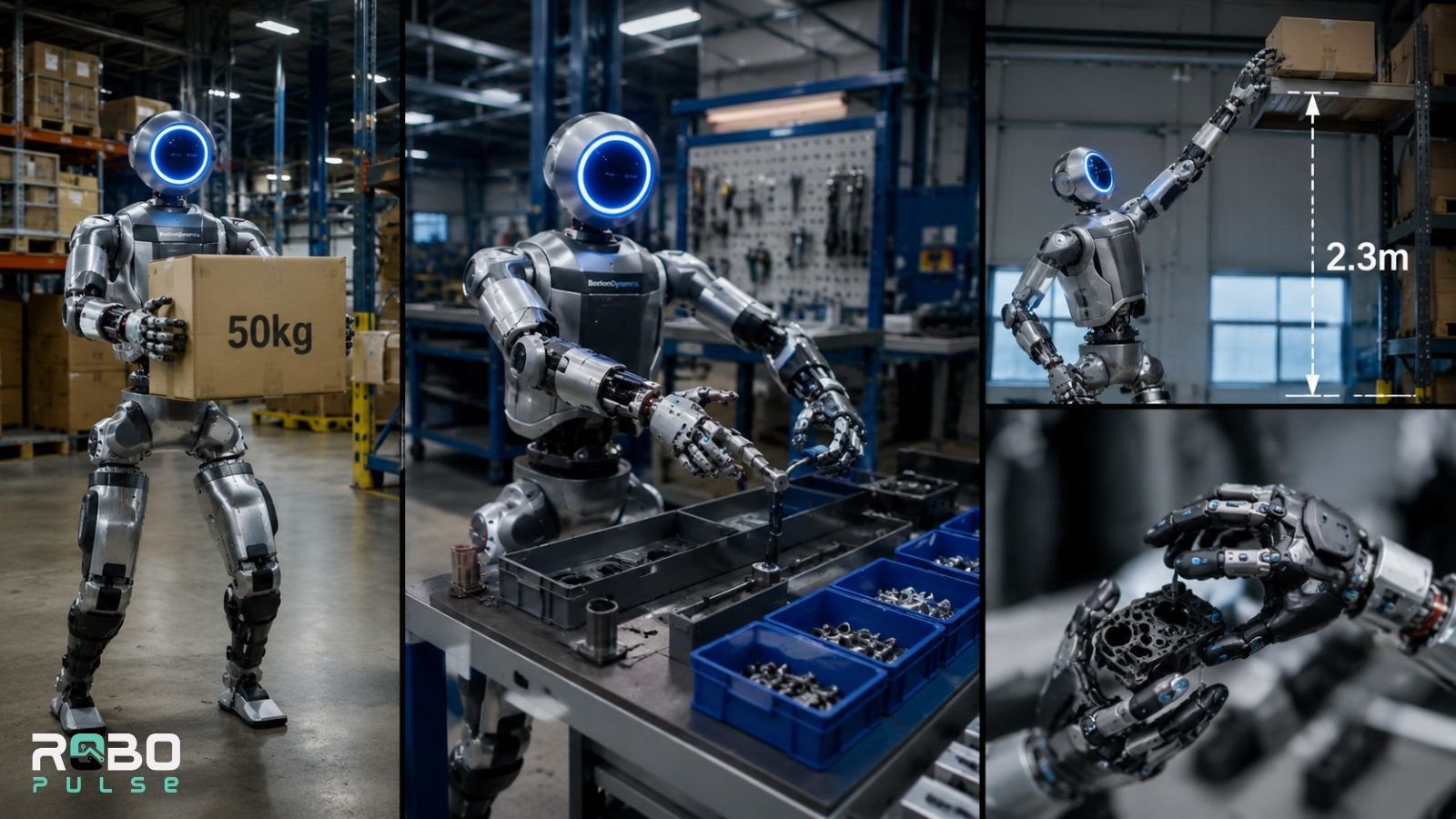
Most competing humanoids run 28–43 DoF. Atlas runs 56.
- Works in confined spaces without compromised motion planning
- 2.3m reach covers standard workstation heights without repositioning
- Adjusts grip in real time via tactile finger and palm sensors — not just camera estimates
- Handles irregular object shapes that stymie more constrained systems
Payload in context: The 50kg instant lift exceeds every competing humanoid currently shipping. The 30kg sustained capacity supports continuous handling across a full shift.
The AI Stack: What Gemini 3 and Jetson Thor Actually Do
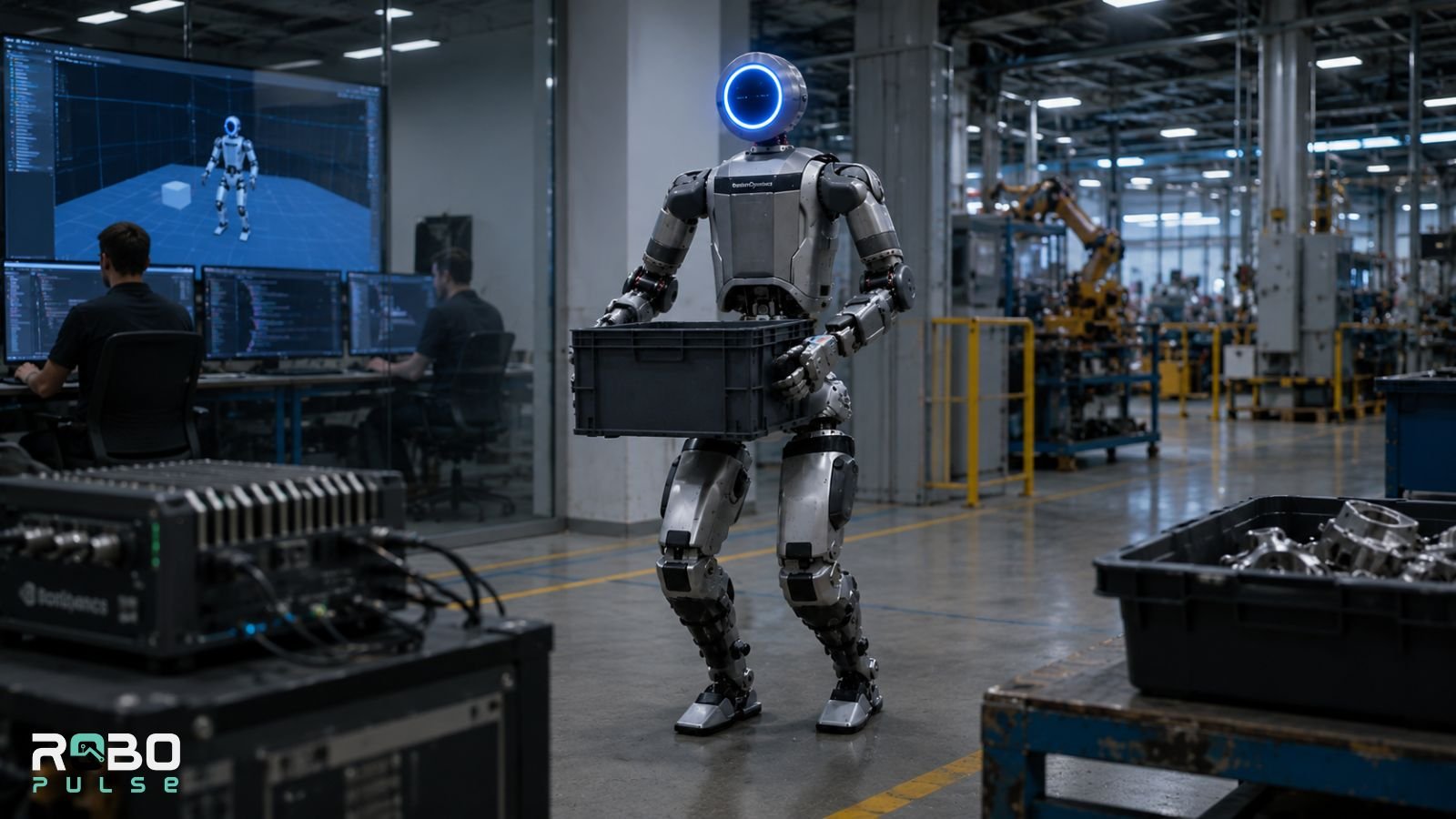
Atlas runs on NVIDIA Jetson Thor compute. At CES 2026, Boston Dynamics and Google DeepMind integrated Gemini 3 as the core AI layer.
Traditional industrial robots need explicit programming for every task variation. A box placed 10 degrees off-centre requires a coded response or human correction.
Gemini 3 means Atlas generalises from training examples to similar tasks without pre-programmed fallbacks.
How training works
- NVIDIA Isaac Lab runs physics simulations — millions of task attempts virtually
- Successful policies transfer to physical hardware via Sim-to-Real
- Real factory experience feeds back into the training pool
- One unit learning a skill deploys fleet-wide via Orbit
Boston Dynamics also partnered with Toyota Research Institute (October 2024) on Large Behavior Models — diffusion-based motion planning for multi-step manipulation sequences.
Where the AI still falls short
Simulation environments are clean. Factory floors aren’t.
An oil film on the floor, a deformed bin, a part arriving in the wrong orientation — these break Sim-to-Real transfer.
Atlas’s failure rate in non-simulated edge cases is not publicly disclosed. Figure 03 has specifically cited real-world error-recovery rates from its BMW pilot as a differentiator against this gap.
The RMAC deployment generates Atlas’s first comparable data. Until it’s public, the AI claims are credible but unverified at production scale.
Where Atlas Will Probably Struggle
Based on known Sim-to-Real limitations and factory environment variables, expect friction in:
- Reflective or wet floors — sensor confusion on specular surfaces
- Loose cables or hoses — unstructured obstacles not present in simulation
- Transparent or deformed packaging — vision models trained on regular shapes
- Oil or coolant spills — traction and grip force recalibration in real time
- Unexpected human obstruction — safety system slows or stops Atlas, breaking task flow
- Damaged or irregular pallets — geometry variations outside training distribution
None of these are disqualifying. All are engineering problems with known solution paths.
But enterprise buyers should plan for edge case handling protocols — and budget time for iterative retraining — before declaring full autonomous operation.
Fenceless Guarding and Human-Robot Collaborative Safety
Traditional industrial robots require physical safety caging. A human entering the operating zone stops the machine.
Reconfiguring a facility around robot cages adds cost, limits flexibility, and creates throughput bottlenecks.
Atlas operates in shared human workspaces without physical barriers.
The safety system uses active human detection to adjust behaviour when people are nearby. For enterprise buyers, this removes a facility reconfiguration cost that often exceeds the robot unit price on first deployment.
Orbit: The Fleet Software That Makes Atlas Enterprise-Ready
A humanoid robot that can’t talk to existing operational software creates a parallel management layer most enterprises won’t accept.
Orbit eliminates that problem with native MES and WMS integration:
- Centralised fleet performance monitoring
- Task assignment and status tracking
- Barcode scanning and RFID workflow support
- Fleet-wide skill deployment from a single update
Customers already running Orbit for Spot or Stretch have a meaningful head start on Atlas deployment.
Hyundai’s Role: Vertical Integration as a Structural Advantage
Hyundai acquired Boston Dynamics in 2021. The relationship controls the production ecosystem end-to-end.
| Entity | Role |
|---|---|
| Boston Dynamics | Platform development and software |
| Hyundai Mobis | Actuator manufacturing at automotive scale |
| Hyundai Glovis | Logistics and supply chain |
| Hyundai RMAC | Primary deployment site and AI training data source |
CEO Robert Playter has described RMAC as a “data factory” — every Atlas movement generates training data that improves performance fleet-wide. Deployment and training are the same operation.
Hyundai has committed to deploying more than 25,000 Atlas units across Hyundai and Kia plants — 83% of the planned 30,000-unit annual production capacity. Savannah, Georgia deployment targets 2028.
No other humanoid robotics company has this level of vertical integration in place.
One tension to watch: South Korea’s Korean Metal Workers’ Union publicly stated in January 2026 that Atlas will not enter Hyundai factories without a labour-management agreement. How this resolves will set a global precedent for humanoid factory deployments.
Boston Dynamics Atlas vs. The Competition
Atlas vs. Tesla Optimus
| Feature | Atlas Electric | Tesla Optimus |
|---|---|---|
| Degrees of Freedom | 56 | ~43 (Gen 2) |
| Payload | 50 kg / 30 kg sustained | ~20 kg (est.) |
| IP Rating | IP67 | Not confirmed |
| Autonomous Battery Swap | Yes — 3 min | No |
| AI System | Google DeepMind Gemini 3 | Tesla FSD neural net |
| Est. Unit Price | ~$150K–$320K | $20K–$30K (target) |
| Availability | Enterprise partners, 2027+ | Internal Tesla only |
Where Atlas leads: Every physical capability metric, by a significant margin.
Where Optimus leads: Price trajectory and Tesla’s manufacturing scale potential.
Bottom line: Different buyers, different timelines.
The Broader Competitive Field
| Atlas | Figure 03 | Agility Digit | Apptronik Apollo | Unitree G1 | |
|---|---|---|---|---|---|
| Payload | 50 kg | ~20 kg | ~16 kg | ~25 kg | ~3 kg |
| DoF | 56 | ~35 | 30 | 34 | 43 |
| IP Rating | IP67 | Unconfirmed | Unconfirmed | Unconfirmed | Unconfirmed |
| Est. Price | $150K–$320K | Undisclosed | ~$250K | Undisclosed | From $43,500 |
| Status | Enterprise pilots | Limited B2B | GXO deployed | Mercedes pilot | Ships now |
Where each competitor genuinely leads:
- Figure 03 — More publicly documented real-world data from the BMW Spartanburg pilot (30,000+ vehicles)
- Agility Digit — Warehouse deployment maturity; 100,000+ totes moved at GXO, available now
- Apptronik Apollo — Open SDK; more accessible for custom application development
- Unitree G1 — $43,500, ships today, ROS2 compatible; a developer platform, not an industrial deployment system
If Atlas Isn’t an Option: Alternatives by Use Case
| Need | Best Alternative | Why |
|---|---|---|
| Warehouse logistics now | Agility Digit | 100K+ totes at GXO; commercially proven |
| Manufacturing pilot with strong AI | Figure 03 | BMW track record; Helix AI in verified production |
| Developer/research access | Unitree G1 | $43,500, ships now, full SDK |
| Flexible manufacturing, open software | Apptronik Apollo | Open SDK; Mercedes pilot underway |
ROI Framework: Does the Price Make Sense?
No official pricing exists. Industry estimates: $150,000–$320,000 per unit.
Worked example
| Cost Component | Calculation | Per Hour |
|---|---|---|
| Hardware ($250K, 5 yrs, 6,000 hrs/yr) | $250K ÷ 5 ÷ 6,000 | ~$8.33 |
| Maintenance + software (est. $20K/yr) | $20K ÷ 6,000 | ~$3.33 |
| Total estimated | ~$34–42/hr | |
| US skilled manufacturing worker | Wages + benefits + overtime | $45–75/hr |
The math works for: heavy part handling, extreme environment tasks, high-consistency operations where human error generates measurable quality cost.
The math is harder for: flexible assembly where task variety changes faster than retraining allows, or smaller operations without 3-shift volume.
Critical caveat: This assumes Atlas uptime matches specification in real factory conditions. That’s unverified. RMAC is the test.
What We Still Don’t Know
| Unknown | Why It Matters |
|---|---|
| Official unit pricing | Can’t model ROI without confirmed cost |
| MTBF | Core reliability metric for industrial planning |
| Annual maintenance cost | Major total cost of ownership factor |
| Software licensing terms | Orbit access, AI model update cadence |
| Battery lifespan over cycles | Long-term operating cost |
| Warranty and service contract structure | Risk transfer in enterprise procurement |
| Real-world uptime at RMAC | Only data that validates the specs |
| Sim-to-Real edge case failure rate | Critical for safety planning in shared spaces |
Boston Dynamics will need to address most of these for serious procurement conversations. Expect disclosure as RMAC data accumulates through 2026.
Who Should — and Shouldn’t — Consider Atlas
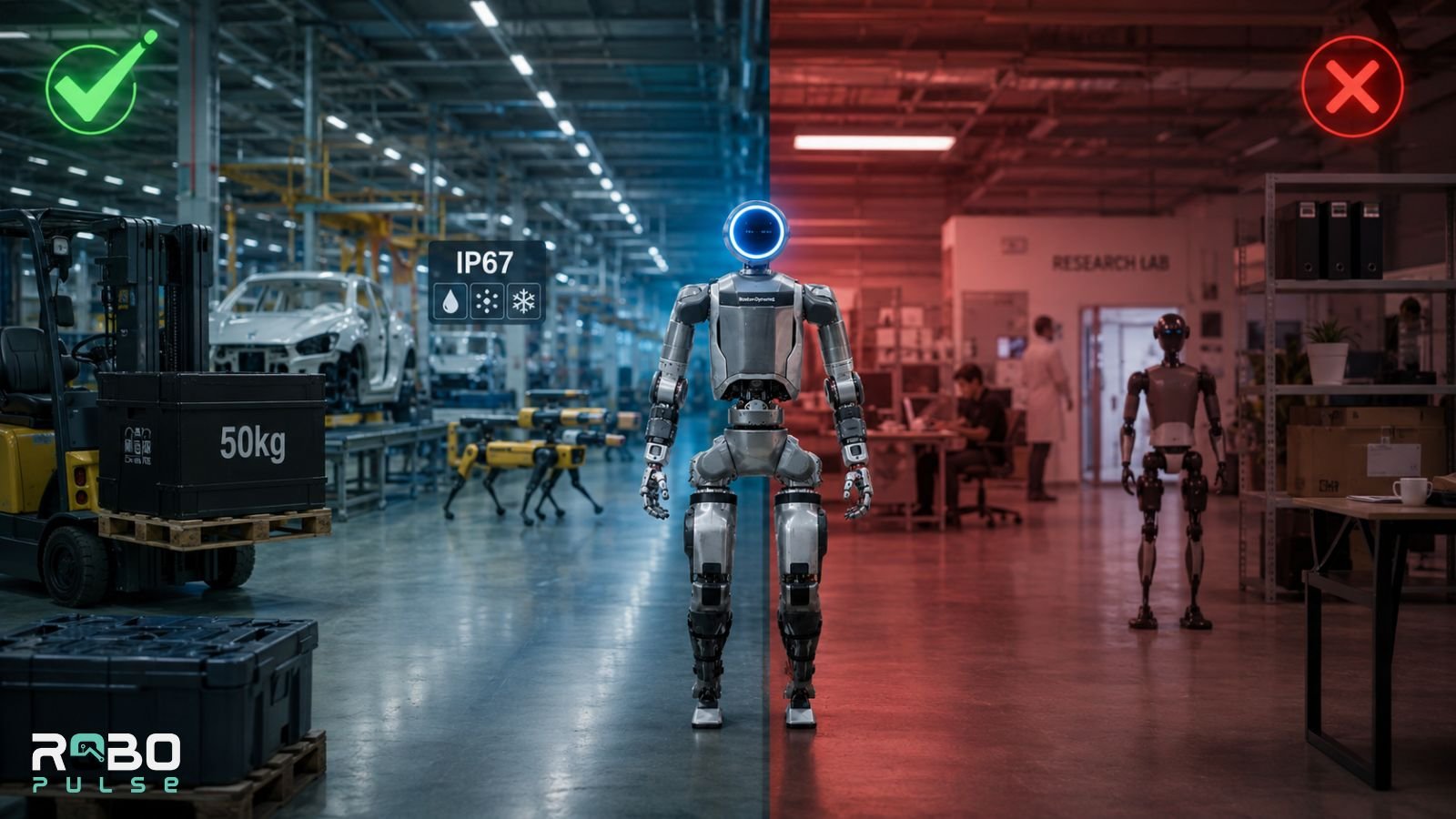
Strong fit:
- Automotive manufacturers with high-volume, physically demanding assembly
- Heavy logistics with 50kg+ material handling requirements
- Environments with extreme temperature, dust, or moisture where IP67 matters
- Enterprises already on Orbit with existing Spot or Stretch infrastructure
- Operations running 3+ shifts, 6,000+ annual hours
Not a fit:
- Research labs or universities — Unitree G1 or Apollo are better choices
- Small operations without the capital base or shift volume
- General flexible assembly where task variety outpaces retraining speed
- Anyone who needs a robot before 2027
Who should wait until 2028: Procurement managers planning large-scale factory deployment should wait for RMAC operational data before committing. Real uptime, maintenance cost, and Sim-to-Real failure rate data should be available by late 2026 or early 2027. That data changes the risk calculus significantly.
Latest Updates (June 2026)
- CES 2026: Full production Atlas unveiled; Gemini 3 integration and Hyundai Mobis actuator supply announced
- All 2026 units committed to Hyundai RMAC and Google DeepMind before public launch
- Korean Metal Workers’ Union issues formal objection to Atlas factory entry without labour agreement
- Hyundai confirms 25,000-unit commitment; Savannah, GA target 2028
- Next milestone: First public operational data from RMAC deployment
RoboPulse Take
Atlas Electric has the best hardware shipping in 2026. Hyundai Mobis actuators, 56 DoF, IP67, autonomous battery swap — no competitor matches this on specs.
But specs aren’t proof. RMAC is the test. Until that operational data is public, the premium positioning is a bet, not a guarantee.
Hyundai committing 25,000 units to its own plants is the most credible signal this robot will actually work. Watch Savannah in 2028.
RoboPulse Score
| Category | Score | Notes |
|---|---|---|
| Physical Capability | 9.5 / 10 | Best-in-class payload, DoF, reach, IP rating |
| AI & Software | 8.5 / 10 | Strong stack; edge case performance unverified |
| Durability & Safety | 9.5 / 10 | IP67, fenceless guarding, modular field repair |
| Accessibility | 3.0 / 10 | No public availability, undisclosed price |
| Value for Enterprise | 7.0 / 10 | ROI case exists; unproven at scale |
| Overall | 7.5 / 10 | Weighted against deployment reality |
FAQs
Q. What is the Boston Dynamics Atlas Electric?
Boston Dynamics’ production humanoid robot, unveiled at CES 2026. Stands 1.9m tall, weighs 90kg, has 56 degrees of freedom, and a 50kg payload. Runs Google DeepMind Gemini 3 on NVIDIA Jetson Thor. Targets heavy industrial manufacturing and logistics.
Q.Why did Boston Dynamics switch from hydraulics to electric?
Hydraulic actuators required fluid maintenance, generated disruptive noise, wasted energy in heat, and were too complex to manufacture at commercial scale. Electric actuators using planetary roller screws achieve comparable force density at 85–90% efficiency — with an automotive-grade supply chain via Hyundai Mobis.
Q. Can you buy Boston Dynamics Atlas?
No. All 2026 units are committed to Hyundai and Google DeepMind. Enterprise availability expected from early 2027. No consumer option exists.
Q. How long does the Atlas battery last?
4 hours standard, 2 hours under heavy lifting. Atlas autonomously swaps its battery in 3 minutes, enabling continuous multi-shift operation. Recharge takes 1.5 hours.
Q. Is Atlas better than Tesla Optimus?
On physical metrics — payload, DoF, IP rating, battery swap — yes, clearly. On price trajectory and production scale potential, Optimus has the long-term advantage. Neither is publicly available as of mid-2026.
Q. What actuators does Atlas use?
Custom electric actuators using planetary roller screws and high-density neodymium magnets, manufactured by Hyundai Mobis. Actuators account for ~60% of humanoid robot material costs — automotive-scale manufacturing gives Atlas a structural cost advantage as production scales.
Q. Does Atlas use AI?
Yes. NVIDIA Jetson Thor compute, Google DeepMind Gemini 3 for task generalisation, NVIDIA Isaac Lab for simulation training, and Large Behavior Models (Toyota Research Institute) for multi-step manipulation. Skills deploy fleet-wide via Orbit software.
Q. Who owns Boston Dynamics?
Hyundai Motor Group, which acquired Boston Dynamics in 2021. Production at Boston Dynamics’ Massachusetts headquarters. Hyundai Mobis supplies actuators.
Methodology & Disclosure: This review draws on official Boston Dynamics documentation, CES 2026 materials, manufacturer specifications, and reputable third-party reporting. Where pricing or deployment costs are discussed, they represent industry estimates rather than official figures. Product capabilities and timelines may evolve as commercial rollouts continue.