


Among humanoids with published figures, a single charge lasts anywhere from about 90 minutes to five hours. Working hours per day are a separate question. A robot that docks, swaps packs or tags out for a teammate can keep going long after one battery runs dry.
Marketing tends to live in the gap between those two numbers. Agility says Digit 5 will deliver more than 20 productive hours a day, but early customers won’t get one until 2027. Figure ran a 200-hour demonstration with five robots taking turns at a single sorting station. Both are interesting. Neither is independent proof that a humanoid can produce around the clock.
It helps to keep three questions separate. How long does one robot run on a charge? How long can that robot work through a shift? And how long can a station stay covered when several robots rotate? Each one needs its own evidence.
Staying switched on all day is also a lower bar than producing all day. Maintenance, task errors, and the occasional human rescue eat into output, even when the robot never powers down.
Last verified against public sources: October 2026.
How long does each humanoid robot run per charge?
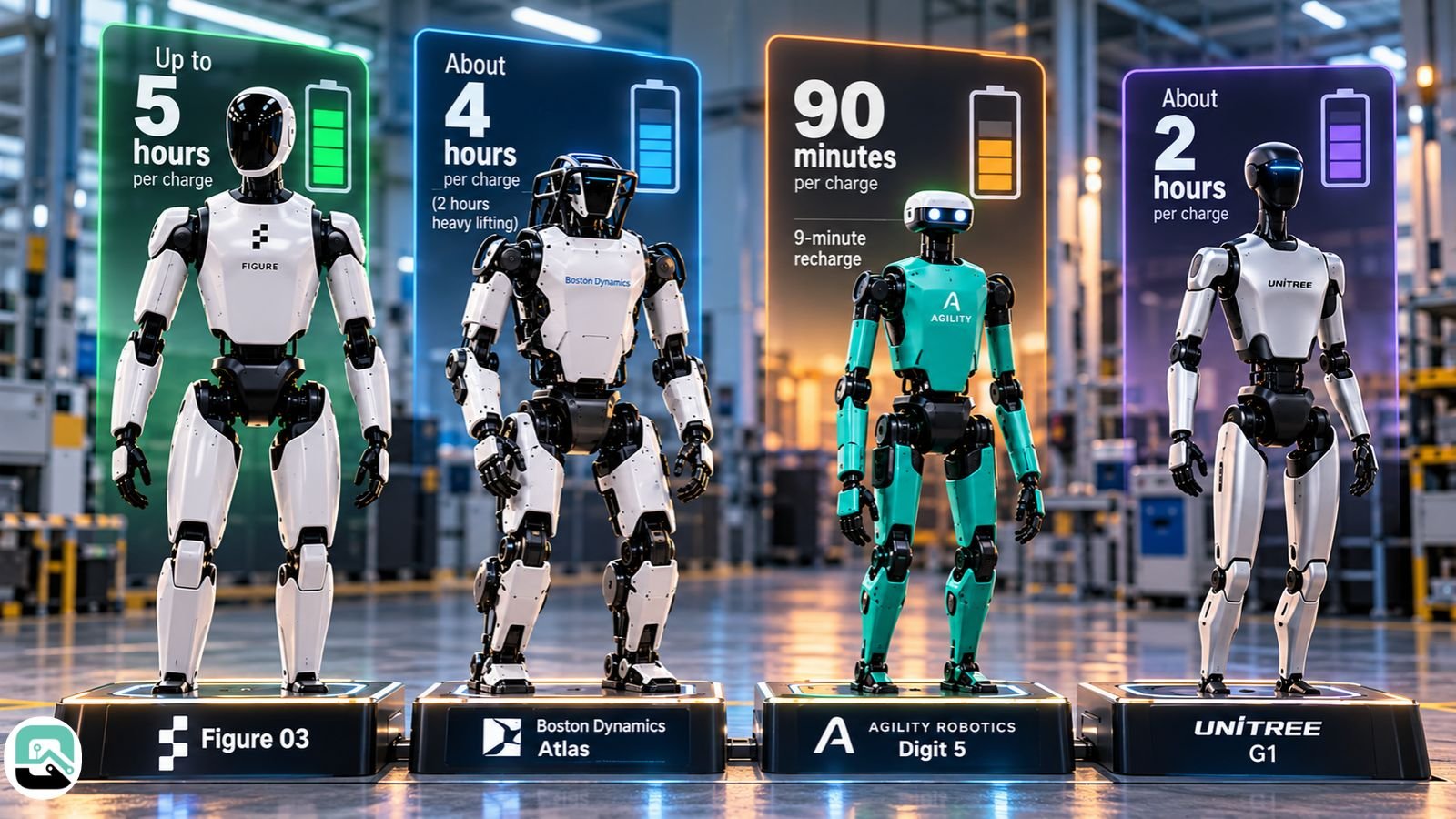
Published figures range from 90 minutes to about five hours, and heavy loads can roughly halve them. Each row is labeled by evidence type: product specification, manufacturer demonstration, deployment report, or independent verification (third-party evidence an outsider could audit).
| Robot | Runtime per charge | Recharge or swap | Evidence | Status (Oct 2026) |
|---|---|---|---|---|
| Figure 03 | Up to 5 h (2.3 kWh) | Wireless dock; fleet rotation | Spec + maker demo | Current platform |
| Atlas | About 4 h; about 2 h heavy lifting | 3-min swap; 1.5-h charge | Spec | Line work from 2028 |
| Digit 5 | 90 min | 9-min recharge | Spec; 20+ h a day is a target | Early access H1 2027 |
| Digit 4 | Disputed; 2:1 run-to-charge | Dock charging | Deployment report | Shipping |
| Walker S2 | Not published | 3-min swap; dual battery | Maker demo | Marketed for factories |
| Unitree G1 | About 2 h | Quick-release pack | Spec | Shipping |
| Apollo (original) | 4 h per pack | Hot-swap packs | Spec | Apollo 2 unconfirmed |
| HMND 01 Alpha (wheeled) | Not published; 8+ h uptime | Not stated | Two-week proof of concept | Not comparable to bipeds |
| Tesla Optimus | No official figure | Self-docking reported | Unverified | No published spec |
No row reaches independent verification. Every figure comes from a maker, a maker-run demo or a customer report the maker chose to share.
Why some runtime figures are missing or disputed
Digit 4 reports conflict, so Agility’s own 2:1 ratio is the safest anchor. UBTech’s Walker S2 page covers the swap but never says how long a pack lasts. The press figures of two hours walking and four standing don’t trace to a UBTech spec.
Tesla hasn’t published a runtime for its Optimus Gen 3 robot, and the eight-hour figure in circulation comes from enthusiast sites. Figure 02 is absent because Figure retired that fleet in November 2025.
A model made the table only with a public runtime claim or a documented run. Missing numbers stay blank instead of being estimated.
Which humanoid robots have shown full-shift operation?
Three public runs have reached shift length. All three were reported by the companies themselves. As of October 2026, no independent, multi-day production record exists for any bipedal humanoid.
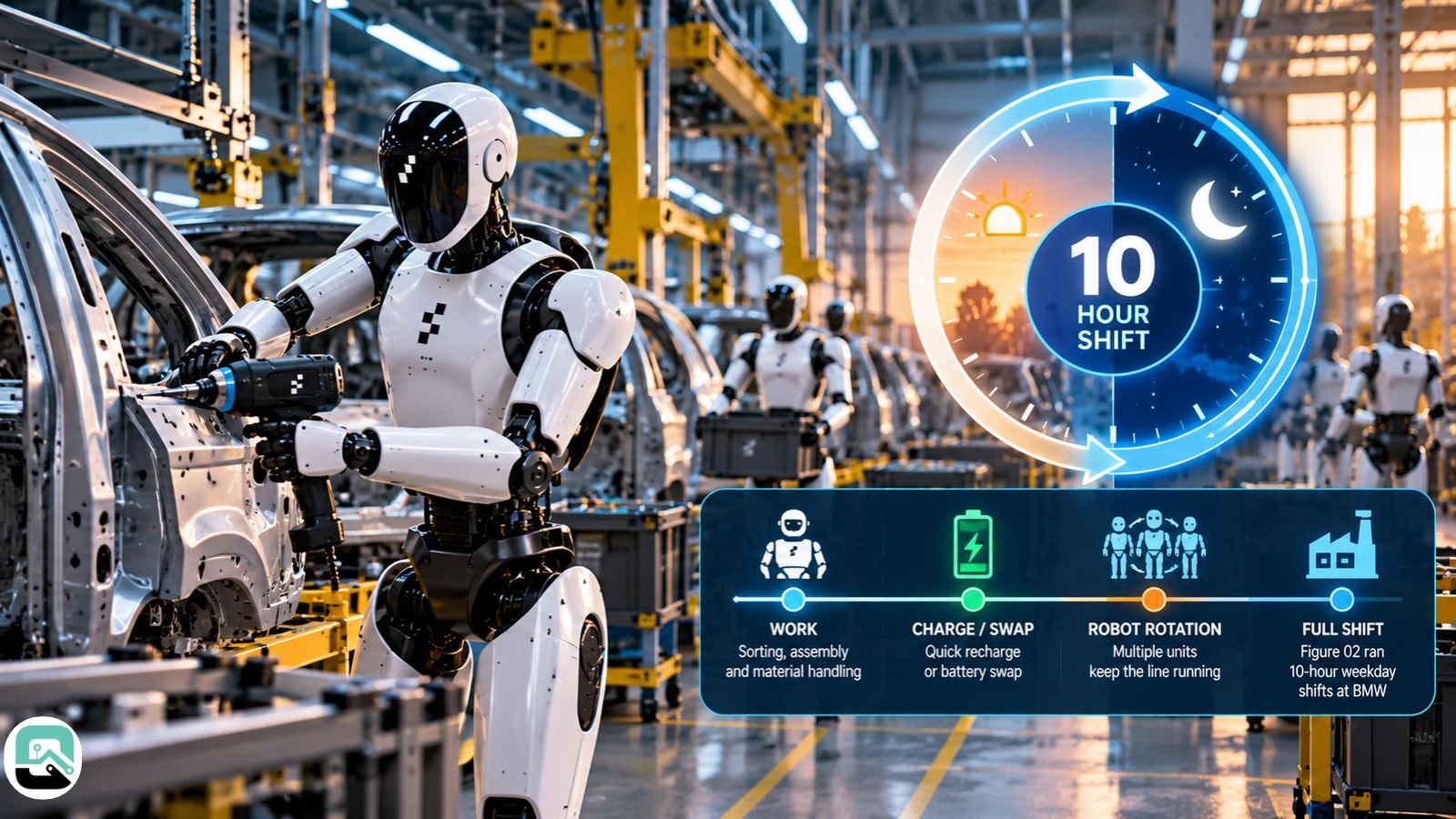
Figure 02 at BMW (concluded)
Figure 02 spent 11 months at BMW’s Spartanburg plant, lifting sheet-metal parts onto welding fixtures. When Figure retired the fleet in November 2025, it reported more than 1,250 runtime hours and over 90,000 parts loaded. Full deployment came late, around month 10, and the robots eventually worked 10-hour shifts, Monday to Friday.
On paper, 10-hour weekday shifts over 11 months should add up to far more than 1,250 hours. The slow ramp-up explains most of that, since the long shifts only covered the pilot’s final stretch. What public reports never settle is whether 1,250 hours belongs to one robot or the whole fleet.
The forearm broke down more than any other part. Constant motion wore on a microcontroller board and the cabling that ran to the wrist, so Figure dropped both from Figure 03. Reports say Figure 03 has since picked up a parts-sequencing job at the same plant.
Figure 03 200-hour fleet demonstration (company demo)
In May 2026, Figure put its newer robots on an unedited livestream for 200 hours. They sorted 249,560 packages, and Figure reported zero hardware failures. Five robots shared the station. Each worked about four hours, handed off to a teammate and walked to a wireless dock, comfortably inside Figure’s five-hour peak rating.
It wasn’t flawless. Viewers spotted packages sliding off the belt and items set down the wrong way up. The whole run took place in Figure’s own building, on one narrow task, with nobody outside auditing it.
What it did show is a station that stayed staffed through rotation. No single robot worked 200 hours. Still, few humanoid demos made public have run this long.
Partway through, Figure staged a 10-hour race against a human intern. The intern sorted 12,924 packages at 2.79 seconds apiece, and the robots managed 12,732 at 2.83 seconds. He took the breaks California law requires, while rotation let the robot station absorb every charging stop.
One thing Figure didn’t share is how many robots a paying customer would need per station. That ratio decides whether the math works.
A treadmill test from October 2026 tackled something else entirely. Figure said one Figure 03 walked 348 miles over nine straight days. Since Figure shared neither the power setup nor an intervention log, read it as a durability result. It tells you little about battery runtime.
HMND 01 Alpha at Siemens (proof of concept)
Humanoid’s HMND 01 Alpha, which rolls on wheels, spent two weeks at Siemens’ electronics plant in Erlangen moving totes onto a conveyor. The published results list 60 tote moves an hour, uptime above eight hours, pick-and-place success above 90% and continuous autonomous work beyond 30 minutes.
Look closely at that last figure. Eight hours of uptime and eight hours of unbroken autonomy are different claims, and some coverage blurred them. Wheels also burn far less energy than legs, so these results don’t carry over neatly to a walking robot.
What is the difference between runtime, uptime, and productive hours?
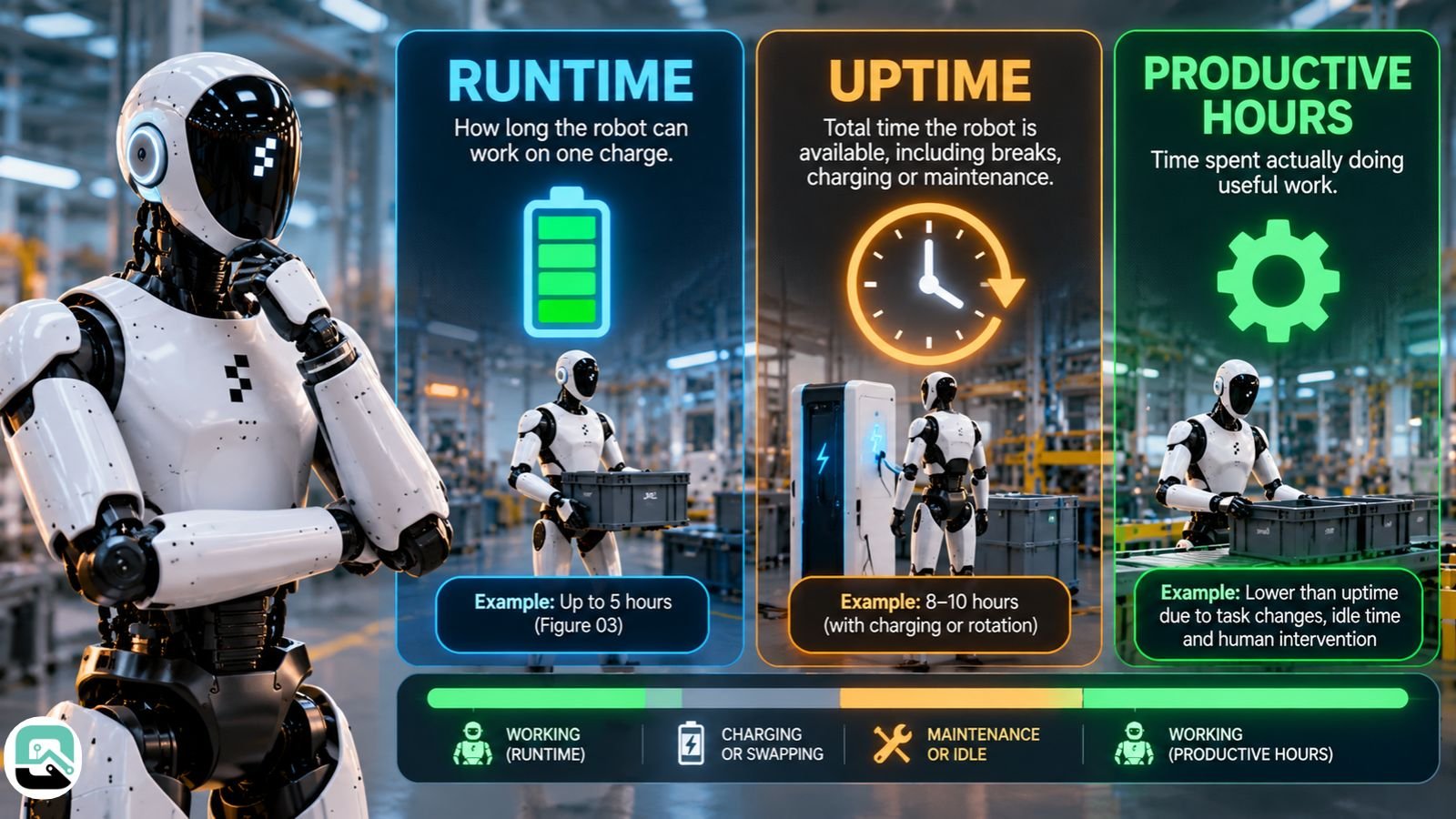
Runtime is about one charge. Uptime is the slice of a shift when the robot is available. Productive utilization is the slice it spends on the actual task, and output counts accepted units of work. Each has its own denominator, which is why a great score on one can hide a weak score on another.
| Metric | Definition |
|---|---|
| Runtime per charge | Operating time between charging or battery-replacement events |
| Scheduled-shift uptime | Share of the scheduled shift when the robot is available for work |
| Productive utilization | Share of the shift spent completing the intended task |
| Task output | Completed, accepted units of work per hour or shift |
Denominators are where vendors get creative. A robot that’s down for 30 minutes of an eight-hour shift shows 93.75% availability. Its productive utilization will come in lower, since waiting and setup eat time too.
Illustrative example, not measured data. Picture a ten-hour shift: 7 hours on task, 1 hour charging, half an hour on faults and maintenance, and 1.5 hours waiting or moving between jobs. Productive utilization is 70%. Count only charging and faults as downtime, and availability jumps to 85%. Same robot, same shift, two very different stories.
Can fast charging, swapping, or fleet rotation enable 24/7 operation?
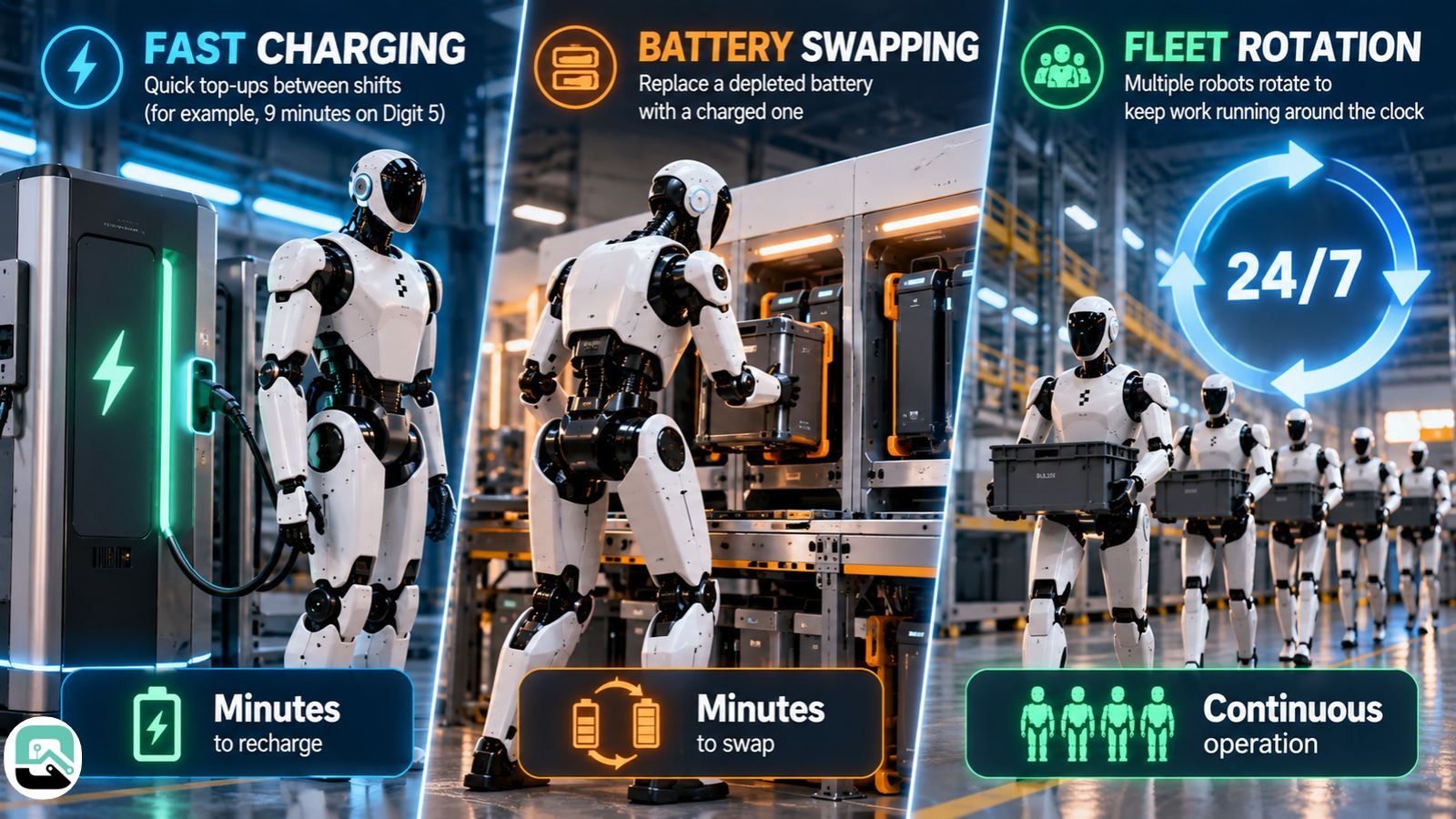
All three cut downtime. None of them, on its own, proves a full day of work. Fast charging shortens each trip to the dock. Swapping skips the wait but needs stations and charged spares, and rotation keeps a station staffed while robots take turns charging, which means buying more hardware.
- Fast charging (Digit 5). On October 15, 2026, Agility named Nyobolt as Digit 5’s battery supplier and quoted a 90-minute runtime with a 9-minute recharge. Repeat that cycle all day, and you get about 14.55 cycles, or roughly 21.8 hours of runtime. Treat that as a duty-cycle calculation. It ignores the walk to the dock, queues, faults, and task changes, and Agility’s 20-plus productive hours is still a manufacturer target. The same math caps Digit 4, with its 2:1 ratio, at about 16 hours.
- Swapping (Atlas, Walker S2, Apollo). Atlas trades a 90-minute charge for a swap of under three minutes. Walker S2 is harder to judge because UBTech hasn’t published hours per pack. With swapping, the swap itself is rarely the bottleneck. Spare packs and charging time are.
- Rotation (Figure 03). Figure kept its livestream station busy by cycling five robots through charging. That was a demo setup. Buyers still don’t know how many robots one station really needs, and that number drives the cost.
Battery health is the biggest open risk
Agility hasn’t published Digit 5’s battery capacity or a cycle-life rating. Running 90 minutes and recharging for 9 adds up to 14 or 15 charging sessions a day.
Sessions and full battery cycles aren’t the same thing. The real cycle count depends on how much energy each top-up puts back and how the battery maker defines a cycle.
Without capacity-retention data, 21.8 hours describes an idealized first day. Year five could look quite different. Swap pools carry the same risk, since every spare pack ages too, and no humanoid fleet has public, independent capacity-loss data yet.
What limits a humanoid robot’s working hours?
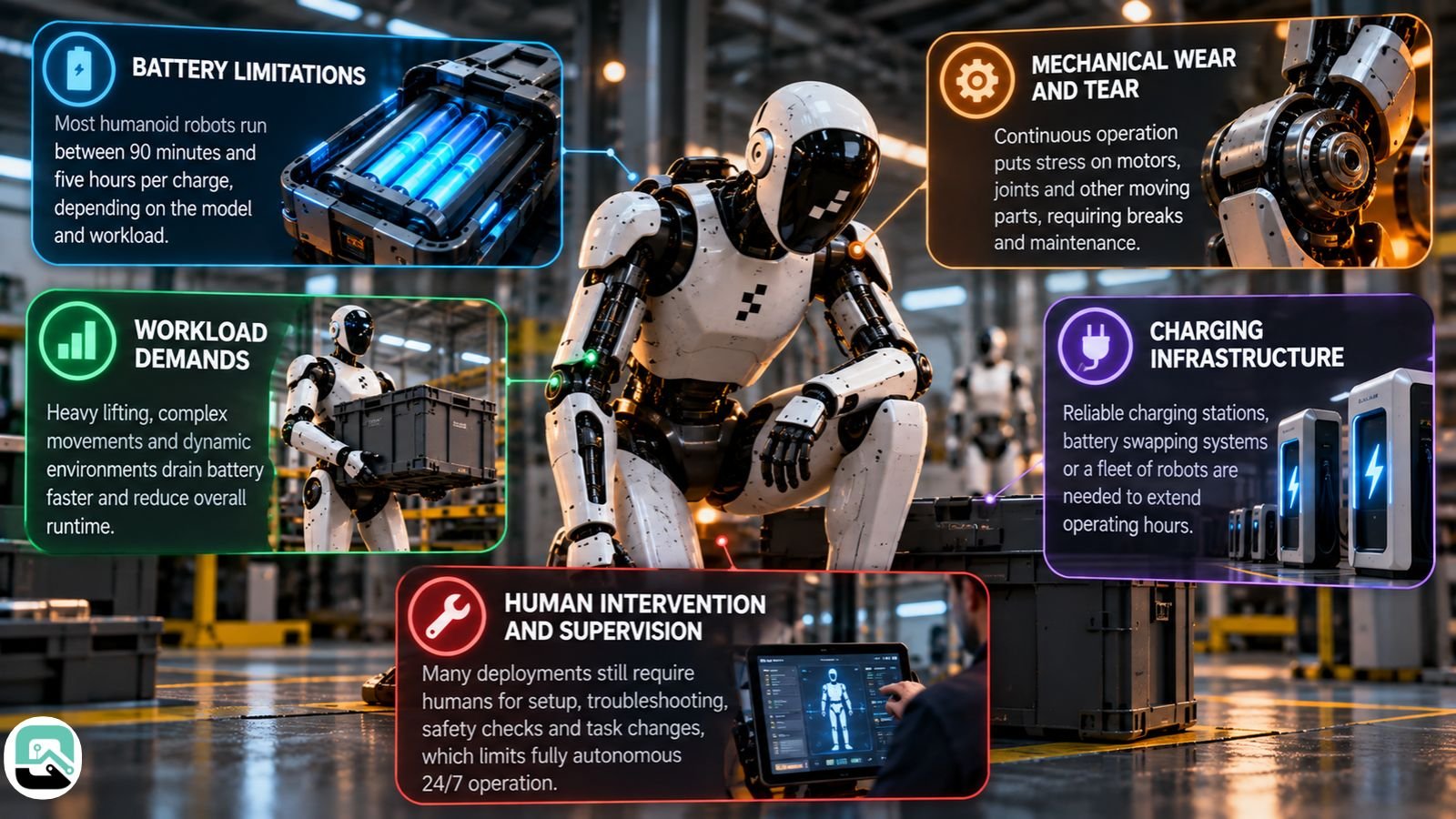
Battery life is only one of five limits on daily hours, and often not the tightest. A fully charged robot that’s broken, stuck, or idle adds nothing.
- Human intervention. It’s the least reported limit and, after power, probably the most important. A robot that needs a person every 15 minutes is a different product from one that finishes the shift alone. Vendors rarely publish interventions per shift or mean time between interventions, and Figure’s livestream and BMW pilot left those numbers out as well. Hyundai’s own Atlas validation work runs with shifts of staff handling remote operation, demonstrations and data collection.
- Mechanical faults. At BMW, hardware reliability shaped Figure’s results more than the battery did. The forearm went first.
- Workload. Heavy lifting cuts Atlas’s rated runtime from about four hours to about two.
- Charging infrastructure. Docks, swap stations, and spare packs cost money and floor space. A queue at the dock is lost time.
- Waiting. A robot parked at a stalled conveyor racks up runtime and finishes nothing.
What does a productive robot hour cost?
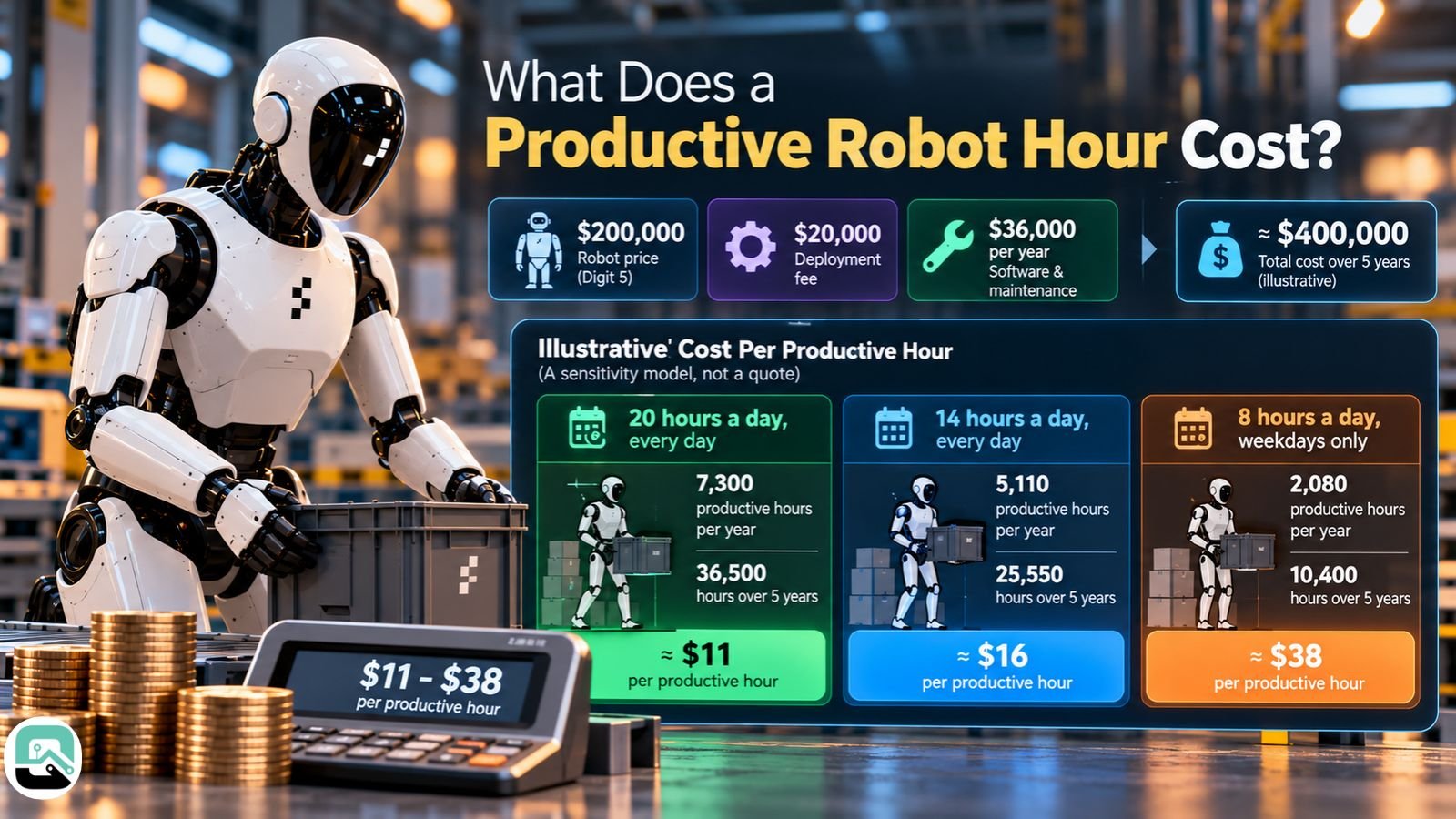
Utilization swings the cost of a robot hour far more than battery chemistry does. Digit 5’s reported launch pricing makes a handy test case: about $200,000 for the robot, a $20,000 deployment fee, and roughly $36,000 a year for software and maintenance. That comes to around $400,000 over five years, and real contracts may differ.
Agility says the robot breaks even in about 1.1 years against a $30.50 hourly wage. That’s the company’s estimate, built on its own assumptions about daily hours and the labor replaced. The model below doesn’t confirm it.
Illustrative cost per productive hour (a sensitivity model, not a quote). Here’s the same $400,000 spread across three utilization levels:
| Scenario | Productive hours per year | Hours over 5 years | Cost per productive hour |
|---|---|---|---|
| 20 h a day, every day (Agility target) | 7,300 | 36,500 | about $11 |
| 14 h a day, every day | 5,110 | 25,550 | about $16 |
| 8 h a day, weekdays only | 2,080 | 10,400 | about $38 |
At eight hours on weekdays, the model lands near $38 per productive hour, above the $30.50 benchmark wage. Keep in mind that this weighs a robot’s cost against a wage, which is less than the full cost of employing a person.
Plenty is missing from the model too: electricity, chargers, spare packs, floor space, integration, and staff time spent on interventions. It also assumes every scheduled hour stays productive for five years. Use it as a sensitivity check, then swap in your vendor’s quote and your own measured hours.
Hours aren’t output, either. If a robot works eight hours but turns out fewer accepted units, each unit costs more than this table suggests.
What the public data still does not show
Five things are still missing from the public record:
- Independent, audited multi-day production runs for any bipedal humanoid
- Interventions per shift, mean time between interventions and recovery time
- Battery cycle life and capacity fade under fast charging or frequent swaps
- Per-robot daily productive hours, rather than fleet totals such as Digit 4’s 65,000
- How many robots a workstation needs when a fleet covers charging by rotation
How should you evaluate an operating-hours claim?
Ask for productive hours under your own workload. A claim worth trusting names the payload, the task, the charging method, and the accepted output. If a vendor can’t give you those, you’re looking at a headline.
- Start with interventions. Ask how many happen per shift, how long the robot goes between them, and how long recovery takes.
- Define the hour. Runtime, uptime, utilization, and output answer different questions.
- Match the load. A runtime measured on light work will mislead a heavy-duty site.
- Ask about failures. Get the top failure points and their service history.
- Ask about battery aging. Request cycle-life ratings and expected capacity after a year.
- Price the productive hour. Divide total cost by hours of real work. Runtime is the wrong denominator.
What to watch next
- First half of 2027: Digit 5 early access, the first field test of the 20-hour target
- 2028: Atlas begins parts sequencing at Hyundai Metaplant America in Georgia
- Ongoing: shift-level data from Figure 03 sites such as BMW and Catalyst Brands, the first customer test of fleet rotation
FAQs
Q. How many hours can humanoid robots work per day?
Humanoid robots typically run for 90 minutes to five hours per charge, depending on the model and workload. With charging, battery swapping, or fleet rotation, they can operate across longer shifts. However, independently verified 24/7 productive operation remains unproven.
Q. How long does a humanoid robot battery last?
Humanoid robot battery life varies by model. Figure 03 offers up to five hours, Boston Dynamics Atlas provides about four hours under typical workloads, and Digit 5 targets 90 minutes with a nine-minute recharge. Heavy lifting can reduce Atlas’s runtime to approximately two hours.
Q. Can humanoid robots work an eight-hour factory shift?
Yes. Humanoid robots can cover eight-hour factory shifts using scheduled charging, battery swaps, or fleet rotation. Figure 02 reportedly completed 10-hour weekday shifts during its BMW deployment. However, continuous productive work depends on reliability, task complexity, and human intervention.
Q. Can humanoid robots operate 24/7 without stopping?
No humanoid robot has independently demonstrated 24/7 productive operation in a real factory deployment. Figure completed a 200-hour sorting demonstration using five Figure 03 robots rotating between work and charging. This demonstrated continuous workstation coverage, not nonstop operation by one robot.
Q. Are humanoid robots ready for real-world deployment?
Yes, for selected repetitive industrial tasks. Agility Robotics’ Digit has been deployed in warehouse and manufacturing environments, including GXO facilities. However, large-scale deployment remains limited by battery management, hardware reliability, operating costs, and the need for human supervision.
Q. Is battery swapping better than fast charging for humanoid robots?
Battery swapping minimizes downtime by replacing depleted batteries in minutes, making it useful for extended factory shifts. Fast charging reduces downtime without requiring immediate battery replacement. The better option depends on charging infrastructure, spare battery costs, battery lifespan, and deployment requirements.
Q. Why does heavy lifting reduce humanoid robot battery life?
Heavy lifting increases power consumption because the robot’s motors and actuators must generate greater force. For example, Boston Dynamics Atlas drops from approximately four hours of typical runtime to two hours under heavy lifting, according to its published specifications.
Related: What Is Humanoid Robot Design? From Human Anatomy to Intelligent Machines
| Disclaimer: This article is for informational and educational purposes only. Humanoid robot battery life, operating hours, deployment performance, and cost estimates are based on publicly available manufacturer specifications, demonstrations, and reports as of October 2026. Actual results may vary depending on workload, operating conditions, maintenance, and charging infrastructure. Manufacturer claims and projected performance figures should not be treated as independently verified results. Readers should confirm current specifications and deployment capabilities directly with manufacturers before making purchasing or investment decisions. |