

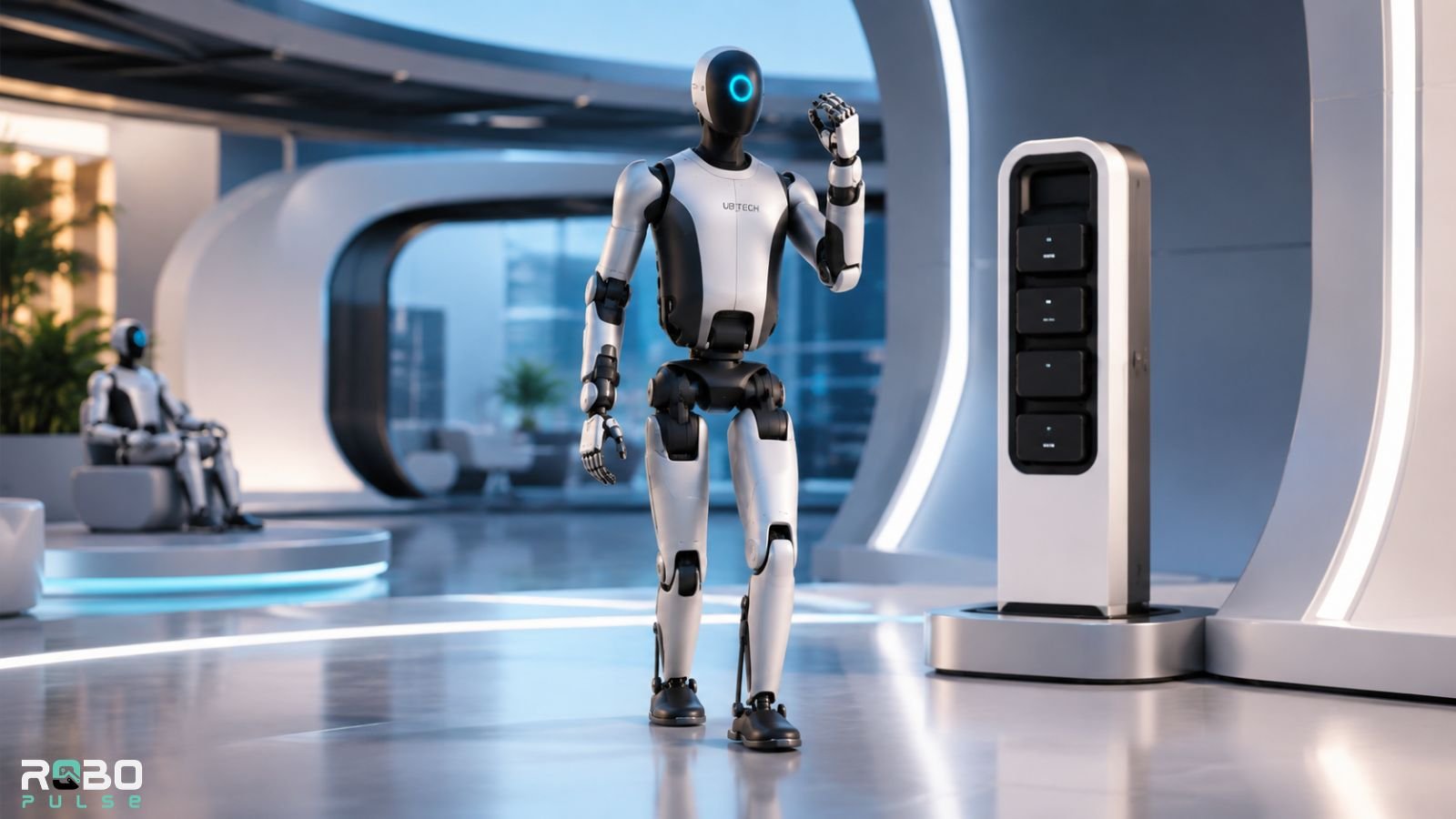
UBTECH’s Walker S2 is one of the few humanoid robots already shipping to real factories, not just demo stages. The company has never published a public price. Enterprise contracts and 2025 financial filings suggest buyers are paying somewhere in the low-to-mid six figures, depending on the deployment.
Here’s the quick version, then the detail behind each number.
| Item | Value |
|---|---|
| Status | Mass production, shipping since November 2025 |
| Manufacturer | UBTECH Robotics (Shenzhen) |
| Public price | Not published; contact sales only |
| Third-party price estimates | Roughly $90,000–$300,000, unconfirmed |
| Disclosed deal data | 1.3B+ yuan in cumulative Walker-series orders by year-end 2025 (from 800M in November); 1,079 units delivered across the Walker S line in 2025 |
| Known customers | BYD, Geely Auto, FAW-Volkswagen, Audi FAW, BAIC New Energy, Foxconn, SF Express, Fangchenggang border authority |
| Signature feature | Autonomous 3-minute battery swap |
| Availability | Enterprise contract only, no consumer sales |
Is the Walker S2 Real?
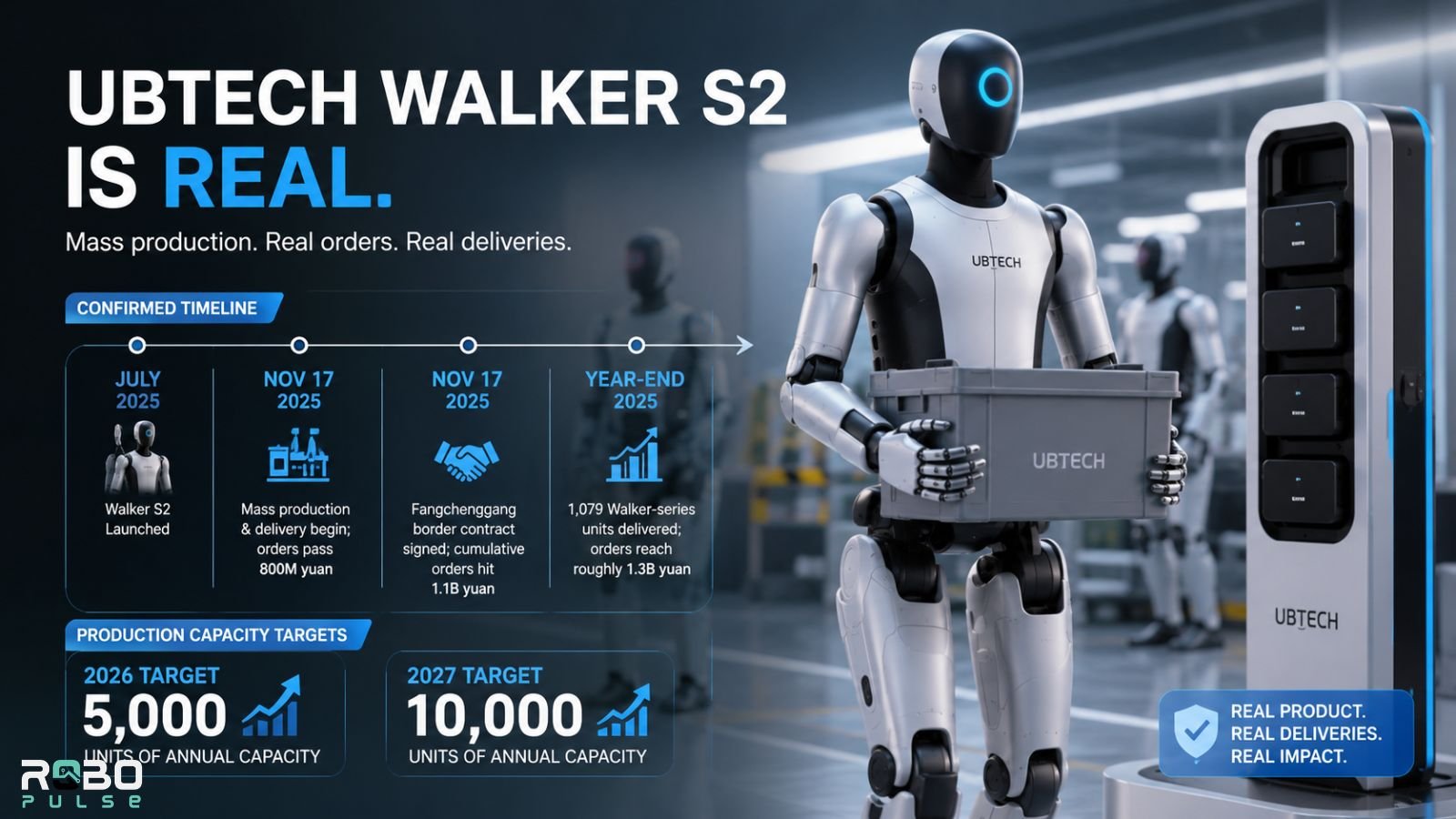
Yes. This isn’t a concept video — UBTECH began mass production and delivery in November 2025, shipping the first batch of several hundred units to industrial customers.
The company targeted 500 units delivered within 2025, scaling to 5,000 units of annual capacity in 2026 and 10,000 by 2027. Those are UBTECH’s own production goals, not independent confirmation the ramp will hit them. Humanoid production plans slip often industry-wide, and Walker S2 isn’t guaranteed to be the exception.
The confirmed timeline so far:
- July 2025 — UBTECH launches Walker S2
- Nov 17, 2025 — Mass production and delivery begin; orders pass 800M yuan
- Nov 25, 2025 — Fangchenggang border contract signed; cumulative orders hit 1.1B yuan
- Year-end 2025 — 1,079 Walker-series units delivered; orders reach roughly 1.3B yuan
- 2026 target — 5,000 units of annual capacity
- 2027 target — 10,000 units of annual capacity
How Much Does the Walker S2 Cost?
UBTECH hasn’t published an official price. Its product page routes every inquiry to a sales form, standard practice for industrial B2B robotics sold through direct contracts rather than a catalog.
Third-party trackers fill that gap with inconsistent numbers — estimates range from roughly $90,000 to $300,000 per unit, with some distributor pages quoting $160,000 or $180,000 plus a leasing option near $5,000 a month. None of these carry UBTECH’s confirmation. The spread itself is informative: this is contract-priced equipment, not a catalog item, so the real number depends on order volume, region, service package, and how much integration support gets bundled in.
The Order and Revenue Numbers That Do Exist
What is verifiable is deal-level data, and it moved fast in late 2025. UBTECH’s November 17 mass-production announcement cited over 800 million yuan in cumulative Walker-series orders since early 2025. By November 25 — after the Fangchenggang border contract was signed — the company put that figure at 1.1 billion yuan. Chinese financial media later reported cumulative Walker-series orders had reached roughly 1.3 billion yuan by year-end. Divide order value by unit counts at any of those checkpoints and the average lands in the low-to-mid six figures per robot — consistent with, though not identical to, the third-party estimates above.
UBTECH’s full-year 2025 results add a harder number: 1,079 full-size humanoid robots delivered for the year, generating roughly 820.6 million yuan (about $115 million) in humanoid revenue — a segment that grew over 2,200% year-on-year and became the company’s largest revenue line. Do that division yourself and you get roughly 760,000 yuan, or about $106,000, per unit.
That figure needs a caveat most coverage skips. The 1,079 units and the revenue behind them span three models — Walker S, Walker S1, and Walker S2 — not Walker S2 alone. UBTECH hasn’t broken out per-model pricing, and the three models aren’t priced the same. The ~$106,000 number is a real, calculable average, but it’s a blended average across three different products, not a Walker S2 price. Treat it as a useful anchor for “roughly what UBTECH gets paid per humanoid,” not a Walker S2 quote.
Why Doesn’t UBTECH Publish a Price?
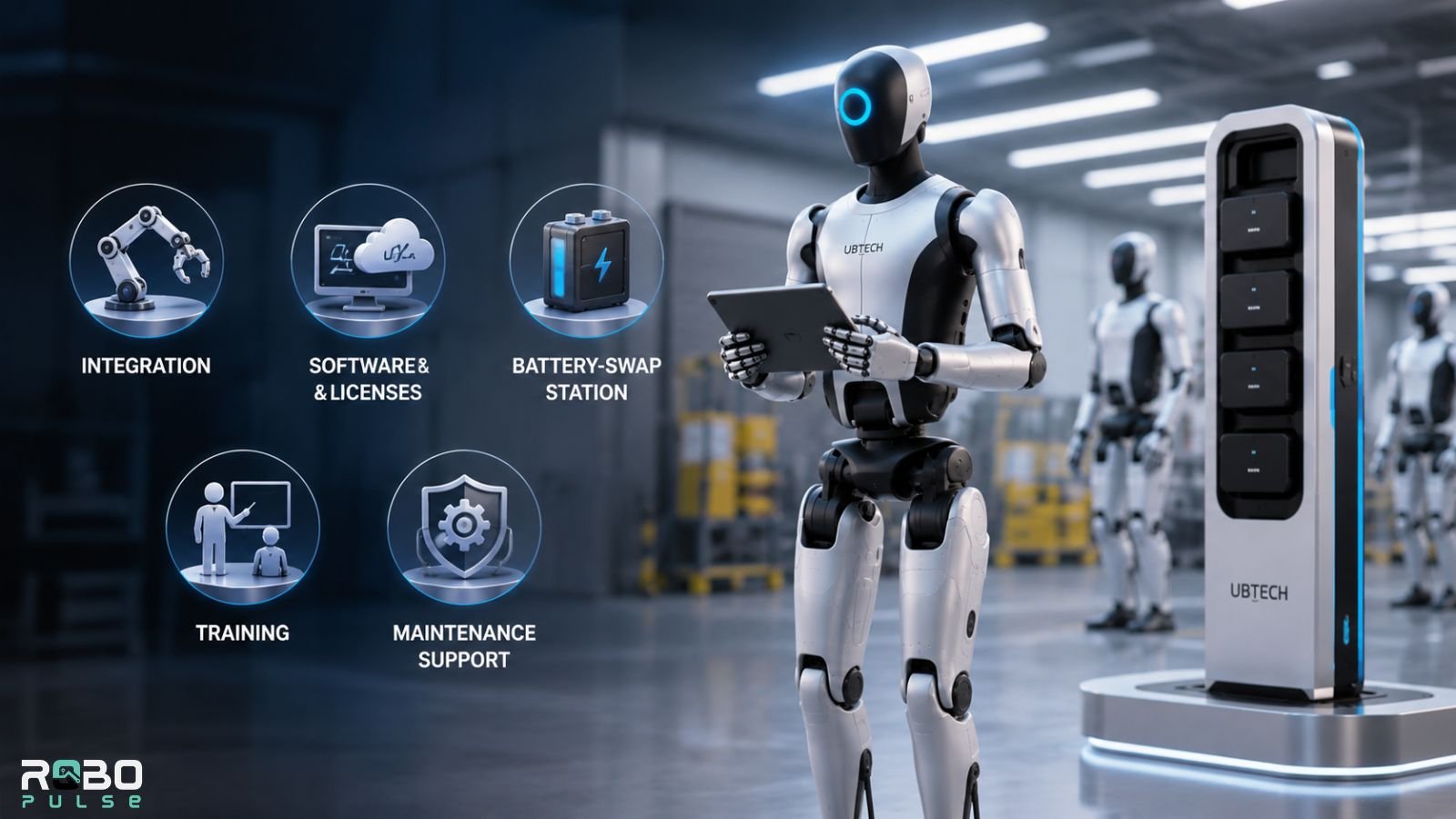
Industrial humanoid deals bundle far more than hardware: battery-swap station installation, software licensing for Co-Agent and BrainNet, factory integration work, operator training, and ongoing maintenance contracts. Two customers buying the “same” robot can end up with very different invoices depending on how much of that package they need — which is exactly why a single sticker price would misrepresent most deals.
What Can Walker S2 Actually Do?
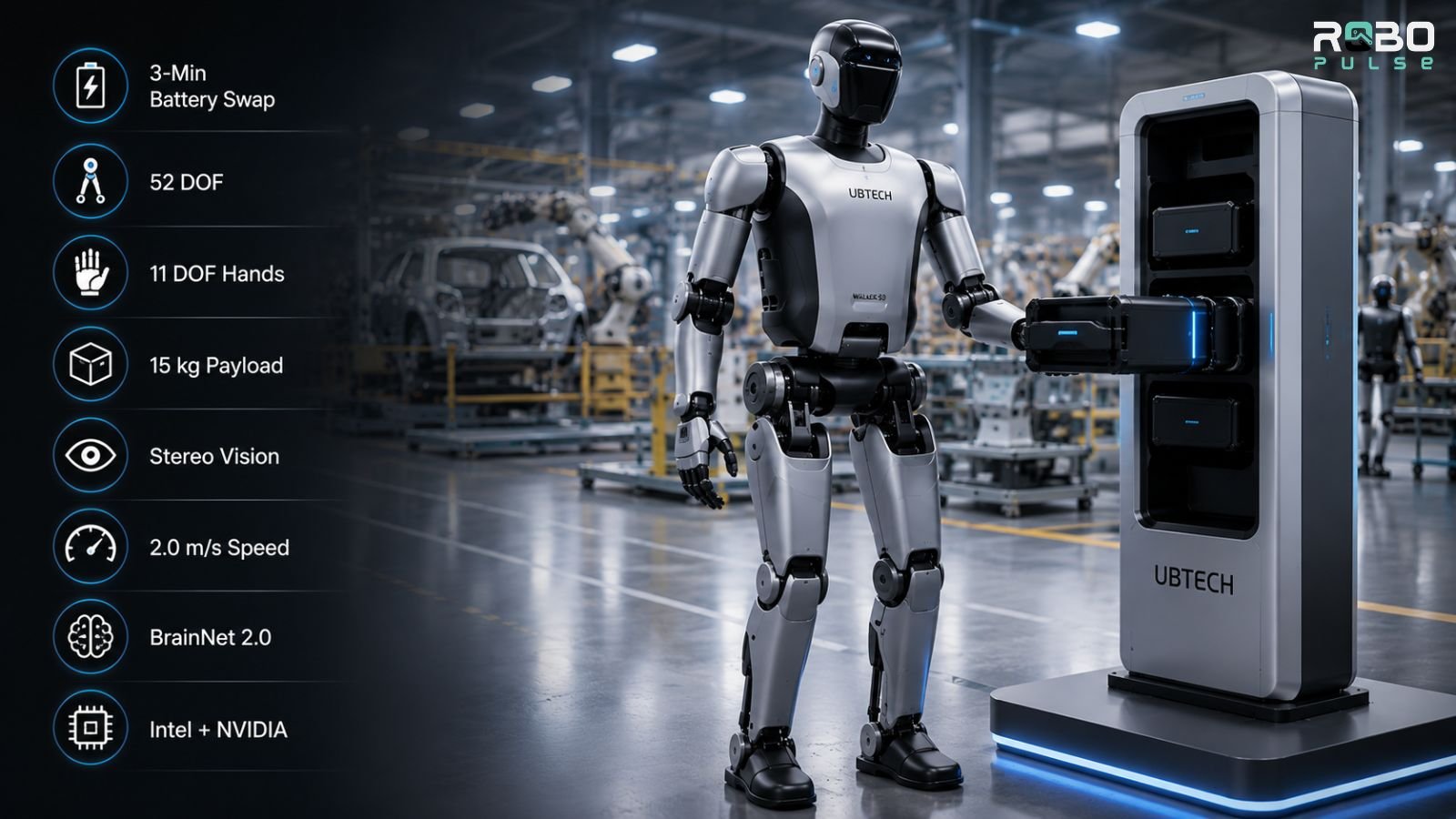
The standout feature is autonomous battery swapping. UBTECH describes Walker S2 as the first humanoid able to detect its own power state and swap a depleted battery for a charged one without human help, in about three minutes. The robot runs dual battery packs and can switch between single- and dual-battery modes, choosing between docking at a swap station or continuing to charge based on task priority.
This solves the biggest operational complaint about earlier industrial humanoids: a robot that needs to be walked over to a charger and babysat can’t run a real 24/7 shift. One that manages its own power budget can, at least on paper.
For perception, Walker S2 uses passive RGB binocular stereo vision in the head, generating real-time depth maps through deep-learning stereo estimation rather than structured light or lidar alone. Task intelligence runs through UBTECH’s Co-Agent system paired with BrainNet 2.0, letting fleets of robots coordinate on a shared production line instead of operating as isolated units.
Walker S2 Specifications
UBTECH’s own product page doesn’t publish a numbered spec sheet. The figures below are the ones that show up consistently across independent trackers, robotics retailers, and press coverage of the border and factory deployments — well-corroborated industry reporting, not a manufacturer datasheet.
| Spec | Walker S2 |
|---|---|
| Height | ~1.76 m |
| Degrees of freedom | 52 |
| Hands | Gen-4 dexterous, 11 DOF each |
| Max payload | 15 kg, ±162° waist rotation |
| Walking speed | Up to 2.0 m/s |
| Balance range | 125° pitch, 0–1.8 m workspace |
| Compute | Intel Core i7-1185G7 (real-time control) + NVIDIA Jetson AGX Orin (vision/AI) |
| Vision | Passive RGB binocular stereo |
| OS/stack | Ubuntu + UBTECH ROSA 2.0 |
| AI platform | Co-Agent + BrainNet 2.0 |
| Battery | Dual-pack, 3-minute autonomous swap |
| Runtime per pack | ~2 hours walking / ~4 hours standing, ~90-min full recharge (reported, not UBTECH-confirmed) |
Officially stated by UBTECH: the battery-swap architecture, the 15 kg / ±162° waist spec, the 125° pitch and 1.8 m workspace figures, and the stereo vision description. Everything else in the table is industry-reported, repeated closely enough across unrelated sources to trust, but not yet formalized on UBTECH’s own materials.
This table skips weight deliberately. Sources that otherwise agree closely on height and DOF disagree wildly on weight — figures in circulation range from about 43 kg to roughly 70 kg, which is too wide a spread to average into a single “reported” number without misleading readers.
Walker S vs. Walker S1 vs. Walker S2
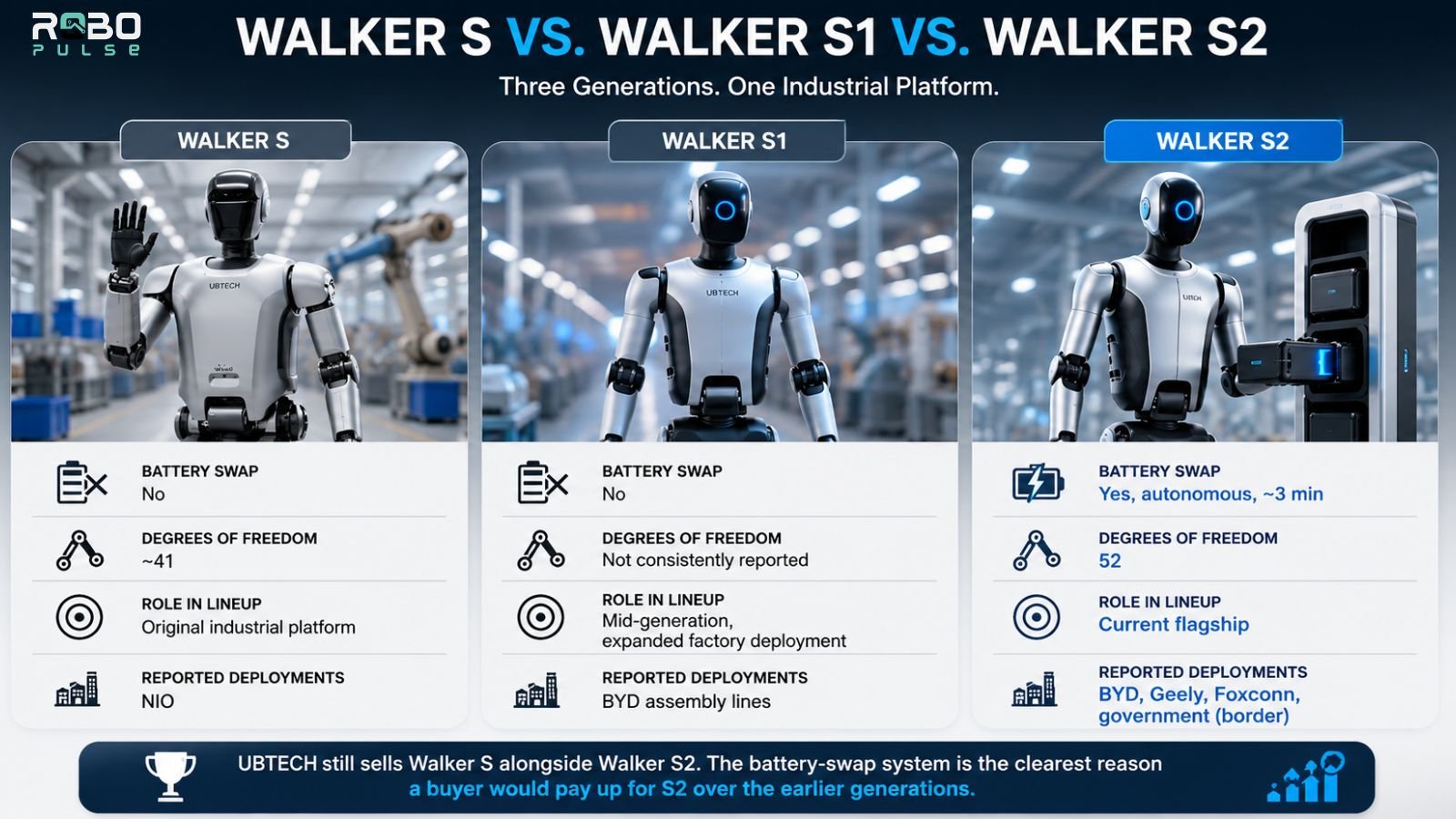
UBTECH now sells three generations of the same industrial platform side by side, and coverage rarely separates them cleanly. Here’s the shape of the difference, kept to what’s consistently reported rather than the exact numbers some sites overstate:
| Walker S | Walker S1 | Walker S2 | |
|---|---|---|---|
| Battery swap | No | No | Yes, autonomous, ~3 min |
| Degrees of freedom | ~41 | Not consistently reported | 52 |
| Role in lineup | Original industrial platform | Mid-generation, expanded factory deployment | Current flagship |
| Reported deployments | NIO | BYD assembly lines | BYD, Geely, Foxconn, government (border) |
UBTECH still sells Walker S alongside Walker S2 rather than discontinuing it, so “which one costs more” isn’t a settled question publicly — the battery-swap system is the clearest reason a buyer would pay up for S2 over the earlier generations.
Where Is Walker S2 Actually Deployed?
UBTECH names real industrial partners rather than pilot-program platitudes: BYD, Geely Auto, FAW-Volkswagen Qingdao, Audi FAW, BAIC New Energy, Foxconn, Dongfeng Liuzhou Motor, and SF Express. Confirmed use cases include automotive assembly and quality inspection, intelligent logistics, and data-collection center operations.
Automakers don’t sign six- and seven-figure contracts for equipment that can’t hold up on a real line, so the customer list is itself a form of validation — though it doesn’t tell you unit-level reliability or how many robots are still running six months later, since UBTECH hasn’t disclosed that.
The Fangchenggang Border Deployment
The most notable deployment outside a factory is a government contract. In November 2025, the South China Morning Post reported a 264-million-yuan (roughly $37 million) deal to deploy Walker S2 at the Fangchenggang border crossing in Guangxi, on China’s frontier with Vietnam. By July 2026, multiple outlets confirmed the robots were live — guiding passenger queues, answering routine questions, and scanning cargo manifests, with human customs officers reviewing the results rather than the robots acting on them autonomously.
It’s a harder environment than a factory floor: coastal humidity, constant vehicle and foot traffic, and no tolerance for downtime. Chinese authorities have signaled a successful run there could lead to airport and rail-station rollouts, though that’s a stated intention, not a confirmed next step. Enterprises weighing a subscription-style entry point rather than a direct purchase can also look at how China’s broader humanoid rental market is shaping pricing expectations across the industry.
Walker S2 vs. Optimus and Other Humanoids
Walker S2 and Tesla’s Optimus sit at opposite ends of the same bet. Optimus is chasing a much lower price point at scale, while UBTECH is proving out factory and government deployment now, at a materially higher price.
One note on naming: Tesla has teased a redesigned “Gen 3” or “V3” Optimus, but as of its July 2026 earnings call, that version remained unrevealed, with production “anticipated later this year” for the current-generation line at Fremont. The table below uses Gen 2, the only version with published specs; RoboPulse’s Optimus coverage tracks the V3 transition as it firms up.
| Metric | UBTECH Walker S2 | Tesla Optimus (Gen 2, current) | Figure 03 | Unitree G1 |
|---|---|---|---|---|
| Price signal | No public price; deal data implies low-to-mid six figures | $20,000–$30,000 target (unconfirmed, no external sales) | No public unit price; BMW deployment billed near $25/robot-hour | ~$13,500–$19,990, official |
| Power strategy | Autonomous 3-min battery swap | Plug-in charging | Plug-in charging | Plug-in charging |
| Max payload | 15 kg | ~20 kg (manufacturer claim) | Not independently confirmed | Not built for heavy payload work |
| Availability | Enterprise contract, in mass production | Internal Tesla use only | Enterprise pilot (BMW), not for sale | Ships direct to buyers today |
Only Unitree confirms its G1 price at the source — everything else here is either a stated target with no sales behind it (Optimus) or a billing arrangement rather than a purchase price (Figure 03). The compare tool can go deeper on any of these dimensions for your specific use case, and the full robot database covers specs for every platform mentioned here.
Should You Consider Walker S2?
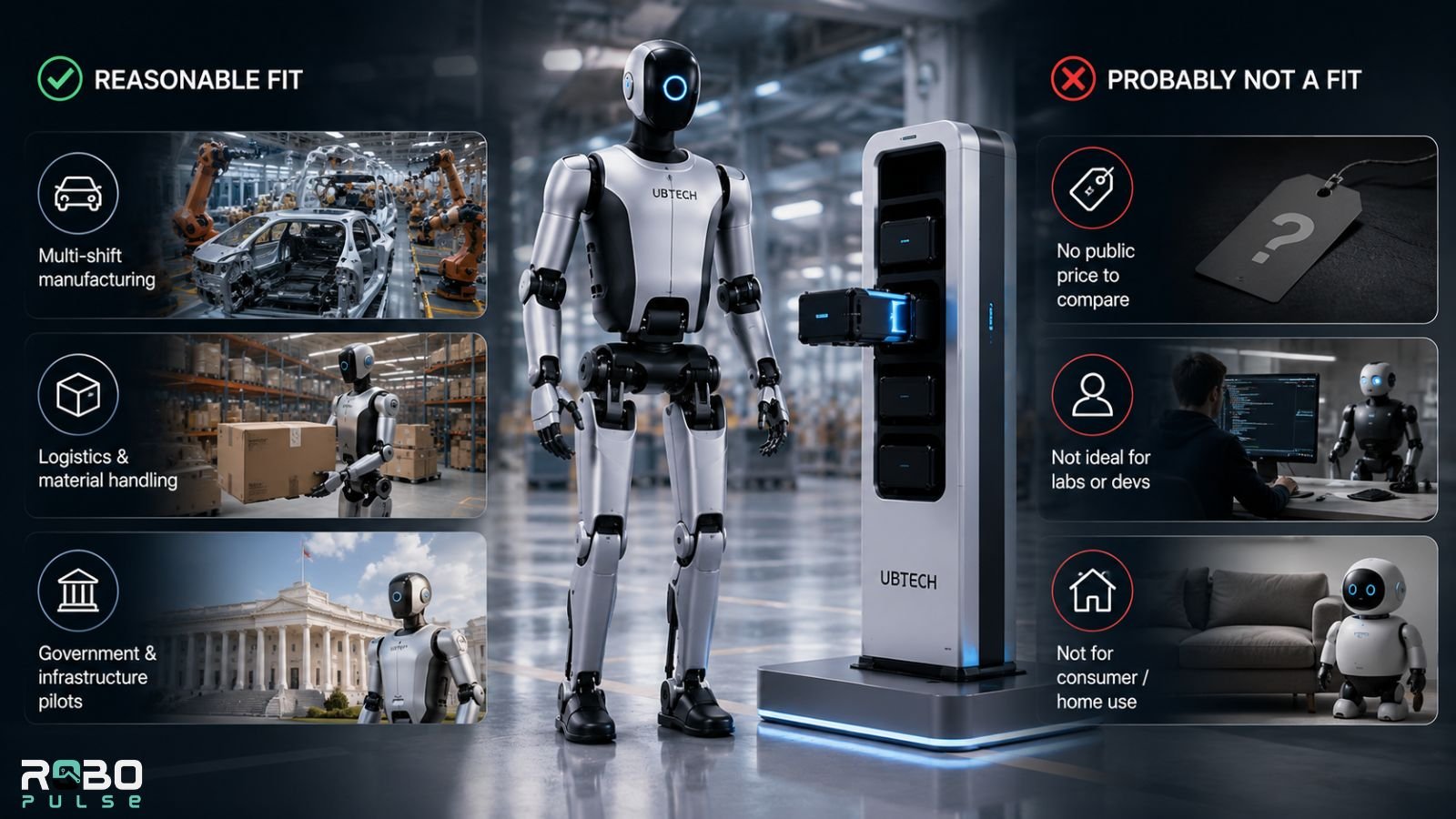
Reasonable fit for:
- Automotive or heavy-manufacturing lines needing sustained multi-shift uptime
- Logistics or material-handling operations where 15 kg payload and a 1.8 m reach cover the job
- Government or infrastructure pilots willing to fund a bespoke integration contract
Probably not a fit for:
- Anyone comparing against a public list price — there isn’t one to compare against
- Smaller labs or developers who want to buy hardware directly and start building same week (the Unitree G1 fits that need far better)
- Consumer or home use — UBTECH sells a separate companion robot line for that market, not Walker S2
What We Still Don’t Know
- An official list price or per-model pricing breakdown
- Confirmed weight (sources disagree by close to 30 kg)
- Unit-level failure or maintenance-interval data from real deployments
- Fleet uptime figures from any of the named customers
- Warranty terms for enterprise buyers
What Are People Saying About Walker S2 Online?
A meaningful share of search traffic comes from a viral clip of the robot rallying tennis balls. Real user reaction on Reddit and social platforms treats it as an impressive but clearly staged demo rather than proof of general-purpose dexterity — a read that matches how UBTECH itself frames the robot, as an industrial tool rather than a consumer novelty. Community sentiment provides useful context, but it does not verify the Walker S2’s real-world performance.
FAQ
Q. Is the UBTECH Walker S2 available for consumer purchase?
No. The UBTECH Walker S2 is not available for individual or consumer purchase. It is sold exclusively through enterprise contracts and industrial distributors for factory automation, logistics, and government deployments. UBTECH does not offer the Walker S2 through retail channels or publish a public list price.
Q. How long can the UBTECH Walker S2 run on a single charge?
UBTECH has not published an official runtime for the Walker S2 on a single battery charge. Instead, the robot uses a dual-battery system with autonomous battery swapping, allowing it to replace a depleted battery in about three minutes without human intervention. This design minimizes downtime and supports continuous industrial operation.
Q. What’s the difference between the Walker S2, Walker S, and Walker S1?
The UBTECH Walker S2 is the latest flagship model in the Walker humanoid lineup. Its biggest upgrade is an autonomous battery-swapping system, enabling continuous operation without manual charging. Earlier models, Walker S and Walker S1, do not include this capability, although UBTECH continues to sell all three platforms for different enterprise applications.
Q. Which companies are using the UBTECH Walker S2?
The UBTECH Walker S2 has been deployed by several major industrial and government organizations. Publicly disclosed customers include BYD, Geely Auto, FAW-Volkswagen Qingdao, Audi FAW, BAIC New Energy, Foxconn, SF Express, and the Fangchenggang border authority. Major manufacturers and government agencies use the UBTECH Walker S2 for automotive manufacturing, logistics, inspection, and intelligent infrastructure operations.
Q. How much does the UBTECH Walker S2 cost?
UBTECH has never disclosed an official price for the Walker S2. Third-party estimates generally range between $90,000 and $300,000, but these figures remain unconfirmed. Based on UBTECH’s reported 2025 revenue and deliveries, the average selling price across the Walker S, Walker S1, and Walker S2 lineup works out to roughly $106,000 per robot. Since this is a blended average rather than a model-specific price, it should be treated as a useful benchmark rather than the actual Walker S2 price.
Q. How many UBTECH Walker S2 robots have been delivered?
UBTECH reported delivering 1,079 full-size humanoid robots during 2025, but this figure includes the entire Walker series—Walker S, Walker S1, and Walker S2. The company has not disclosed how many of those units were specifically Walker S2 robots.
Q. Is the UBTECH Walker S2 really deployed at a border crossing?
Yes. The UBTECH Walker S2 is operating at the Fangchenggang border crossing between China and Vietnam. Under a reported $37 million contract, the humanoid robots assist with passenger guidance, cargo inspection support, and routine information services while human customs officers remain responsible for final decisions.
Q. Can the UBTECH Walker S2 really play tennis?
Yes. The UBTECH Walker S2 can rally tennis balls in controlled demonstrations, showcasing its balance, vision, and motion control. However, those demonstrations do not show human-level dexterity or general-purpose manipulation. UBTECH designed the Walker S2 for industrial applications, including manufacturing, logistics, and inspection, rather than sports or entertainment.
Related: The Future of Work Isn’t Humans vs Robots — It’s Humans, AI Agents, and Robots Together