

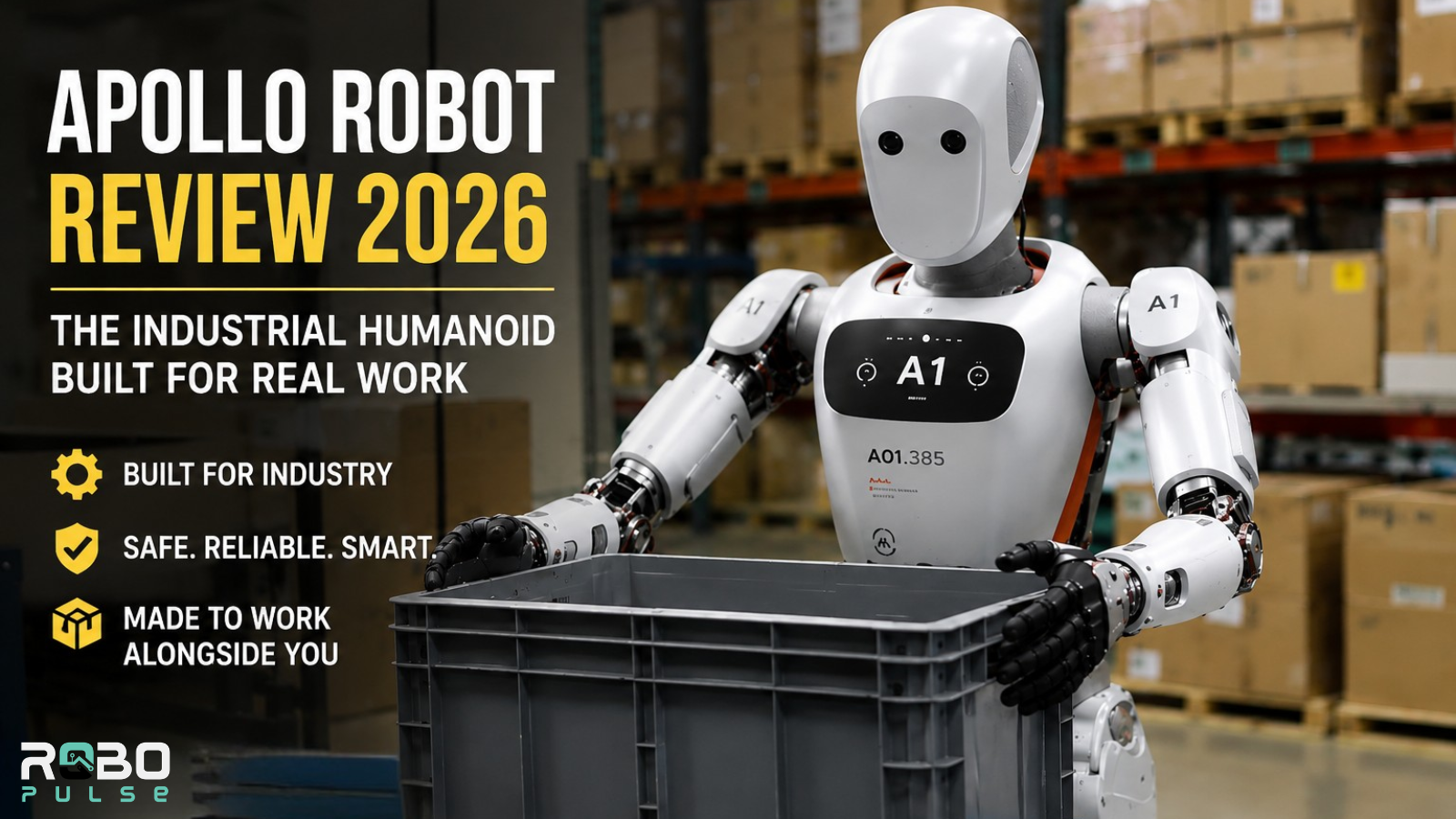
In February 2026, Apptronik closed a funding round, bringing total capital raised to nearly $1 billion, with Google and Mercedes-Benz as lead backers and a post-money valuation of approximately $5.3 billion. Confirmed deployments are live at Mercedes-Benz, GXO Logistics, and Jabil — the global manufacturing partner that also produces Apollo at scale.
Behind the hardware sits a company that has built over ten previous robots before Apollo, including NASA’s Valkyrie. That engineering pedigree matters: Apollo isn’t a first-generation platform discovering edge cases in production. It’s a robot whose architecture reflects years of handling failure modes that spec sheets don’t capture.
This review covers hardware, AI, battery system, deployments, pricing, competitive comparison, and honest limitations.
Quick Verdict
RoboPulse Score: 9.0 / 10
Apollo is among the most commercially credible humanoid robots in active industrial deployment in 2026. The combination of 25 kg payload, hot-swappable battery continuity, confirmed NVIDIA GR00T AI integration, and deployments across three industrial sectors builds a platform whose credibility comes from engineering decisions and deployment results — not press releases.
Current enterprise pricing puts Apollo out of reach for mid-market buyers. For well-capitalised industrial operators with structured, high-volume use cases, it delivers.
Apollo at a Glance
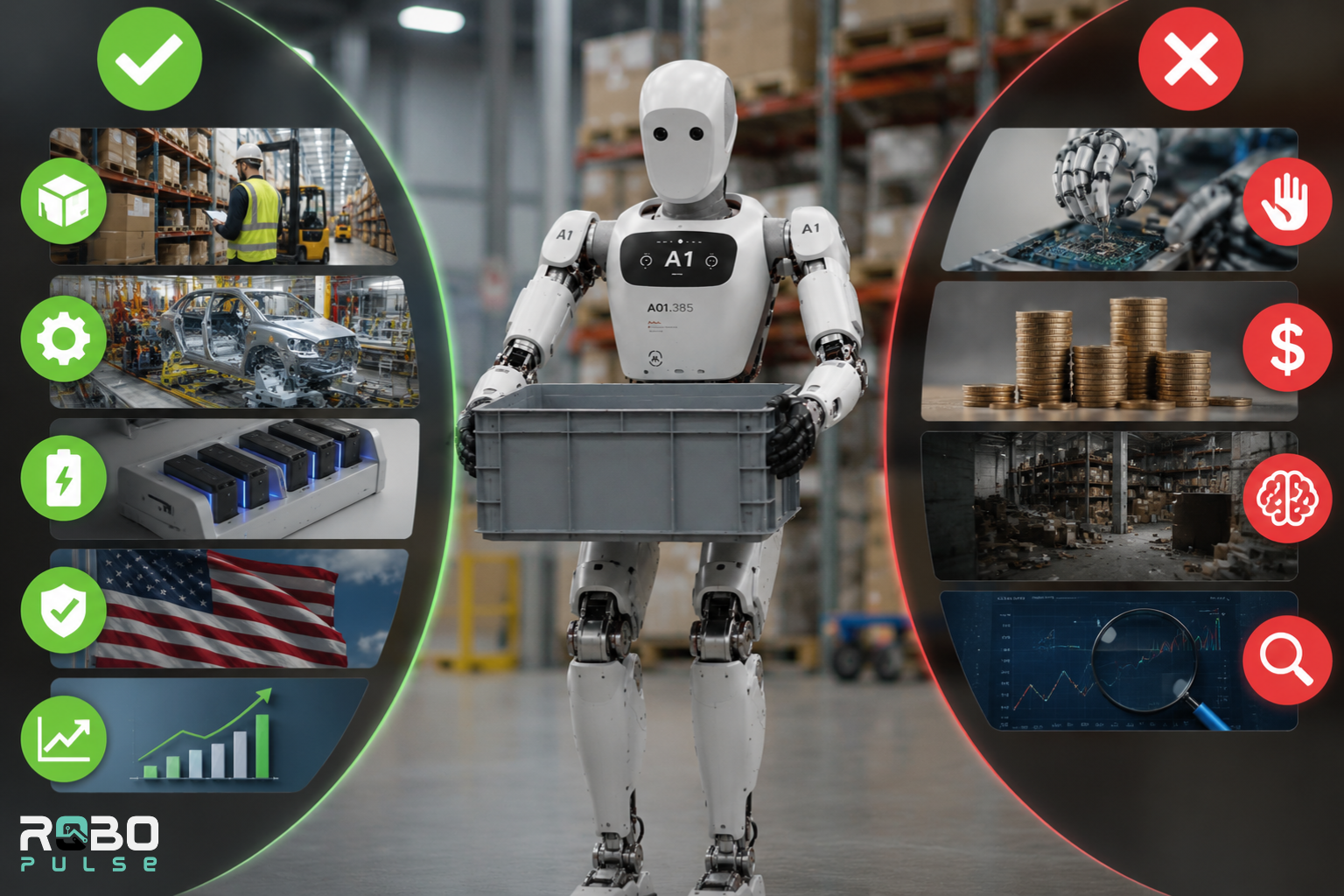
| ✅ Apollo Strengths | ❌ Apollo Weaknesses |
|---|---|
| Highest payload among major US humanoids (25 kg) | Enterprise pricing (~$200k+) locks out mid-market |
| Hot-swappable batteries for multi-shift operations | Battery rotation requires active operational planning |
| NVIDIA Project GR00T AI — confirmed integration | Less dexterous than Figure 02 for precision assembly |
| Confirmed deployments: Mercedes-Benz, GXO Logistics, Jabil | Limited publicly verified deployment case studies |
| NASA engineering heritage; not a first-generation platform | AI generalisation in unpredictable environments is still maturing |
| Nearly $1B raised; Google + Mercedes-Benz backers | Bipedal locomotion sensitive to floor conditions |
| Three modular configs: bipedal, wheeled, stationary |
Who Is Apollo For?
Best for:
- Warehouses and logistics operators with repetitive, high-volume, physically demanding tasks
- Manufacturing facilities that need humanoid deployment without infrastructure redesign
- Multi-shift operations where hot-swap battery continuity is a practical operational advantage
- Organisations that require US-based hardware, support, and supply chain reliability
- Industrial buyers who prioritise deployment track record over the lowest current price
Not the right choice for:
- Precision dexterous assembly — Figure AI’s 16-DOF hands lead on that dimension
- Mid-market buyers with budget constraints — 2026 enterprise costs are substantial
- Buyers who need highly unpredictable environments handled at the edge of AI generalisation
- Buyers who require detailed, publicly verified deployment case studies before committing
Apollo Robot Specifications
| Feature | Apollo Details |
|---|---|
| Payload | 55 lbs (≈25 kg) |
| Degrees of Freedom | 71 DoF |
| Walking Speed | 3.4 km/h |
| Runtime | 4 hours per battery pack |
| Battery System | Hot-swappable + plug-in option |
| AI Framework | NVIDIA Project GR00T + Google DeepMind Gemini Robotics |
| Hand Design | Five-finger hands |
| Modular Design | Bipedal legs · Wheeled base · Stationary pedestal |
| Est. Price | ~$50,000 long-term target (~$200k+ current enterprise) |
Core specs verified from Apptronik’s official Apollo product page. Walking speed from industry reporting. DoF, AI architecture, pricing, and deployment details are drawn from industry sources and the RoboPulse Database.
What Tasks Can Apollo Perform?
Apptronik has published five confirmed operational solutions — active commercial development areas, not roadmap aspirations:
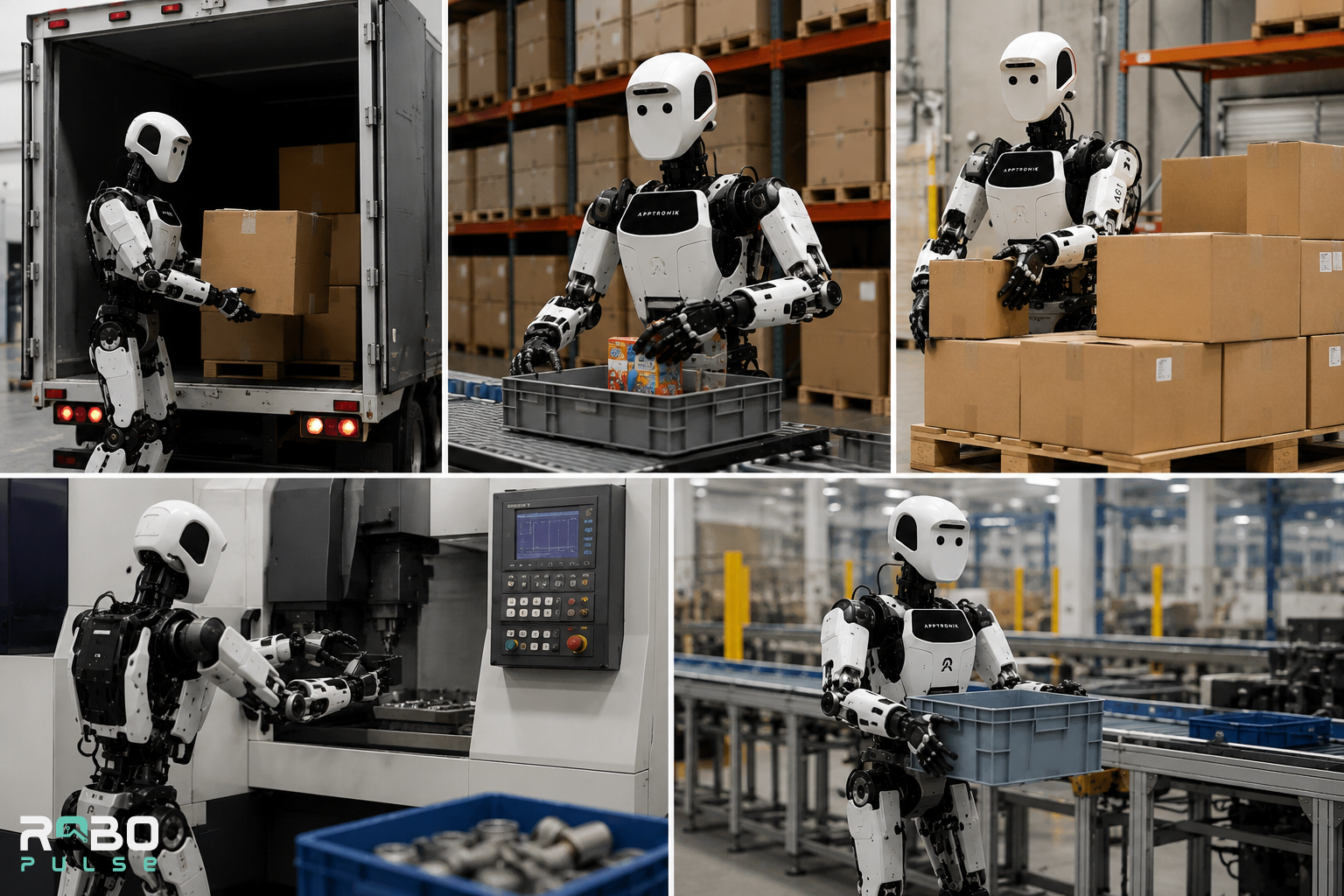
Trailer Unloading — The most physically demanding and injury-prone task in logistics. Apollo’s 25 kg payload and human-scale reach handle it without trailer modifications.
Case Picking — High-volume, repetitive warehouse work. No fatigue, no injury risk, no end-of-shift degradation.
Palletization — Consistent load building reduces errors and removes one of the highest injury-rate roles in warehouse operations.
Machine Tending — Loading materials, removing completed parts, and maintaining machine cycles. Straightforward ROI against displaced labour cost.
Workcell Delivery — Moving components between workstations. Replaces human runners and specialised AGVs that require dedicated infrastructure.
Real-World Deployments
Apollo has confirmed deployments across three industrial sectors — a track record no competitor in this comparison currently matches.
| Partner | Role | Sector |
|---|---|---|
| Mercedes-Benz | Lead backer and manufacturing deployment site | Automotive manufacturing |
| GXO Logistics | Active warehouse trials | Third-party logistics / 3PL |
| Jabil | Manufacturing partner and live deployment site | Electronics manufacturing |
Mercedes-Benz is both a financial backer and an active deployment partner — a stronger signal than either alone. Automotive manufacturers apply hard criteria: labour efficiency, safety compliance, operational scalability, and multi-year ROI. The relationship reflects performance accountability, not speculative interest.
GXO Logistics operates high-volume, multi-client fulfillment environments where Apollo’s task profile — trailer unloading, case picking, palletization — maps most cleanly. For procurement teams in 3PL and warehousing, this is the most directly relevant data point.
Jabil is both the production partner and a live validation site. Newly manufactured Apollo units complete real-world tasks on Jabil’s own production lines before shipping to customer sites. The long-term goal: Apollo robots building more Apollo robots. Jabil’s global manufacturing footprint gives Apptronik production flexibility without requiring proprietary factory infrastructure from scratch.
Specific deployment details — unit counts, task scope, production line configurations — are based on industry reporting. Verify specifics directly with Apptronik.
Apollo’s AI Architecture
Apollo runs two distinct AI layers — separating physical reflexes from high-level reasoning.
NVIDIA Project GR00T (onboard): Running via NVIDIA Jetson AGX Orin and Jetson Orin NX, GR00T handles real-time physical intelligence — spatial awareness, path planning around shifting pallets, grip force adjustment, and obstacle avoidance. This is a confirmed integration.
Google DeepMind Gemini Robotics (semantic layer): Backed by Google’s lead investment, Apptronik is co-developing next-generation behaviours with Google DeepMind. This layer processes open-ended natural language instructions and handles unfamiliar objects without retraining. A warehouse supervisor saying “clear the damaged inventory from Aisle 4″ is a valid instruction. Apollo watches demonstrations, understands instructions, plans multi-step procedures, and adapts when conditions change.
| Capability | What It Does |
|---|---|
| Dynamic Path Planning | Real-time navigation around obstacles without pre-mapped tracks |
| Generalisable Manipulation | Handles novel object geometries without explicit SKU programming |
| Force-Reflective Control | Adjusts grip pressure in real time based on object resistance |
| Natural Language Instructions | Responds to spoken operational commands |
Verify current AI capabilities and integration scope directly with Apptronik before procurement.
Apollo’s Battery System
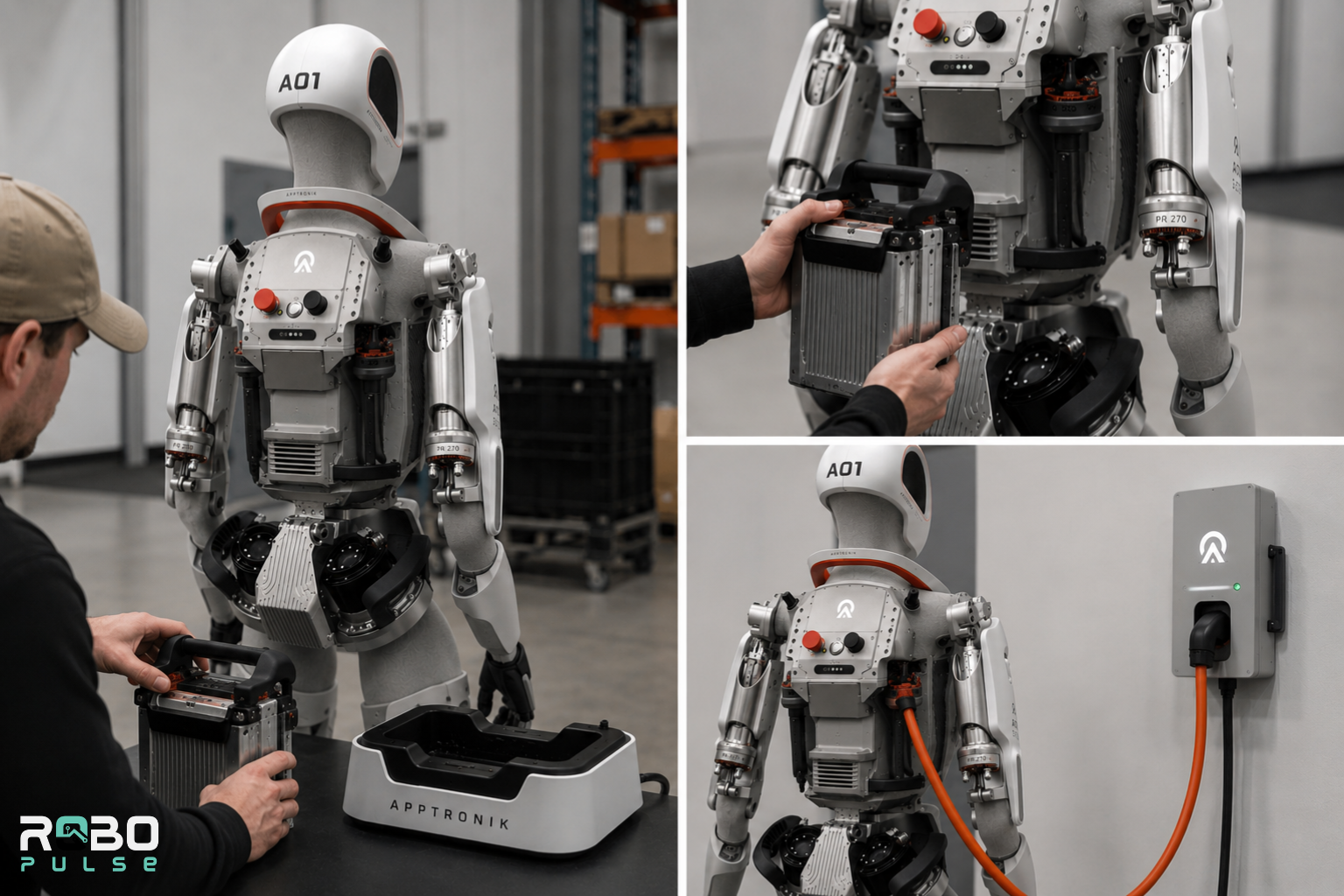
Each battery pack delivers 4 hours of runtime. Packs hot-swap in minutes — no charging downtime, no robots parked idle between shifts.
Battery rotation becomes a managed inventory task rather than a hard constraint on utilisation. A depleted pack comes out, a charged pack goes in, and Apollo returns to the floor within minutes. Most industrial facilities already manage consumables at exactly this level. Apollo fits that existing workflow rather than creating a new one.
A plug-in tethered charging option is also available for fixed-station deployments.
Apollo vs Agility Digit vs Tesla Optimus vs Figure 02
| Specification | Apollo | Agility Digit | Tesla Optimus | Figure 02 |
|---|---|---|---|---|
| Developer | Apptronik (TX) | Agility Robotics (OR) | Tesla (TX) | Figure AI (CA) |
| DoF | 71 DoF | 20–24 DoF | 22 DoF (hands only) | ~41 DoF (est.) |
| Payload | ≈25 kg | ≈16 kg | ~20 kg (est.) | 20 kg |
| Battery | Hot-swap 4-hr | Autonomous dock | Internal dock | Wired / dock (est.) |
| Hand Design | Five-finger | Functional effectors | 22 DoF (Gen 2) | 16-DOF dexterous |
| AI System | NVIDIA GR00T + Gemini | Agility Arc cloud | Tesla Autopilot | Helix VLA (onboard) |
| Deployments | Mercedes, GXO, Jabil | Amazon fulfillment | Tesla Gigafactories | BMW + pilots |
| Availability | Enterprise partnerships | Enterprise partnerships | Internal only | Limited pilots |
| Est. Price | $50k target (~$200k+ now) | ~$250,000 | Sub-$20k long-term | ~$20k–$30k (est.) |
Specifications marked as estimates are based on industry sources. For full side-by-side comparisons of humanoid robots, use the RoboPulse Compare Tool.
Quick winner by category:
| Category | Winner |
|---|---|
| Payload Capacity | Apollo |
| Multi-Shift Operations | Apollo |
| Industrial Readiness (2026) | Apollo |
| Confirmed Deployments at Scale | Agility Digit (Amazon) |
| Hand Dexterity | Figure 02 |
| Long-Term Cost Target | Tesla Optimus |
How they actually differ:
Apollo leads on payload at ≈25 kg — paired with a hot-swap battery system built for continuous multi-shift operation. Its brownfield-compatible design drops into existing warehouse and manufacturing footprints without SOP changes.
Agility Digit holds the deployment credibility edge at scale. Digit became the first commercial humanoid to pass an OSHA-recognised safety field inspection at a live e-commerce fulfillment site. The Amazon at-scale deployment is confirmed and operational. The trade-off: narrower task focus and a 16 kg payload ceiling.
Tesla Optimus is the most consequential long-term variable. As of mid-2026, Optimus runs in limited pilot capacity across select Tesla Gigafactories — but remains locked to Tesla’s internal fleet. The sub-$20,000 long-term price target is a genuine potential market disruptor. For deployment decisions that need to happen in 2026, Optimus is a watchlist item, not a shortlist one.
Figure 02 is Apollo’s closest direct competitor for industrial buyers who also need precision manipulation. Its 16-DOF dexterous hands are the strongest system in this group — a real advantage for precision assembly where Apollo’s five-finger design reaches its limits. Apollo counters with higher payload, broader overall mobility, and a stronger confirmed industrial track record. The newer Figure 03 builds on this foundation with further refinements in design and capability.
Verdict by use case:
- Choose Apollo if a payload above 20 kg is required, hot-swap continuity suits your shift structure, and multi-task deployment flexibility is the priority.
- Choose Agility Digit if warehouse tote handling is the primary use case and OSHA-validated deployment credentials are a procurement requirement.
- Choose Tesla Optimus if you’re planning for 2027–2028 and want the most cost-aggressive long-term platform, while accepting that external availability is not confirmed.
- Choose Figure 02 if precision dexterous manipulation is the primary requirement, and you can work within the current pilot-stage availability.
Apollo Robot Price and Total Cost of Ownership
Apptronik has not published official retail pricing. Industry sources estimate current enterprise deployment costs at $200,000+, including hardware, integration, and support. The long-term manufacturing target is approximately $50,000 per unit as production scales.
Model TCO across a realistic deployment horizon — not hardware price alone:
| Cost Category | Consideration |
|---|---|
| Hardware | Unit cost + spare components |
| Integration | WMS connectivity, facility configuration, SOP updates |
| Software / Maintenance | Annual agreements, model updates, support contracts |
| Battery Infrastructure | Charging bay setup, pack rotation management |
| Labour Displacement | Value of tasks replaced × shift hours × operational weeks |
Industry comparisons suggest well-deployed humanoid platforms in high-volume logistics can reach $10–15 per operating hour at scale — competitive with fully-loaded human labour costs in most developed markets. That number shifts materially depending on local labour costs, deployment volume, and task mix. Model your specific context.
Biggest Limitations of the Apollo Humanoid Robot
Battery rotation requires active planning. Four hours per pack means facilities deploying Apollo at fleet scale need a battery management workflow from day one: packs charged, staged, and available for swap on a defined rotation schedule. The hot-swap architecture eliminates downtime, but it introduces a logistics requirement that autonomous dock-charging platforms don’t have.
Bipedal locomotion has specific floor constraints. Floor slopes, threshold lips, drainage grates, wet surfaces, and uneven industrial flooring challenge bipedal locomotion in ways controlled demonstrations don’t reveal. Facilities should assess floor conditions across the full intended operating area. The wheeled base configuration resolves this for flat-floor environments.
Current pricing locks out the mid-market. Enterprise deployment costs in the $200,000+ range put Apollo out of reach for mid-market industrial operators — even those with quantifiable ROI cases. The $50,000 target depends on the production scale still being built.
AI generalisation in unpredictable environments. Apollo performs reliably in structured industrial contexts with defined task parameters. As environments become less predictable, the generalisation challenge grows. Large-scale deployment data accumulated over time will determine how well Apollo handles genuine operational variability at the edges.
Performance Scores
| Category | Score /10 | What It Means |
|---|---|---|
| Dexterity | 8.8 | Five-finger hands handle industrial tasks reliably — precision manipulation trails 16-DOF systems |
| AI / Intelligence | 9.0 | Dual-layer AI: NVIDIA GR00T + Gemini Robotics — among the strongest confirmed AI stacks in the category |
| Value for Money | 6.0 | Current ~$200k+ enterprise costs are high; long-term $50k target substantially changes the ROI equation |
| Hype Ratio | 8.2 | Lower public profile than some competitors — deployment credibility is consistently underreported |
| Real-World Usefulness | 8.5 | Deployment-first design produces tangible results in structured industrial environments |
| Build Quality | 8.8 | NASA-heritage engineering and industrial-grade construction throughout |
| Overall | 9.0 / 10 |
Final Verdict
RoboPulse score: 9.0 / 10
The Apptronik Apollo earns its standing as one of the most commercially credible humanoid platforms in active industrial deployment in 2026. Confirmed NVIDIA GR00T and Google DeepMind Gemini Robotics AI integration, a hot-swappable battery system, 25 kg payload, deployments at Mercedes-Benz, GXO Logistics, and Jabil, and nearly $1 billion in capital raised at a ~$5.3 billion valuation — this is a platform whose credibility comes from engineering decisions and deployment results.
It is not the most dexterous platform in the category. It does not carry the highest public profile. Also, it is not the cheapest option in 2026.
What Apollo is: a robot engineered to do real industrial work, in real facilities, without requiring those facilities to change around it. The buyers who get genuine value today are large industrial operators with the capital to absorb current enterprise pricing, a structured deployment use case, and the operational infrastructure to manage battery rotation at fleet scale.
If the use case fits and the budget supports it, Apollo delivers.
For full specifications and cross-platform context, refer to available industry data and deployment records.
Frequently Asked Questions
Q. What is Apollo Robot?
Apollo is a general-purpose humanoid robot developed by Apptronik, based in Austin, Texas. It operates in warehouses, manufacturing facilities, and logistics operations built for human workers — without requiring infrastructure redesign.
Q. Who makes Apollo Robot?
Apollo is developed by Apptronik, an Austin, Texas robotics company that built over ten previous robots — including NASA’s Valkyrie — giving it one of the deepest engineering pedigrees in the commercial humanoid field.
Q. How much does an Apollo Robot cost?
Apptronik has not published official retail pricing. Industry sources estimate current enterprise deployment costs in the $200,000+ range, with a long-term manufacturing target around $50,000 per unit. These are industry estimates — not confirmed by Apptronik. Contact Apptronik directly for current pricing.
Q. How long does Apollo’s battery last?
Each battery pack delivers approximately 4 hours of runtime. Packs are hot-swappable — a depleted pack can be replaced in minutes with no operational downtime, enabling near-continuous multi-shift operation.
Q. What can Apollo Robot do?
Apollo handles trailer unloading, case picking, palletization, machine tending, and workcell delivery. Near-term focus is on warehousing and manufacturing; longer-term targets include construction, retail, home delivery, and elder care.
Q. Does Apollo Robot use AI?
Yes — two confirmed AI layers. NVIDIA Project GR00T runs onboard via NVIDIA Jetson processors, handling real-time path planning, manipulation, and grip control. Apptronik is also co-developing with Google DeepMind, integrating Gemini Robotics models that allow Apollo to follow natural language instructions and handle unfamiliar objects without retraining.
Q. Can Apollo Robot climb stairs?
Yes — Apollo’s bipedal legs handle human-scale environments, including stairs. Performance depends on gradient, surface condition, and tread width. Apollo also offers a wheeled base for flat-floor environments.
Q. Is Apollo better than Figure 02?
They serve different primary use cases. Apollo leads on payload (≈25 kg), hot-swap battery continuity, confirmed industrial deployments, and 71 DoF overall mobility. Figure 02 leads on hand dexterity (16-DOF) and precision manipulation. For heavy-duty logistics and manufacturing, Apollo is the stronger choice. For precision assembly, Figure 02 leads.
Q. How does Apollo compare to Tesla Optimus?
Apollo is commercially available through enterprise partnerships today. Tesla Optimus scales internally across Tesla facilities and is not available to external buyers in 2026. Apollo is the practical near-term industrial choice; Optimus is the long-term cost-aggressive platform to evaluate for 2027–2028.
Q. What industries use Apollo Robot?
Confirmed near-term focus: warehousing, manufacturing, logistics. Longer-term targets include construction, oil and gas, electronics production, retail, home delivery, and elder care.
Disclaimer: RoboPulse is independent and unaffiliated with Apptronik or any other company mentioned in this review. No organization commissioned or funded this article. All specifications are based on Apptronik’s official documentation and publicly available deployment information. Pricing and valuation figures reflect industry analyst estimates as of 2026 and are not confirmed by Apptronik.