

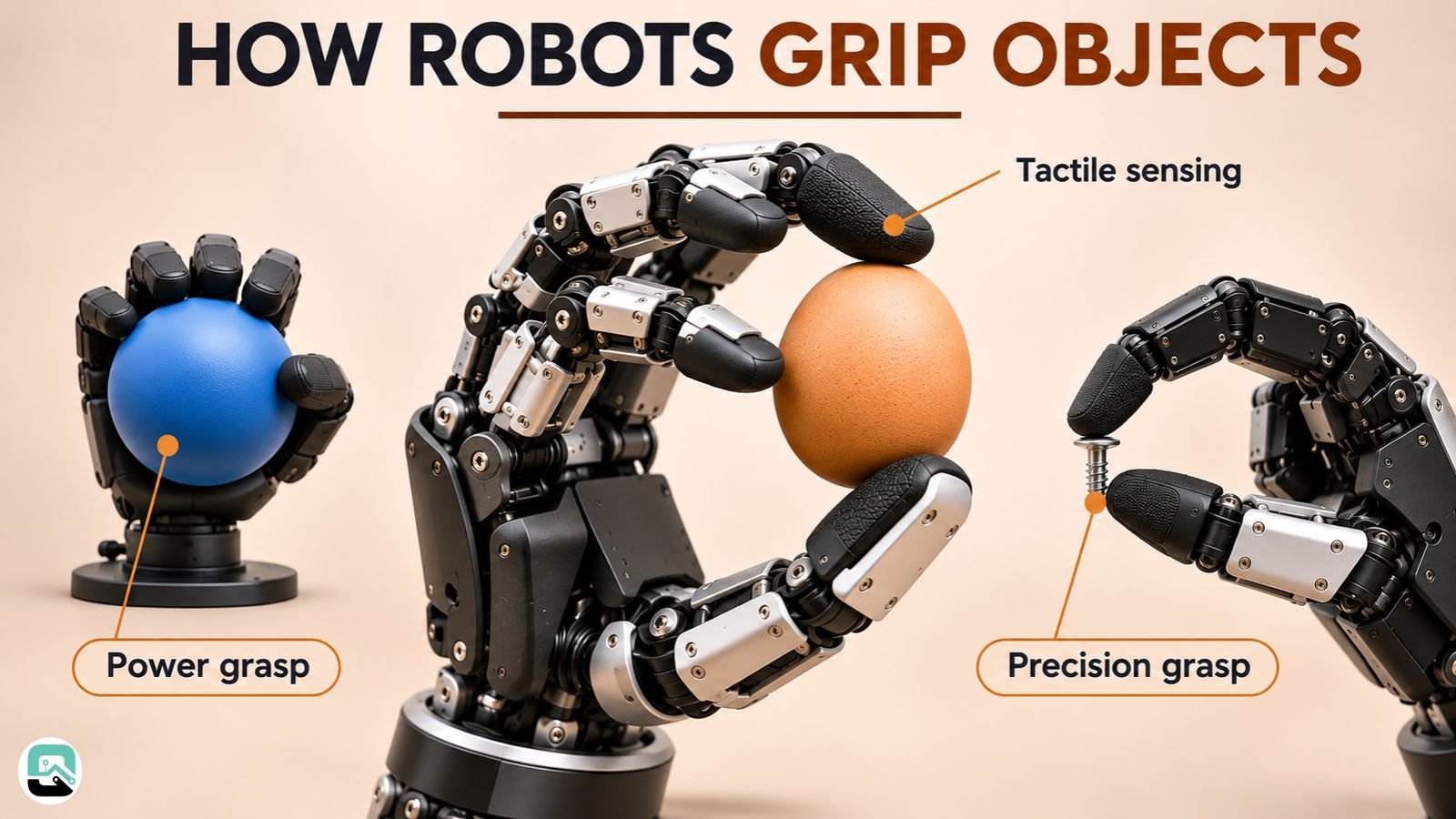
Robots grip objects by combining four things: a hand that can wrap around an object, sensors that report contact, software that chooses where to grab, and a controller that adjusts force while the object moves. In humanoid robots, a weakness in any one of them breaks the grip, which is why a hand with many joints can still drop a cup. Closing the fingers is easy. Knowing how hard to squeeze is the hard part.
Figure says the fingertip sensors in its Figure 03 hand detect forces as small as three grams (about 0.03 newtons), enough to feel a paperclip. That is a manufacturer-reported figure and a useful indicator of sensitivity. A force threshold alone doesn’t show how accurately a hand locates contact, detects slip, or handles fragile objects.
Figure, 1X: Boston Dynamics and Tesla have each described a different hand approach since late 2024. The sections below cover how those hands work, what happens during a single grasp, and where published claims still outrun the evidence.
Degrees of freedom and the human benchmark
Engineers count hand complexity in degrees of freedom (DoF), the number of independent movements a hand can make. The human hand is commonly described as having 27 DoF, and one frequently cited count puts the touch receptors in its hairless skin at about 17,000. Counts vary with how joints and the wrist are modeled, so treat both as rough benchmarks. Robot hands now approach the human joint count, but commercial designs mostly sense touch at the fingertips and palm.
Power grasps and precision grasps
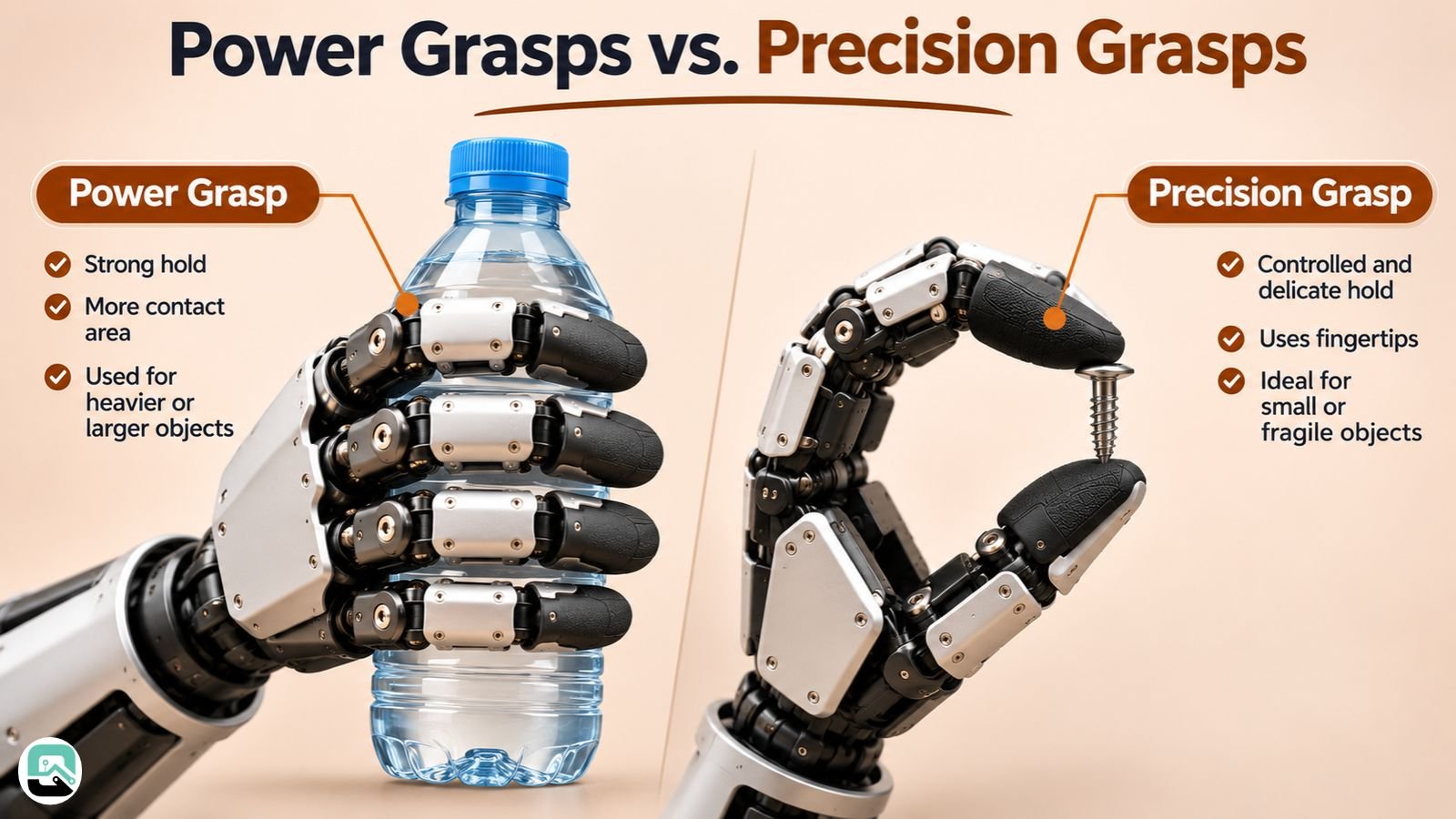
A robot hand does not use the same grip for every object.
| Grip | Typical object | What it delivers |
|---|---|---|
| Power grasp | Bottle, tool handle | Stability from a large contact area across fingers and palm |
| Precision grasp | Screw, pill | Fine control at low force between fingertips and thumb |
The split explains why an opposable thumb, fingertip compliance and independent finger control matter so much.
How humanoid hands differ from industrial grippers
Industrial grippers are usually simple. One of the most common designs is the parallel two-jaw gripper, which opens and closes to lift objects. A systematic review of robotic arm grippers sorts designs by mobility:
| Gripper type | Strength | Limit |
|---|---|---|
| Completely constrained | High output torque | Predefined finger paths and limited DoF restrict which shapes it can adapt to |
| Underconstrained | Passive DoF handle irregular objects | Carries less load than fully constrained rigid designs |
| Deformable | Widest range of objects | Deformation models make it hard to control |
Holding fragile items at the right force is a known problem, and it pushed designers toward deformable grippers. Finger count alone settles none of this.
Humanoid hands trade simplicity for range. They add joints, a thumb, touch sensors, and more demanding control, aiming for one hand that handles many objects and tools.
How the hand is built: joints, tendons, and motors
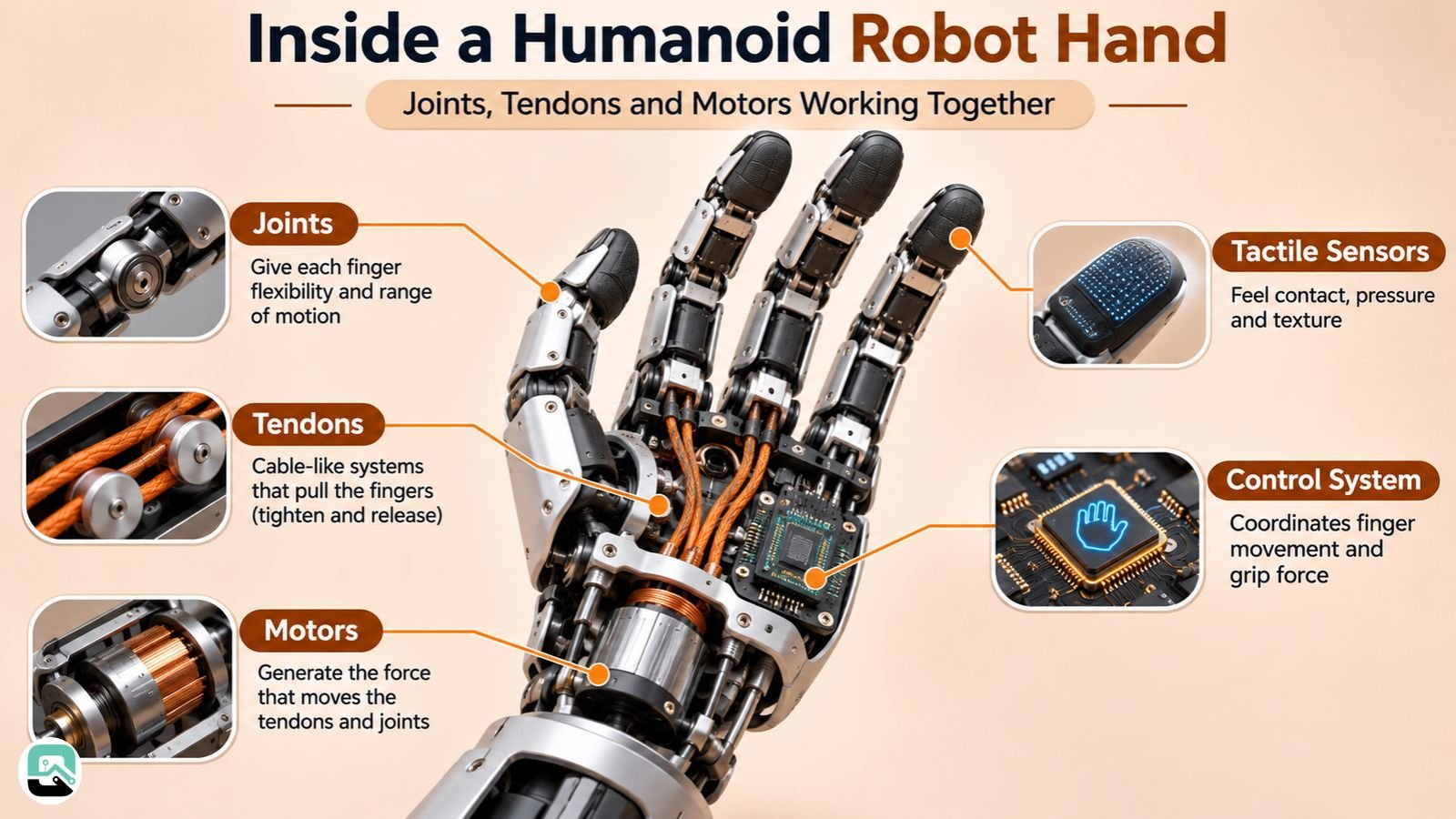
Motor placement shapes the whole hand. Motors inside the fingers make a hand bulky, so some designs move the actuators into the forearm and pull the fingers with tendons.
| Hand | Reported DoF | Drive |
|---|---|---|
| Tesla Optimus (Kovac, Nov 2024) | 22 in the hand, plus 3 in wrist and forearm | Forearm actuators, tendons |
| 1X NEO | 25 (22 in fingers and palm, plus 3 at the wrist) | Forearm motors, tendons |
| Boston Dynamics Atlas | 13, four fingers | Direct actuation, one actuator type |
| Figure 03 | Not published | Not published |
Tesla: a 2024 hand and a 2026 patent
In November 2024, Milan Kovac, who led the Optimus program, described an Optimus hand with the DoF count shown above. A Tesla patent published in April 2026 describes a cable-driven finger design. Coverage of the patent describes three tendons per finger routed from the forearm through the wrist, with routing meant to reduce cable stretch, friction, and crosstalk. That coverage counts four DoF per finger plus two at the wrist, a total of 22 including the wrist, which differs from Kovac’s count.
Elon Musk said in an April 19, 2026 post that Tesla had already changed the design and that the patented one hadn’t worked. The patent is therefore not a confirmed specification for the current hand. Tesla has published no official V3 spec sheet or reliability data, so Optimus Gen 3 hand specs rest partly on earnings calls and third-party reporting.
1X: tendons from the forearm
1X says its NEO hand has 25 DoF, with motors in the forearm pulling tendons. Tendons stretch, rub and can drift out of calibration, which is the price of keeping fingers light.
Boston Dynamics: no cables, no pinky
Boston Dynamics chose the opposite path. The Atlas hand uses direct actuation with encapsulated actuators and no cables crossing the joints. The company says this improves ruggedness, manufacturability and repairability. The thumb has four DoF and each of the three fingers has three.
Atlas has no pinky by design. A Boston Dynamics executive asked team members to tape their pinky and ring fingers together for a day and report what they couldn’t do. The team agreed the hand didn’t need one. A fifth finger would add three actuators, along with cost, volume, and failure points.
Fewer motors than fingers
A research hand from the Karlsruhe Institute of Technology (KIT) drives five fingers with three motors. Its underactuated mechanism lets each finger keep closing even when another is blocked, so the fingers conform to the object. The trade-off is less independent finger control in exchange for simpler control.
Fingertip material matters too. Figure says Figure 03 has softer, more adaptive fingertips than earlier versions, which it says improves stability across different sizes, shapes, and textures.
How a humanoid robot feels an object
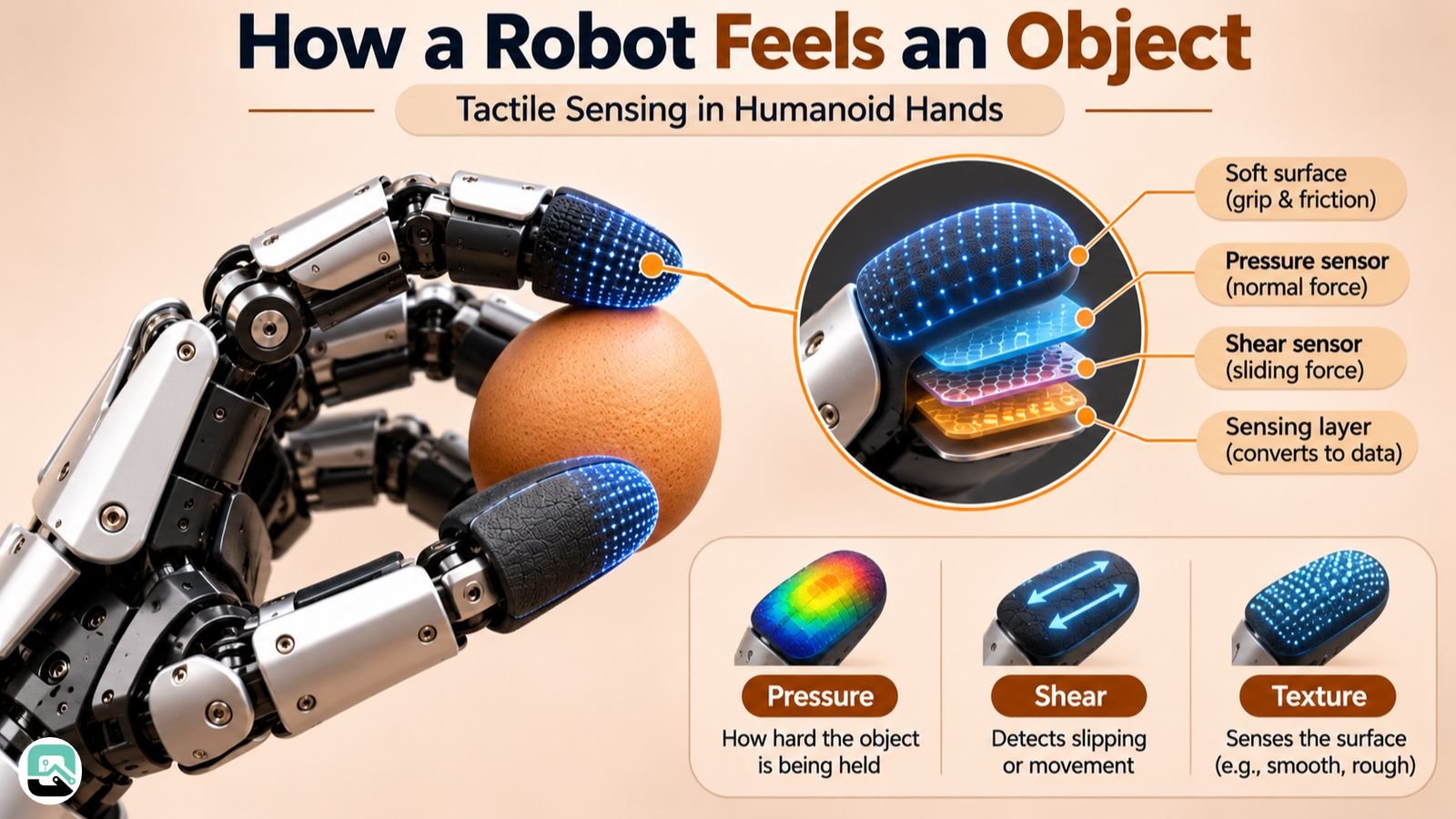
Humanoid hands feel through three channels:
| Channel | What it reports | Examples |
|---|---|---|
| Tactile sensors | Contact, pressure, shear | Figure’s fingertip sensors; Atlas’s dense pressure sensors across fingertips and palm; 1X’s pressure, contact-location and shear sensing |
| Joint feedback | How hard a finger was pushed | 1X’s 25 force-controlled DoF with a backdrivable tendon system; Atlas’s backdrivable actuators for proprioceptive force regulation |
| Palm cameras | The object when the head camera can’t see it | Figure’s in-hand visual feedback |
Normal force and shear force
Pressure alone is not enough, because slipping happens sideways. Normal force presses the fingers into the object. Shear force acts parallel to the surface and rises when the object starts to slide. A stable grip needs enough normal force to resist the shear, given the friction between finger and object. Too little drops the object. Too much crushes it.
1X says its sensors measure shear, which lets the hand detect a slipping object and adjust grip in real time. The KIT controller applies the same principle by comparing sideways force against pressing force and raising grip strength when the ratio suggests slip. It assumes a fixed friction coefficient, and its authors note that slip detection could let it estimate friction dynamically.
A research example of full-hand coverage
The F-TAC Hand, published in Nature Machine Intelligence in 2025, shows the direction of travel. It has tactile sensing at 0.1 mm spatial resolution across 70% of its surface. In 600 real-world trials, the researchers report that it significantly outperformed non-tactile alternatives. It is a lab system, not a commercial humanoid.
Every sensor figure for Figure, 1X and Atlas above is a manufacturer claim. The sources reviewed contain no independent measurements.
How robots grip objects: what happens in a single grasp
Researchers split human grasping into phases: reach, load, lift, hold, replace and unload. A KIT team built a tactile controller for its soft hand on the ARMAR-6 humanoid, published at IROS 2021 by Weiner, Hundhausen, Grimm and Asfour (DOI 10.1109/IROS51168.2021.9636484). It merges those phases into four stages.
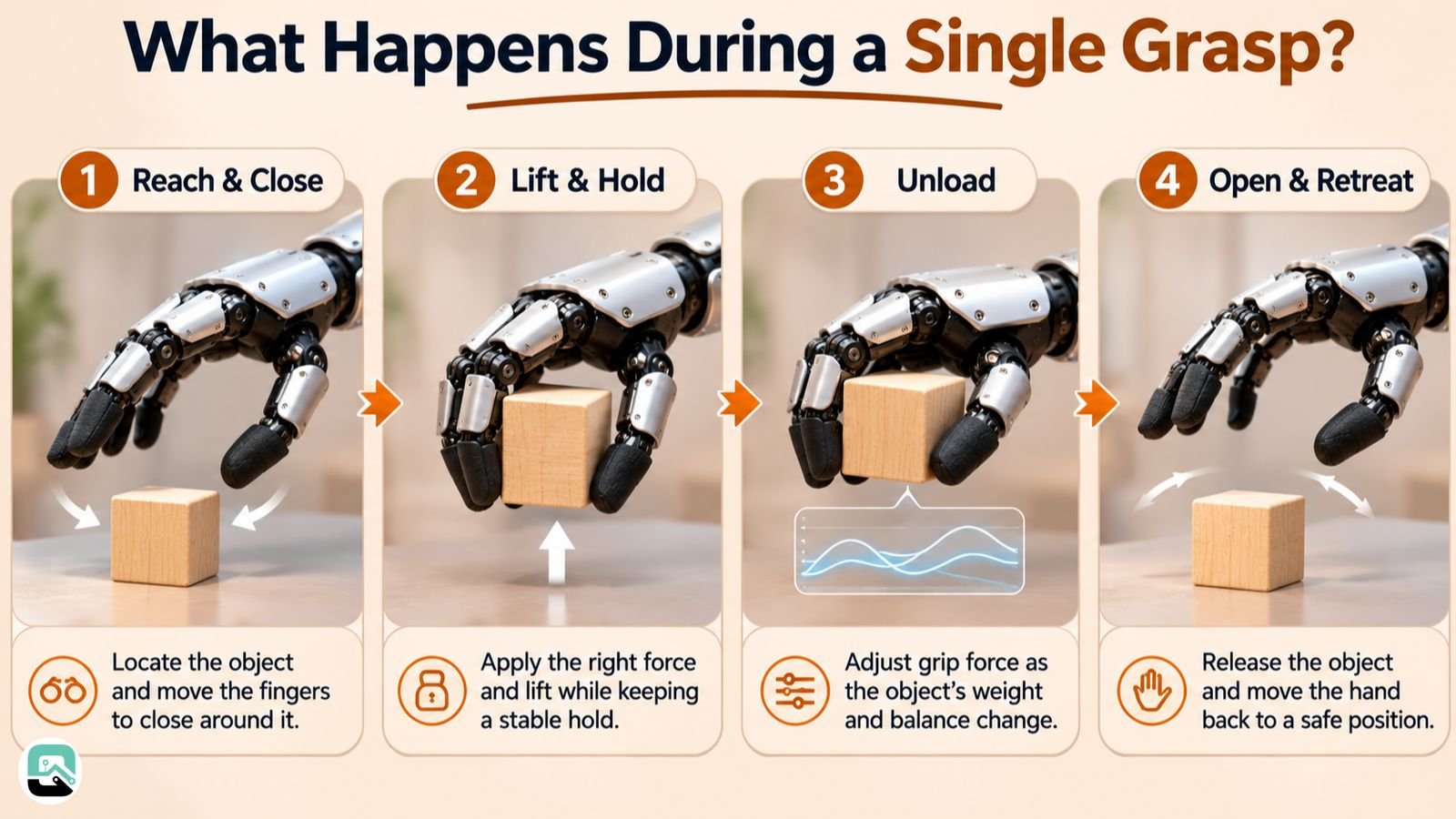
The four stages
- Reach and close. The fingers close quickly, slow down as a proximity sensor detects the object at roughly 2–3 cm, and stop on contact.
- Load, lift, hold and replace. The hand switches to force control and holds the object using tactile readings.
- Unload. The robot’s control system first signals that it intends to place the object. Once the signal arrives and at least three fingertip accelerometers sense 400–800 Hz vibration from contact with a supporting surface, the controller reduces pressure before opening.
- Open and retreat. The fingers open fully.
What the test showed
- Scope: 31 objects, weighing 4.8 g to 1,133.8 g.
- Effort: average motor effort was 35.64% across all motors and trials, measured from the start of finger closing through the end of the open-and-retreat phase, against 100% for a baseline that always grips at maximum. That is a PWM-based motor-effort measure, not a direct reading of grip force.
- Damage: the baseline damaged nine objects, while the tactile controller only slightly pushed in a slice of toast.
- Limits: it could not lift a yeast dumpling or a bag of potato starch. It put 22 objects back in their original pose, against 23 for the baseline, which used a more accurate wrist force sensor.
This is a university hand, not a commercial humanoid. It shows the logic commercial hands now follow: touch first, then force adjustment.
How robots decide where to grab
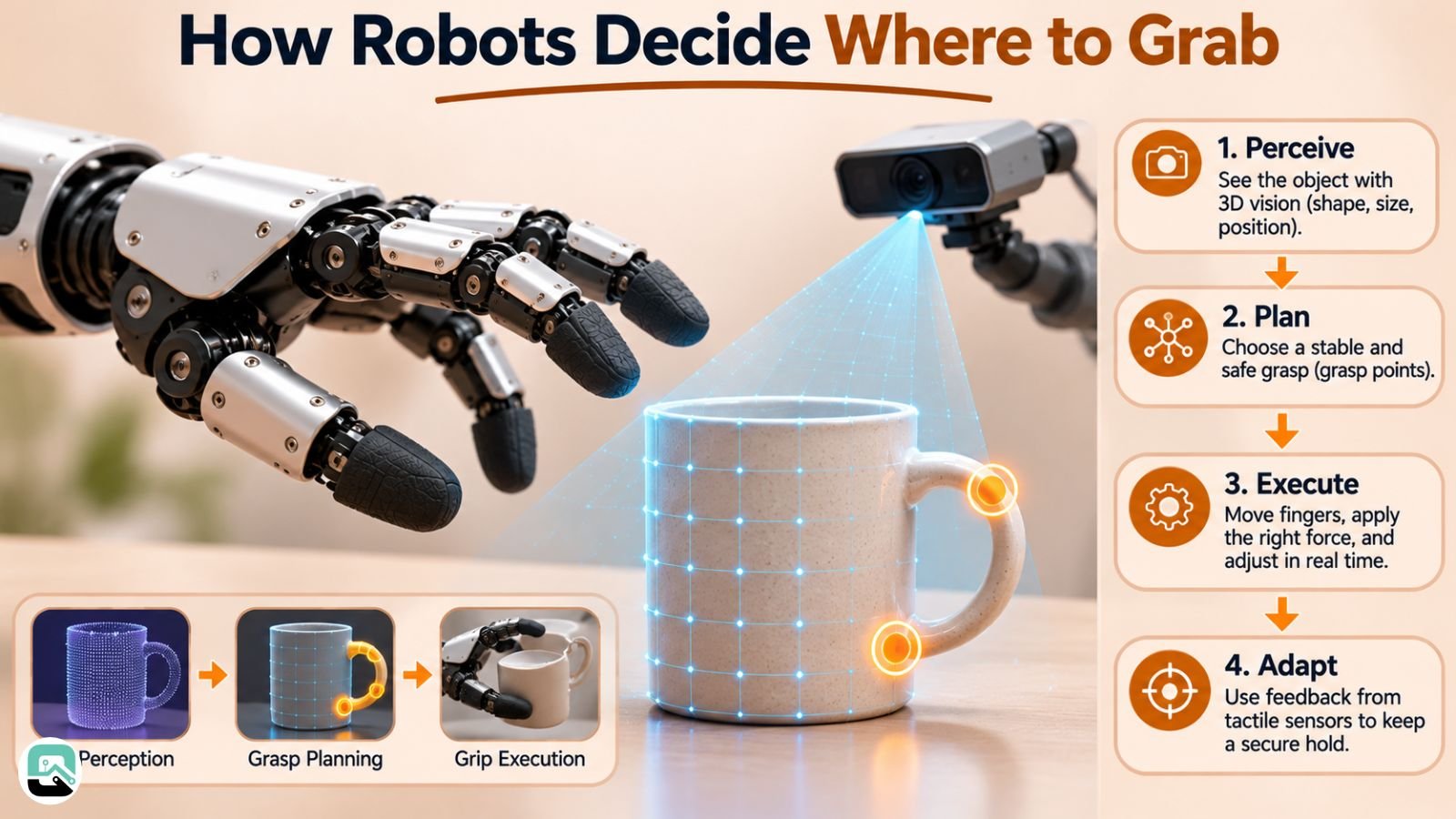
Four grasping problems
| Problem | Question it answers |
|---|---|
| Planning | Where should the fingers contact the object? |
| Execution | How does the hand move into that position? |
| Stabilization | How much force holds it? |
| In-hand manipulation | How can the object be repositioned without dropping it? |
Planning from depth images
Planning starts with cameras and depth sensors that give the robot a 3D picture of the object. Software then proposes candidate grasps and scores them. The best-known example is Dex-Net 2.0 from UC Berkeley. It trained a neural network on 6.7 million synthetic point clouds, grasps and quality metrics. In more than 1,000 trials on an ABB YuMi robot, it planned grasps in 0.8 seconds with a 93% success rate on eight known objects with awkward geometry. That work dates to 2017 and used a two-finger parallel-jaw gripper, so it shows depth-based planning rather than humanoid dexterity.
Folding in touch and simulation
Newer systems fold perception and touch into one model. Figure’s Helix 02 takes head cameras, palm cameras, fingertip tactile sensors and full-body proprioception as inputs, and outputs joint-level control down to individual fingers. Figure says the dexterity videos on that page, including bottle-cap removal, pill extraction and syringe dispensing, are fully autonomous, not teleoperated.
Boston Dynamics adds simulation. It designed the Atlas hand so its physical behavior can be reproduced in simulation. Reinforcement learning then trains manipulation policies that transfer to the real hand, and the company reports early sim-to-real results. It treats human demonstrations and simulated learning as complements, and says the four-finger hand can recover from a slipping grasp.
Together, these sources show a shift from planning one perfect grasp before contact to correcting the grip continuously afterward. That is an editorial reading, not a claim any company makes.
Where humanoid grip still fails
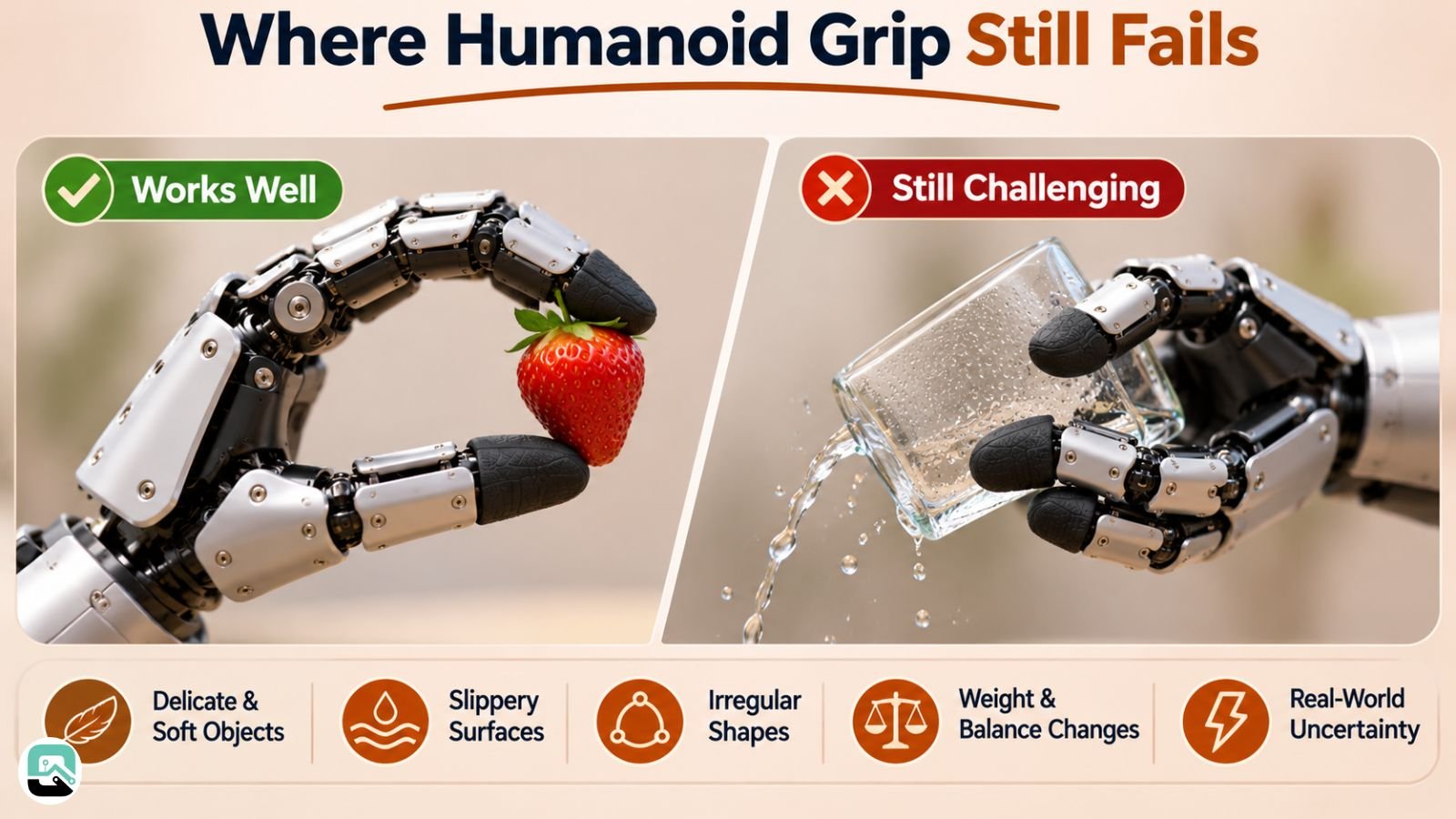
| Weak point | What the evidence shows |
|---|---|
| Slip detection with soft fingers | KIT authors report that soft fingers slide uniformly over flat surfaces, which makes vibration and shear changes hard to detect. Thin, heavy, box-shaped objects also remained difficult. |
| Demos versus deployment | A demo shows one task under particular conditions, not reliability across thousands of attempts. Google DeepMind’s 96% Mercedes-Benz result, where Apptronik’s Apollo 2 humanoids ran Gemini Robotics 2.5 on bracket sorting, comes from a proof of concept with no published trial size or intervention counts. |
| Unscripted settings | Coverage of 1X’s hand calls performance in unscripted household settings the more important test, and notes that real-world failure modes and the autonomous-versus-teleoperated split are not reported. |
| Durability data | 1X cites a wrist rated beyond 2 million cycles but gives no tendon-specific cycle count. |
| Joint count as a proxy | DoF sets the ceiling for a hand, not the result. Control software, sensing and tendon quality decide the rest. |
How to judge a humanoid hand
Five questions separate a capable hand from an impressive spec sheet:
| Question | What to check |
|---|---|
| Where are the motors? | Forearm actuation keeps fingers light. Direct actuation favors durability. |
| What can it feel? | Fingertip and palm coverage, shear sensing, joint-level force feedback. |
| Does it work when the camera is blocked? | Palm cameras and touch cover that gap. |
| Who controls the demo? | Autonomous, teleoperated and scripted footage show very different capabilities. A human-controlled Optimus snack demo in Austin showed the hardware working but said little about the robot’s decision-making. |
| What is the hand built for? | Factory sorting and tool use call for different engineering than handing a glass of water to someone at home. |
Read side by side, each team appears to be optimizing for a different bottleneck: Atlas for durability, 1X for force sensing, Tesla for anatomy-like tendons and Figure for redundant perception. That reading is interpretive, and no hand should be ranked by joint count alone. RoboPulse’s tool lets readers compare humanoid robot specs, including hand type and degrees of freedom.
FAQs
Q. Do humanoid robots need five fingers?
No. Atlas runs four fingers and 13 DoF, up from an earlier hand with 7 DoF, while 1X’s hand follows the human layout more closely with an opposable thumb. Each choice reflects what the robot is built to do.
Q. How do robots avoid crushing fragile objects?
They measure contact and drop force to the minimum that holds the object, as the KIT controller did when it avoided the damage the always-maximum baseline caused.
Q. How does a robot know an object is slipping?
It watches for rising sideways force or fingertip vibration. Boston Dynamics says Atlas can recover from slipping grasps, though soft fingertips can make detection harder.
Related: 1X NEO Robot Review: Brilliant, But Not Ready Yet
| Disclaimer: This article is based on publicly available research and manufacturer information. Robot capabilities and specifications may change over time, so we recommend checking official sources for the latest details. |