

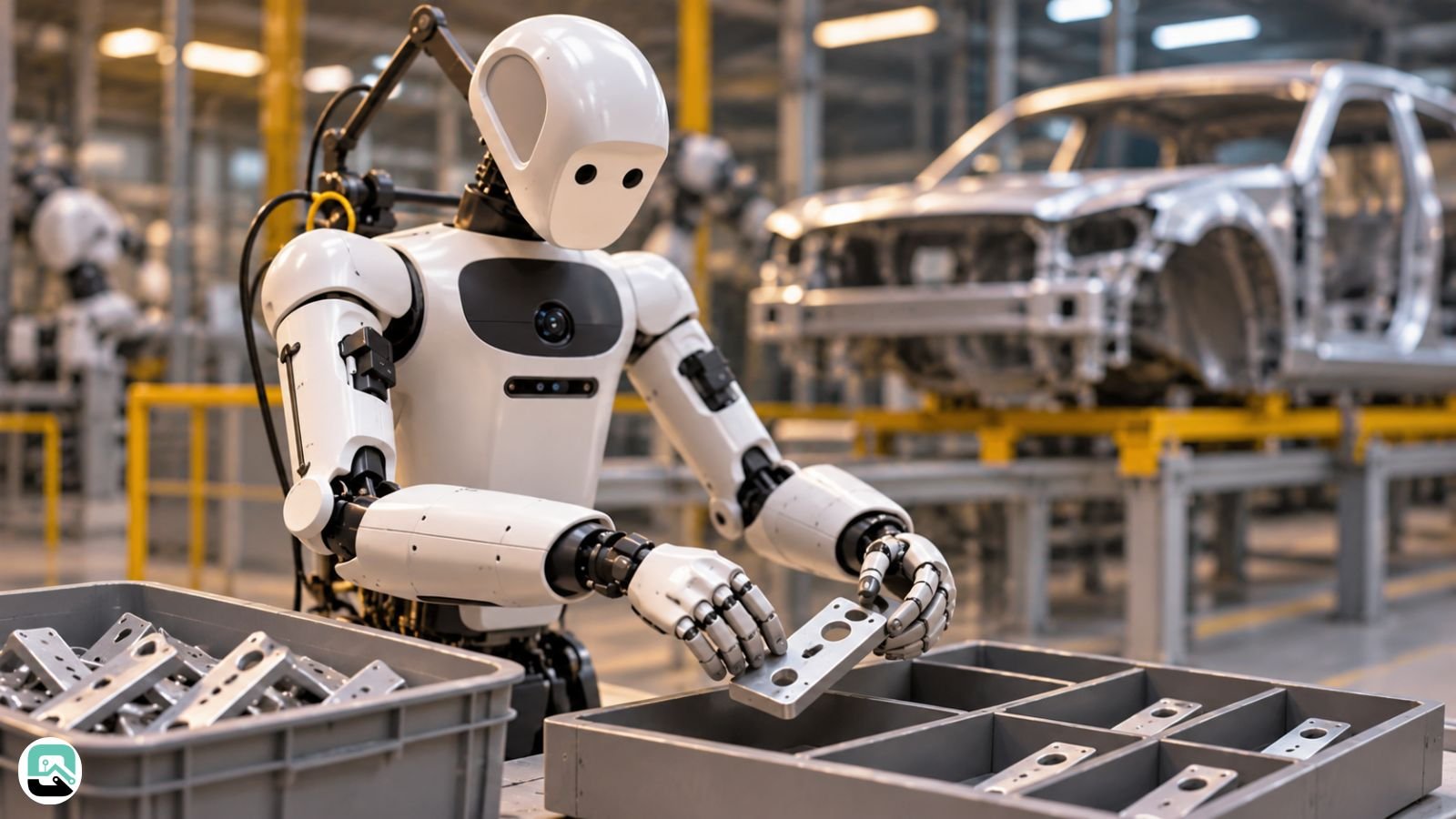
Google DeepMind has unveiled Gemini Robotics 2.5. The model aims to help robots learn physical tasks faster and handle delicate objects. Its headline result is a 96% success rate on Mercedes-Benz production lines.
The job is bracket sorting
Apptronik’s Apollo 2 humanoids ran the model at Mercedes-Benz sites in Kecskemét, Hungary, and Sindelfingen, Germany. They picked metal brackets from supply bins. They placed each one into sequencing containers, in the order assembly requires.
The task is dull, and that makes it a good test. Success is easy to score. Mercedes also knows its partner well. Apptronik’s Apollo has Mercedes as both a backer and a deployment site.
Google says the work could free technicians for more complex assembly. That matches how carmakers pitch humanoids: help with repetitive, physically tough jobs.
A proof of concept, not a rollout
The 96% figure comes from a proof-of-concept. It does not show widespread commercial use. Interesting Engineering’s report says as much.
Key details are also missing. Coverage of the announcement gives no trial size, duration, failure criteria, or intervention count.
That gap changes the meaning. One robot might finish 96% of picks alone across a full shift. Another might need a technician after every stumble. Both give the same headline.
Why the missing 4% costs money
Humanoid economics punish downtime. Agility’s Digit v5 only breaks even if it works close to a 20-hour day. A standard eight-hour cycle pushes payback beyond four years.
Apollo faces the same math. A strong success rate means little without uptime behind it.
Relative gains hide the starting line
Google evaluated the model on more than 200 tasks. They included serving food with tongs, tying bows on gift boxes, and moving liquids with pipettes. Google reports success rates 30% to 100% higher than earlier baselines. It also reports tasks finishing 20% to 30% faster.
Percent gains depend on the starting point. A task that climbs from 20% to 40% has doubled. It still fails most of the time. The useful question is how many tasks now clear a bar a factory would accept.
Two models, one job
At Mercedes, the model did not work alone. Gemini Robotics ER tracked the workflow. Gemini Robotics 2.5 controlled the arms and hands. Apollo adjusted its movements when needed.
The model also runs on other hardware, including the Franka Duo system with two-finger grippers. That cross-platform reach matters. Robot makers want one brain for many bodies.
Some builders bet the other way. Digit trades versatility for dependability and sticks to warehouse totes. That narrow focus makes it reliable but limits the work it can take on. Google wants range and reliability together. Nobody has proven both yet.
Safety gets its own benchmark
A hacked chatbot writes bad text. A hacked robot moves badly.
Google says its inference-time guidance raised safe task completion by 33% around obstacles and 43% near people. It also released ASIMOV-Jailbreak, an open-source benchmark with hundreds of prompts across dozens of scenes. The test checks whether robots resist disguised unsafe instructions.
One detail needs care. The 99.5% jailbreak resistance belongs to Gemini 4 Argon, not to the robot model itself. Argon beat the 82% score of the earlier Gemini Robotics ER 2 baseline.
AI that trains the robot’s AI
Argon also sped up development. It turns real camera footage into thousands of simulated practice runs. It builds digital twins of physical spaces. Even studies failed attempts and suggests fixes for the next round.
Researchers then blend those simulations with real demonstrations. The goal is better performance on unfamiliar objects and settings.
If this holds, training stops being the bottleneck. Verification takes its place.
The real milestone
Gemini Robotics 2.5 is rolling out to Google’s robotics partners. Nobody else can buy it yet.
The next step is not a bigger percentage. It is independent data. Shift-length trials, intervention counts, and failure logs would turn a claim into proof.
Until then, the model marks real progress toward robots that handle varied work. The 96% still comes from the company grading its own system.
Related: Will Robots Take My Job? What 2026 Data Really Reveals