


Probably not soon, if “robot” means a physical machine. Robots can already handle a large share of physical tasks in controlled settings, but they cost more than people for almost all of them. The faster pressure in 2026 comes from AI software, and it shows up first as fewer entry-level hires, not mass layoffs.
Your own risk depends on three things: which tasks fill your week, whether a machine can do them reliably where you work, and whether it can do them for less than you cost. What follows keeps hard data apart from forecasts, treats robots and AI software as two separate threats, and ends with a quick way to size up your own job.
Are robots replacing workers in 2026?

Not at scale. In a study published September 30, 2026, Anthropic estimated that robots can perform 74% of US physical job tasks in some setting, yet are cheaper than human workers for just 0.3% of all job tasks. Being able to do a task and being worth paying for it are two very different bars.
One caveat up front: Anthropic is an AI company, and its own model, Claude, scored the tasks and estimated the costs. The authors say the method requires many judgment calls, so treat every Anthropic figure in this guide as a model-based estimate, not a count of workers replaced.
The headline figures in Anthropic’s robot exposure study use different bases, which is why news coverage often misreads them:
| Measure | Share | Measured against |
|---|---|---|
| Physical tasks today’s robots can do in some setting | 74% | US physical work |
| The same tasks as a share of all working hours | 34% | All US work |
| Work exposed to robots or AI language models combined | About 80% | All US work |
| Tasks where a robot is already cheaper than a worker | 0.3% | All US job tasks |
And most of that capability only works in tidy, controlled spaces. Half of physical tasks are doable only in purpose-built spaces such as assembly lines. Just 2% can be done in unstructured places like city streets, mostly by autonomous vehicles.
Factories are where robots actually live. The International Federation of Robotics counted a record 5 million industrial robots operating worldwide in 2025. Humanoid robots remain a small slice: citing Counterpoint Research, Anthropic notes that most humanoids today serve entertainment and data collection. No humanoid has independently shown round-the-clock productive work in a real factory, as our analysis of humanoid robot operating hours found.
Why can a robot do a task but still not take the job?
A slick demo video is one thing. Getting past cost, clumsy hands, regulators, and customers who’d rather deal with a person is another. Anthropic found that capability gaps block robots from about 70% of physical tasks, and weak manipulation, meaning touching and handling objects, blocks half on its own.

- Cost, where robots win. Packers and packagers are the clearest case in Anthropic’s cost estimates. A robotic packing line costs over $2 million to buy and install and replaces the yearly work of about 14 people. That works out to roughly $45,000 a year per replaced worker, against about $49,000 in pay and benefits, a margin near $2,500.
- Cost, where robots lose. Automating a welder’s full job takes robots costing around five times more than the welder, because welding comes bundled with positioning heavy parts, climbing ladders, inspection, and grinding.
- Regulation. Anthropic estimates current rules would keep robots off 14% of physical tasks, mainly in healthcare, protective services and education. Robotaxis cost only about $7,000 more than taxi drivers, yet still face regulatory hurdles.
- Preference. By Anthropic’s estimate, human preference holds robots back from about a quarter of physical tasks, such as changing diapers or greeting restaurant guests.
Robots are improving, just slowly. Each year, robots have gained the ability to do about 2% of the physical work they previously couldn’t, and robot prices have fallen roughly 3% a year since the 1990s. At that pace, Anthropic estimates it would take about 40 years for robots to become cost-competitive for 10% of today’s work, and until 2085 for half of physical work. In its fast scenario, the halfway point arrives by 2050.
The authors also warn that AI-powered robots could jump ahead of these estimates by learning skills they lack today, such as climbing ladders. Labs are already chipping away at that gap. ETH Zurich has trained a Unitree G1 humanoid to climb ladders and recover from falls.
Which jobs are most exposed to robots?
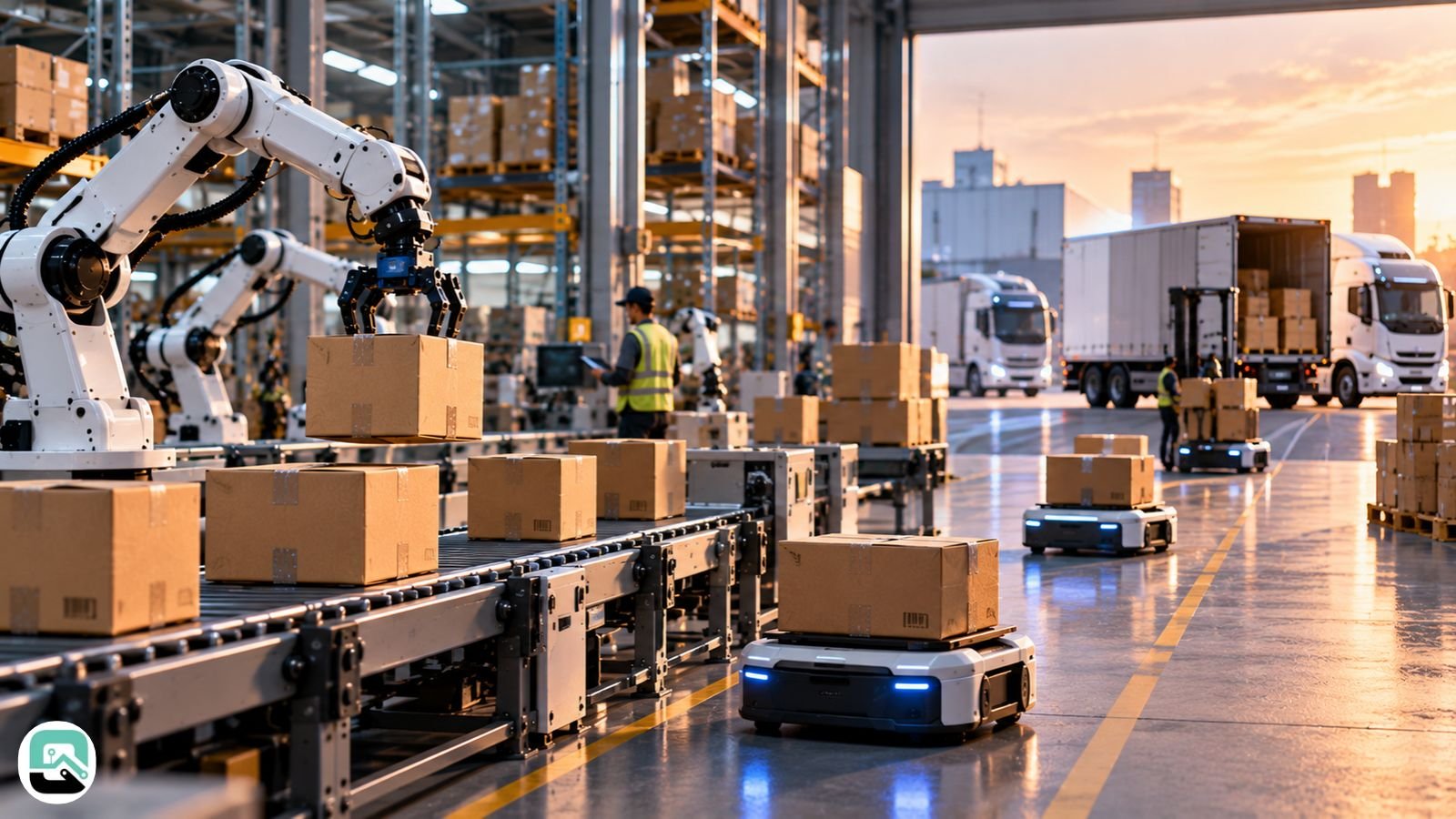
Mostly driving and warehouse jobs. Nine of the ten occupations most exposed to today’s robots are vehicle operators, led by taxi drivers, because autonomous cars, trucks, and tractors already work on open roads. Nursing and general repair sit near the bottom, since current robots can do little of that work even in controlled settings.
- Vehicle operators. Fewer than 15% of transportation and moving tasks are exposed to AI language models alone. About 90% become exposed once robots count. Even so, the Bureau of Labor Statistics (BLS) projects transportation and material moving jobs to grow 4.3% from 2025 to 2035. A machine that can drive isn’t the same as an employer handing it the keys.
- Packers and packagers. This is the largest occupation where robots already cost less than people. US employment in the job has fallen 22% since 2015, and BLS projects it will shed the 11th-most jobs of any occupation by 2035.
- Warehouse material handlers. Mobile robots already move freight inside structured warehouses. Humanoids such as Agility’s Digit handle totes in some facilities, though industry estimates put a single unit near $250,000, according to our Agility Digit review.
- Recycling sorters. Robots with cameras and suction grippers can perform over three-quarters of a recycling worker’s tasks by work time.
Robots and AI software also hit very different people. Workers in robot-exposed jobs are more likely to be male, less likely to hold a degree, and lower paid.
Which jobs face more pressure from AI software than from robots?

Mostly desk jobs that run on written procedures. BLS expects office and administrative support to shrink faster than any other occupation group through 2035.
BLS projections for 2025 to 2035 show where pressure and growth sit:
| Occupation group | Projected change, 2025–2035 |
|---|---|
| Healthcare support | +13.3% |
| Healthcare practitioners and technical | +8.0% |
| Computer and mathematical | +7.3% |
| Transportation and material moving | +4.3% |
| All occupations | +3.5% |
| Legal | +2.9% |
| Arts, design, entertainment, sports and media | +1.5% |
| Educational instruction and library | +1.4% |
| Production | −0.4% |
| Sales and related | −1.4% |
| Office and administrative support | −4.0% |
The two healthcare groups together account for almost a third of all new jobs BLS expects through 2035. For office support, BLS points to automation tools, including AI, as a reason for the decline, according to its Economics Daily summary.
Office and administrative workers
That works out to 752,100 fewer jobs. A shrinking field still hires, though. BLS projects about 1.7 million office and administrative openings a year, mostly to replace workers who leave.
Customer service and data entry workers
These roles show some of the highest real-world AI use. In Anthropic’s labor market study, AI usage already covered about 70% of customer service representatives’ tasks and 67% of data entry keyers’ tasks.
Programmers and software developers
Here the signals clash. Computer programmers topped Anthropic’s list at 75% task coverage, and Stanford researchers found employment of software developers aged 22 to 25 fell nearly 20% from its late-2022 peak. Yet BLS projects computer and mathematical jobs to grow 7.3%, with data scientists up 34.6%. The pain is in getting hired the first time. Experienced engineers are still in demand.
Graphic designers
BLS projects graphic designer employment to fall 2% from 2025 to 2035, even though the wider arts and design group grows slightly.
Healthcare workers
Healthcare is close to a worst-case for automation: hands-on care, face-to-face contact, and heavy regulation. Surgical robots are no exception. A system a surgeon fully controls doesn’t count as an autonomous robot in Anthropic’s index, and robotic surgery still depends on the surgeon at the console.
Why are young workers feeling AI first?

Employers appear to be hiring fewer young workers in AI-exposed jobs rather than laying off experienced staff. Stanford’s August 12, 2026 update found employment of 22- to 25-year-olds in highly AI-exposed occupations 19% below where it would be had it kept pace with less-exposed peers, based on ADP payroll data through June 2026.
Experienced workers in the same occupations show no comparable gap. The gap has widened steadily since Stanford first reported it in August 2025, and it runs mainly through reduced hiring rather than more departures. Stanford also found no widespread, economy-wide displacement tied to AI.
The 19% is a relative gap, not proof that AI cost 19% of young workers their jobs. Whether AI caused the gap, and by how much, is still an open argument.
Do AI layoff headlines mean machines are replacing people?
Often, no. Employers cite AI in a growing share of layoff announcements, but an announcement records a stated reason, not proof that automation caused the cut.
Outplacement firm Challenger, Gray & Christmas counted 120,136 announced US job cuts attributed to AI from January to September 2026, about 21% of all announced cuts and the leading reason for the year. In September alone, AI accounted for 3,961 cuts, about 9% of that month’s total, according to its September 2026 report.
Yale Budget Lab’s Martha Gimbel has told Fortune she suspects some companies blame AI rather than admit to cuts driven by tariffs, policy uncertainty or weaker demand, a practice critics call “AI-washing.” Goldman Sachs economist Joseph Briggs, on the other hand, estimates AI is already trimming 10,000 to 15,000 jobs a month from growth in tech, management consulting and graphic design. In a labor market that creates and loses millions of jobs a year, that’s close to a rounding error, unless it’s your field.
How many jobs will robots and AI replace by 2030 or 2035?
Honestly, nobody knows. The three most cited forecasts measure different things, so their numbers can’t be added together or compared directly.
| Forecast | Scope | Headline estimate | What it measures |
|---|---|---|---|
| WEF Future of Jobs Report 2025 | Global, 2025–2030 | 170M roles created, 92M displaced, net +78M | Expectations from a survey of 1,000+ large employers |
| Goldman Sachs | US, about a decade | About 9% of workers (roughly 15M) displaced | A model assuming AI lifts productivity 15% |
| BLS Employment Projections | US, 2025–2035 | +5.9M jobs (+3.5%) | A long-run structural projection, not a hiring forecast |
Goldman raised its estimate from an earlier 6–7%. In October 2026, the bank warned that a downturn could speed up automation-related job losses.
“Displaced” in these forecasts means people forced to change jobs, not permanent unemployment. Some find work quickly, and others don’t. WEF’s net gain also doesn’t mean the people who lose roles are the ones who fill the new ones.
How can I tell if robots or AI will take my job?
Your title matters less than what you actually do all day. Start with official data on your exact occupation, then test your own week against a few questions.
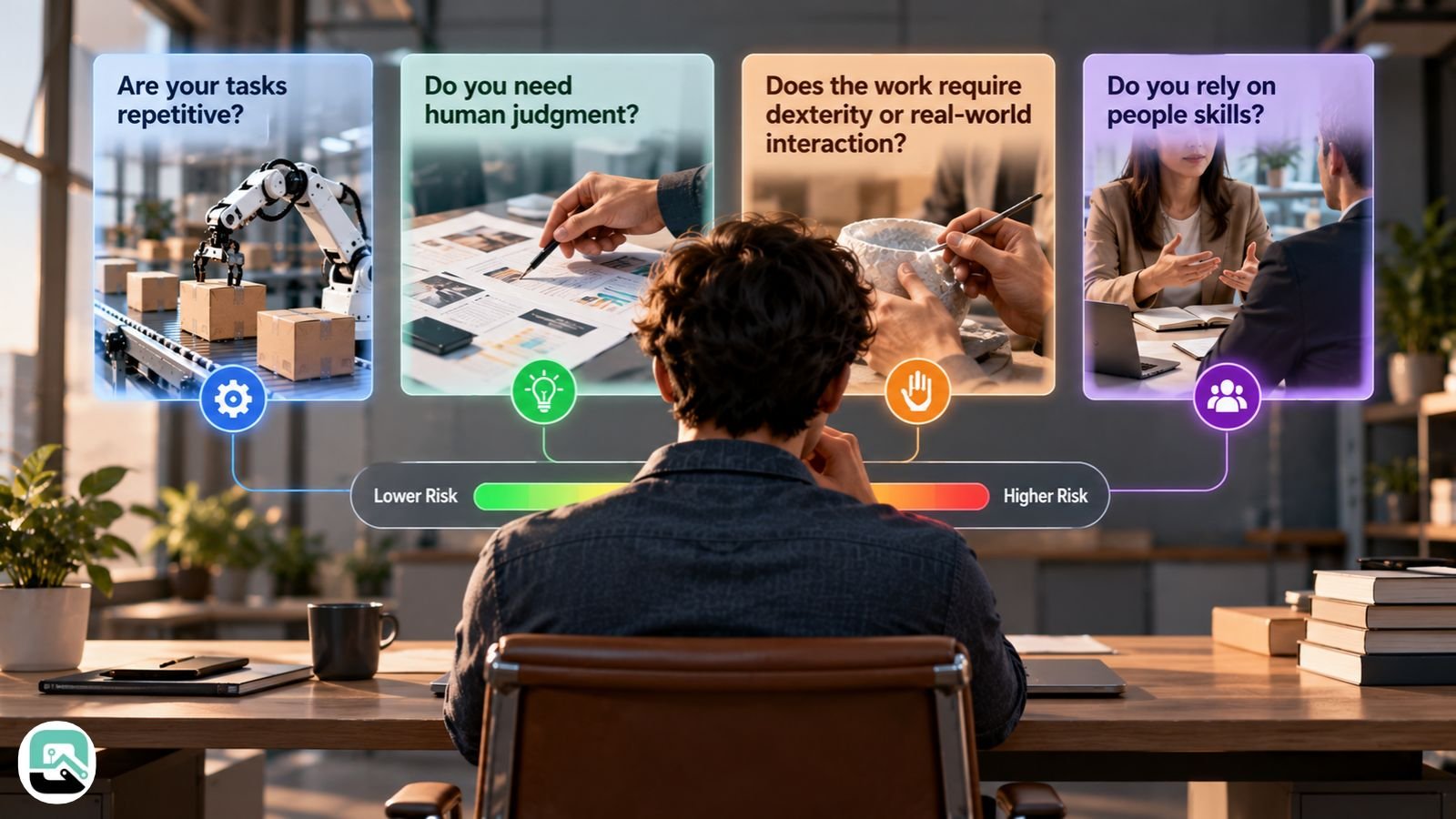
- Find your occupation’s outlook. The BLS Occupational Outlook Handbook lists each job’s 2025–2035 projection and expected annual openings.
- Check its AI exposure rating. In August 2026, BLS rated all 831 occupations it projects as Low, Moderate, High, or Very High relative AI exposure. The ratings rank jobs against one another and aren’t forecasts of job loss.
- Score your own tasks with the table below.
| Question | Higher-risk sign | Lower-risk sign |
|---|---|---|
| Is my physical work in a controlled space? | Same items, same layout, every day | Changing sites, messy materials, delicate handling |
| How much of my week follows written procedures? | Templates, standard forms, scripted replies | Judgment, unwritten experience, face-to-face work |
| Does AI replace my output or speed me up? | AI output ships with little human review | AI drafts, and I own the decision |
| Is the entry ramp still open? | Junior postings shrinking | Employers still hire juniors behind me |
The first row reflects Anthropic’s robot findings. The next two reflect Stanford’s finding that declines concentrate in codified-knowledge work and where AI substitutes for people rather than assisting them. It’s a rule of thumb we put together, not a tested risk score.
Two quick examples. A worker packing identical boxes on a fixed line does work robots already handle cheaply, while a worker sorting damaged stock or handling odd customer requests does not. Filling a standard contract clause from a template is codified work; deciding whether to push back on a client is judgment.
What can I do now to lower my risk?
None of this is personal career advice, but the evidence points the same way on a few things.
- Use AI on your own core tasks, so you become the person who reviews output and makes the call.
- Keep a record of decisions you made and why. Unwritten judgment is the part of a job AI copies least well.
- Lean toward hands-on, interpersonal, or dexterous work if you’re choosing a path.
- Watch junior job postings in your field each quarter. A shrinking count tells you more than any viral layoff post.
- Take employer training seriously. The World Economic Forum’s report frames upskilling as urgent for workers in disrupted roles.
Frequently asked questions
Q. Are humanoid robots taking jobs yet?
Not many, so far. Humanoids are in pilots and early commercial deployments, mostly in warehouses and car factories, and ship in small volumes. Our ranking of the top humanoid robot companies compares makers by shipments and real-world deployments.
Q. Did Elon Musk say robots will take our jobs?
In effect, yes. At a November 2025 investment forum in Washington, Musk predicted work would become optional within 10 to 20 years as AI and robots take over most labor, and he has repeated the claim since. Keep in mind his own company builds humanoid robots, so read it as a prediction, not proof. University of Pennsylvania economist Ioana Marinescu told Fortune that technical and economic hurdles make that timeline unrealistic.
So, will a robot take your job?
For most people, not anytime soon.
Repetitive work in predictable spaces, such as driving, packing, and sorting, carries the most robot risk. Desk work built on written procedures carries the most AI risk. If your work mixes judgment, careful hands, and dealing with people, you’re about as safe as anyone gets. Nobody is fully off the hook, though. Re-check your occupation when BLS publishes its 2026–2036 projections in 2027.
Related: What Is Humanoid Robot Design? From Human Anatomy to Intelligent Machines
| Disclaimer: This article is for informational and educational purposes only and does not constitute professional career or financial advice. Automation statistics, employment projections, and AI-related job risks are based on available research and estimates as of October 2026. Actual outcomes may vary by industry, occupation, and technological developments. Readers should consult official labor market sources before making career decisions. |