

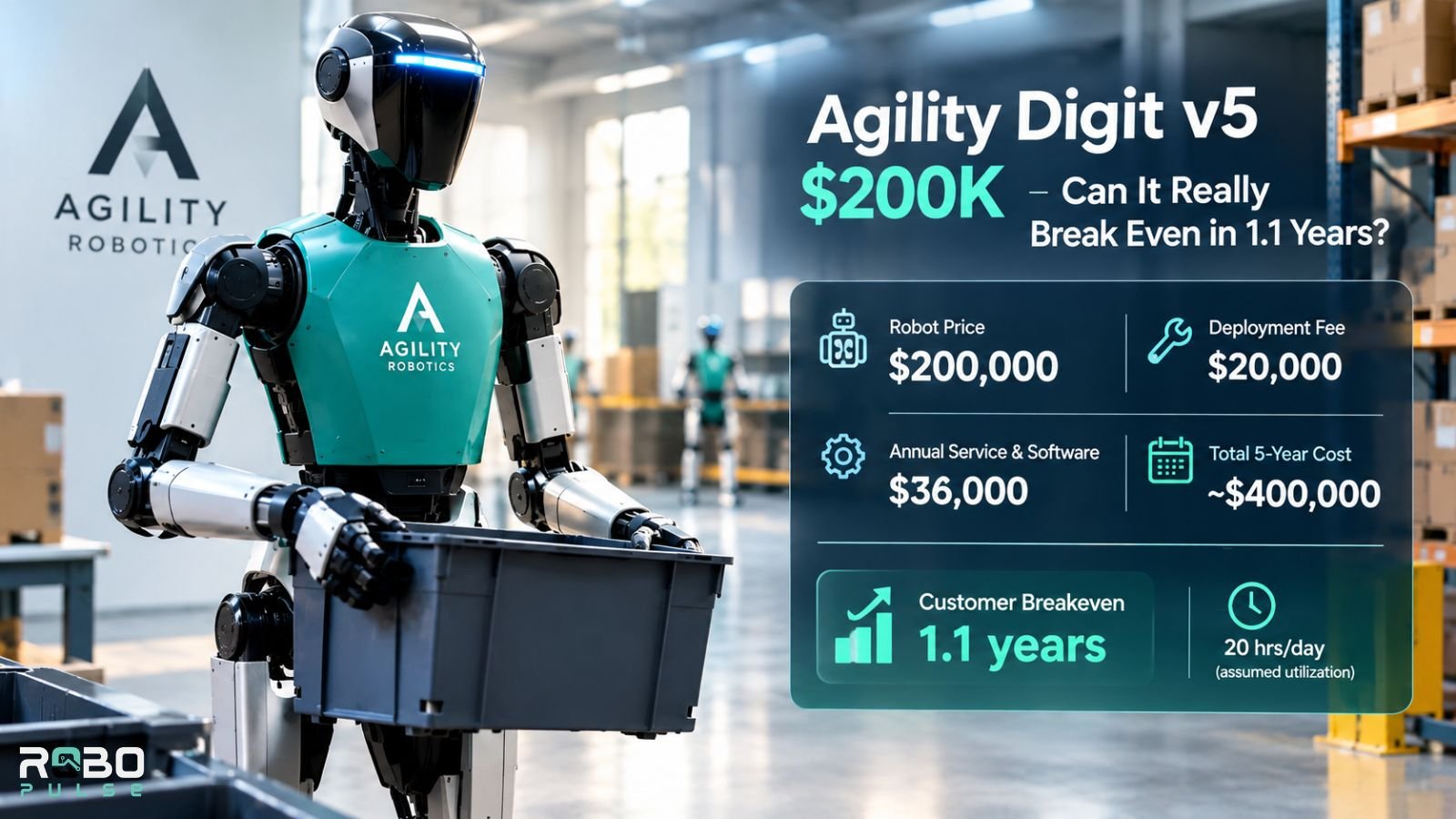
A securities filing put $200,000 on Digit v5 and promised payback in 1.1 years. The second number depends entirely on an assumption buried in the first.
Ask a humanoid robotics company what its robot costs, and for the past three years you’d get a shrug and a brochure about Robots-as-a-Service. Agility Robotics broke that habit on Tuesday, in the least glamorous venue available to it: a filing with the SEC.
The numbers, as reported by Business Insider, are unambiguous. Roughly $200,000 buys the next-generation Digit v5 outright. Deployment adds a one-time fee of about $20,000. Software and maintenance run another $36,000 a year. Stretch that across the five-year useful life Agility assumes in its own model, and one robot costs somewhere around $400,000.
Buried a little further into the same document is the claim that will end up in every humanoid investor deck between now and Christmas: Digit v5 hits customer breakeven in approximately 1.1 years.
Agility didn’t show its work on that one. It did publish enough inputs that the arithmetic reconstructs, and it reconstructs almost too cleanly.
Where 1.1 years comes from
Two figures in the filing carry the entire claim. The first is that Digit is designed to run about 20 hours inside a 24-hour window. The second is the labor comparator: $30 an hour, fully loaded.
Run them together, and you get 7,300 robot-hours across a year, which at $30 an hour represents $219,000 of displaced labor. Year one costs the customer $256,000 once you add the hardware, the deployment fee, and the first annual service charge. Divide the second by the first, and you land at 1.17 years, which rounds neatly to the number Agility published.
So the payback claim isn’t really about what the hardware costs. It’s a bet on utilization. Digit only clears breakeven inside fourteen months if it works something close to a continuous 20-hour day, more or less every day, for a full calendar year, and if each of those hours substitutes for a person earning $30 fully loaded. Both conditions have to hold.
What happens when the robot sits down
Below is the same model at duty cycles that resemble what actually happens on a warehouse floor. Cost stays at $220,000 up front plus $36,000 a year; the value side is just hours multiplied by $30.
| Duty cycle | Annual labor value | Breakeven |
|---|---|---|
| 20 hrs/day, 365 days | $219,000 | 1.2 years |
| 16 hrs/day, 365 days | $175,200 | 1.6 years |
| 20 hrs/day, weekdays only | $156,600 | 1.8 years |
| 12 hrs/day, 365 days | $131,400 | 2.3 years |
| 8 hrs/day, 365 days | $87,600 | 4.3 years |
An eight-hour cycle, roughly one human shift, pushes payback past four years and consumes almost the whole useful life Agility assumes. Twelve hours a day still lands in respectable industrial-automation territory but nowhere near the headline.
Wage assumptions move things too, and in a lot of US logistics markets fully loaded warehouse labor sits closer to $22 or $25 than $30. Drop the comparator to $22 and even a flawless 20-hour cycle stretches breakeven out toward 1.8 years.
The practical takeaway for anyone running a pilot is that you don’t need to argue about actuator torque or grip dexterity to evaluate this. You need one number, measured over at least a quarter: productive hours per day, sustained. The rest is commentary.
The buy-versus-rent inversion
There’s a second story in the filing that got less attention. A footnote assumption tracked by independent price researchers puts Agility’s Robots-as-a-Service model at roughly $8,500 per robot per month. That annualizes to $102,000, or $510,000 across five years.
Set against a $400,000 purchase, the subscription runs about 28% more expensive over the same period.
None of that is scandalous. Leasing costs more than buying in every capital-goods category ever invented, and RaaS genuinely buys you something: no capex line, no obsolescence exposure when v6 arrives, and someone else’s problem when an actuator fails. But it does mean Agility has now effectively published the discount it offers customers willing to carry balance-sheet risk on a product category that’s about eighteen months old. Whether that discount survives contact with a negotiated contract is a separate question, and the filing explicitly declines to answer it.
Fencing is the line item nobody quotes
The $400,000 covers the robot. It doesn’t cover the building.
Nearly every humanoid working in a warehouse today operates behind safety fencing, which eats floor space, forces workflow changes and, in genuinely tight facilities, kills the deal before anyone reaches a purchase order. No vendor puts a dollar figure on it, but the cost is real, and it lands on the customer.
Deleting that cost is much of the point of v5. Forbes covered the fence-free positioning when the spec first went public, and Agility backed it up in November 2025 by passing an OSHA-recognized NRTL field inspection at a live customer site, assessed against ANSI/RIA R15.08 and ISO 13849.
That claim needs a caveat that Agility itself has been careful about. NRTL field evaluations are site-specific, so what the company earned was field labeling at one facility rather than blanket product certification. The broader ISO functional-safety clearance rides on v5 and hasn’t landed yet. If it does, and if fence-free operation holds across a range of sites, it shifts total cost more than a $20,000 swing in sticker price ever could.
Why comparing Digit to a $13,500 Unitree is a trap
The reflexive reaction to a $200,000 humanoid is to point at Unitree’s G1 at $13,500 and ask what Agility thinks it’s selling. Fourteen G1s for the price of one Digit does sound absurd.
The comparison falls apart on contact, though. Unitree sells research and developer hardware and doesn’t claim otherwise. Nobody is running warehouse throughput on a G1. Payload, duty cycle, safety certification, and service coverage all diverge by an order of magnitude. The two machines occupy the same category on a spec sheet and completely different ones on a floor.
The comparison that matters is Digit against the automation budget it actually competes for: goods-to-person systems, AMR fleets, conveyor retrofits. Those projects routinely run into seven figures and take two to four years to pay back. Judged against that benchmark, $400,000 with a realistic two-year payback isn’t outrageous. It’s ordinary industrial automation pricing that happens to arrive with legs.
Digit does carry one advantage the spreadsheet can’t easily hold. A conveyor installed for a process stays installed for that process; a humanoid can be reassigned when the line changes. That option value is real, it’s hard to quantify, and Agility’s model doesn’t attempt to, which if anything understates its own case.
How much to trust the vendor
A company setting both the price and the productivity assumption behind its own payback claim is a structural conflict, and to Agility’s credit, the filing flags it. The figures are described as illustrative, and contracts remain subject to negotiation.
What the company does have, and most of the field doesn’t, is an operating record. Digit v4 runs at nine customer facilities including Schaeffler, GXO, Toyota Motor Manufacturing Canada and Amazon, with more than 65,000 hours logged. Around $300 million in booked revenue sits behind the $2.5 billion SPAC merger with Churchill Capital Corp XI that will take the company public as AGLT.
Cofounder Jonathan Hurst has also been unusually blunt that what Digit does today is simple: picking bins, moving totes. That candor cuts in both directions. It makes the productivity numbers easier to believe, and it caps how much labor any single unit can plausibly absorb. And 65,000 hours, while a genuine record by humanoid standards, is a rounding error next to the millions of industrial robots already installed worldwide.
What actually changed this week
Going public forces disclosure, disclosure invites comparison, and comparison eventually produces price discovery. Agility is about to become the first US pure-play humanoid company reporting real financials, which means every competitor’s private valuation now has a public benchmark sitting next to it.
The $200,000 figure itself won’t age well. Component costs are falling, Chinese manufacturers are shipping in volume, and Agility has every commercial reason to drive its own bill of materials down before v6 ships.
The framework will outlast the number, though. Cost per productive hour, measured over months, in a working facility, against a defensible wage. That’s the calculation the industry has spent three years avoiding in favor of demo reels, and it’s now filed with a regulator where getting it wrong carries consequences.
None of this settles whether $200,000 is the right price. It does mean every other vendor now has to answer the question in the same units.
Related: 25 Types of Humanoid Robots in 2026: What They’re Built For and Why It Matters