
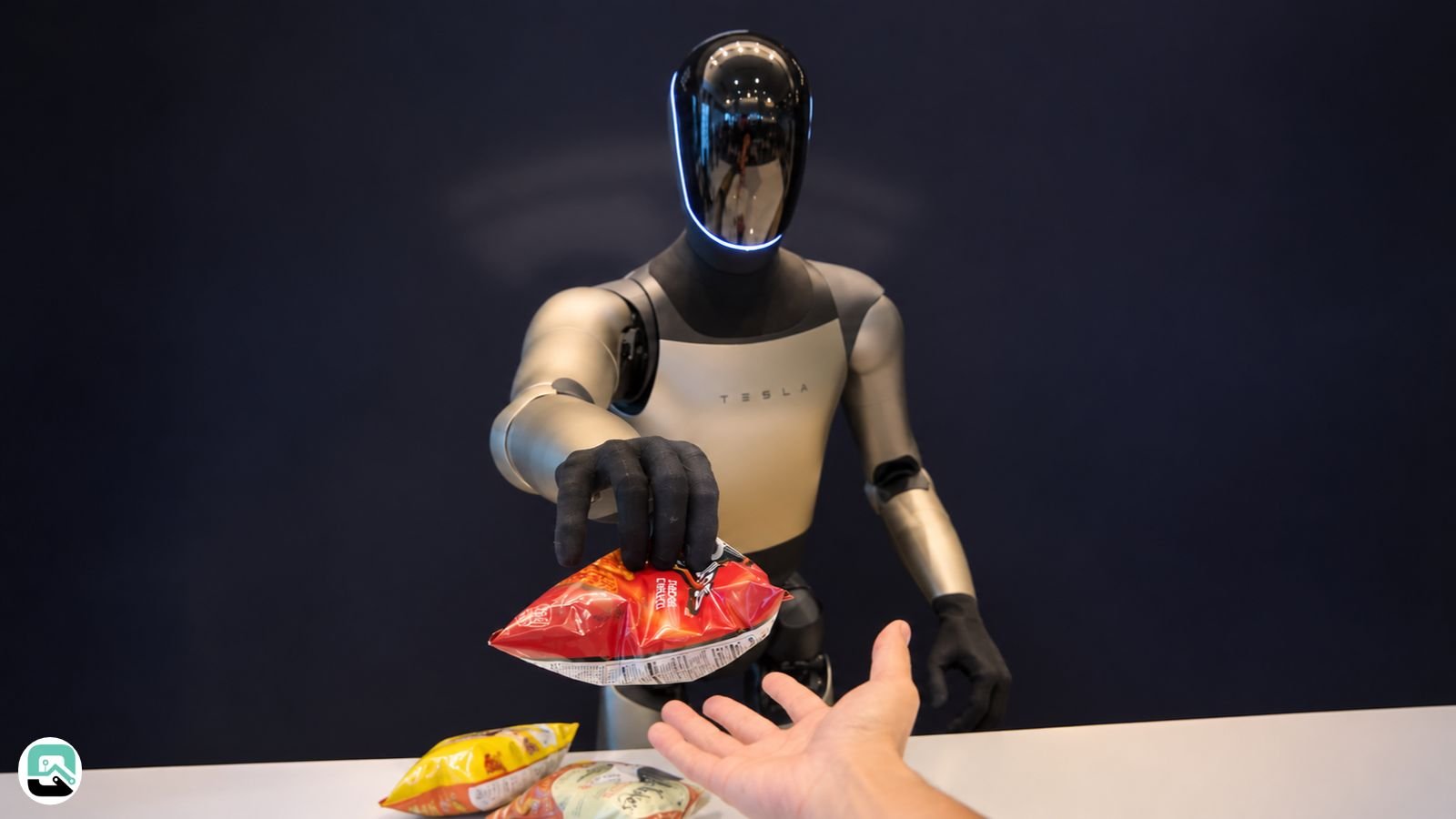
Tesla’s Optimus humanoid robot passed out snack packets at a robotics conference in Austin this month. The robot grasped each packet and held it out. Attendees took it.
A human operator steered the robot remotely, according to event footage and reporting on the demo.
That detail tells you more than the demo itself. It shows where Optimus stands today, and it points to the question that will decide Tesla’s 2027 plan.
What the Austin demo actually proved
The motion looked smooth. The hardware worked. But the operator made every decision.
Doing the same job alone takes three calls:
- Where to grip the packet
- How to adjust the reach as the person moves
- When to let go
Humans make these calls without thinking. Robots struggle with all three. Teleoperation hides that struggle, so a remote-controlled demo shows the body and says little about the brain.
Tesla’s timeline so far
Most of the public timeline comes from Elon Musk.
- January: Musk told the World Economic Forum in Davos that some Optimus units already did simple tasks in Tesla factories. He expected more complex industrial work by the end of 2026. He gave few details on the jobs or the supervision involved.
- October: Musk said deliveries to outside companies could start around the end of 2027. He also said Tesla hoped to show Optimus doing unscripted tasks within a month or two.
- Now: Tesla has begun early production in Fremont, California.
Household help sits further out. Tesla calls it a longer-term goal.
Why factories come first
Tesla expects its first customers to give Optimus repetitive or hazardous industrial work. Think of jobs that strain human bodies or run around the clock. Tesla has not named the specific tasks.
Factories give robots structure. Parts arrive in roughly the same spot. The sequence repeats. Few surprises walk through the door.
Tesla also has a training plan. Optimus watches people do a task. It then practices in simulation and in the real world. Those runs produce data on how the robot moves and handles objects, and Tesla feeds that data back into its software. The newest hardware, covered in this breakdown of Optimus Gen 3’s specs and release timeline, will generate that data at a larger scale once production ramps.
The Recovery Gap
Most humanoid coverage asks what a robot can do. A better question asks what it does when something goes wrong.
I call that distance the Recovery Gap. It is the space between a robot’s best run and its worst-case response. The term is mine. Nobody has measured the gap for Optimus in public.
Picture a bracket that lands a few centimeters off. Or a grip that slips mid-transfer. A scripted robot freezes. A useful one adjusts, retries, and keeps the line moving. The next station never waits.
Other humanoid trials show why this matters. Google’s Gemini Robotics 2.5 posted a 96% success rate sorting parts at Mercedes-Benz. Coverage of that trial gave no failure criteria and no count of human interventions. One robot could finish 96% of picks alone. Another could call a technician after every stumble. Both would earn the same headline.
Optimus will face the same scrutiny. Buyers will pay for uptime, and a line that stalls whenever a part shifts costs more than it saves.
Optimus by task
| Task | What Tesla has shown or said | What autonomy requires |
|---|---|---|
| Handing out snacks | Done in Austin, apparently by remote control | Picking a grip, tracking a moving person, timing the release |
| Folding a shirt | Shown in an earlier demo | Adapting when fabric shifts, such as a sleeve hanging off the table |
| Moving parts between workstations | Tesla’s expected first use | Recovering from misplaced or slipping parts without stopping the line |
| Full household laundry | A longer-term goal | Pulling items from a pile, untangling them, folding shirts and jeans differently |
Why laundry is harder than it looks
Folding one shirt on a clear table is a controlled test. A full load is chaos.
The robot would pull garments from a pile and separate tangled items. It would then choose a fold for each piece, from a T-shirt to a pair of jeans. Fabric changes shape constantly. One sleeve over a table edge can change where the robot should grip.
Tesla says four areas still need work:
- Hands: They need the dexterity to handle objects of different shapes and sizes. Building a human-like robotic hand remains one of robotics’ hardest problems.
- Software: It has to adjust when something moves or a task goes wrong.
- Durability: The robot must survive repeated use.
- Safety: It must work safely around people.
Rivals attack the same chore from different directions. Some bet on remote human guidance, others on video of people or recording gloves. A side-by-side look at how five home robots learn chores shows that Optimus takes the factory-first route. Its lessons come from the production floor, not from living rooms.
One test to watch for
Musk has promised unscripted demos soon. Here is a simple way to judge them.
Put the same snack packet in a new spot. Then watch whether Optimus finds it, picks it up, and hands it over with no operator.
If it does, the Austin demo becomes a baseline. If Tesla shows only scripted footage again, the 2027 timeline deserves more doubt.
What comes next
The next six months will clarify a lot. Any one of these would move Optimus from promise toward product:
- An unscripted public demo
- A list of named industrial tasks
- A signed outside customer
Tesla owns a major advantage in its own factories. It can test Optimus on real work and collect data at scale. Its challenge is trust. Public claims have run ahead of public proof, and Musk has offered few details on how much human supervision the robots need.
FAQs
Q. Was Optimus autonomous at the Austin demo?
No. Footage and reporting from the event indicate a human operated it remotely.
Q. When could outside companies get Optimus?
Musk said in October that deliveries beyond Tesla could begin around the end of 2027.
Q. What will Optimus do first?
Tesla expects customers to use it for repetitive or hazardous industrial work. The company has not named the tasks.
Q. Will Optimus do household chores?
Tesla treats home use as a longer-term goal. Chores like laundry demand better dexterity and stronger error recovery.
Q. Where does Tesla build Optimus?
Early production has started in Fremont, California.
Q. How does Tesla train the robot?
Optimus learns from people performing tasks. It then practices in simulation and in the real world. Tesla uses the resulting data to improve its software.
Related: Tesla’s 20,000-a-Week Optimus Plan Could Make Texas Instruments a Big Winner