

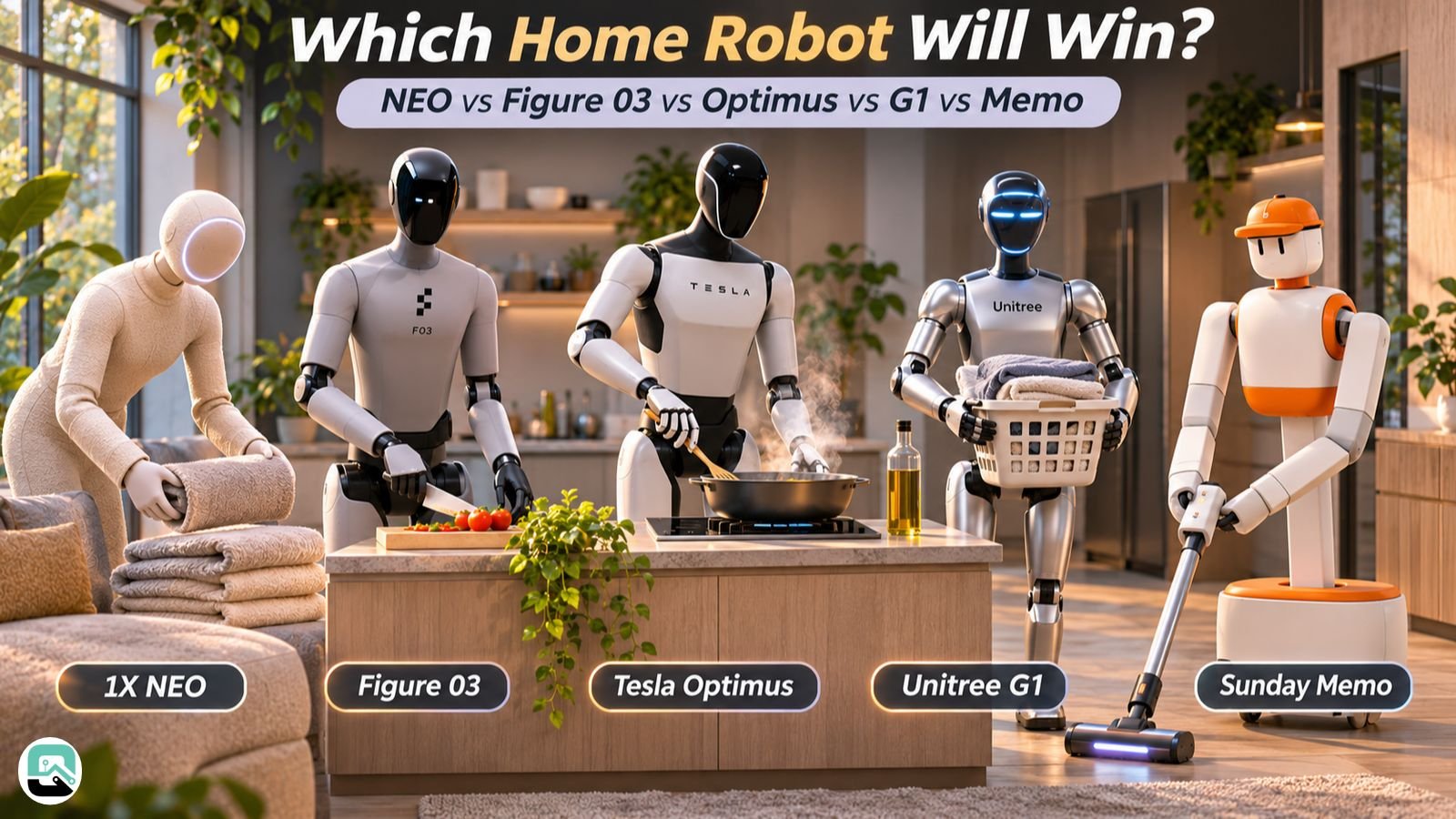
Every humanoid maker pitches the same dream. A robot folds your laundry and empties the dishwasher while you do something else.
The pitches sound alike, but the engineering doesn’t. Each company bets on a different way to teach its robot, and that choice will decide who reaches your living room first.
CTech put five contenders through a reality check: 1X’s NEO, Figure 03, Tesla’s Optimus, Unitree’s G1 and Sunday’s Memo. This piece builds on that reporting and adds a fresh check on the key numbers.
Why build a robot in human shape?
Ofir Ozeri, a robotics engineer and content creator, gives the common answer. People built the world around their own bodies. A robot with a torso, arms and legs can use doors, tools and appliances without any redesign.
The shape isn’t a rule, though. Memo rolls on wheels, and the wider range of humanoid body types shows how many layouts engineers now try.
AI lowers the barrier too. Ozeri expects robot development to get as easy as app development someday.
The demonstration supply chain
A home robot needs demonstrations. Someone has to show it what “folded” looks like. Each contender gets those demonstrations from a different place.
| Robot | Where the demonstrations come from | Price signal | Status |
|---|---|---|---|
| 1X NEO | Remote human guidance in owners’ homes | $20,000, or $499/month later | Pre-order, no delivery date |
| Figure 03 | Human behavior data plus home trials | None announced | No timeline |
| Tesla Optimus | Tesla’s own factory work | Long-term target of $20,000–$30,000 | Outside industrial customers late 2027 |
| Unitree G1 | Nobody yet; the buyer supplies the software | $13,500 base | Orderable now |
| Sunday Memo | People wearing a recording glove | About $20,000 per hand-built unit | Home trials only |
NEO learns from a human in the room
When NEO meets an unfamiliar task, its owner can schedule a 1X employee to guide it remotely. The robot then learns to repeat the job alone.
Ozeri calls NEO his favorite to win the market. He likes its cable-driven movement, which allows gentle, controlled motion.
The trade-off is privacy. PCMag reported that a 1X employee in the US can see inside a home during these sessions. An owner has to schedule each session, and the robot’s ear rings change color while an operator is active. NEO’s Expert Mode and privacy trade-offs matter as much as its price.
Figure 03 learns from video of people
Figure sent its robot into 30 Bay Area homes it had never entered. The robot completed 237 of 420 full tasks, a 56% success rate, compared with 9% for a version without Figure’s Index pretraining. Index is a dataset of human behavior.
TechRepublic points out that Figure scored all or nothing, so the robot failed 44% of its trials. The tasks were tidying a living room, folding towels and making a bed.
Ozeri rates Figure a serious contender. He doubts its safety work breaks new ground. Figure 03’s sensor design is the stronger part of its case.
Figure hasn’t named a consumer price. Ozeri estimates production cost near $300,000 per unit. That figure is his guess, not Figure’s. At that price, a building manager could own the robot and send it to several apartments.
Tesla Optimus learns on the factory floor
Tesla has shown Optimus handling battery cells. CTech reports that initial production started this month at a California plant.
Elon Musk has admitted the AI still can’t handle tasks nobody defined in advance. In October, he said the design still needs work on safety, reliability, and durability.
Tesla hopes to supply outside companies late in 2027, for industrial use first. Household sales have no date.
Unitree’s G1 sells the body and leaves the brain to you
The G1 ships today, including to Israel. The base model costs $13,500 before shipping and taxes. It moves well. It can’t follow a general instruction like “fold the laundry.”
The base model’s locked firmware can’t run custom code, so developers need a pricier EDU version. Unitree’s own G1 page lists the configurations. Most buyers today are researchers, not households.
Ozeri sees Unitree’s factory capacity as a real asset. It pays off only if someone writes software worth running on the hardware.
Sunday’s Memo learns from gloves
Memo rolls on wheels and has a torso with two arms. People wear a Sunday glove while they do chores, and those recordings train the robot.
Sunday reports that Memo folded and stacked laundry successfully 778 times in 785 attempts, a 99.1% success rate. The homes were new to the robot. Humanoids Daily notes that the benchmark is first-party and unaudited.
The wheels give Memo a stable base. Sunday says its low center of gravity keeps it upright in a power outage. The cost is obvious: Memo can’t climb stairs.
Sunday says each hand-built unit costs about $20,000. It hopes to cut that at least in half with mass production.
Don’t compare 56% with 99.1%
The two numbers look like a scoreboard. They aren’t one.
Figure’s result covers three different chores with all-or-nothing scoring. Sunday’s covers one chore, folding. A single repeated task will always score higher than a mixed set. Both companies reported their own results, and no independent lab has confirmed either.
When will one reach your home?
Ozeri expects robots that help with some chores as early as the first half of 2027. He expects early models to add work, not remove it. Hobbyists and early adopters will buy first. A human helper will stay cheaper.
The slower problem is manufacturing. Software spreads instantly. Robots need factories, supply chains, capital, repair crews, and logistics.
Ozeri says an affordable robot for the middle class is still “quite a few years” away.
FAQs
Which home robot can I buy today?
Only the Unitree G1 ships now. It can’t do chores out of the box. NEO takes pre-orders without a delivery date.
How much will a home humanoid cost?
NEO costs $20,000, or $499 a month later. The G1 starts at $13,500. Tesla’s long-term target is $20,000–$30,000. The figure hasn’t named a price.
Why does NEO use remote human operators?
The operator steps in when NEO meets a task it doesn’t know. The session also teaches the robot. It raises the privacy questions covered above.
Can I trust the success rates?
Treat them as company claims. Figure’s 56% and Sunday’s 99.1% measure different jobs, and no outside lab has audited either.
The takeaway
The best demo video won’t win this race. The winner will be the company that gets steady demonstrations, passes the safety test, and builds robots at a price people can pay. Today, no contender does all three.
Related: Tesla Optimus Gen 3 Explained: Real Specs, Price, AI5 Chip & 2026 Release