
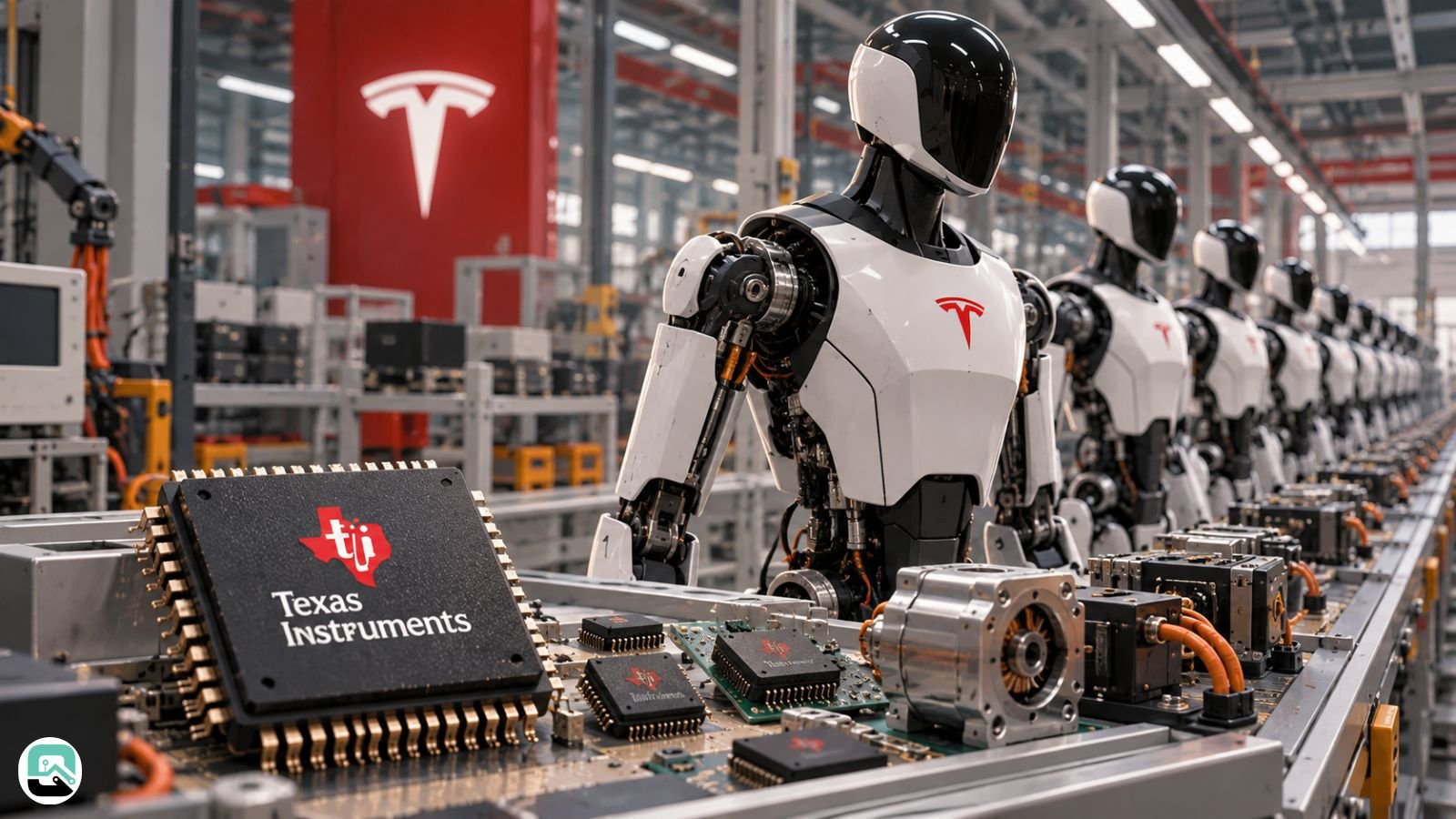
Tesla has started building Optimus robots on its Fremont line. The line carries a design target of 20,000 robots a week, roughly a million a year.
Musk set a long runway for that number. He told investors the ramp will take at least a year, maybe longer. The headline figure describes a future factory, not today’s output.
The more useful question is who gets paid when that factory runs. The answer isn’t the chipmaker most people expect.
The brain is already spoken for
Nvidia sits this one out. A Motley Fool analysis points out that Optimus runs on Tesla’s own inference chips, which grew out of the company’s Full Self-Driving work. Tesla designs the compute and keeps the margin. It also plans to bring its AI5 chip to the robot.
Other chipmakers are staking claims on different layers of the robot, from perception to edge computing. The motion hardware is where a less famous name shows up.
The body needs different silicon
A humanoid moves with dozens of motors. Each one needs clean, precisely timed current. Motor controllers and gate drivers deliver it, and Texas Instruments makes both.
Sensors add another layer. Force sensors, encoders, and tactile fingertips all produce analog signals. Converters turn those signals into data the brain can use. TI makes those too.
Hands raise the stakes. Tesla’s next-generation hand reaches 22 degrees of freedom, double the Gen 2 hand. More joints mean more drivers and more sensing.
Power runs through the same supply chain. Battery monitors and cell-balancing chips track each cell’s voltage and temperature. The Fool analysis lists TI there as well.
Tesla hasn’t published a parts list for Optimus. The supplier picture comes from teardown-based analysis, so weigh it that way.
What the money looks like
The analysis estimates TI sells $250 to $500 of chips per robot. At a million robots a year, that adds $250 million to $500 million in annual analog revenue.
Now compare it to TI’s size. Its analog segment earned $4.91 billion in the third quarter, up 32%, according to TI’s SEC filing. The top-end Optimus estimate equals about 2% of TI’s revenue at that pace.
That’s a tailwind. It won’t change the company.
Small share of the price, big share of the risk
Tesla hasn’t announced an Optimus price. Musk’s long-term target sits between $20,000 and $30,000. At those prices, the estimated chip content works out to roughly 1% to 2.5% of the robot’s cost.
The chips cost little next to the robot. A missing one stops the line.
That asymmetry explains why analog suppliers matter at scale. At 20,000 robots a week, parts delivery matters more than model quality. Suppliers with automotive-grade qualification have the edge. According to the Fool analysis, TI has supplied Tesla’s cars for over a decade.
The ramp will test everyone
Tesla calls this early production. Musk expects the climb to be bumpy, TechCrunch reported. The same earnings report showed Tesla’s profit falling 43%, and the company cut its 2026 capital spending plan.
Outside demand is still a promise. Musk puts deliveries to outside companies around the end of 2027, so outside buyers still can’t order a humanoid from Tesla. Tesla also hasn’t named a customer or an order.
TI carries its own risk. Its fourth-quarter guidance brackets the third-quarter result, which signals steady demand rather than another jump. Optimus orders won’t move that picture for years.
The wider bet
Tesla isn’t the only builder. Chinese makers already ship the most humanoid units. A chipmaker that sells to every builder gets paid whichever robot wins.
That’s TI’s real appeal. Its Optimus exposure matters less than its place in the whole market.
What to watch next
Three signals will show whether the thesis holds.
- A disclosed weekly production rate from Tesla.
- A named outside customer or a confirmed price.
- Robotics getting its own mention on a TI earnings call.
Brains win the headlines. Parts like these build the robots.
Related: Tesla Optimus Gen 3 Explained: Real Specs, Price, AI5 Chip & 2026 Release