

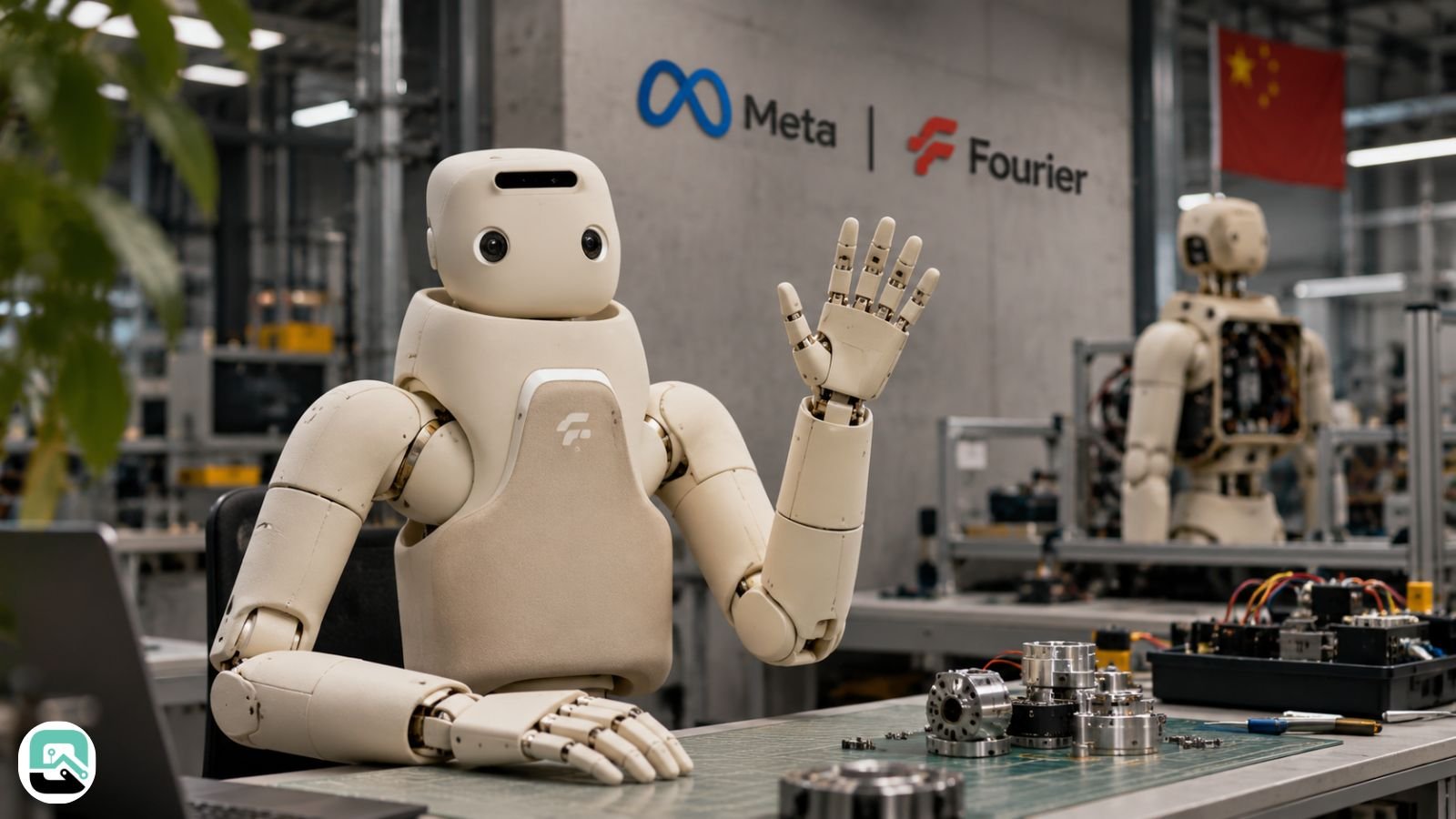
Meta built the mind first. Now it wants a body for it.
Muse launched in September as a personal agent for emails, bookings, and purchases. Reports say Meta partnered with Chinese robotics company Fourier to build a humanoid prototype called Max in about three months.
The project tests a bigger idea. Can a consumer AI agent leave the screen and work inside a home?
What Meta built
Max stands about 1.5 meters tall and weighs roughly 48 kg. It has five-fingered hands, built-in speakers, and a screen that mimics facial expressions. It runs on Nvidia’s Jetson Thor chip.
Meta and Fourier built the robot through close cooperation at Fourier’s factory. The team showed the prototype internally in August.
Meta calls the work research. The company says the Fourier partnership is limited to research and experimentation. It has no plans to sell the units.
Max 2 targets stairs and hands
Work on Max 2 began in September. The upgrades cover the torso, hands, and stair-climbing sensors.
Stairs expose weak balance control quickly. Homes have plenty of them.
Hands matter even more. Household chores demand grip, touch and patience. Most humanoid programs stall right there.
Why Muse needs a body
Muse already works as a delegation product. Meta says it can send emails, book travel, sell a car and lower a bill. It rolled out first in the United States on iOS, Android, the web and WhatsApp.
Every one of those tasks happens behind a screen. A humanoid extends the same idea into a kitchen or a hallway.
CTO Andrew Bosworth reportedly calls humanoid robots the physical embodiment of Muse. That phrase explains the whole project. Meta is not entering the robot business. It is giving an agent hands.
A software company’s robot
Most humanoid makers build the body first and hope intelligence arrives later. Meta works in reverse. The intelligence layer exists, and the hardware search has started.
That approach has a clear advantage. Meta can focus its engineers on the agent while a partner handles the machine.
It also has a clear risk. Software teams rarely understand how hardware fails in the real world.
Household work makes the risk bigger. It is the hardest setting in robotics. Figure AI aims at the same prize with a humanoid built for home life.
Why Fourier
Fourier is a Shanghai-based company with an unusual background. Alex Gu founded it in 2015, and it released its first upper-limb rehabilitation robot in 2016. The humanoid project started in 2019.
That history brings bipedal platforms, actuator supply chains and manufacturing experience. Humanoid.guide profiles Fourier’s roots in more detail.
Meta gets working hardware in months instead of years. Speed explains the choice better than anything else.
Faces, voices and eye contact
Max reportedly interacts with people through voice recognition, gestures, and eye contact. That design choice says a lot.
Meta wants a robot people talk to, not just one that lifts boxes. Muse already communicates through a chat thread. A face carries that relationship into the room.
Expressive faces also raise expectations fast. Plenty of expressive humanoid robots promise more personality than their abilities deliver.
The geopolitical problem
Speed carries a price. US regulators are weighing import restrictions on Chinese robotics hardware.
Washington has also started targeting humanoid robots over national security and data privacy concerns. That push against Chinese humanoids could reach partnerships like this one.
The industry’s dependence on China explains the pressure. Chinese firms accounted for roughly 90 percent of global humanoid shipments in 2025. Any US company building humanoids will lean on Chinese supply chains somewhere.
Trust gets legs
Meta sells Muse on privacy. A separate security agent called Sentinel controls internet access, and Muse cannot see stored passwords or payment details. Meta also promises an audit trail.
That design fits software. A robot with cameras in your home, built with a Chinese contractor, tests the pitch much harder.
Mistakes change shape too. Meta admits Muse will sometimes make mistakes. A refund fixes a bad purchase. Nothing refunds a dropped glass.
The reality check
Max is no household helper yet. Robots still struggle to recognize objects, grasp them safely, and navigate changing rooms.
Working humanoids narrow the job to survive. Agility built a warehouse humanoid for one job, and that focus explains its commercial progress. Meta’s home target runs the opposite way.
A three-month build also proves little about durability. A prototype can impress on stage and still fail after a week of daily use.
What to watch
Max 2’s hands come first. Manipulation decides whether this program matters.
Hiring comes second. Meta is reportedly recruiting production-ready talent in Shanghai and Shenzhen. Research projects rarely need people who ship hardware at scale.
Regulation comes third. Any new restriction on Chinese robotics hardware would hit this partnership first.
Meta’s own messaging comes last. Watch whether the company keeps calling Max research or starts talking about products.
The takeaway
Max is a cheap way to test an expensive idea. Meta spends a few months and one partner’s factory to learn whether Muse belongs in a body.
The answer will shape more than one product. It will show whether the next humanoid wave starts with hardware makers or with the AI companies that already hold your data.
Related: Tesla Optimus Gen 3 Explained: Real Specs, Price, AI5 Chip & 2026 Release