


There is no independently verified “most realistic humanoid robot” in 2026. Realism divides into four separate engineering problems, and no machine currently leads all four.
Ameca focuses on facial expression and cannot walk. Mesmer replicates specific real people from 3D scans. Sophia remains the most recognised social robot in the world and the hardest to assess for autonomy. Moya pairs a walking body with temperature-controlled silicone skin. XPeng IRON pursues human-like movement behind a deliberately non-human face. Aria sells companionship on a wheeled base. Origin M1 concentrates almost everything into a head. Protoclone rebuilds human anatomy and cannot yet stand up.
This guide compares all eight against a stated definition of realism, and labels every claim by how strongly it is evidenced.
How we assessed these robots
We assess each robot across four dimensions: face, motion, touch and autonomy. We do not combine those dimensions into a single score and we do not name an overall winner, because the evidence does not support one. No robot here was tested in person by RoboPulse, and no independent head-to-head realism test exists for this group. Prices are estimates unless a manufacturer publishes a figure.
Evidence labels used throughout
| Label | Meaning |
|---|---|
| Maker specification | Published by the manufacturer in technical documentation |
| Vendor claim | Manufacturer performance claim, not independently tested |
| Demonstrated | Observable in a public demonstration |
| Independent reporting | Reported or examined by an outside source |
| Unverified | Insufficient public evidence either way |
The 8 humanoid robots compared
| Robot | Face | Walks | Touch | Autonomy | Price | Availability | Evidence |
|---|---|---|---|---|---|---|---|
| Ameca | 27 facial DoF | No | Grey silicone | Cloud AI | Not published | Quote | Spec + demo |
| Mesmer | 3D scan of a person | No | Custom silicone | Tritium; telepresence | Not published | Quote | Spec |
| Sophia | Frubber; 74 DoF | Varies | Frubber | Mixed autonomous/scripted | Not published | Inquiry | Spec + reporting |
| Moya | Micro-expressions | Yes | 32–36 °C* | Not disclosed | ~$173,000* | Late 2026 | Vendor claims |
| IRON | Lattice shell | Yes | Flexible lattice | Onboard, no teleop* | Not announced | 2027 | Demo + claims |
| Aria | 17 facial motors | No | Silicone | Cloud or local | From ~$125,000 | Quote | Spec + vendor |
| Origin M1 | 25 micromotors | No | n/a | External LLMs | Not published | Research | Spec + reporting |
| Protoclone | Faceless | No | Synthetic muscle | Not disclosed | None | Reservation | Description + demo |
Vendor claim unless otherwise stated.
Full specifications are in the RoboPulse robot database; you can set any two models side by side in the comparison tool.
What you mean by “realistic” decides which robot to examine
| If you mean… | Examine |
|---|---|
| Facial expression | Ameca, Origin M1 |
| Resemblance to a specific real person | Mesmer |
| Human-like walking | XPeng IRON, Moya |
| Warm synthetic skin | Moya |
| Human anatomy | Protoclone |
| Social interaction and companionship | Sophia, Aria |
No robot appears in more than one row. That is the finding, not an evasion of one.
How to verify a robot’s realism claim

Five questions separate a specification from a capability. They apply to every robot below, and to any video you encounter afterwards.
1. Who measured it? Moya’s 92% figure is a maker claim about walking posture, not a test of overall realism.
2. Does it walk? Ameca, Mesmer, Aria, and Origin M1 do not. That fact alone reorders most published lists.
3. Is a human in the loop? Ask about teleoperation. Engineered Arts supplies telepresence software for Mesmer, 1X uses scheduled operators for NEO, and Sophia has combined autonomous responses with scripted input depending on the setting.
4. Which version is on screen? Specifications shift between announcements. Earlier XPeng materials listed a higher DoF count for IRON than the 76 reported in September 2026.
5. Can it be reproduced outside the launch environment? A controlled demo is not a deployment.
A specification is not a capability.
Russia’s AIdol lists 19 servomotors, silicone skin, a 48-volt battery rated at six hours and a walking speed of 6 km/h. At its Moscow debut on 10 November 2025, it walked a few steps and fell flat on its face. The company attributed the fall to calibration. A published walking speed and a robot that can walk are different claims.
How do we define “realistic”
Face. Eyes, blinking, gaze direction, lip sync, and micro-expressions. Measured in facial actuators and in how convincingly they coordinate.
Motion. Gait, balance, recovery from disturbance, hand movement, and the timing of gesture against speech. A robot can have accurate proportions and still move like a machine.
Touch. Skin material, compliance, texture, and temperature. The least-tested dimension here, because it requires physical access almost no reviewer gets.
Autonomy. Conversational capability, memory, whether processing runs onboard or in the cloud, how independently the robot acts, and whether an operator is involved.
A robot can perform well in one dimension and not at all in another. Ameca is documented on face and has no motion to assess. IRON reverses that.
Two supporting concepts help when reading spec sheets: what degrees of freedom actually measure, and how bipedal robots balance and walk. A higher DoF count does not automatically mean more natural movement.
Included in this guide: full-body humanoids, upper-body social robots, and embodied platforms marketed on human likeness. Included but flagged: head-only and half-body systems such as Origin M1, which compete on face alone. Excluded: industrial humanoids making no human-likeness claim, and screen-based avatars.
Ameca: degrees of freedom and facial actuators
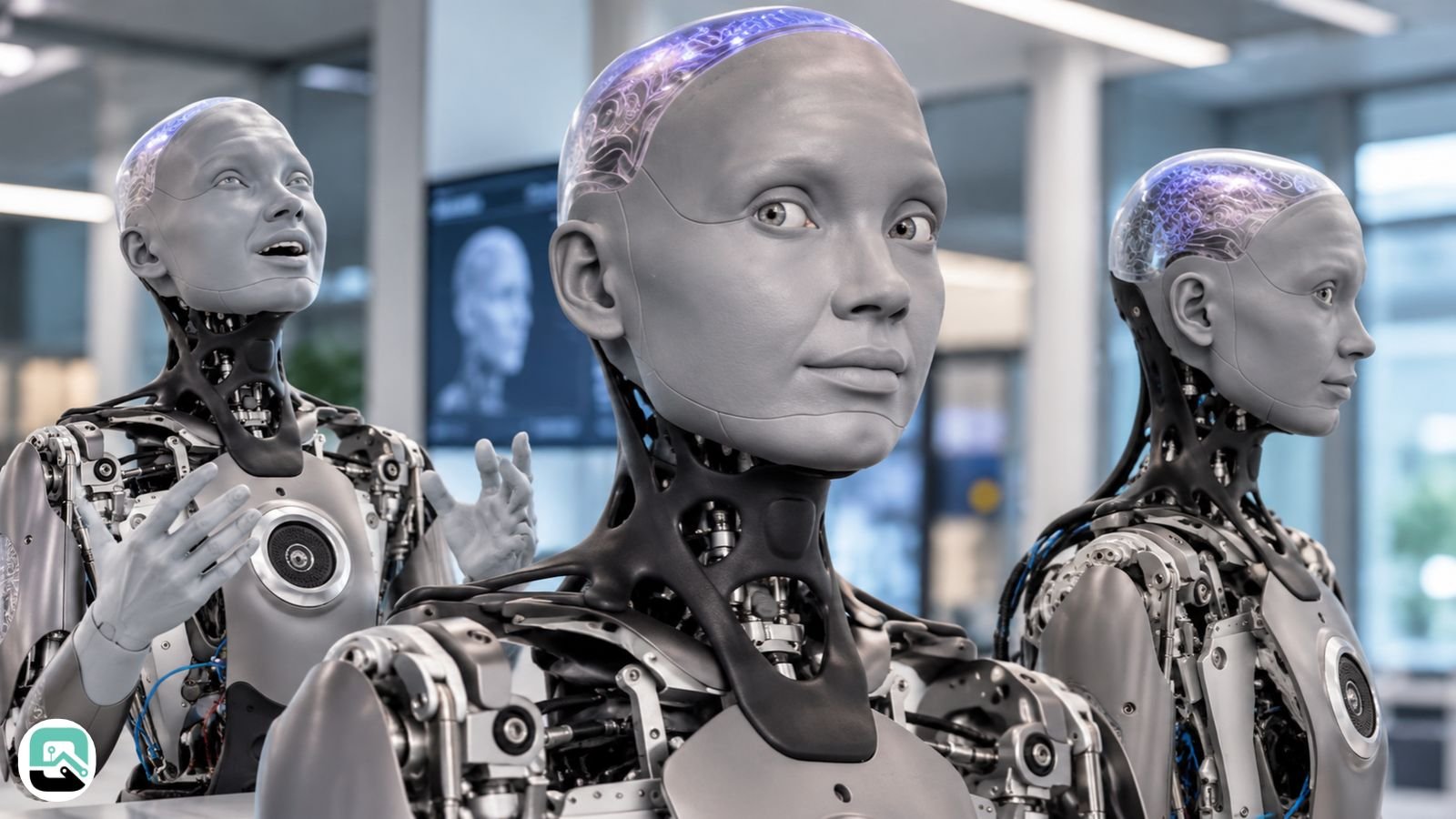
Ameca is the most fully documented case of robotic facial expression in this group, built for conversation rather than labour.
Engineered Arts’ technical documentation lists Generation 2.6 (2024) at 1,870 mm and 62 kg, with 61 actuated degrees of freedom, 27 of them animating the eyes, lips and other facial features. Each eye holds an 8 MP camera.
What the spec sheet omits matters as much: no battery, no legs, no walking speed. Ameca runs on mains power from a fixed base.
The grey skin is deliberate. Engineered Arts uses grey silicone on the face and hands and designs for a genderless appearance. Ameca pursues expressiveness rather than disguise, which is what separates it from Mesmer.
Price: Engineered Arts publishes no prices and sells by quote or rental. Third-party estimates run from roughly $130,000 to $500,000, with around $250,000 per unit the most specific figure in press reporting. Treat all of them as guesses.
One caution when researching Ameca. Several AI-generated reference sites describe a walking “Generation 3” with an eight-hour battery. Engineered Arts’ own specifications describe no such model.
Mesmer: building a robot that resembles a specific person
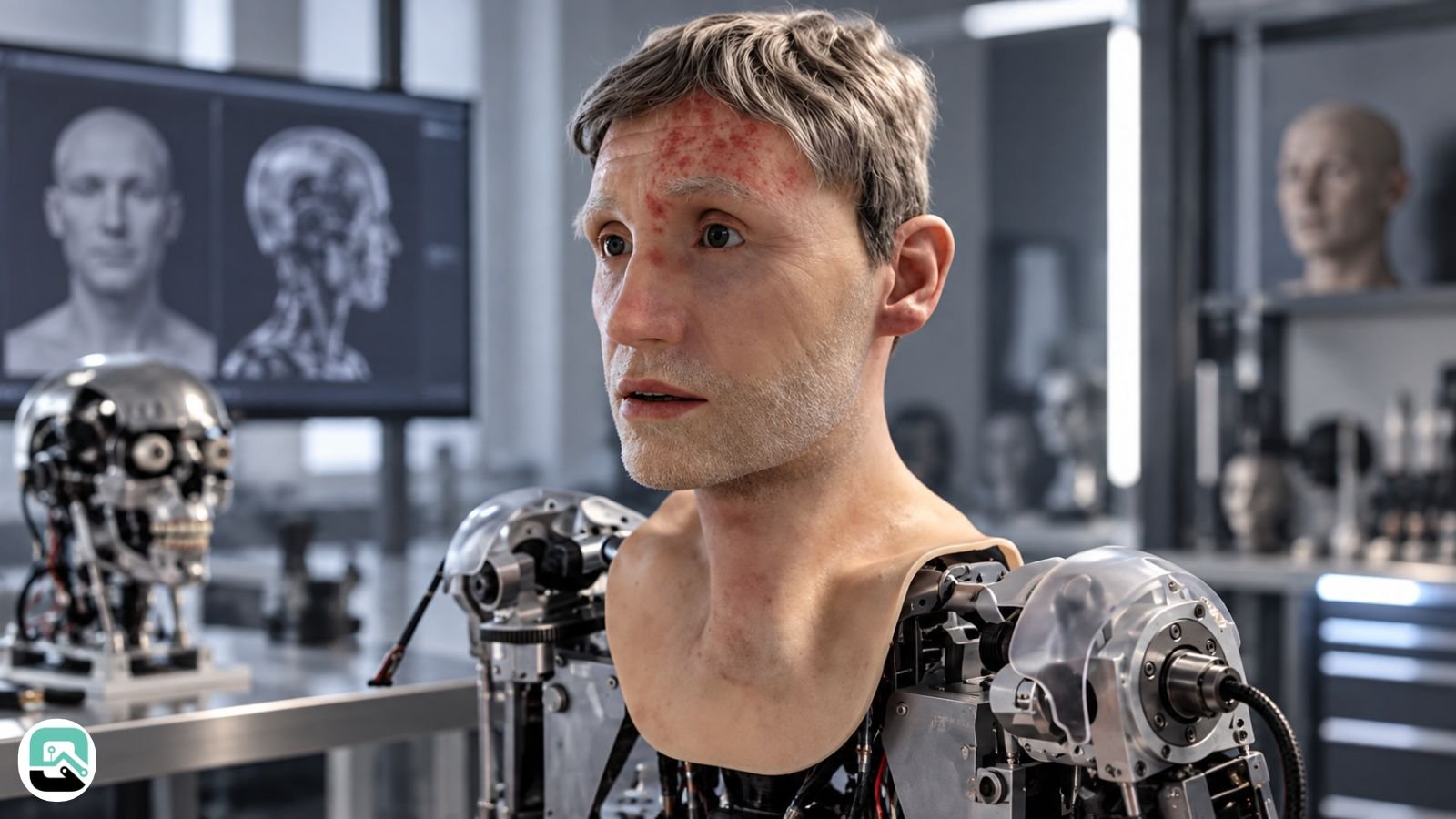
Mesmer answers a different question. Ameca asks how expressive a robot face can be; Mesmer asks how closely a robot can resemble one particular human.
Engineered Arts builds each Mesmer from in-house 3D scans of a real person, reproducing bone structure, skin texture, and expression. The company positions it for brands, intellectual property, and recreations of actual people. Ameca’s hardware descends from Mesmer technology.
One detail matters for anyone judging realism from a video. Engineered Arts supplies telepresence software that lets an operator drive a Mesmer remotely. A strikingly responsive Mesmer in a public setting may be a person.
That is not a criticism of the product. It is a reason to ask, of any lifelike robot demonstration, who is actually speaking.
Mesmer sells by quote. Most public documentation dates from 2020–2024 rather than 2026, so treat it as an established platform rather than a current launch.
Sophia: a famous face with a mixed autonomy record
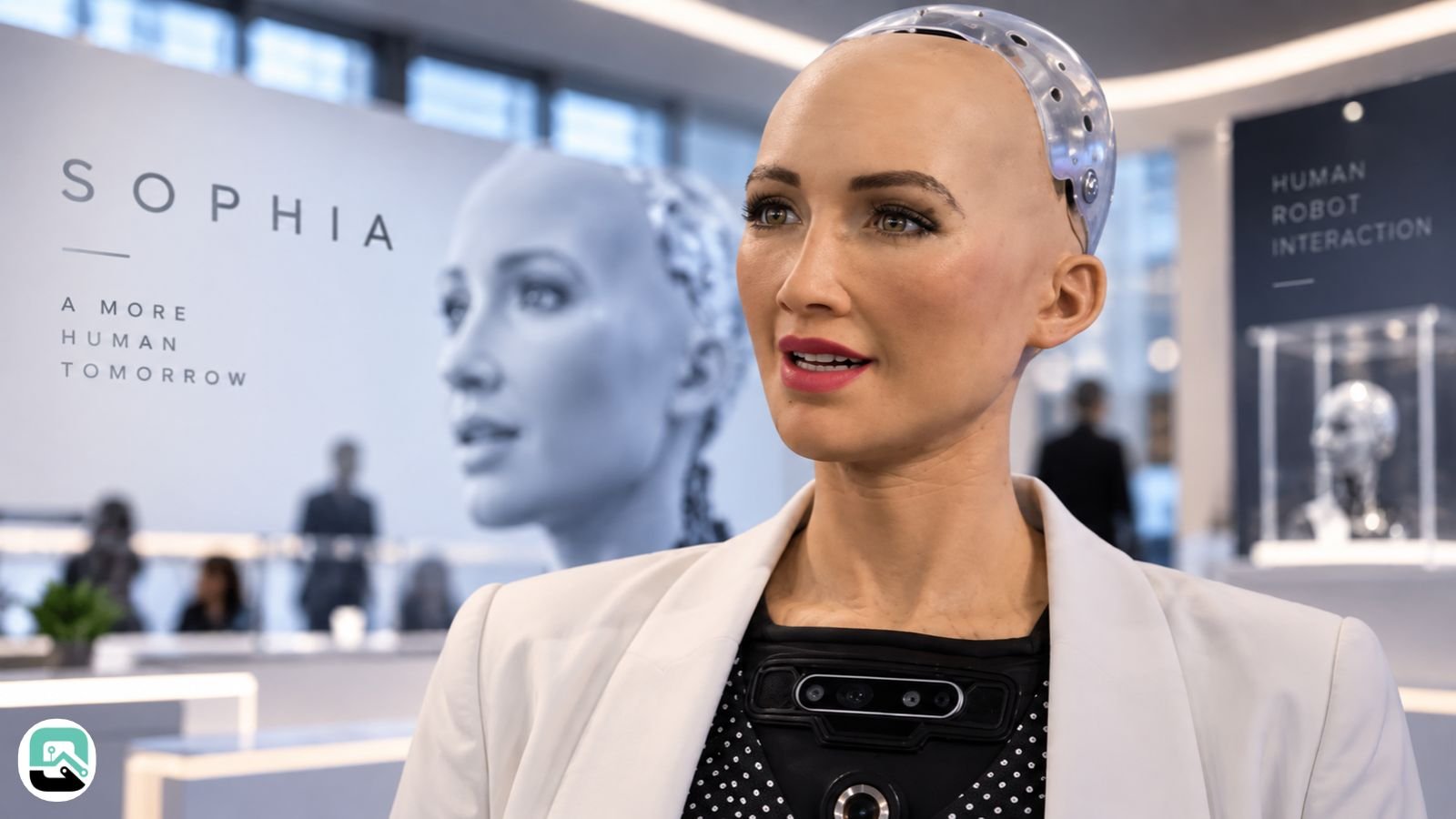
Sophia is the robot most people picture when they hear “realistic humanoid,” and its autonomy is harder to assess from public documentation than its appearance.
Hanson Robotics activated Sophia in February 2016. The 2020 configuration is documented at roughly 167 cm with 74 degrees of freedom, using Hanson’s proprietary Frubber skin.
Depending on the setting, Sophia has used autonomous responses alongside scripted or operator-supplied input. Claims of specific large-language-model integration circulate widely but trace to aggregator sites rather than primary sources, so we treat them as unverified. Underneath sits real robotics work, including published research on arm control.
The practical consequence for a buyer: Sophia has often been presented in ways that make its autonomous capabilities difficult to separate from scripted or operator-assisted demonstrations.
Availability: Hanson’s site was rebuilt in 2026 around an inquiry form for a “Sophia Utility” platform, positioned as an early product for retail, education, healthcare and events. No prices are published, and the company’s deployment claims are its own.
Moya: warm-skin claim and the 92% gait figure

DroidUp makes the boldest full-body claims in this group, and nearly all the evidence comes from DroidUp.
The Shanghai company unveiled Moya in early 2026 at about 1.65 m and 32 kg, with silicone skin over flesh-like padding and a rib cage, and a camera behind the eyes. Launch reporting put the skin temperature between 32 °C and 36 °C.
DroidUp also claims a gait 92% human-like, derived from its Walker 3 skeleton, successor to a platform that placed third in Beijing’s robot half-marathon in April 2025.
Read that figure narrowly. It covers walking posture, not overall humanness, and observers at the launch described a residual stiffness in the stride.
Skin temperature is a specification, not a sensation. No test of whether people find the skin lifelike appears in the coverage reviewed here.
Is Moya the most human-like humanoid robot? The public evidence does not establish that. Its 32–36 °C claim addresses temperature, and its 92% figure addresses walking. Neither measures facial realism, touch perception, autonomy, or overall human likeness.
DroidUp has not detailed Moya’s conversational AI or autonomy, placing it within a broader pattern in China’s humanoid rental market, where autonomy claims often outrun demonstrated capability.
Price: a maker estimate of roughly $173,000, with sales expected late in 2026, targeted at healthcare and education buyers.
XPeng IRON: gait demonstrations and production status
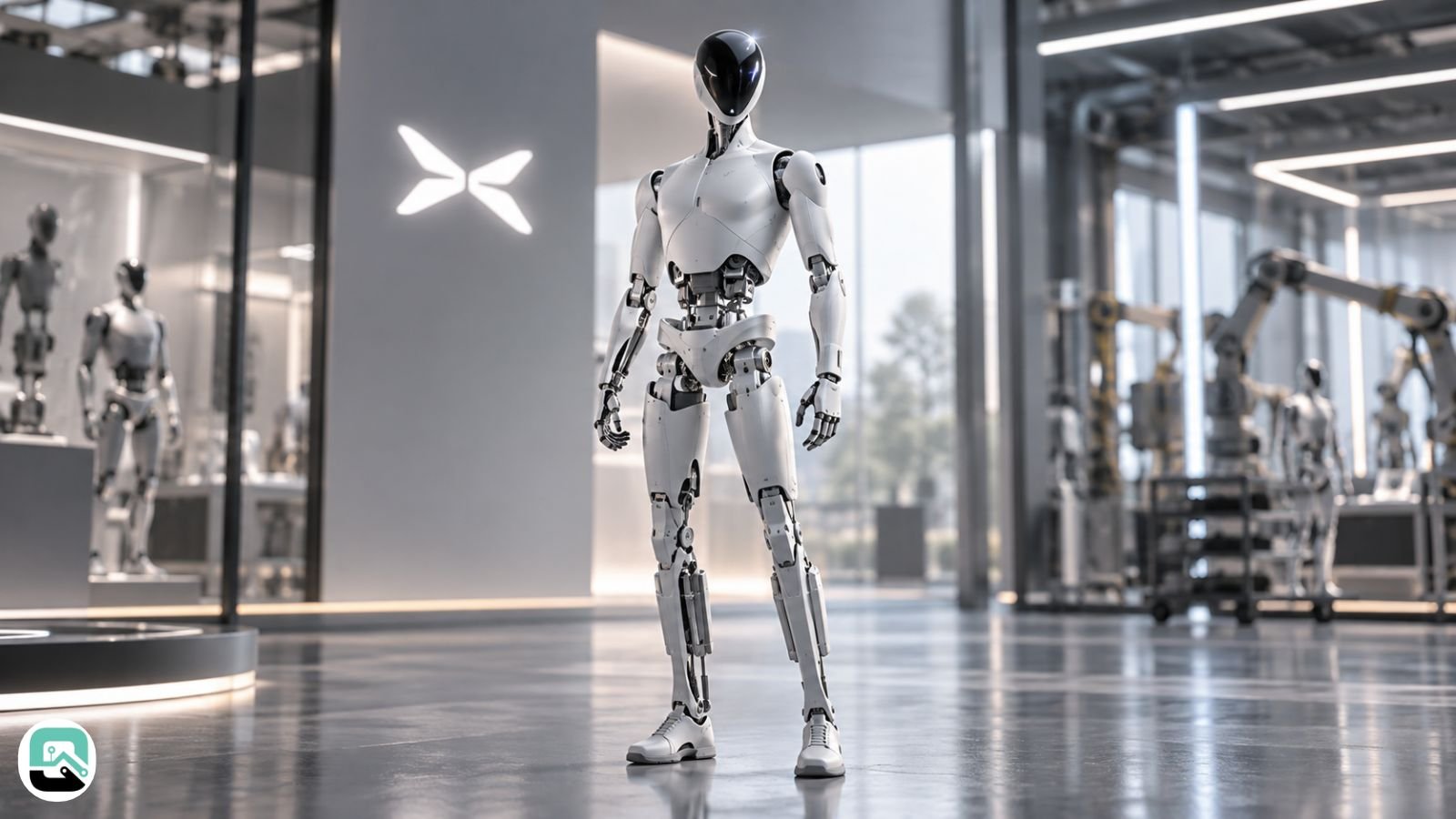
IRON has some of the clearest public demonstrations of human-like bipedal walking among these eight. It is a movement contender rather than an appearance contender.
Is IRON real, or a person in a suit? At its November 2025 debut, viewers suspected a person was inside, so engineers cut into a leg on stage to show the internal structure. It is a robot.
XPeng commissioned its humanoid production lines on 8 September 2026, with the first unit completing assembly and walking off the line under its own control. The company lists 76 degrees of freedom across the body and 21 in each hand, under a fully enclosed flexible lattice treated as both skin and safety feature. Three in-house Turing chips provide what XPeng rates at up to 2,250 TOPS.
Three caveats accompany that milestone. One robot walking off a line is not mass production. The claim that IRON needs no remote operator comes from the company, and independent task benchmarks have not been published. Initial deployments target XPeng’s own stores and campuses.
XPeng targets mass production by the end of 2026 and commercial deliveries in 2027. No price announced. Hardware details are in the XPeng IRON review.
Realbotix Aria: companion AI on a wheeled base
Aria is built as a companion, so autonomy matters more than gait.
Realbotix says its robots connect to local or cloud AI providers, and has described a proprietary model built on open-source engines. Launch coverage describes long-term memory and recognition of returning users, with remote access to the AI even without the robot present.
That is a vendor description. No independent test of the memory appears in the coverage reviewed here. Ask which parts run on the robot and which run elsewhere.
What the money buys is a wheeled humanoid that cannot walk: 44 degrees of freedom, 17 facial motors, magnetically swappable faces, 4–8 hours of battery, delivery quoted from 12 weeks.
Pricing has moved since launch. CES 2025 coverage quoted $10,000–$12,000 for a bust, $150,000 for the modular, and $175,000 for the full-size. Current listings put the F-Series at around $125,000, plus a $199.99 monthly AI subscription. Treat the 2025 figures as historical.
Vendor stability deserves attention at these prices. Realbotix reported $353,037 in revenue for the quarter ended 31 December 2025, down from $815,655 a year earlier, with gross margin at 32.2% and monthly cash burn around $425,000. Later quarters have been reported since; check the most recent filing.
AheadForm Origin M1: facial micro-actuation without a body

Origin M1 pushes facial realism further than anything else here, within a deliberately narrow scope.
The head packs 25 brushless micromotors driving eyes, mouth and facial muscles, with RGB cameras in the pupils and built-in microphones and speakers. A Half-Body Edition adds a neck and torso with real-time lip synchronisation and head-eye coordination.
Reviewers have been clear about the limits. One assessment of the launch video noted visible wiring, mechanical sounds, and slightly unnatural blinking.
AheadForm targets research, AI embodiment studies, and character installations. There is no walking, no grasping, and no full body, which is why it sits in the flagged category rather than competing directly with Moya or IRON.
Clone Robotics Protoclone: human anatomy, rebuilt
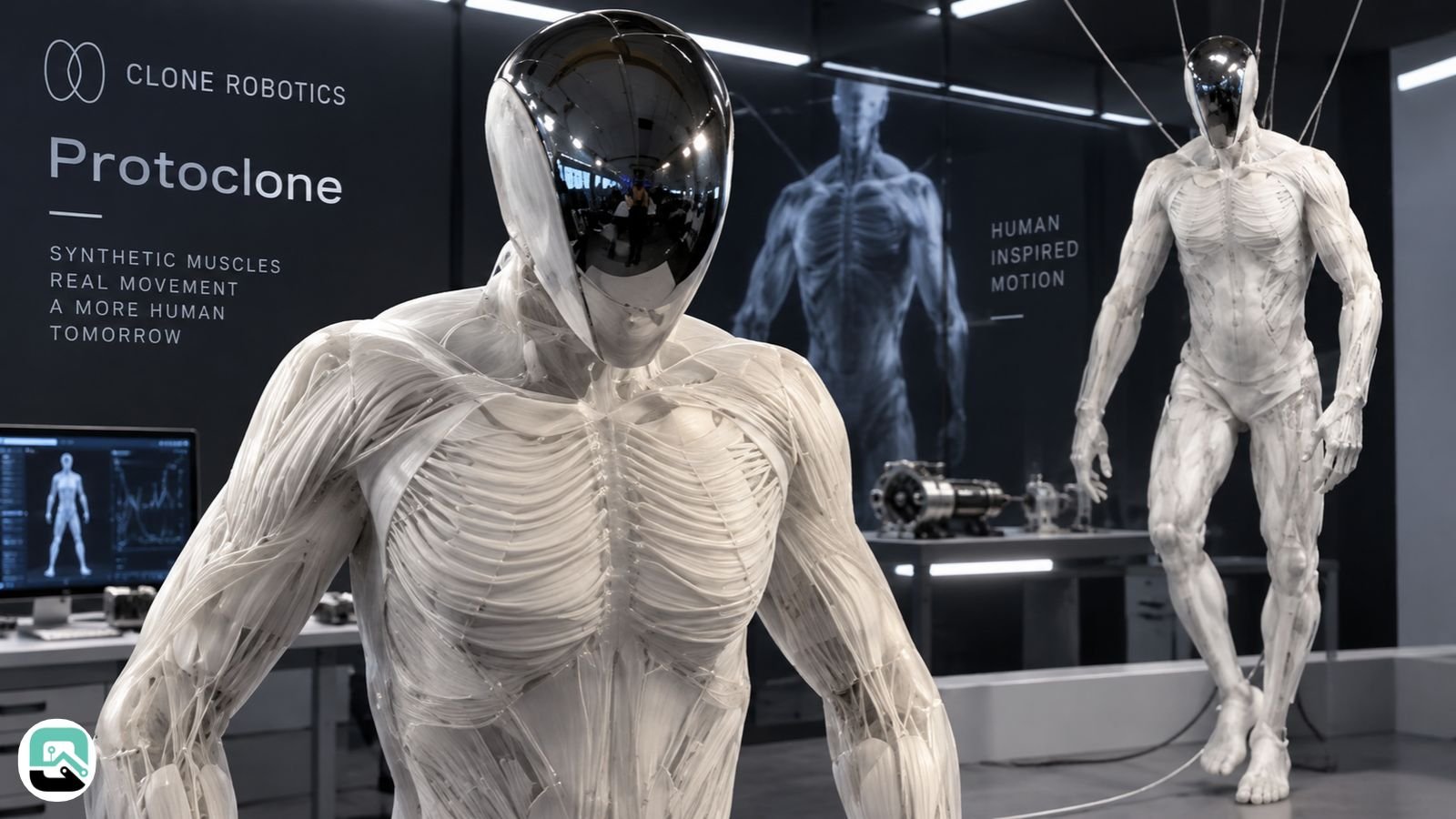
Protoclone is the most literal attempt at human replication and the least proven as a working machine.
Clone Robotics built it on a polymer skeleton replicating all 206 human bones, driven by more than 1,000 synthetic muscle units that contract when a 500-watt pump fills them with hydraulic fluid. Four depth cameras sit in the skull, with 70 inertial sensors and 320 pressure sensors.
A reflective mask covers the face, chosen to sidestep the uncanny valley.
Anatomical imitation does not guarantee lifelike behaviour. Protoclone cannot yet stand or walk unsupported, and demonstrations show it suspended from a frame.
One point is frequently misreported: the 279-unit limited batch refers to Clone Alpha, a further-developed model, not Protoclone. No price exists for either.
What other humanoid robots did we consider?
Two were assessed and excluded under the evidence threshold above.
UBTECH U1. A full-size ultra-bionic humanoid with silicone skin and an explicit human-likeness focus, now taking pre-orders. Excluded because independently verified evidence on movement, touch, and autonomy remains limited. It is the most likely addition to the next revision of this guide.
AIdol (Idol, Russia). Covered in the callout above. Excluded as a prototype with no verified commercial availability.
Why Optimus, Figure and Atlas are a different comparison
Tesla, Figure, Boston Dynamics, Agility, and Sanctuary AI prioritise balance, manipulation, payload and uptime rather than human facial appearance or synthetic skin. That makes them central to humanoid robotics and not directly comparable under this guide’s definition of physical realism.
Boston Dynamics Atlas illustrates the split: widely regarded for its dynamic balance and fall recovery, with no human face at all. Appearance realism and motion realism are now separate engineering paths pursued by different companies.
If you want a humanoid that does useful work, start with our guide to the main categories of humanoid robot.
Which realistic humanoid robots can you actually buy?
None from a shopping cart. Availability breaks into stages that marketing tends to blur:
| Stage | Robots |
|---|---|
| Order by quote | Ameca, Mesmer, Aria |
| Inquiry only, no published price | Sophia |
| Sales announced, not yet shipping | Moya (late 2026 target) |
| Reservation only | Protoclone |
| Production announced, deliveries later | IRON (2027) |
| Research and installation | Origin M1 |
Announcements and production milestones are not purchase routes.
Cheaper alternatives. 1X’s NEO is the lowest-priced humanoid with a public purchase route at $20,000 or $499 a month, but it is not a human replica: soft-bodied, human-scale, built for domestic tasks, with a scheduled human operator handling anything unfamiliar. Delivery reporting has been inconsistent through 2026, so confirm dates before committing. See the 1X NEO review. If you want a working bipedal humanoid rather than a lifelike one, the Unitree R1 ships globally from $5,900.
Does a more realistic robot feel more human?
For a buyer, the practical question is whether a more human-looking robot will actually be received better by the people around it. The research does not promise that.
Masahiro Mori proposed the uncanny valley in 1970: comfort dips as a robot nears human appearance, then recovers close to full likeness. Later research disagrees on almost every detail.
A 2022 study using full-body images of 251 real-world robots found two valleys rather than one — Mori’s, for highly human-like robots, and a second for moderately low human-likeness. The same work found “uncanny” was not a reliable measure of the effect. Other reviews report scarce evidence for any nonlinear effect at all.
There is also evidence that more expressive robots can lose trust faster when behaviour fails to match appearance. That is a direct risk for every machine on this list: the more human a robot looks, the more its behaviour has to carry.
What to check before buying a lifelike robot

Price is the smallest issue.
Before you believe a demo
Ask three questions: Is anyone operating this remotely right now? If so, does the robot indicate it? And when the operator disconnects, what can it still do?Teleoperation isn’t deception — several makers here sell it as a feature. The risk is a demo that doesn’t say which mode it’s running in.
Teleoperation and autonomy. Three of the eight have documented human-in-the-loop modes: Mesmer via telepresence software, Sophia via scripted and operator-supplied input, and NEO among the cheaper alternatives via scheduled operators. Ask who the operator works for and when handoff occurs.
Privacy. Cameras sit in Origin M1’s pupils and behind Moya’s eyes. Ask what data operators can access during a session, where footage is stored, and for how long.
Vendor stability. Published financials exist for Realbotix. For DroidUp, AheadForm, Clone Robotics, and Idol, no public financials were found as of 23 September 2026. Ask about support, spare parts and what happens if the company fails.
Regulation. California enacted companion-chatbot rules on 10 September 2026. SB 1119, known as Adam’s Law, requires crisis protocols, parental controls, restricted child defaults and independent audits, with core requirements beginning 1 July 2027. The same package included SB 867, banning toys that contain companion chatbots. Legal analysts read that as an early signal of how California may treat AI software embedded in a physical product’s safety profile. Whether these rules reach a $173,000 social robot is a question for a lawyer.
So which humanoid robot is the most realistic?
No single robot holds that title.
Use the dimension table above. Ameca is the documented case for facial expression, Mesmer for resemblance to a specific person, Sophia and Aria for social interaction, Moya for warm skin, IRON for gait, Origin M1 for facial micro-actuation, Protoclone for anatomy.
Buy for the dimension you need. Treat any video that crowns a winner as entertainment.
Frequently asked questions
Q. What is the most realistic humanoid robot in 2026?
There is no independently verified most realistic humanoid robot in 2026. Current robots excel in different areas such as facial realism, movement, touch, and autonomy, but none performs strongly across all four.
Q. Which humanoid robot has the most realistic face in 2026?
Ameca and AheadForm Origin M1 have some of the most documented facial actuation. Ameca uses 27 facial degrees of freedom, while Origin M1 uses 25 micromotors; for resemblance to a specific person, Engineered Arts Mesmer is built from 3D scans of real individuals.
Q. Ameca vs Sophia: which robot has the more realistic face?
Ameca offers more documented facial actuation, while Sophia has a more conventionally human-looking face. Moreover, Ameca publishes detailed specifications, whereas Sophia uses Hanson Robotics’ Frubber skin and has appeared in demonstrations combining autonomous, scripted, and operator-assisted responses.
Q. Which realistic humanoid robots can walk in 2026?
Among the eight robots compared, Moya and XPeng IRON are the clearest walking humanoids. Ameca, Mesmer, Aria and Origin M1 do not walk, Protoclone cannot yet stand unsupported; and Sophia’s mobility varies by configuration.
Q. Is XPeng IRON a real robot or a person in a suit?
XPeng IRON is a real humanoid robot. After viewers questioned its November 2025 demonstration, XPeng engineers cut into one of the robot’s legs on stage to reveal its internal mechanical structure.
Q. Which realistic humanoid robots can you buy in 2026?
Ameca, Mesmer, and Realbotix Aria have purchase routes through direct quotes, while Sophia is available through an inquiry process. Ameca and Mesmer focus heavily on facial realism, whereas Aria combines companion interaction with a wheeled humanoid platform.
Q. How much does a Mesmer robot cost?
Engineered Arts does not publish a fixed price for Mesmer and sells the robot by quote. Unlike Ameca, which is a standard expressive humanoid platform, each Mesmer can be created from a 3D scan to resemble a specific person or character.
Q. How much does a realistic humanoid robot cost in 2026?
Realistic humanoid robots with disclosed estimates generally fall around $125,000 to $175,000. Moya has a maker estimate of about $173,000, while Realbotix Aria’s F-Series starts around $125,000; several other models do not publish pricing.
Q. What is the difference between a humanoid robot and an android?
A humanoid robot has a body or form inspired by humans, but it does not need to look convincingly human. An android is generally designed to resemble a human more closely, so Atlas is a humanoid but not an android, while Mesmer fits both descriptions.
Related: Rizzbot Price: How Much Does the Viral Cowboy Robot Cost?
| Disclaimer: This article is for informational and editorial purposes only. Robot specifications, pricing, availability, and capabilities can change, and some figures or performance claims come directly from manufacturers and may not be independently verified. RoboPulse has not physically tested every robot featured here. Always confirm current details with the manufacturer or an authorised seller before making purchasing, investment, or deployment decisions. |