

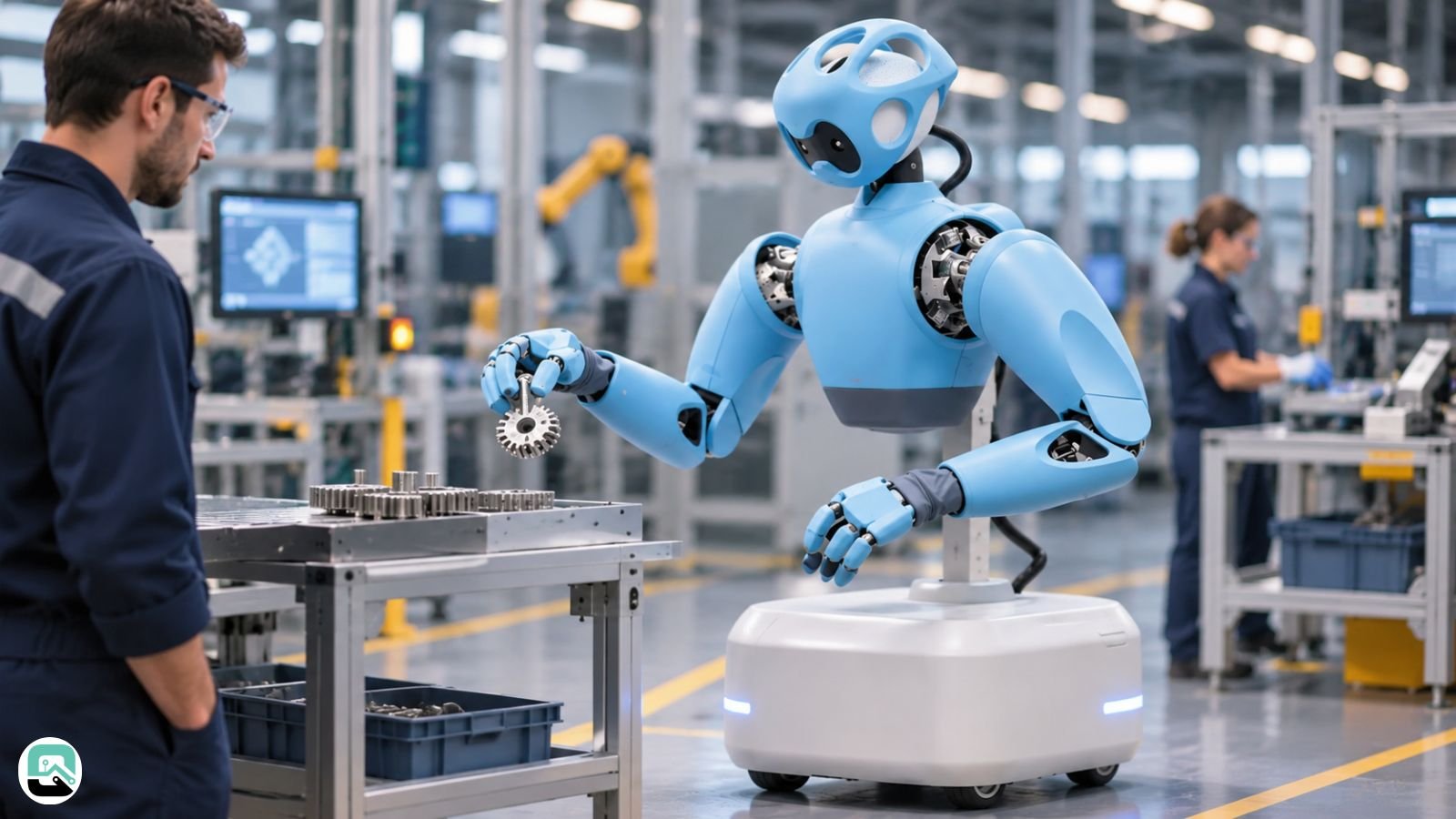
A Swiss startup says its two-armed wheeled robot can learn a factory task in about a month. The bolder claim is that it can work beside people without a fence.
Swiss startup Embodied AI has unveiled AIR, a two-armed robot on a wheeled base. It targets factory work and runs without the safety cage that normally separates industrial robots from people. The company will take orders after showing AIR at Humanoid Europe 2026 in Munich.
CEO Francesco Stella calls safety and reliability the entry ticket for physical AI. The company’s launch announcement builds its whole pitch on that idea.
The cage is the real bottleneck
Factories fence off most industrial robots. Heavy, rigid arms can hurt people, so plants add barriers and light curtains. Those barriers eat floor space and lock each robot into a single job.
AIR attacks the problem in hardware. A 25-person team spun out of EPFL built it with a torso, two light arms, and a wheeled base. The logic is simple: a robot that can’t hit hard doesn’t need a fence.
Heavy torso, light arms
Embodied AI keeps the heavy motors inside the torso. Cables carry motion out to the arms. That tendon-driven setup keeps the moving mass low, so the arms give way when they meet an obstacle or a person.
The only arm figures so far come from an investor description. Each arm unit weighs about 2 kg (4.4 lb) and lifts to 5 kg (11 lb). The company hasn’t published AIR’s size, weight, reach, battery capacity, or total payload.
Battery capacity decides whether a robot covers a full shift. Some industrial humanoids answer that with hot-swappable packs built for multi-shift work. AIR’s answer remains unknown.
Learning on the job
AIR doesn’t start autonomous. A remote operator drives it through its first shifts. Those sessions produce training data, and the company’s AI learns the task from them.
Embodied AI says the robot can work independently after about a month. A customer gets a useful machine on day one while the software catches up. That also eases a standoff in robotics: labs need real factory data, and factories won’t wait for perfect autonomy.
The software isn’t brand new. The same AI stack already runs a two-armed robotic cell on a customer’s production line. Paid pilots have run with a consumer electronics maker and an automotive and industrial technology supplier.
The hunger for real-world data shapes the whole sector. South Korea, for one, is building an AI humanoid data factory to feed its robots.
Why wheels?
AIR carries the humanoid label, yet it has no legs. That choice matches where factories are heading.
Chinese manufacturers favour wheeled robots on factory floors because wheels cost less, use less energy and carry heavier loads. One executive in that report claims legs swallow 40 percent of a biped’s energy and 60 percent of its computing power.
The report also gives the other side. Jiang Lei of a national humanoid innovation center says wheeled robots are positioned only to the centimeter, short of the sub-millimeter precision some industrial work demands. He expects bipeds to win once full-body models mature.
SAIC-GM’s Xu Xiaoshun calls wheeled humanoids the smarter transition into factories. A toppling biped worries safety engineers. Wheels calm both the physical risk and the workers’ nerves.
Money follows that logic. London startup Humanoid plans to put a four-digit number of wheeled robots into Schaeffler plants by 2032.
Legs still have a case. Balancing on two legs ranks among the hardest control problems in engineering, yet it opens up stairs and rough ground. Bipedal Digit units already work in paid warehouse deployments.
AIR sits in the mobile-manipulator camp. The humanoid label draws attention. The wheels suit a plant manager’s budget.
The numbers need context
Embodied AI reports a 95 percent average task success rate across its paid pilots. It also says one AIR can do the work of up to three people per shift, depending on the application.
Both figures come from the company. It hasn’t said how many tasks it measured, how long the trials ran, or how it defined success. A 95 percent rate could mean a quick retry on a harmless task, or a stopped production line. That gap decides everything.
The three-worker claim carries the same caveat. Output per shift depends on the task, the cycle time, and how often a human steps in. No independent test backs it yet.
What to watch next
Embodied AI hasn’t announced a price or a delivery date. Three things will show whether AIR works outside a pilot.
First, the method behind the 95 percent figure. Second, named customers willing to discuss results. Third, full specs. Payload, reach, and runtime will let buyers run side-by-side comparisons across humanoid platforms.
If AIR holds up on a real line, its biggest contribution may be the fence it removed.
Related: Unitree’s Humanoid Robots Can Paint and Play Go. Who Built Their AI Brain?