

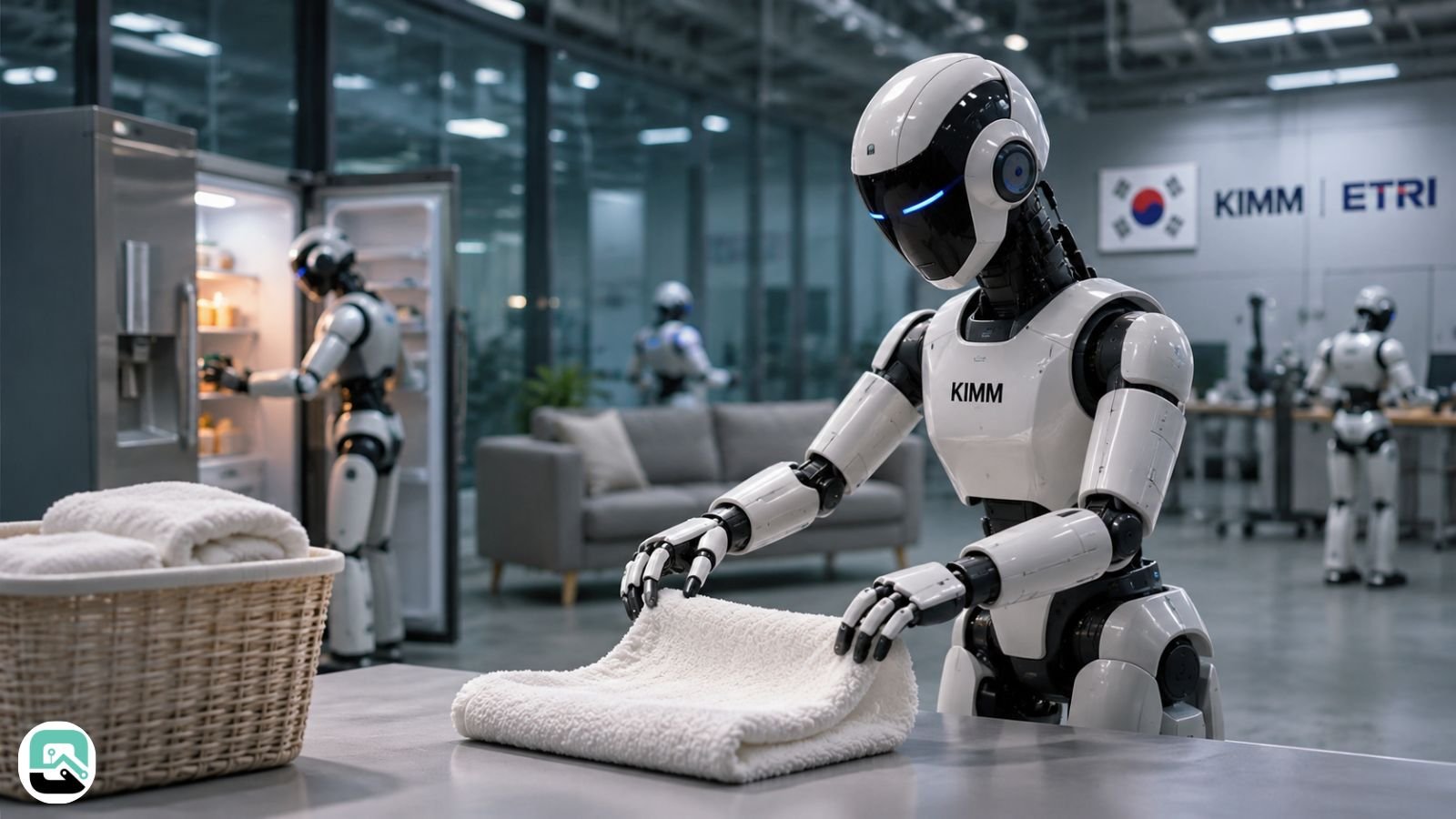
South Korea opened its first humanoid data factory on Tuesday. It sells no robots. It produces the demonstration robots learn from.
What KIMM built
The Korea Institute of Machinery and Materials (KIMM) built the AI Humanoid Data Factory with the Electronics and Telecommunications Research Institute (ETRI). Twelve humanoids work across about 1,000 square meters on two floors. Planners want 25.
At the opening, researchers drove the robots by remote control. The machines pulled items from a refrigerator, handled laundry, tidied a sofa, and worked the buttons and levers inside a car, AJU Press reported.
Each recorded motion trains vision-language-action (VLA) models. These models turn what a robot sees and hears into movement. Figure AI’s in-house Helix system is a well-known example. A slower vision-language model plans the task. A fast policy then moves the joints.
The loop behind the factory
KIMM describes a closed cycle:
- Operators guide a robot through a task.
- The system records every motion.
- Engineers train a VLA model on those recordings.
- The trained model returns to the robot for testing. Data from those runs flows back into training.
The idea has precedent. Agility Robotics ran a similar loop with Digit, feeding real-world telemetry back into simulation. Korea’s version adds scale and a state budget.
Why data beats another prototype
Language models learned from the internet. Humanoids have no such archive. Nobody has scraped the web for laundry folding at scale. Someone has to make that data.
The authors of TWIST2, a humanoid teleoperation system, make the same point. They argue that humanoids lack data collection tools as effective as those behind language models.
KIMM president Ryu Seog-hyeon called high-quality robot task data at scale “the core of national technological competitiveness.” The institute also expects the facility to reduce reliance on foreign data and AI models.
Most countries debate who owns the chips and the models. Korea also asks who owns the demonstrations.
Three layers of humanoid independence
A simple framework helps here. A national humanoid industry needs control over three layers.
| Layer | What it covers | Korea’s move |
|---|---|---|
| Bodies | Hardware and core parts | Raise the local share of core parts from about 45% to 80% |
| Brains | VLA and foundation models | Train on domestic data, cut reliance on foreign models |
| Experience | Task demonstrations at scale | Open the AI Humanoid Data Factory |
Compare this with Figure AI. Its BotQ production line targets up to 12,000 humanoids a year in its first generation. That line builds bodies. Korea’s new facility builds the experience those bodies need.
The money and the mission
The factory sits inside K-Moonshot. The Ministry of Science and ICT runs the program, which applies AI to 12 national missions. Humanoids are one of them.
The ministry wants a world-class national humanoid platform within three years. A Next-X Humanoid Challenge will make its final pick from 2027.
On Aug. 27, the Ministry of Planning and Budget earmarked 2.3 trillion won (about $1.7 billion) through 2030. The plan includes buying 1,080 domestic humanoids. That order gives local builders a first customer.
A reality check
Two months before the opening, four of six humanoids on a Seoul stage swung their arms to calisthenics music. Their feet barely left the floor.
KAIROS looked better on Tuesday. KIMM started building it a little over a year ago. At the ceremony, it handled objects precisely and mimicked whole-body human motion. Version 1 arrives in April 2027.
Humans still drive every demonstration. That is not a flaw. Several commercial makers already sell human-assisted autonomy, 1X’s NEO among them. The factory’s job is to shrink the human share over time.
Teleoperation also has a rival: human video. The Human-as-Humanoid team converts recordings of people into robot-ready labels. In its own analysis, that pipeline gained 4.8 to 7.2 times the demonstration throughput of motion-capture teleoperation. If video keeps closing the gap, a physical data factory loses part of its edge.
What to watch next
- Outside access. KIMM plans staged access for companies, universities and research institutes from late 2027. The terms will show whether Korea wants a closed advantage or an open ecosystem.
- The 2027 challenge. The Next-X selection will reveal which design the government backs.
- The parts target. Climbing from 45% to 80% domestic core parts by 2030 is steep.
- Data variety. Twenty-five robots must produce enough variety for models to work outside the lab.
FAQs
Q. What is the AI Humanoid Data Factory?
It is South Korea’s first facility built to mass-produce training data for two-legged humanoids. KIMM and ETRI run it.
Q. How many robots does it use?
It runs 12 humanoids now. Planners want 25.
Q. What is a vision-language-action model?
It is an AI system that turns what a robot sees and is told into physical movement.
Q. How much is Korea investing?
The government earmarked 2.3 trillion won (about $1.7 billion) through 2030 for the humanoid industry.
Q. When can outsiders use the factory?
KIMM plans staged access for companies, universities, and research institutes from late 2027.
Related: Realbotix Echo: A $60,000 Humanoid Robot With a Rented AI Brain