

Wang Xingxing spent years doubting humanoid robots. Unitree didn’t start building them until 2022, and its founder was once a vocal skeptic. Now he says OpenAI’s GPT-6 has changed his mind.
What the robots can do now
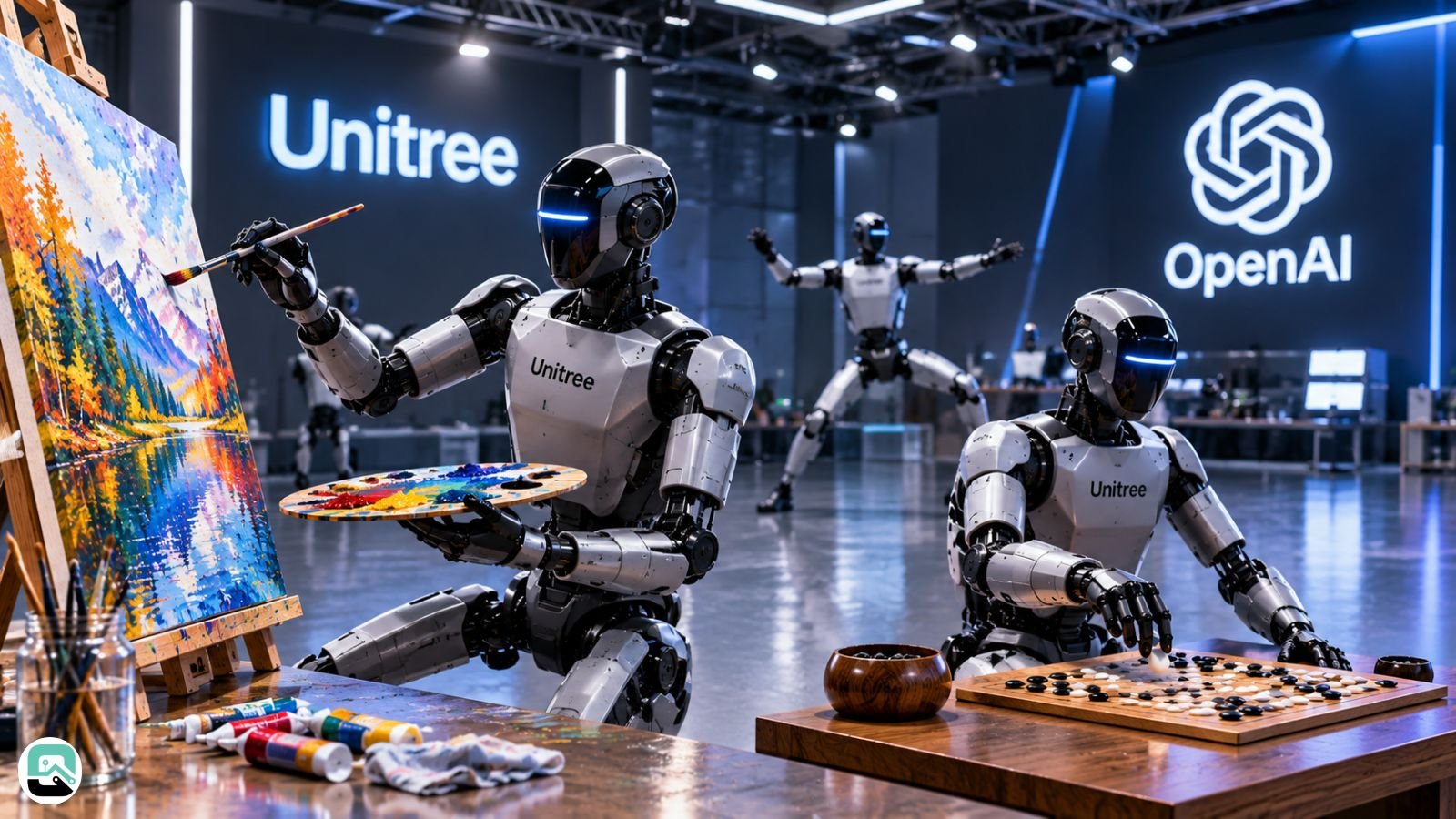
Wang says Unitree humanoids running GPT-6 can paint. They change colours and rinse the palette between strokes. They also play Go, placing each stone on a small, crowded grid.
Both tasks demand precision and sequencing. A robot has to pick the right tool, finish one step, and start the next. That is harder than replaying a dance.
Unitree knows choreography well. In February, 24 of its G1 robots and one H2 performed at the Spring Festival Gala. Painting and Go ask for something different. The robot has to respond to what happens in front of it.
A hardware maker with a borrowed brain
Unitree built its name on hardware. It makes more robot dogs than any other company and ranks second in humanoid shipments. In 2025, it shipped about 5,500 humanoids, according to Singularity Hub.
The intelligence behind its newest demos comes from a US lab. That puts a Chinese manufacturer in a new position. It supplies the body, and OpenAI supplies the mind.
Unitree isn’t alone in this arrangement. Realbotix sells a $60,000 humanoid that runs on a rented AI brain. The pattern suggests that hardware makers may soon compete less on motors and more on which model they can plug in.
Wang appears to see it the same way. He told an industry event in Shanghai that a GPT-7 release next year could solve embodied intelligence. He credits GPT-6 Astra for the shift in his thinking. The model scored 92.7% on a benchmark for operating on-screen interfaces, up from 76.9% for its predecessor.
Unitree wants the robots to teach themselves
The company is building a system called Unitree Rehearsal. The idea is simple: let robots practice and improve without engineers rewriting their instructions each time. Wang calls it the company’s most important project this year.
He also expects a decade of fast, autonomous progress. In his view, language models that learn to improve themselves will drive it.
Wang’s timeline keeps shrinking
The change in his predictions tells its own story. In August 2025, Wang said the industry sat one to three years before its ChatGPT moment. This year he says the moment is close.
He defines it in practical terms. Robots would complete up to 80% of household tasks with little or no special training. A peer at robotics startup Galbot sets a similar bar for 2028. He puts it at 70% to 80% of everyday tasks.
Wang also admits where things stand today. A humanoid home robot probably can’t clean your room yet.
What outside testing shows
Independent evidence is thin but encouraging. A Stanford lab reportedly paired a Unitree robot with GPT-6 Astra. The robot cleaned a kitchen it had never seen and found a remembered object from a vague request. It used no environment-specific training data.
Another group worked on a different problem. Researchers at ETH Zurich taught a Unitree G1 to climb ladders and recover from falls. That shows the hardware can handle demanding movement when software catches up.
The painting and Go demos remain company claims. No one has tested them at scale. Treat them as a signal, not proof.
The money is already moving
Investors have not waited for proof. Unitree’s shares nearly sixfold on debut, then fell 11% the next day. That swing shows how much hope and nerves sit in this sector.
China delivered more than 40,000 humanoids in the first half of 2026, according to an industry body. Unitree now plans to expand production for demand that could reach tens of millions of robots.
Bottom line
Unitree can build bodies at scale, and it has the capital to build more. The harder question is who controls the intelligence inside them. If GPT-7 or a rival model delivers the breakthrough Wang predicts, the model maker may capture more of the value than the robot builder.
Related: Can 1X Neo’s Robot Head Run Your Entire Smart Home?