

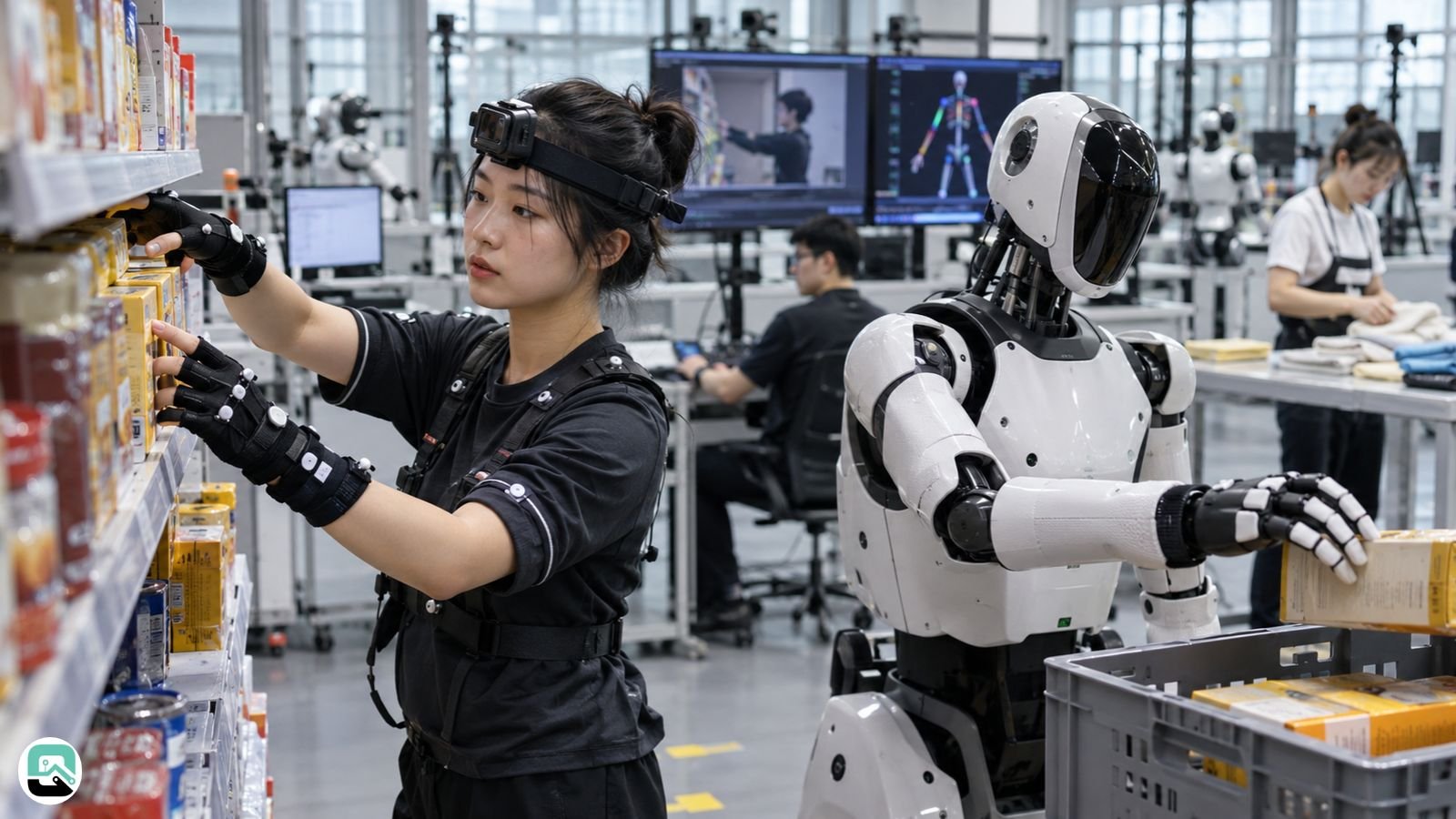
In Shenzhen, startups pay workers to film their jobs and sell the footage to robot makers. That data now shapes how humanoids learn, and it raises questions about who owns a skill.
A humanoid robot in a Shenzhen park pulls a lever and curls ice cream into a cup. It hands the cup to a customer. A second robot beside it makes coffee. Each treat costs about $4, and passersby film the whole thing.
AI² Robotics built both machines. The company says up to 300 coffees sell here every day. A person still refills the beans and empties the grounds. An AI model drives everything else. The startup says 200 of its humanoid servers now work across China.
The timing is no accident. Donald Trump, Vladimir Putin and other leaders are heading to Shenzhen for this week’s APEC summit. The city wants visitors to see robots at work.
Workers become the dataset
Robot brains need examples. Chinese startups now buy those examples from workers.
In a Dongguan supermarket, 23-year-old Wang Lin stocked shelves in sensor gloves and a camera-fitted helmet. A startup called Strange Attractor recorded every move. It resells that data to companies that build robot AI.
Wang isn’t the only one. Cobblers, hairdressers, florists, factory workers and cleaners record their skills for pay. Strange Attractor says it collects data at about 1,600 sites in China and 1,000 abroad.
Other cities pool their efforts. One Shanghai center puts more than 100 robots from different companies through training side by side. Shared practice speeds up learning for every maker involved.
A strange kind of teaching
Think about what Wang does all day. She stocks shelves, and a machine learns to stock shelves from her hands. She gets paid for it.
Now, she sees the upside. Robots can take dangerous, repetitive jobs, she says, and people can move to creative work. That view is common among the workers AFP interviewed.
It also describes an odd bargain. People sell the most personal part of a trade, the tacit know-how in their fingers. A cobbler can’t write that knowledge down. A headcam can capture it.
The payment is clear. The terms are not. AFP’s report doesn’t explain who owns a skill once a model absorbs it. It also doesn’t say what workers keep if the robot learns the job well.
Why Shenzhen
Strategist Dermot McGrath calls China “the workshop of the world.” Motors, sensors and batteries all come from nearby suppliers. Developers build a part, test it, and deploy it faster than almost anywhere.
Beijing now writes rules for the parts too. Revised national standards for the harmonic reducers inside robot joints take effect in April 2027. Shared standards help suppliers and buyers speak the same language.
Money follows the momentum. Chinese tax authorities report that industrial spending on embodied AI jumped 230% year on year from January to May 2026. Xiaomi and Alibaba back X Square Robot, a Shenzhen startup less than three years old. Big rounds raise a fair question about which robotics startups deliver after the funding lands.
A public that cheers
Culture matters as much as capital. An Ipsos poll found 83% of Chinese respondents excited about AI products. Only about a third of Americans agreed. The Ipsos survey of 32 countries shows how sharply attitudes split by region.
That gap shapes deployment. A robot barista in a public park works when the crowd wants to film it. It works less well where people feel nervous about it.
Officials push a reassuring message. A Beijing tech-hub official said last year that humanoid robots will boost efficiency and take on tasks humans avoid, not cause mass unemployment. Workers like Wang echo that line. Time will test it.
Babies with jobs
Strange Attractor’s founder, Kang Yu, calls today’s robots “like babies.”
Two X Square Robot arms sort parcels in a Shenzhen logistics center. A soft bag gets a grip from the grippers. A cardboard box takes both arms. Vice-president Arnold Pei says an ideal robot decides for itself what to do.
Homes break that ideal. Lighting, floors and objects change from house to house. X Square trained its Wall-B model on data from more than 100 households to handle the mess, Reuters reports. Reuters also notes that humanoids can outrun elite athletes in a half-marathon, yet folding clothes still stumps them.
Chinese and Western machines are among the home robots racing for the same kitchen. The winner will need far more than a good demo.
Factories offer easier wins. At battery maker CATL, humanoids from Spirit AI plug in high-voltage connectors. People used to do that dangerous job.
Analyst Pavlo Zvenyhorodskyi of the Carnegie Endowment says most Chinese robots still handle well-defined, repetitive tasks. He expects wide deployment once their skills improve. Kang predicts a “massive deployment” next year, in jobs like strawberry picking and housework. He adds that the machines won’t be smart yet.
Ask who drives the robot
A park robot looks autonomous. Always ask who runs it.
A human controlled a snack-serving robot demo in Austin while the crowd watched a machine. Teleoperation can pass for intelligence.
AI² says its model drives the Shenzhen pair. The human refilling the beans shows where autonomy ends today. Every robot job still leans on a person somewhere.
What it means
The headcam data may matter more than the humanoid itself. Hardware is easy to copy over time. A deep library of real human motion is harder to build.
That makes workers like Wang valuable in a new way. They supply the raw material for machines that may one day compete with their trades. Few people sign that kind of deal with full awareness of what comes next.
What to watch
- Whether data contracts spell out what workers keep
- How many robots leave pilot sites for paid jobs in 2027
- Whether home robots cope with real kitchens
- Whether other countries copy China’s pay-for-skills model
The ice-cream robot draws the crowd. The headcams will matter more.
Related: Meet Howl, the Humanoid Robot With One Job: Picking Up Eggs