

Humanoid robots have a showreel problem. They dance, flip, and jog on stage. Few hold a real job.
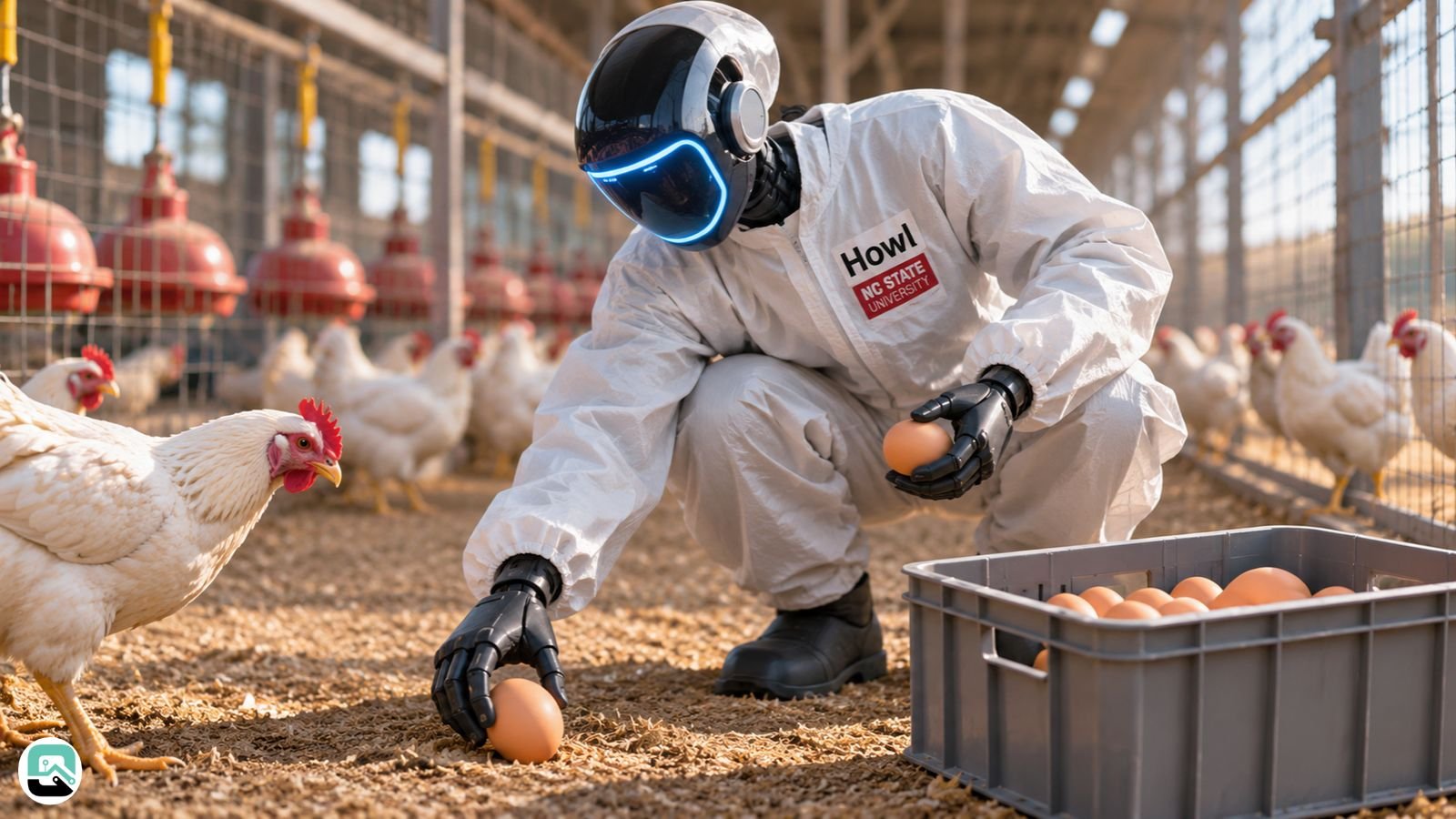
Researchers at North Carolina State University want Howl to change that. The four-foot robot has one task: find eggs on the floor of a cage-free poultry house and pick them up without a crack. The team aims to have it working by early 2027, according to Interesting Engineering’s report.
Why floor eggs matter
Cage-free housing changed egg collection. In a conventional cage system, eggs roll onto a conveyor belt. In a cage-free barn, hens roam. Some lay their eggs on the floor instead of in the nesting boxes.
In some environments, floor eggs make up 2 percent to 15 percent of production. Take a barn with 100,000 birds. At the high end, workers gather up to 15,000 eggs by hand every day.
That work is slow and repetitive. Delays also hurt egg quality. Farms already struggle to staff it, and Howl targets that gap.
How researchers train Howl
Howl runs on a Unitree G1 base. It is a platform that suits research labs where space and budget run tight.
The NC State team writes the robot’s control systems largely from scratch. Training combines three methods:
- VR demonstrations. Researchers perform the task in virtual reality to show the robot each movement.
- Imitation learning. Howl copies those demonstrations.
- Reinforcement learning. Howl improves its handling through repeated attempts.
The lab now finishes its egg-detection and retrieval simulations. Practical demonstrations follow.
Why an egg makes a brutal benchmark
Most robot demos test speed or strength. An egg tests restraint.
Howl must spot a small object on a cluttered floor. It must reach the egg and close its fingers with just enough force. Too little force drops the egg. Too much cracks it.
The score stays honest. A broken egg is a failed attempt, and no one can spin it.
Other builders chase the same grip problem. Figure’s home humanoid adds tactile sensing and palm cameras for work in confined spaces. Howl faces a similar test in a very different building.
Why a humanoid, and not a custom machine
People designed barns for human bodies. Walkways, equipment, and clearances all assume someone walks through on two legs. A robot that fits the space skips an expensive rebuild.
This is analysis, not a finding from the NC State team. But it echoes a pattern elsewhere. Agility Robotics built Digit around one warehouse job so companies would not have to redesign their facilities. Howl follows the same logic on a farm.
What Howl has not proven yet
The project is early. Howl has not worked a live barn shift. Real barns bring dust, noise, uneven floors and thousands of moving birds. Simulation models part of that. It cannot replace a full day on the job.
The researchers have not published success rates or break rates. Until they do, Howl remains a promising direction, not a proven product.
The wider poultry AI push
Howl is one piece of a greater effort at NC State’s Artificial Intelligence & Robotics Lab.
Poultry Talk is an AI assistant for the poultry industry. It uses retrieval-augmented generation to pair a large language model with a curated library of poultry science. That library includes peer-reviewed research and public agricultural extension publications. Users ask about nutrition, disease prevention, housing, welfare, and production management. The system answers from that library, not the open internet. Poultry professionals now test a working demo and send feedback.
Bird health monitoring is the third project. Fixed 2D and 3D cameras watch individual birds inside a research facility. Computer vision models assess feather condition, plumage density, and body weight. The goal is to catch early signs of disease or stress in a large flock.
The same data could drive precision feeding. Farmers could adjust diets bird by bird instead of treating the flock as one unit.
Cage systems vs. cage-free barns
| Conventional cage | Cage-free barn | |
|---|---|---|
| Egg collection | Eggs roll to conveyor belts | Some eggs land on the floor |
| Manual work | Lower | Higher, for floor eggs |
| Floor egg share | Not a factor | 2% to 15% in some environments |
| Automation gap | Small | Where Howl aims to help |
What to watch next
Three signals will show whether Howl works:
- Simulation results on egg detection and retrieval.
- First demonstrations on a real farm floor.
- Published break rates and speed compared with a human worker.
FAQs
Q. What is Howl?
Howl is a four-foot humanoid robot from NC State researchers. It detects and collects floor eggs in cage-free poultry houses.
Q. What hardware does Howl use?
The project builds on the Unitree G1 humanoid platform.
Q. How do researchers train it?
They combine VR demonstrations, imitation learning and reinforcement learning.
Q. When will Howl work on a farm?
The team aims for early 2027.
Q. Why do cage-free farms need a robot for this?
Floor eggs need manual collection. At scale, that means thousands of eggs a day and a hard labor problem.
The idea is simple. The test is hard. If Howl can lift an egg without breaking it, humanoid robots will finally have earned a job outside the demo reel.
Related: This Humanoid Robot Uses Living Human Brain Cells. But Why?