

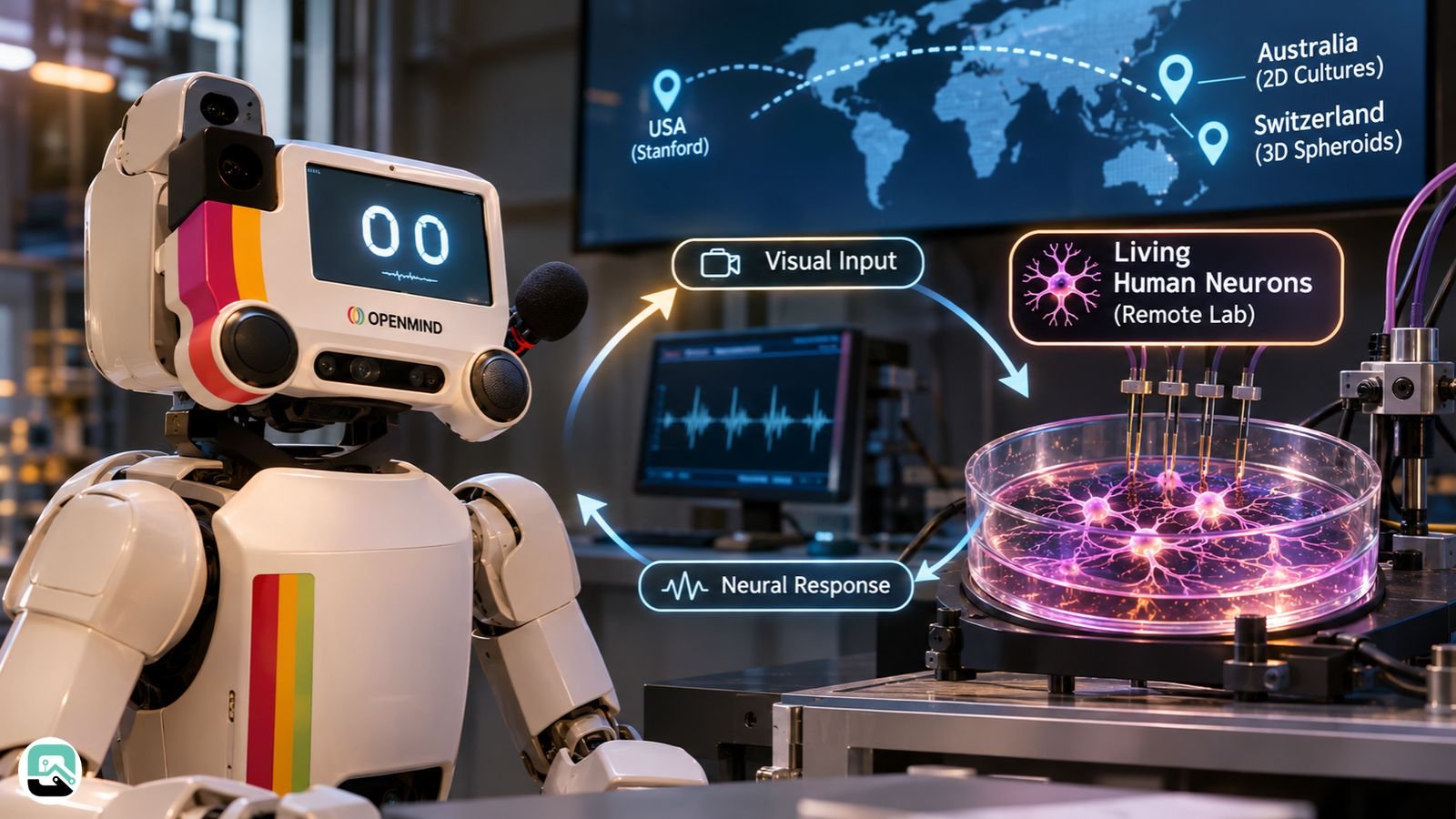
A humanoid robot now closes part of its control loop through living brain cells that sit in labs thousands of miles away. It works. It also runs slowly, ages, and drifts.
Stanford bioengineer Jan Liphardt connected his company OpenMind’s humanoid, Iris, to cultured human neurons over an API. The cells never traveled. They stayed at their suppliers, and Iris reached them remotely.
Sneha Khedkar’s report in The Scientist provides the base for this analysis.
Neurons as a cloud service
Two commercial platforms supplied the tissue. An Australian company provided flat 2D cultures. A Swiss company provided 3D spheroids. Both grow cortical neurons from induced pluripotent stem cells on electrode arrays. Both sell remote access.
That setup matters more than the headline. Researchers no longer need a wet lab to run a biological experiment on a robot. They need an account and an API key.
Brett Kagan, CEO of Cortical Labs, built the 2D platform. He says the hard part isn’t the humanoid. The hard part is making the integration reliable and scalable in real products.
How the loop works
Iris’s cameras capture her surroundings. Software converts that footage into electrical stimulation. The neurons react, and electrodes pick up the spikes. Software turns those spikes into outputs and sends them back to Iris.
The behavior stays simple. When a person engages Iris, she warms up. When someone turns away, she cools off.
The reporting describes the neurons handling social cues. It doesn’t describe them handling balance or walking. That distinction shapes everything below.
Where this sits in the robot stack
Most humanoids split control into layers. A high-level AI “brain” handles perception and decisions. A lower-level motion system handles balance and movement. A Bank of America Institute breakdown of humanoid architecture describes this hierarchy and notes that some leaders are moving to end-to-end models.
Silicon is merging those layers. Figure’s Helix 02 unifies perception, balance and manipulation in one neural network. Iris goes the other direction. She adds a biological layer to the perception side and leaves the rest alone.
Accuracy is high. Speed is not.
The team ran nearly 500 stimulations. Fresh 2D cultures decoded signals with up to 94 percent accuracy in 150 to 240 milliseconds. Spheroids reached up to 91 percent but took as long as two seconds.
Human motor loops run between 10 and 100 milliseconds. Neuroengineer Steve Potter, who didn’t work on the study, called the result a “very humble first step.”
Silicon sets a high bar. Google’s humanoid posted a 96 percent success rate in a Mercedes trial. The two figures measure different things, so they don’t compare directly. They do show how far biology has to climb in speed.
A mirror image of brain-controlled robots
Another approach to “brain plus robot” made news this year. BrainCo showed a platform at WAIC in Shanghai where a wearer’s EEG headset picks up brain signals. AI decodes the intent and turns it into robot commands. The Robot Report covered the demo.
The two systems mirror each other. In BrainCo’s setup, a human brain stays outside the machine and steers it. In Iris’s setup, cultured neurons sit inside the control loop, and no person steers anything.
So why use neurons?
Liphardt doesn’t pitch speed. He pitches uniqueness and security.
His example is a home robot that adapts to one family’s habits using living cells instead of a standard chip. Nobody could copy that robot’s learned behavior as easily, he argues. Home humanoids from 1X, Figure, Tesla and Unitree already compete for the same living rooms, so a trait that no rival can clone would carry real weight.
The claim has a gap, though. The cells in this experiment sit at a supplier. Any security story has to cover the link between the robot and the lab.
A brain that ages
Cultures age, and Iris showed it. The 2D neurons stayed viable for more than 100 days. The spheroids lasted only a few. As the tissue got older, lag increased, and Iris’s temperament drifted.
Most engineers would call that a defect. Liphardt calls it a feature. Each robot gets a personality, makes its own mistakes, and eventually dies. He suspects people may bond more with that than with a standard reasoning model.
Product teams will split on this. A warehouse operator wants identical units. A companion robot might benefit from character.
Who actually decides?
Robot demos already face a credibility problem. Tesla’s Optimus handed out snacks in Austin, and a human controlled its movements. Iris removes the human operator. In their place sits living tissue whose behavior changes as it ages.
That raises a fair question for buyers. When a robot acts on its own, what is making the call?
Ethics, in short
Liphardt says these simple cultures raise no consciousness questions. Kagan agrees. He says Cortical Labs works with independent bioethicists, philosophers and regulatory experts.
Potter sees donor consent as the main issue. The project met it. Others argue that human neural organoid research needs better regulation as structures grow more complex.
Liphardt draws his own line. The calculation changes if teams build far richer neural structures or wire electrode arrays into animals or people, as in brain-computer interfaces.
Old idea, new scale
The idea isn’t new. Researchers first drove a robot with lamprey brain cells in 2000, in a study on connecting brains to robots. What changed is the supply chain. Labs can now buy human cultures by the hour and reach them from anywhere.
What to watch
Liphardt’s team plans to extend cell lifespan. That fix matters most, since a robot that outlives its own neurons can’t ship as a product.
Two numbers will show whether this goes anywhere: how long the tissue lives and how fast the loop runs. Until both improve, Iris stays a research platform.
Related: Humanoid War Robots Are Winning Pentagon Deals, but Can They Actually Fight?