

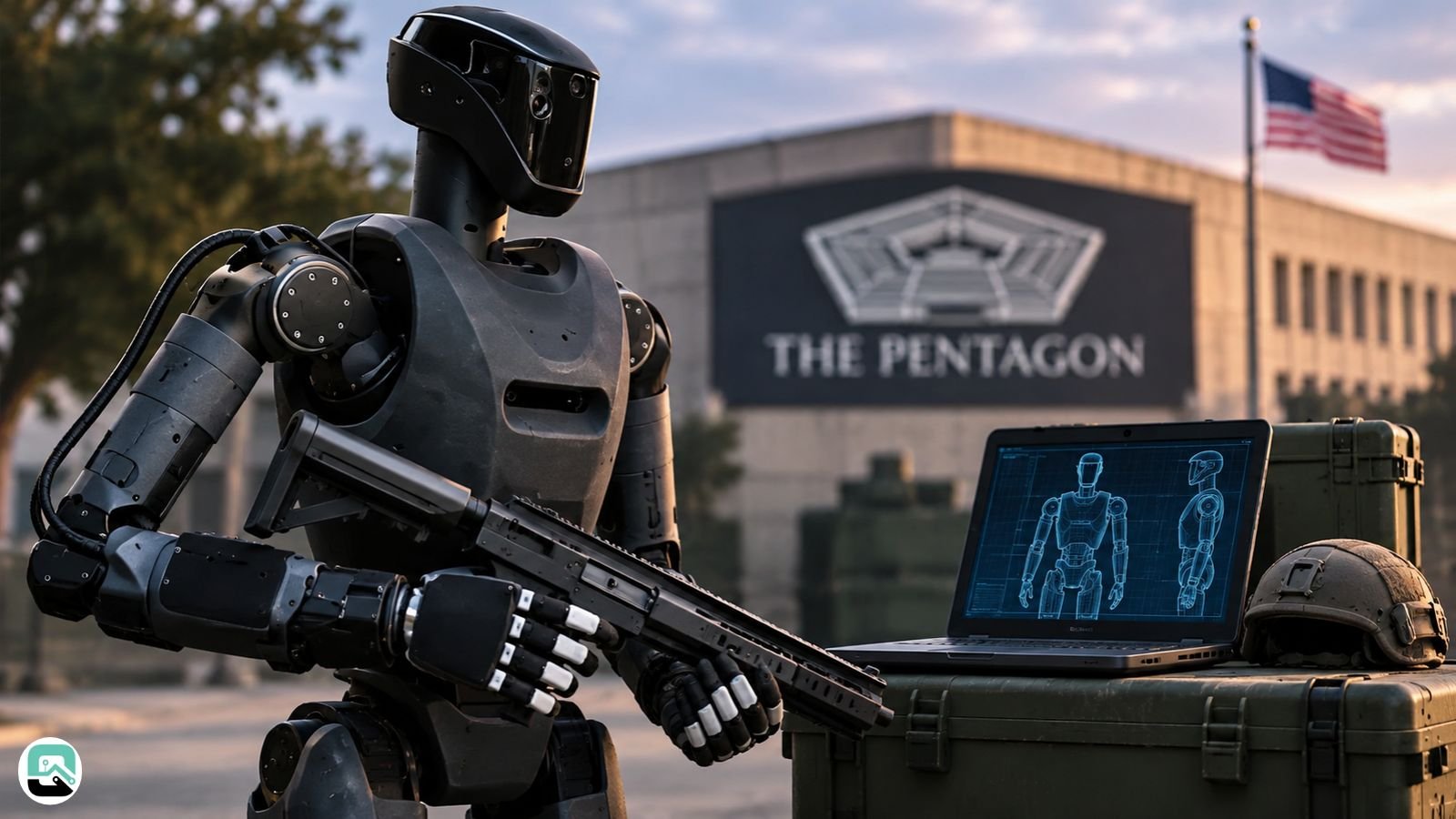
Foundation’s Pentagon push shows how defense tech can sell a capability years before it exists.
In April, a Fox Business anchor told viewers that a San Francisco robot startup had just landed a $24 million Pentagon contract. In July, that startup’s robot spent 15 minutes failing to load a mortar shell.
That gap between pitch and proof is the real story of Foundation and its humanoid war robots, first reported by Zara Stone at The San Francisco Standard.
What Foundation is building
Foundation works out of SoMa. Cofounder Sankaet Pathak, 36, previously ran Synapse, the fintech that went bankrupt in 2024. The CFPB later flagged a $60 million to $90 million shortfall in customer funds.
Pathak launched Foundation that same year, aiming at factories and warehouses. Then he bought Boardwalk Robotics and inherited roughly $3.2 million in government research work. By early 2025, the pitch had shifted from military logistics to weapons. Several employees quit.
The hardware carries the Phantom name. The MK-2 stands six feet tall and weighs 200 pounds. Foundation leases the older MK-1 for $100,000 a year with a 100-unit minimum. Pathak wants to drop the price to $10,000, because he expects many units to get blown up.
Why humanoid war robots have a verification problem
Factory robots face a public test. They rack the parts, or they don’t. War has no such audit.
Contracts stay murky, and field trials stay hard to check. That makes defense a friendly place to sell a story, and Foundation’s story keeps outrunning its paperwork.
Federal spending records list no contracts awarded to Foundation itself. Boardwalk holds four, worth about $3.2 million. A $24.8 million Navy award did go to Boardwalk’s research partner, IHMC, but that was in 2025, and it went to a different organization. Months after the TV segment, Pathak told NBC that none of the contracts were new.
The pattern repeats. A “Humanoids for War” pitch deck vanished from Foundation’s website. It claimed an $85 trillion market, while Morgan Stanley projects about $5 trillion in humanoid revenue by 2050.
Foundation also said it tested two robots in Ukraine. A journalist who traveled with the team says they never crossed the border, and Ukraine’s Brave1 confirmed no demos happened. Foundation backed off the claim. Back in 2024, General Motors had called Foundation’s GM claims “fabricated.”
The robot itself
Hardware has improved. Judgment hasn’t caught up. UC Berkeley’s Giuseppe Loianno says the market expects more than the technology delivers today. He puts the gap at a decade or more.
The hard part isn’t one clever task. It’s repeating it in a changing environment. A battlefield floor shifts, slopes, and breaks. Staying upright there demands constant balance recovery, and walking is only the first job.
Hands add their own trouble. A grasp that drops the same shell twice shows how far consistency lags the demo reel.
Veterans and builders quoted by The Standard doubt the form factor. A former Marine who now runs a laundry-folding robot company says a mortar task needs a turret, not a humanoid. Wheeled robots already clear dangerous doorways with fewer headaches. Why add legs, batteries, and ammo logistics to a machine you plan to lose?
Even the commercial leaders move carefully. Tesla has started Optimus production in Fremont, and Elon Musk has said Optimus isn’t a weapons system. Home-focused rivals move slowly too. As of mid-2026, 1X’s NEO still sent most units to internal testing.
Foundation, by contrast, says its robots helped build 24,000 cars. Pathak clarified that “help” meant racking and kitting parts.
What it means
The hardest question has the thinnest answer. Foundation’s robots can’t kill autonomously today, Pathak says. But he adds that the military could ask for that capability and Foundation would enable it. When The Standard asked who answers for a war crime if a robot malfunctions, he said someone might get reprimanded and added that he doesn’t know.
A weapon that gains lethal autonomy through a software update raises a blame question nobody has settled. Rules rarely move as fast as code.
Watch three things in the next six months. First, Washington. The Standard expects Democrats to press harder on contractors tied to the Trump family, and Eric Trump joined the Foundation as a strategy adviser in March. Second, the evidence. Any real military deal will leave a paper trail, and so far Foundation’s trail is thin. Third, the MK-2, which still hasn’t made a public debut. It needs to finish a task on the first try, in front of people who aren’t investors.
Defense tech runs on trust. Foundation has spent a lot of its own.
Related: 25 Types of Humanoid Robots in 2026: What They’re Built For and Why It Matters