

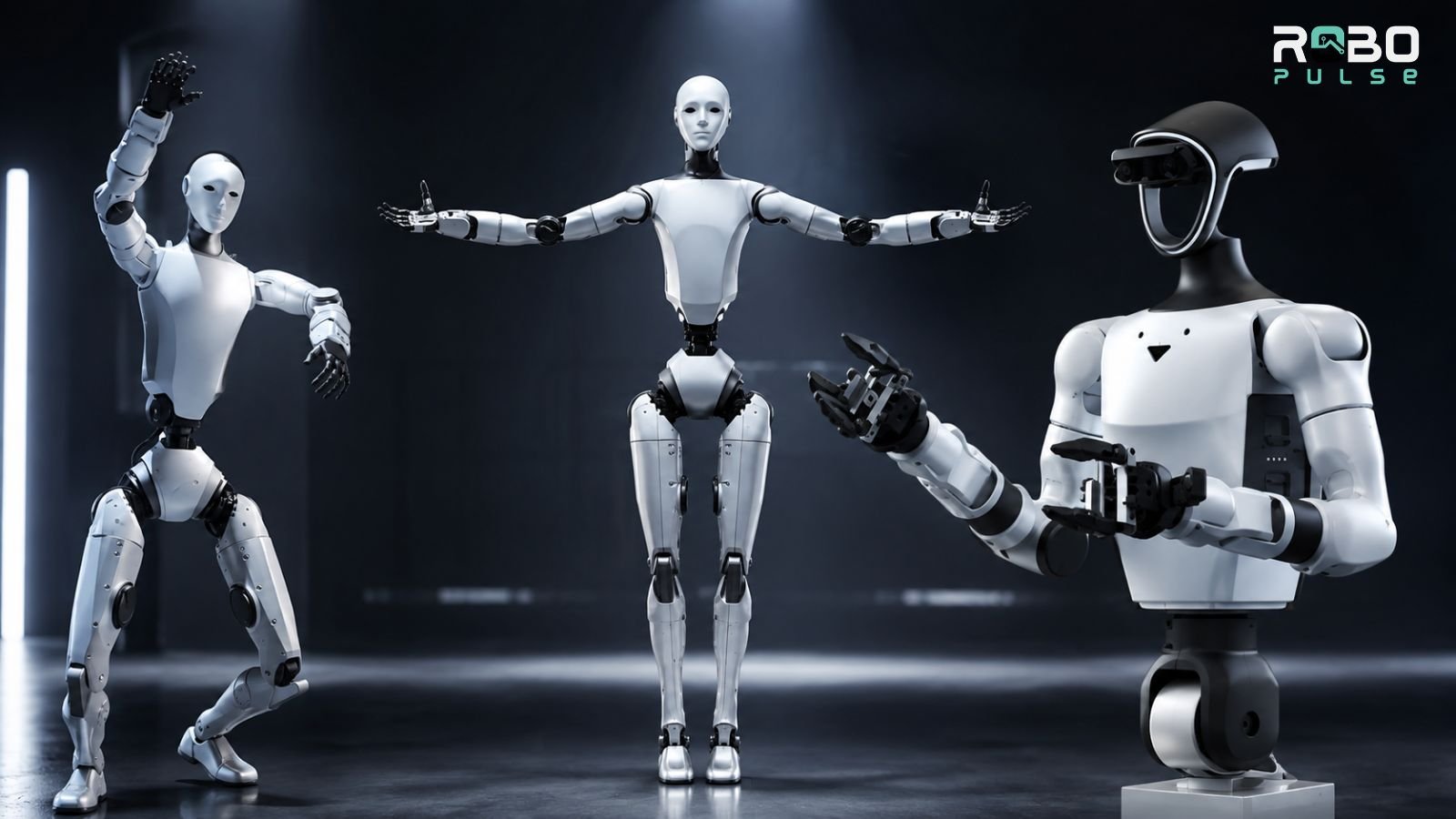
Unitree lists the H2 at $29,900. That price excludes tax and shipping, and it buys a robot with no hands.
The H2 stands 182 cm tall, weighs about 70 kg, and packs 31 degrees of freedom into a full-size humanoid frame. Unitree built it as the successor to the H1, aiming for smoother, more human-like motion through a sculpted head and animated facial features. Research labs, universities, and industrial pilot programs are the target buyers — not consumers looking for a home robot.
This guide breaks down what the sticker price actually includes, what most buyers end up paying once hands and development access enter the picture, and how the H2 stacks up against the H1, the G1, and the newer H2 Plus.
How Much Does the Unitree H2 Really Cost?
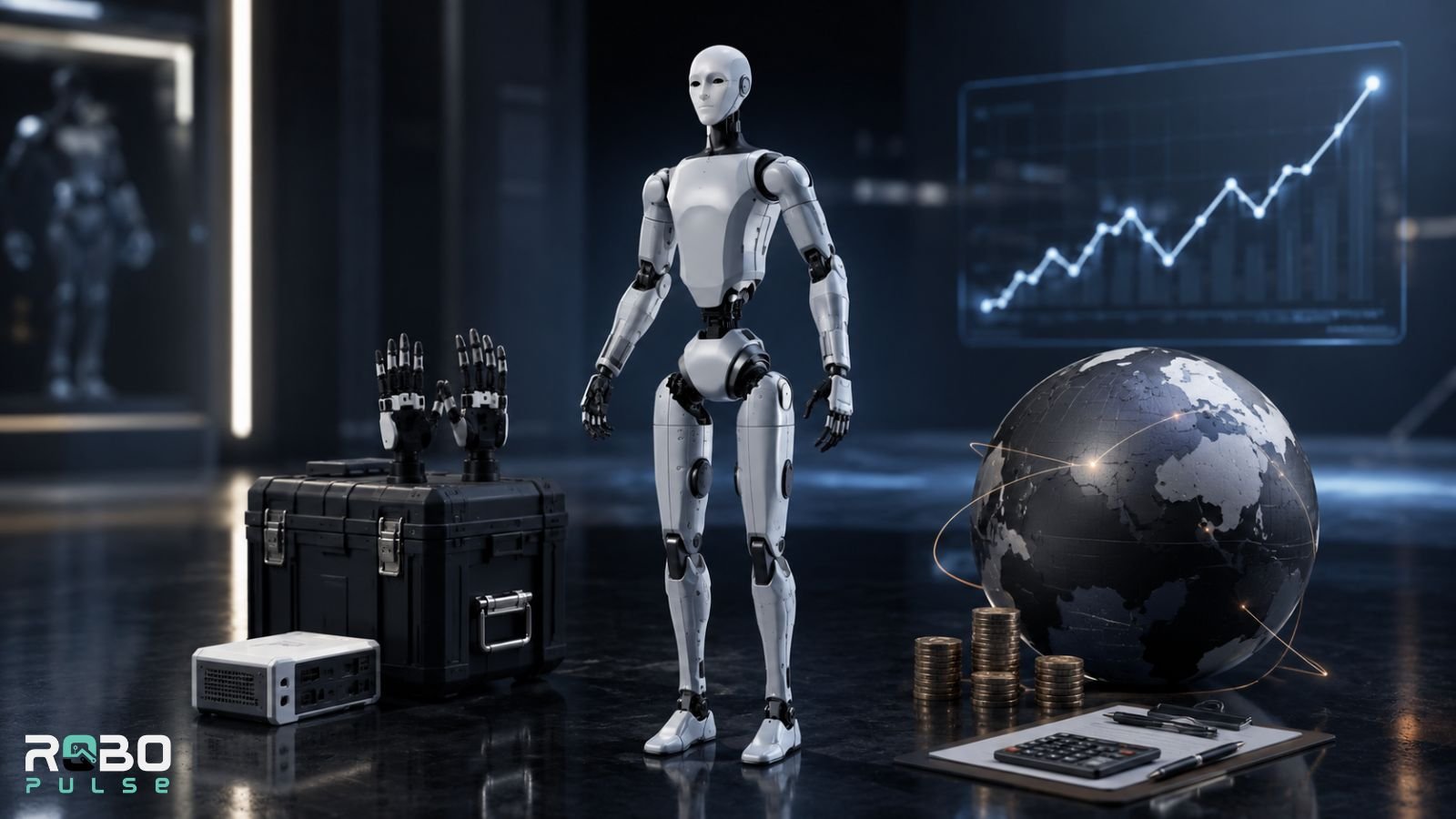
Unitree’s store lists the base H2 at $29,900, excluding tax, shipping, and import duties. That number covers the platform only — no hands included.
The H2 EDU tier unlocks hand options and full SDK access for custom programming. Unitree prices EDU units on request rather than publishing a fixed number.
Regional pricing changes the math further. RobotShop’s community write-up confirms the EDU tier adds a second onboard computer and optional dexterous hands on top of the base spec. North American distributors have reportedly listed the H2 from around $40,900, according to RoboZaps’ pricing analysis — treat that figure as distributor reporting rather than an official Unitree price. European buyers face their own markup: INFUZE Technologies, Unitree’s Central European distributor, told RoboHorizon that the $29,900 figure applies to the China-market version only, before a roughly 7.2% customs duty and VAT.
Budget accordingly. The realistic total lands closer to the mid-$30,000s to $40,000s once you add hands, EDU access, and regional import costs — not the $29,900 sticker price alone.
What Can the Unitree H2 Actually Do?
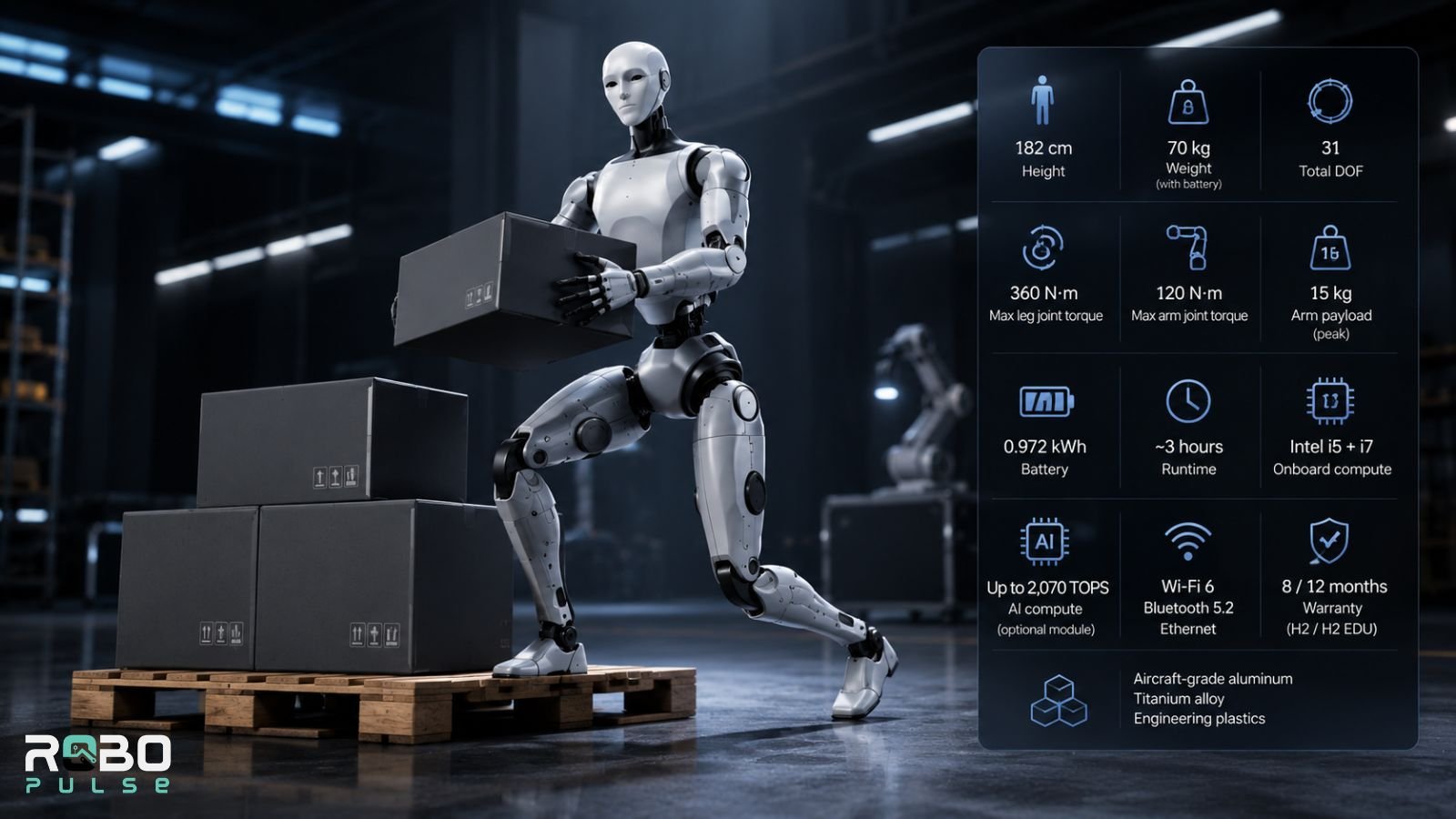
The H2 delivers 360 N·m of leg torque and up to 15 kg of peak arm payload, built for industrial manipulation and stable walking rather than fine dexterity.
| Spec | Value |
|---|---|
| Height (standing) | 182 cm (1820 mm) |
| Weight (with battery) | ~70 kg |
| Total degrees of freedom | 31 (6 per leg, 7 per arm, 3 waist, 2 head) |
| Max leg joint torque | 360 N·m |
| Max arm joint torque | 120 N·m |
| Arm payload | ~15 kg peak, ~7 kg rated per arm |
| Battery | 15 Ah / 0.972 kWh, ~3 hours runtime |
| Onboard compute | Intel Core i5 (platform) + Intel Core i7 (development) |
| AI compute (optional module) | Up to 2,070 TOPS |
| Connectivity | Wi-Fi 6, Bluetooth 5.2, Ethernet |
| Warranty | 8 months (H2), 12 months (H2 EDU) |
| Construction | Aircraft-grade aluminum, titanium alloy, engineering plastics |
Three numbers deserve a second look before you budget around them. The 3-hour battery life forces a charging or swap rotation into any real deployment — plan for downtime or a spare battery. The base H2’s 8-month warranty runs shorter than the EDU tier’s 12 months, which matters if you plan to run the robot hard. And the 2,070 TOPS figure describes an optional compute module, not the standard configuration — don’t mistake it for baseline capability.
Unitree’s DOF-per-limb breakdown explains why the split between 6 leg joints, 7 arm joints, and a 3-DOF waist matters more than the raw total — degree count alone doesn’t tell you how a robot moves. The H2 runs on unitree_sdk2 (C++ and Python), with a LocoClient interface handling walking gait, velocity commands, and posture.
Unitree H2 vs H1 vs G1: What’s the Real Difference?
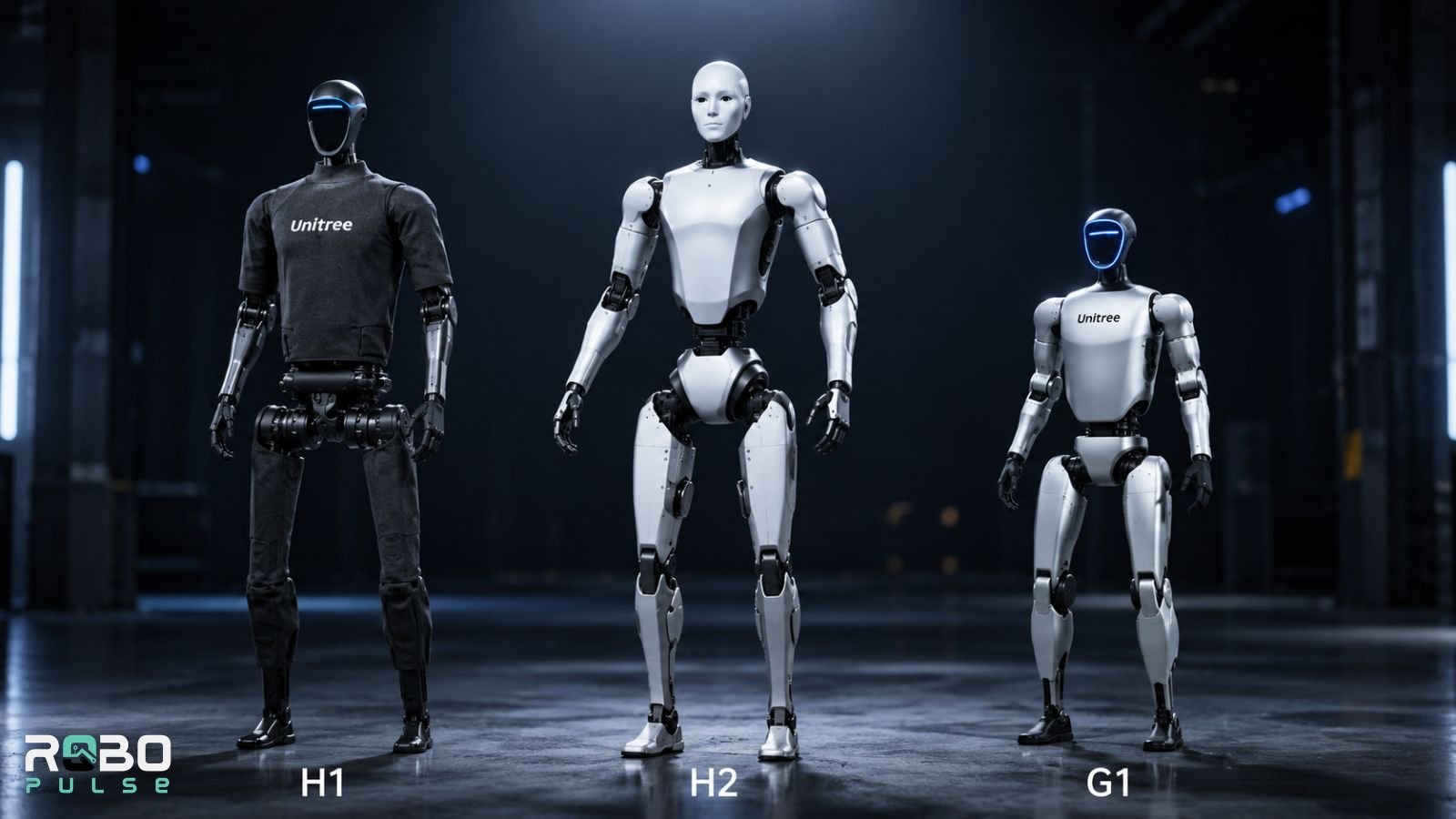
The H2 replaces the H1 as Unitree’s flagship full-size platform and outranks the G1 in payload and reach, but each robot targets a different budget and use case.
Choose the G1 for research, education, or lab work where space and budget are tight. It stands roughly 127–132 cm tall, runs on Jetson Orin-class compute, and costs meaningfully less than the H2 — read the full Unitree G1 review for the complete spec breakdown.
Choose the H1 if dynamic locomotion research is your priority. It built Unitree’s reputation on speed and agile movement, and its track record in labs runs longer than the newer H2.
Choose the H2 for industrial manipulation, heavier payloads, and current-generation motion control. Unitree refined the joint design and added degrees of freedom specifically to improve stability and reach over the H1.
Torque, payload, and price move together across all three robots. Line them up directly in RoboPulse’s humanoid robot compare tool instead of cross-referencing separate spec sheets.
What Is the Unitree H2 Plus?
The H2 Plus shares the H2’s body, torque, and battery specs, but swaps in an NVIDIA Jetson Thor compute module and adds optional tactile hands — pushing total degrees of freedom from 31 to 75.
Unitree’s official H2 Plus page confirms identical height, weight, and torque figures between the two robots. The upgrade is entirely in compute and hands: a Jetson T5000 module rated at 2,070 TFLOPS (FP4) with 128 GB of memory, plus optional SharpaWave dexterous hands carrying 22 active degrees of freedom each and over 1,000 tactile sensing points per fingertip.
NVIDIA built the H2 Plus as its reference platform for Isaac GR00T, its humanoid foundation model stack. Unitree has not published an official H2 Plus price. Some trade coverage cites a figure near $100,000, but that number isn’t confirmed by Unitree directly — treat it as an estimate until Unitree lists one.
Who Should Actually Buy the Unitree H2?
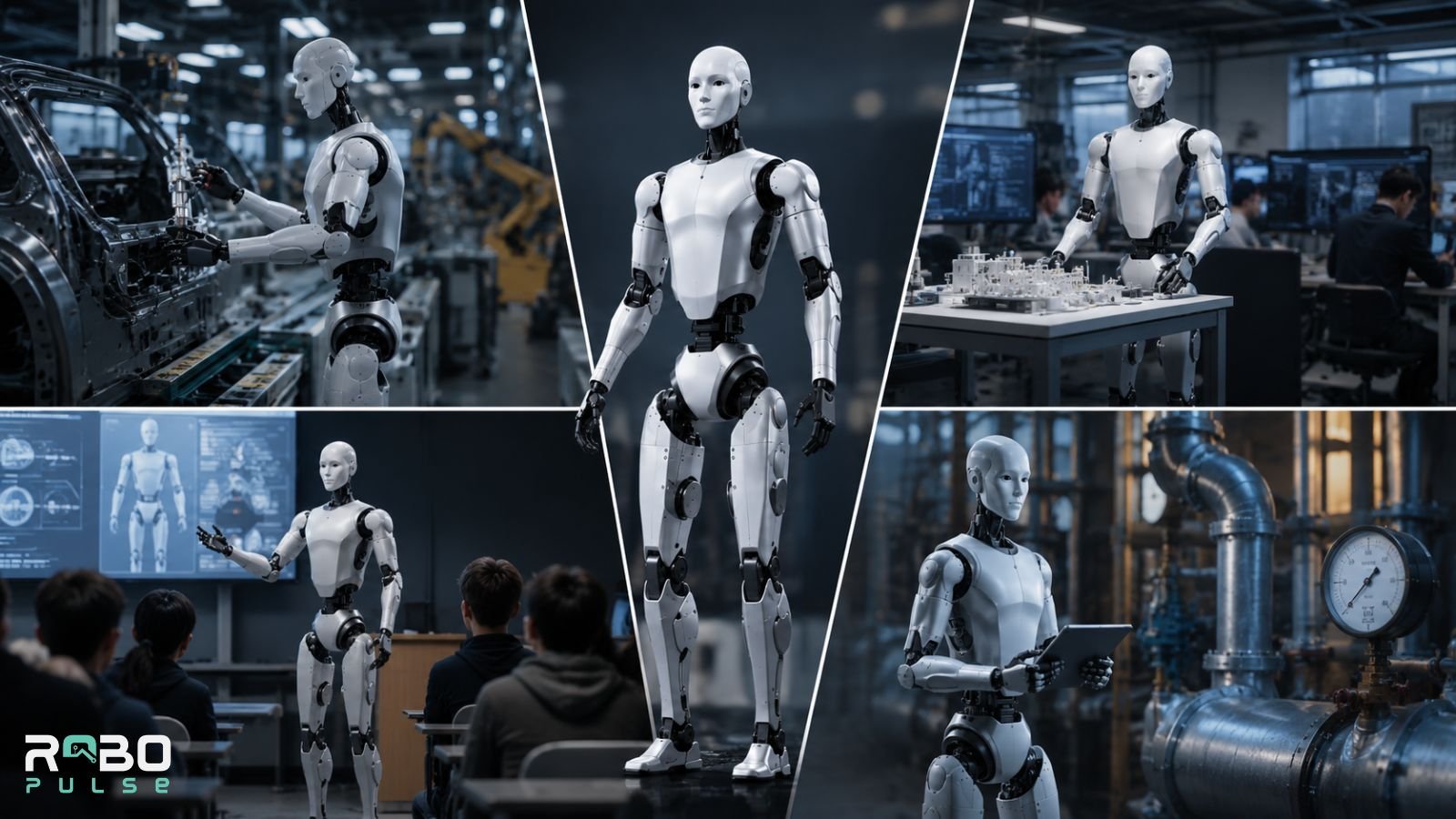
The H2 fits research labs, universities, and industrial pilot programs that need a full-size platform for manipulation research or automation testing — not consumers or hobbyists.
Strong-fit use cases include factory automation pilots, embodied-AI research, university robotics programs, and facility inspection work that benefits from human-scale reach. That kind of industrial deployment is picking up fast — Automate 2026 coverage points to the same trend: humanoids moving from demo floors into working production lines.
Weak-fit buyers include anyone expecting plug-and-play dexterity or a fully capable robot straight out of the box. The base H2 ships without hands, which pushes most serious manipulation work toward the EDU tier regardless of starting budget.
How Does the H2 Compare to Non-Unitree Humanoids?
Buyers evaluating the H2 often cross-shop it against Tesla’s Optimus, Figure’s humanoids, and Boston Dynamics’ Atlas — three robots built around different priorities than Unitree’s cost-focused approach.
The Tesla Optimus Gen 3 and Figure 03 both target mass manufacturing scale rather than research flexibility, with tighter integration into their makers’ own factory pipelines. Boston Dynamics’ Atlas Electric leans further into dynamic movement and industrial dexterity, at a price point well above the H2’s. If open SDK access and a lower entry price matter more than raw payload or manufacturer-scale deployment, Unitree’s platform stays the more accessible option of the group.
What Are the Unitree H2’s Real Limitations?
Battery life, hand availability, and pricing transparency above the base tier are the three gaps that affect real deployment cost the most — more than anything on the spec sheet suggests.
A roughly 3-hour runtime means continuous operation needs battery swaps or scheduled downtime built into the workflow. The base model’s missing hand option pushes most manipulation buyers toward the EDU tier anyway, which narrows the price gap the $29,900 headline implies. And with both EDU and H2 Plus priced only on request, comparing total cost across Unitree’s lineup currently requires a sales call rather than a spec sheet — build that lead time into your procurement timeline.
Stock availability has also fluctuated. The base H2 listing has reportedly shown out-of-stock status after launch, redirecting buyers to a sales inquiry instead of a direct order. Confirm current availability with Unitree or an authorized distributor before you assume the online price reflects same-day ordering.
FAQs
Q. Is the Unitree H2 really $29,900?
Yes. The Unitree H2 is officially listed at $29,900 for the base model, excluding tax, shipping, and import duties. The base H2 also does not include dexterous hands, so the final cost can be higher for buyers who need manipulation capabilities.
Q. Can you buy the Unitree H2 in the US?
Yes. You can buy the Unitree H2 in the US through Unitree’s official sales channels or authorized North American distributors. Distributor pricing has reportedly started around $40,900, but availability, shipping, import costs, and regional pricing can change.
Q. What is the difference between the Unitree H2 and G1?
The main difference is size, payload, and intended use. The Unitree G1 is a smaller humanoid measuring roughly 127–132 cm and is aimed at research, education, and lighter robotics tasks. The H2 is a 182 cm full-size humanoid with higher torque and payload capacity, making it better suited to industrial manipulation and heavier workloads.
Q. Does the Unitree H2 come with hands?
No. The base Unitree H2 does not come with dexterous hands. Hand options are available with the H2 EDU configuration, which is intended for buyers who need more advanced manipulation and development capabilities.
Q. What is the difference between the Unitree H2 and H2 Plus?
The Unitree H2 Plus adds upgraded computing and optional dexterous tactile hands while retaining the H2’s core body, torque, and battery specifications. The H2 Plus uses an NVIDIA Jetson Thor module designed for Isaac GR00T and can reach 75 degrees of freedom with the optional hands, compared with 31 DoF for the standard H2.
Q. Is the Unitree H2 better than the H1?
The Unitree H2 is better suited to industrial manipulation, higher payloads, and current-generation motion control, while the H1 has a stronger track record in dynamic locomotion research. Neither is universally better; the right choice depends on whether manipulation and industrial stability or dynamic movement research is the priority.
Q. How long does the Unitree H2 battery last?
The Unitree H2 has an advertised runtime of about 3 hours. Extended deployments therefore require scheduled charging, battery swaps, or operational downtime.
Q. Is Unitree Robotics a Chinese company?
Yes. Unitree Robotics is a Chinese robotics company operating under Yushu Technology Co., Ltd. The company was founded in 2016 and develops both humanoid and quadruped robots.
Related: NEURA 4NE1 Gen 3.5 Price: This Humanoid Robot Costs Up to €98,000