

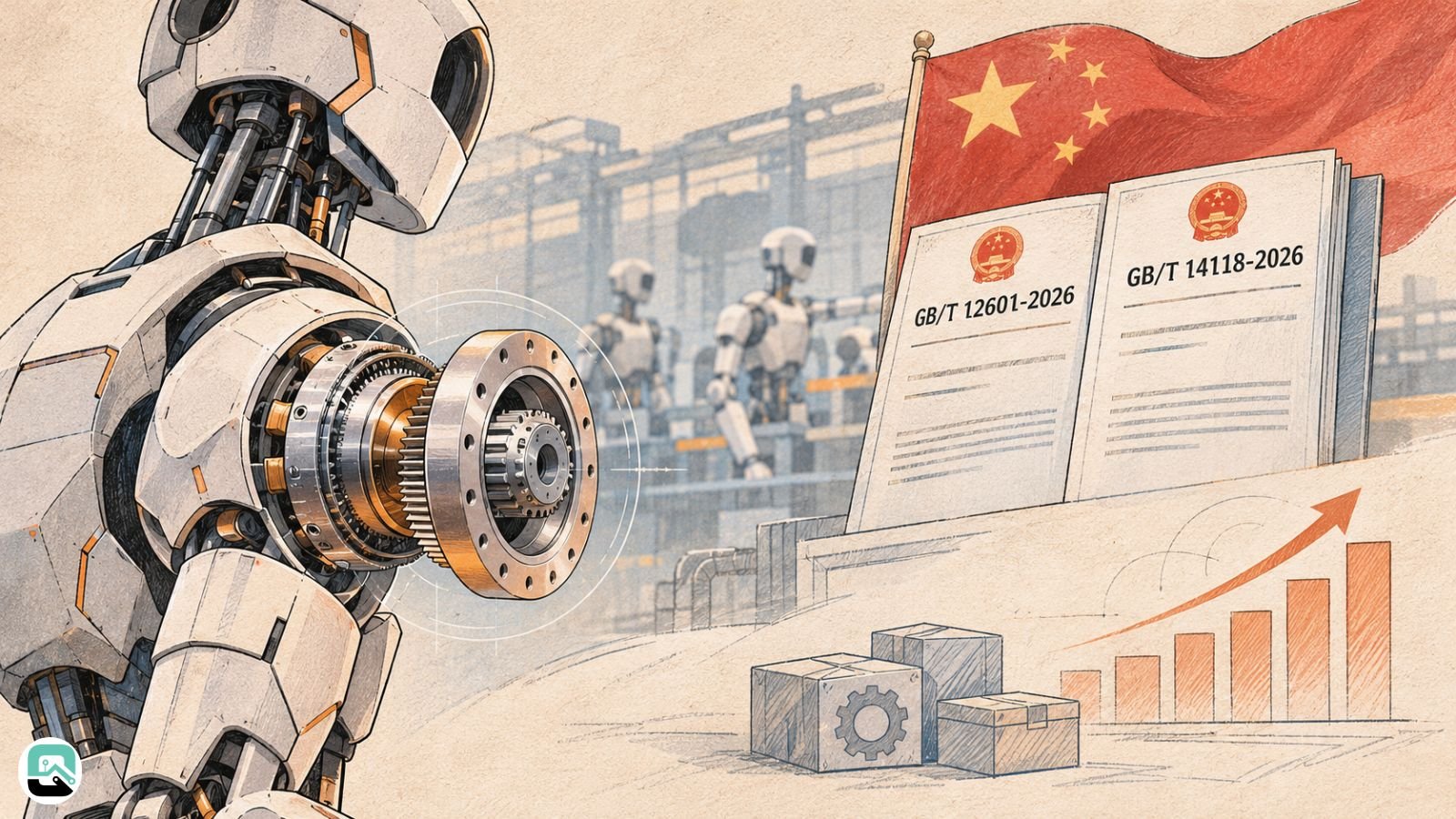
Two revised standards for harmonic drive reducers look dull. They could shape the humanoid race more than the next model release.
Humanoid coverage loves brains: vision models, motion policies, demo reels. Beijing just went after something lower in the stack, the gearbox inside the joint.
What changed
China revised two national standards for harmonic drive reducers. GB/T 12601-2026 sets shared terminology for harmonic gear drives. GB/T 14118-2026 covers the reducers themselves, including product categories, quality requirements, and test procedures. Both take effect on April 1, 2027.
Industry players discussed the revisions at a seminar and launch conference in Shengzhou, Zhejiang. Global Times picked up the Guangming Daily report. The reducer standard last got a major rewrite more than 30 years ago. Its 1993 edition still sits in standards databases.
Why a gearbox matters
A harmonic reducer bends a flexible gear in a controlled way to pass torque. That gives a joint precise motion in a tiny space. Industrial arms, collaborative robots and humanoids all use them. One humanoid can need several.
A robot’s software updates overnight. Its joints don’t. Backlash, wear and heat show up in the gearbox first.
One yardstick for everyone
Until now, buyers and suppliers lacked a common measure. Two vendors could quote the same spec and mean different things. The new documents give both sides shared terms and shared tests.
The numbers
Zhiyan Consulting puts China’s harmonic reducer market at about 3.8 billion yuan ($570 million) in 2025. It expects 4.8 billion yuan in 2026.
China Insights Consultancy projects robot-bound shipments will climb from 1.4 million units in 2025 to 20.7 million by 2030. That works out to a 72.4% compound annual growth rate.
Both figures are consultancy forecasts, and revenue and units measure different things. My read: if units grow roughly fifteenfold, price pressure follows.
The contest has shifted
Japan’s Harmonic Drive Systems and other foreign suppliers long held the premium tier. Chinese makers have closed ground through R&D, better processes and import substitution.
Now the fight turns to performance, reliability and cost. A shared benchmark gives domestic suppliers a target. It gives buyers a way to hold them to it.
Scale rewards boring parts
At volume, small components decide outcomes. RoboPulse’s breakdown of Tesla’s Optimus plan makes that case: at 20,000 robots a week, parts delivery matters more than model quality. A reducer fits the same logic. It costs little next to the whole robot, but a shortage or a bad batch can halt assembly. That second part is my inference.
Cheaper joints only solve part of the problem. Scaling brings hidden costs beyond hardware.
A policy thread
The revision fits a pattern. Chinese builders already ship the most humanoid units. The Ministry of Industry and Information Technology issued humanoid guidelines in 2023 that named precision transmission a priority for core components.
Standards turn that priority into something a factory can measure.
What to watch
- How many suppliers pass the new tests by April 2027
- Whether overseas buyers adopt these benchmarks
- Whether volume squeezes margins faster than quality improves
Models win the headlines. Joints decide whether a robot survives a full shift.
Related: Boston Dynamics Put Scooter Wheels on Atlas—But the Real Test Is Much Bigger