

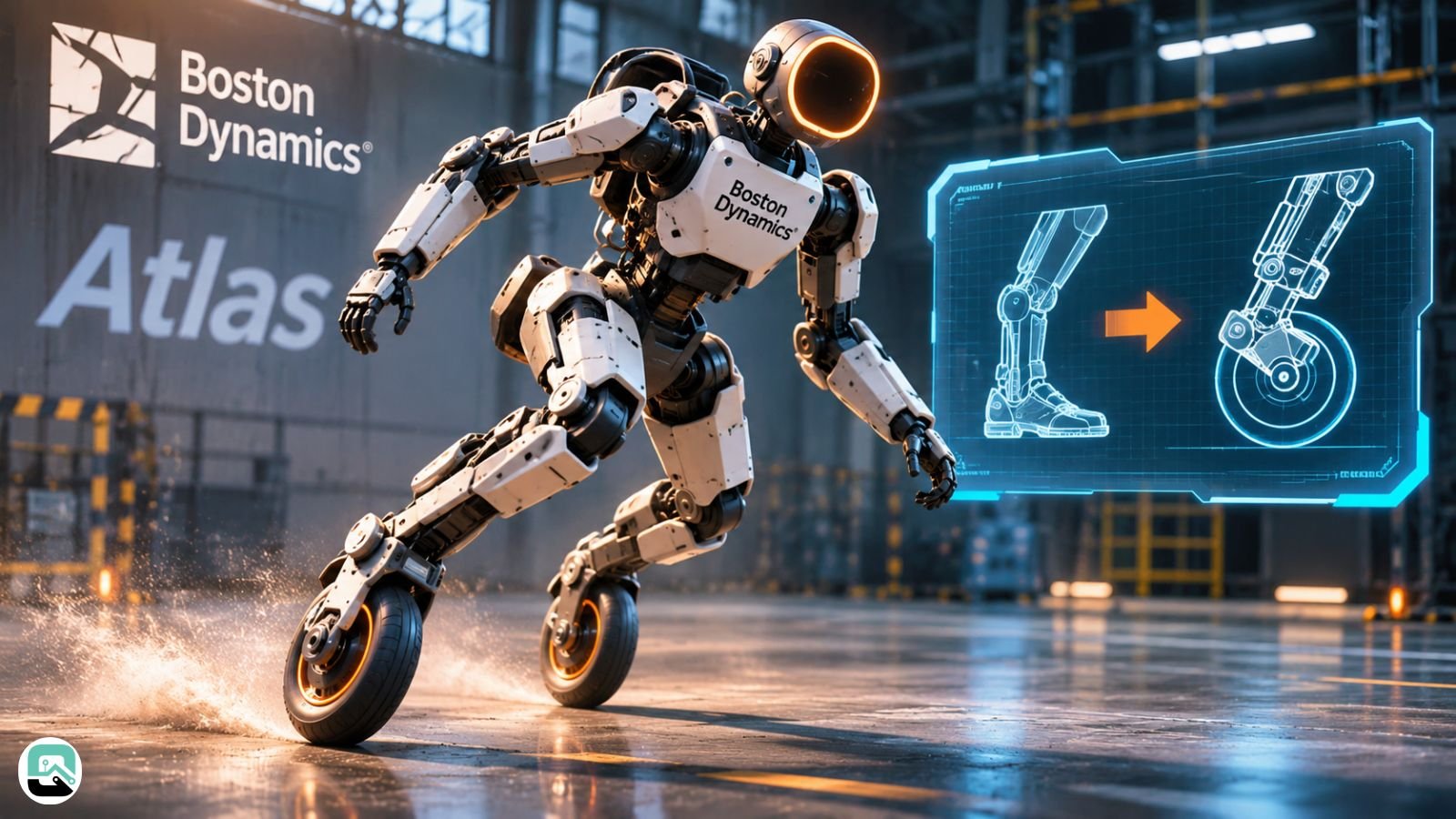
Boston Dynamics released a video on Monday showing Atlas on wheels. Controls engineer Andy Wu attached them to the humanoid’s legs for a round of experiments. The company calls the setup a research testbed and says it is not a product.
Skip the product speculation. The better question is what the wheels reveal about how Atlas controls its body. The Robot Report’s account of the video describes classical model-based control paired with whole-body reinforcement learning, aimed at keeping the robot stable on unstructured terrain.
A retrofit with one new part
One custom adapter mounts an off-the-shelf scooter rim onto Atlas’s existing ankle actuator. That adapter is the only new part in the build. Wu compared the job to swapping a bicycle wheel.
Boston Dynamics designed Atlas from the start for high-volume production and easy servicing, which explains the speed. Hardware that comes apart quickly lets control engineers test ideas in days.
The software change was just as small. Wu modeled each wheel as an ankle that spins continuously. In degrees-of-freedom terms, the robot keeps its joint layout and swaps a hinge with limited travel for one with unlimited travel.
Why wheels make a hard test
Legs give a controller a lot of structure. Feet touch down at predictable points, and decades of research on bipedal balance control build on that rhythm.
Wheels strip the structure away. Contact turns continuous. Slip, bumps, and uneven surfaces arrive as disturbances the model never predicted.
That gap is what Wu wanted to probe. He points to the limits of purely model-based control in conditions that are hard to model or simulate. Atlas also pirouettes and runs aggressive maneuvers on its wheels. Spins load the actuators fast, and Wu’s stated goal was to push the actuation to its limits.
Two control methods, one robot
The model-based layer supplies baseline stability. The reinforcement learning layer reacts. Its policy takes real-time proprioceptive feedback and velocity commands, then outputs pose and force adjustments that absorb unmodeled disturbances and imperfect contact.
Boston Dynamics’ conclusion is direct. The combination delivers better real-world agility than either method alone. That is a notable endorsement of learning from a company known for hand-engineered dynamics. Its own Atlas page describes whole-body control as reinforcement learning working alongside other models.
The company has also worked with the Robotics & AI Institute on reinforcement learning aimed at moving simulated behavior onto physical hardware. The wheeled experiment fits that line of work.
Simulation did the heavy lifting
Wu trained the system in simulation. By his account, Atlas learned every behavior there and ran it on the real robot with surprising accuracy.
Sim-to-real transfer has stalled plenty of robot learning projects. When it works, the constraint shifts to hardware that survives what the simulator asks of it. That is my read, and it matches the stress-test framing.
The idea has academic roots. A 2018 paper on whole-body control for wheeled quadrupeds showed one controller and planner handling both driving and walking, without changing the underlying principles of dynamics and balance. Atlas pushes that concept onto a full humanoid.
The next question is failure
Wu’s next target is how the policy responds when an actuator fails. That is a safety question. A humanoid working near people has to fail gracefully.
Learned policies resist the line-by-line inspection that rule-based controllers allow. Whether reinforcement learning controllers can prove they fail safely may decide how quickly humanoids move into real workplaces. Wu’s team wants data on exactly that.
Wheels versus legs
Many companies are building wheeled humanoids. Others bet on legs for spaces designed for people. Atlas adds a data point without picking a side.
The experiment also shows the robot can switch between fast rolling on flat ground and articulated legged motion over obstacles. One body handling both modes makes a strong case for hybrid designs.
Agility sits in the middle. Co-founder Jonathan Hurst says the company is exploring wheeled configurations, though Digit likely stays on legs. Digit already moves totes in warehouses under robots-as-a-service contracts, so legs are earning their keep today.
The question underneath is how human-like a humanoid needs to be to pay off commercially. Flat floors favor wheels. Stairs, clutter and human-built spaces favor legs. A controller that handles both lets a maker match hardware to the job without rebuilding its software.
What to watch
Boston Dynamics is preparing to ramp up Atlas testing at Hyundai facilities. It is also developing a new four-fingered gripper. Two things matter most from here: results on failed-actuator behavior, and any sign that wheeled concepts leave the lab.