

In June 2026, the Salamanca City Central School District in rural western New York spent $57,590 on a lifelike humanoid robot and an AI teaching assistant. By July 24, the state education commissioner had raised concerns, and the district put the pilot on hold. That same summer, a San Diego charter network paid $500,000 for two humanoid robots of its own.
Both stories sit under one loose phrase: teaching with robots. Sometimes it means students building and coding a machine. Sometimes it means a social robot tutoring a child while the teacher works nearby. And sometimes it means a robot standing in for the teacher altogether.
Researchers treat those three jobs very differently. A 2026 meta-analysis of 78 controlled studies, led by Joost de Winter at TU Delft, found that robots working alongside a teacher produced large learning gains, while robots replacing one produced none. Below, we break down what each role involves, what the evidence supports, where New York went wrong, what schools actually pay, and how to run a pilot that holds up.
What does teaching with robots actually mean?
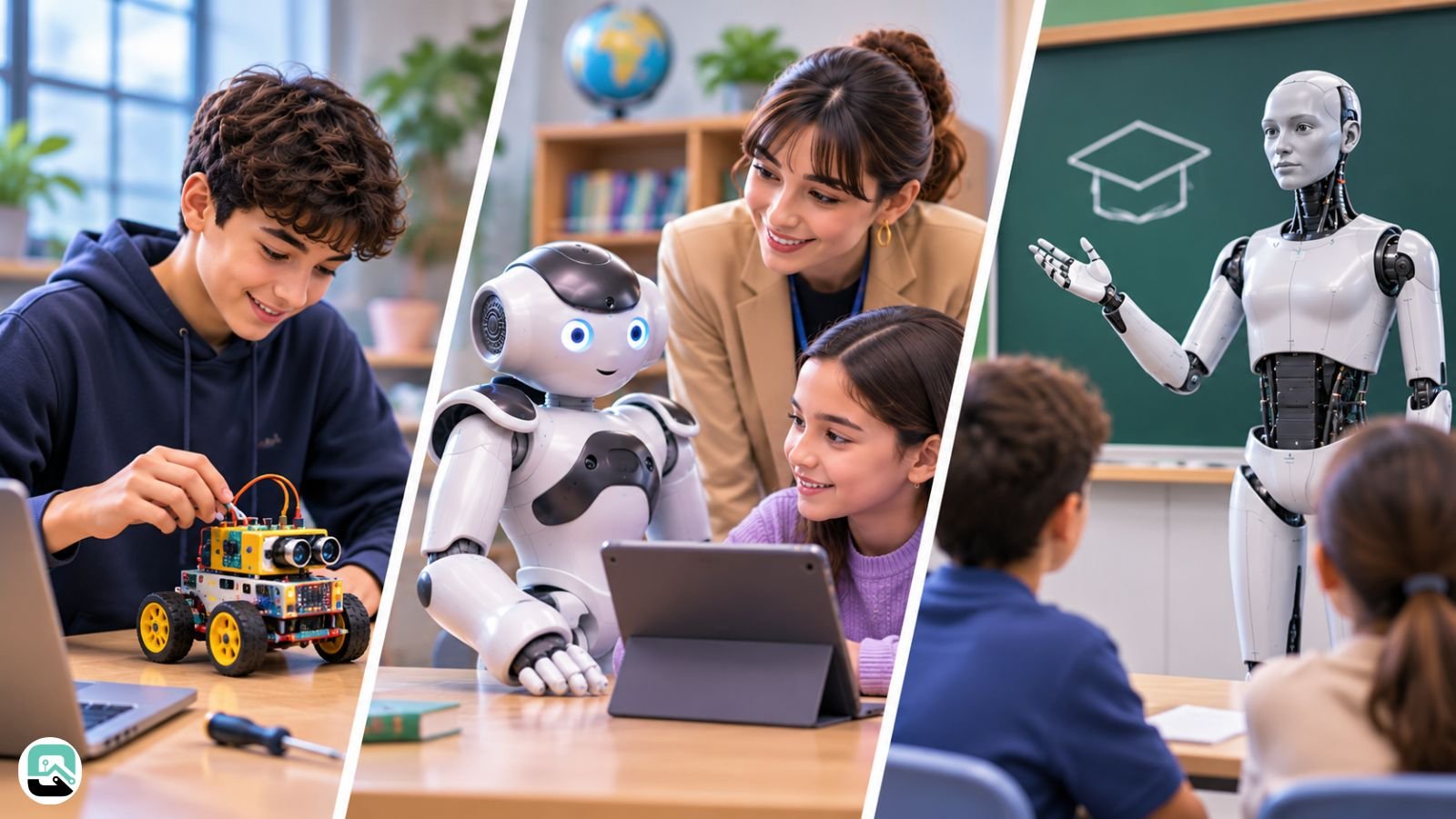
Teaching with robots covers three distinct jobs: a robot students build and program, a robot that tutors or co-teaches beside a human, and a robot that replaces the teacher. The evidence differs sharply by role, so any claim about robots in education means little until you know which job it describes.
| Role | What the robot does | Typical hardware | What the evidence says |
|---|---|---|---|
| Robot as subject | Students write code, test it, and watch a physical machine respond | Programmable kits, small programmable humanoids | Gains in learning performance; mixed results on computational thinking |
| Robot as helper | Runs practice or tutoring with one child or a small group while the teacher works with others | Social robots such as NAO | Strongest results (d = 0.88 in co-teaching studies) |
| Robot as stand-in | Delivers instruction in place of a person | Humanoid “robot teachers” | No measurable benefit (d = −0.06) |
News coverage gravitates to the third role, which also has the weakest evidence. Most of the research below studied kits and social robots used as tutors or assistants, not humanoids built to take over a class.
Shape matters less than purpose. The main types of humanoid robots are split by the environment they’re built for, and social machines like Ameca and Pepper exist to converse, not to lift boxes. So when someone quotes a glowing study, ask one question first: which job did the robot hold?
Does teaching with robots improve learning?
Usually, yes, though the size of the benefit varies widely. A 2023 meta-analysis of 17 articles found a moderate positive effect (g = 0.57), yet the studies disagreed sharply with one another (I² = 82%). Read these figures as promising, not as a guarantee for any single classroom.
A quick note on the numbers: g and d both measure the gap between two groups in standard deviations. Roughly, 0.2 counts as small, 0.5 as medium, and 0.8 as large.
What do the major research reviews show?
Four recent syntheses point the same way, but each studies something different:
| Study | Scope | Main finding | Watch for |
|---|---|---|---|
| Wang et al., 2023 | 17 articles, 34 effect sizes; kits, social robots, humanoids | g = 0.57 (95% CI 0.49–0.65) | High variation (I² = 82%); 7 of 34 effects measure attitude, not knowledge; most randomized studies involved children aged 8 to 12 |
| Ouyang and Xu, 2024 | 21 studies, 30 effect sizes, K–16 STEM | Moderate gains in learning performance and attitudes; no significant effect on computational thinking | Results varied by discipline |
| Tang et al., 2025 | 36 studies of robot-based education | Overall g = 0.71 (95% CI 0.50–0.92); computational knowledge g = 0.85; motivation g = 0.47 | Computational knowledge is a narrower outcome than computational thinking |
| de Winter et al., 2026 | 146 studies retrieved, 78 with control groups; physical social robots, cognitive skills only | d = 0.75 versus no training | Excludes kit-programming studies and emotional outcomes; weights all studies equally; literature search closed in September 2024 |
Don’t rank the rows against each other. They track different outcomes with different statistics, and Wang’s wide spread alone means its pooled figure can’t predict results in your school.
Do robots improve computational thinking?
Computational thinking is where schools most often overreach. Ouyang and Xu found no significant improvement across the studies they reviewed. A separate meta-analysis focused on computational thinking, by Wang and Xie (2024), reached a more positive conclusion, so the fair summary is mixed. Tang et al.’s large effect on computational knowledge measures something narrower, so it shouldn’t be set against either result.
What role do robots play in these studies?
A 2026 systematic mapping of 28 empirical studies in Humanities & Social Sciences Communications found they most often serve as teaching assistants, with the NAO robot a popular platform.
What can’t the research tell you?
Two boundaries apply to everything above. First, de Winter’s team counted only cognitive outcomes, leaving out social skills, anxiety, and wellbeing; a test-score gain says nothing about those. Second, the literature has a tone problem. The same team used a language model to score how warmly each paper described its robot. Papers from outside Europe read as more upbeat, and their studies reported larger effects (d = 0.53) than European ones (d = 0.17). No single study is wrong for that reason, but it’s a good habit to read effect sizes before adjectives.
Should a robot replace a teacher or work beside one?
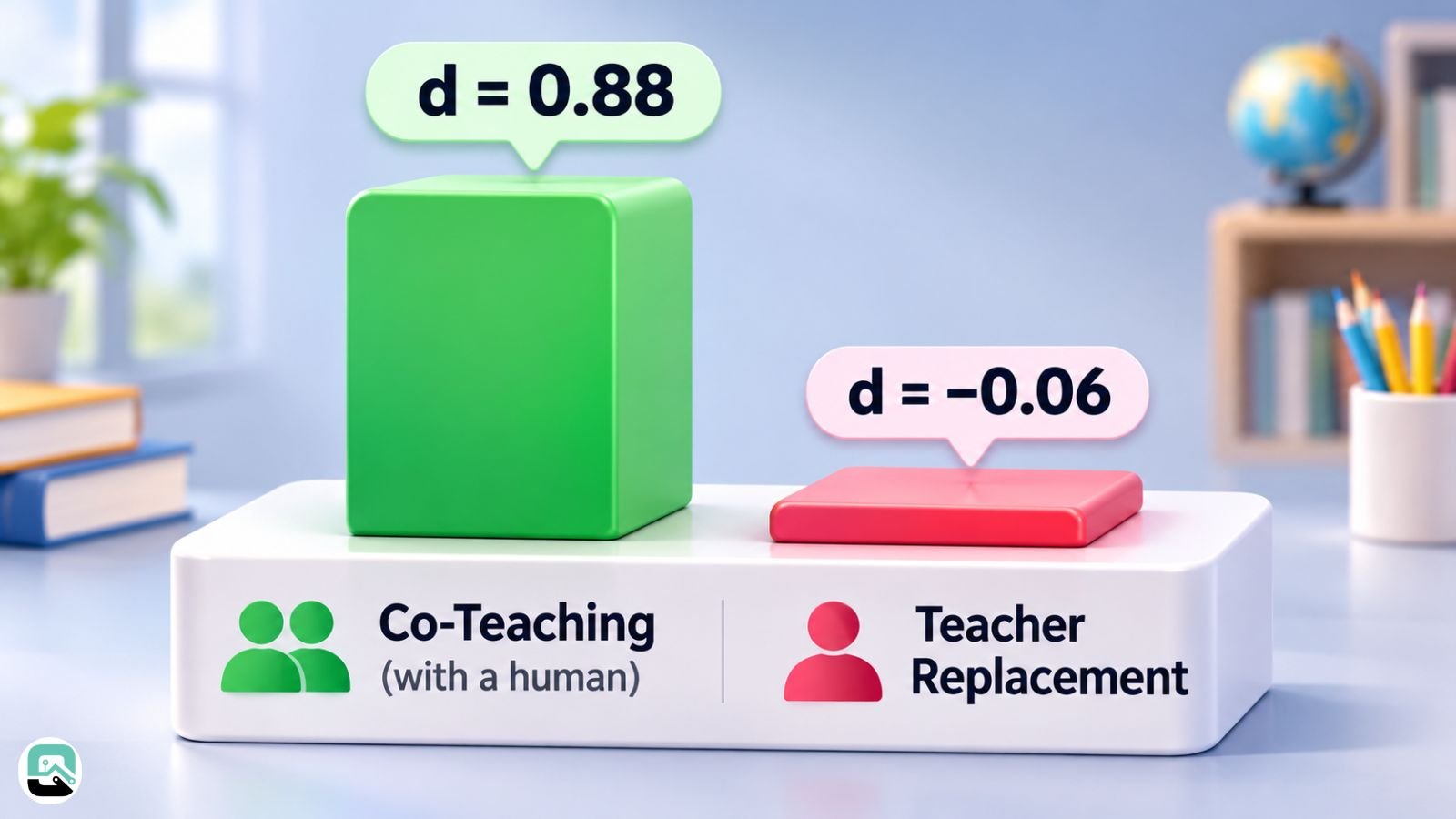
Beside one. In de Winter’s meta-analysis, robots in a co-teaching role beat teacher-only classes by a large margin (d = 0.88), while robots that replaced the teacher showed essentially no difference (d = −0.06). Against human teachers overall, the average was smaller (d = 0.31) and swung widely from study to study.
That split reframes the buying question. Forget whether a robot can match a teacher. Ask what it adds while the teacher does something else, such as running drills with one group so the teacher can coach another.
Three caveats keep that 0.88 in proportion:
- It rests on 18 co-teaching comparisons, against 27 robot-only ones.
- A robot plus a teacher means more instruction than a teacher alone, so part of the gain may come from the extra support rather than the robot itself.
- The review’s literature search closed in September 2024, before LLM-powered humanoids like those in Salamanca and San Diego reached classrooms.
Is a physical robot better than a tablet?
Only slightly, on current evidence. Robots beat virtual interfaces such as tablets and on-screen agents by a small margin (d = 0.20), and the authors call that comparison less clear-cut than the others. For a district weighing a humanoid against laptop software, that small gap is the number to remember.
What a Chicago classroom study adds
University of Chicago researchers tested robot tutors for social-emotional learning with 52 fourth graders in Chicago Public Schools. Students who worked with either robot improved their mastery of lesson concepts compared with classmates who received regular instruction only. The paper, led by PhD student Lauren Wright and Assistant Professor Sarah Sebo, won the Best Paper Award for user studies at the 2026 ACM/IEEE Human-Robot Interaction conference.
The surprise came from the scripts. One robot claimed feelings, friends, and personal stories; the other spoke plainly and admitted it had none. The plain-speaking robot drew deeper use of lesson vocabulary and problem-solving language, and the researchers suggest the invented emotions may have distracted students. With 52 children in one district, treat that as a strong lead rather than a rule.
The finding also feeds a wider argument over faces. Work robots often skip realistic skin because it adds cost and breaks easily, a trade-off covered in RoboPulse’s guide to lifelike humanoid robot design. In classrooms, a human-like face may buy attention without buying learning.
What went wrong with the New York robot teacher pilot?
Salamanca paused its pilot on July 24, 2026, hours after State Education Commissioner Betty Rosa told the district her department remained concerned about a humanoid robot in a high school classroom. Student data privacy, the robot’s role, cost, and the manufacturer’s corporate ties drove the backlash. As of November 6, 2026, no restart has been reported.
What Salamanca actually planned

The school board approved $57,590 for one stationary Realbotix M-Series robot, nicknamed Sally, plus Optio, an AI teaching assistant that students could reach on laptops. Realbotix announced the partnership on June 24, and the district announced its pilot on July 10.
On paper, the plan sat closer to the first two roles than to a robot teacher. Officials aimed Sally at high school students studying robotics and technology, who would also learn how the robot is maintained, updated, and repaired. The district said Sally carried only district-approved curriculum and would guide students through problems rather than do the work for them. Superintendent Mark Beehler argued that his students otherwise travel one to two hours to see emerging technology.
Why the plan stalled
New York Focus reported the plan in July, and pushback came fast from parents, teachers, and the state teachers’ union. NYSUT president Melinda Person argued that students need real relationships with caring adults, not robots. Rosa’s letter pointed out a mismatch: the district had ruled out any role in delivering instruction, yet a board presentation described the robot as a tutoring platform.
Critics also targeted the maker’s corporate family. In April 2024, Toronto-based Tokens.com bought Simulacra, a holding company whose subsidiaries included Realbotix LLC and RealDoll maker Abyss Creations, then renamed itself Realbotix Corp. In a July 22 corporate update, Realbotix Corp. said its robotics unit and its consumer unit, Intima LLC, share no staff, products, or technology. Intima owns 86% of RealDoll.
On privacy, the district said Sally would not collect personal information, record audio or video, or send data back to Realbotix, and that it would store information locally. Realbotix told TechSpot the robot would not use facial recognition. These are district and company statements, not findings from an independent audit.
The lesson is about order of operations. Salamanca bought first, then tried to settle data terms, define the robot’s job, and win over teachers. Reverse that sequence.
What happens next in New York, and how did San Diego differ?
New York lawmakers now want rules in place before the next district tries. On July 30, Senate Education Committee chair Shelley Mayer introduced bill S.10671, which would bar AI-enabled humanoid robots from instructional roles and require every district, charter school, and BOCES to adopt a written humanoid-robot policy.
The ban would reach beyond leading lessons to tutoring and assessing students. NYSUT and the state PTA both backed it. A second proposal takes a different line: humanoid robots could appear only in robotics, engineering, computer science, and similar technical courses, or in demonstrations and research. That carve-out matters here, because Salamanca pitched its robot to robotics students. The legislature is expected to take up the humanoid bill when it reconvenes in January.
San Diego: same summer, different rollout
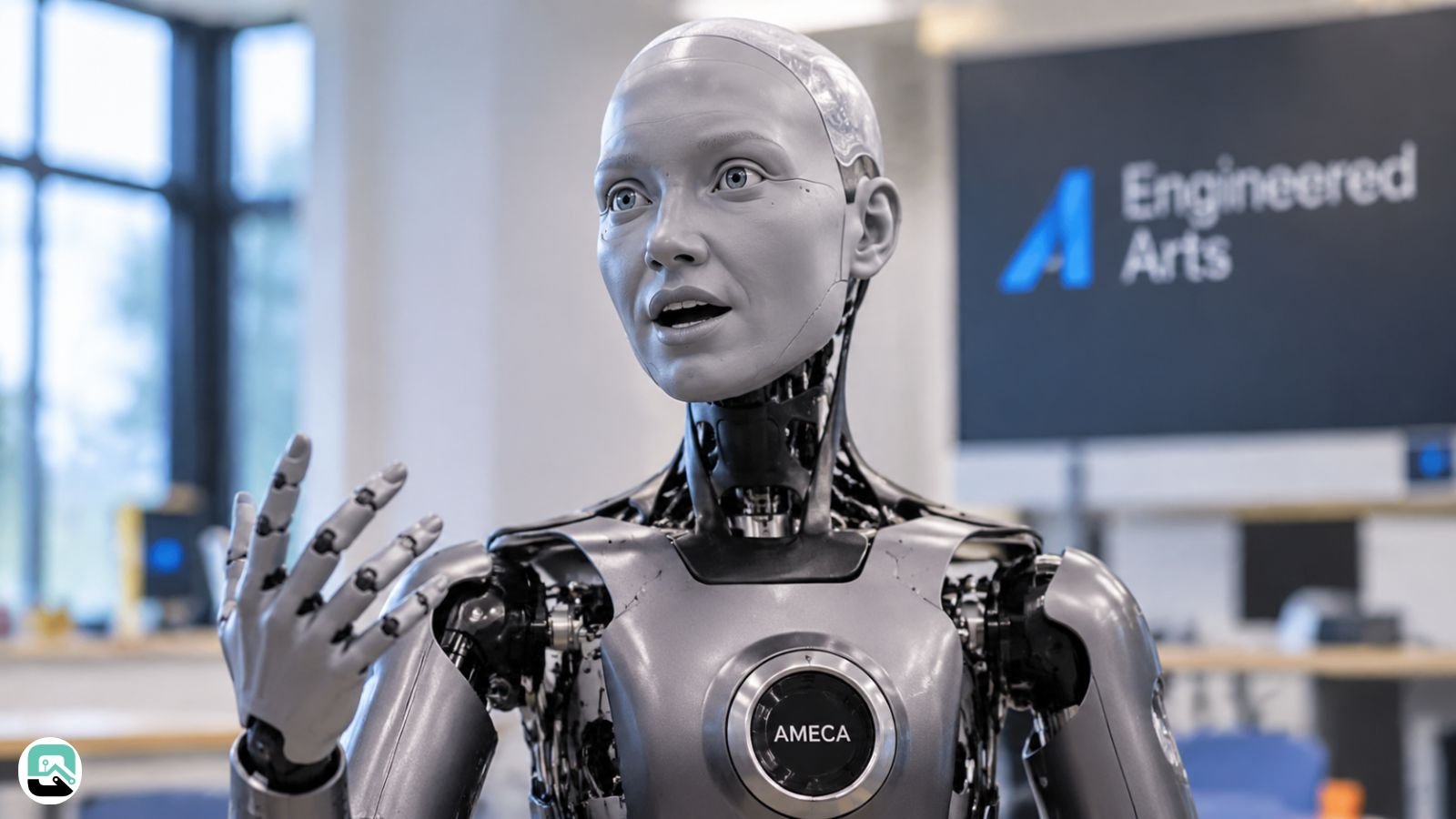
In June 2026, Voice of San Diego reported that Altus Schools, a charter network serving grades 6 to 12, had bought two Ameca humanoids from UK-based Engineered Arts for a combined $500,000. The ChatGPT-connected robots work in the network’s in-person resource centers.
Altus put guardrails up front. Staff said students are never left alone with the robots, the systems record no data, and memory is erased after each interaction. Critics still questioned the price, noting that the purchase came with no published outcome data. Stronger safeguards answer the privacy question; they don’t answer whether students learn more.
What do schools pay for classroom robots?
Prices range from about $12,000 to half a million dollars, and the sticker rarely covers the full bill. The figures below come from 2026 purchases and current list prices.
| Option | Price | What’s included | Status (Nov 2026) |
|---|---|---|---|
| Salamanca: Realbotix M-Series + Optio | $57,590 | One stationary humanoid plus AI assistant software | Purchased; pilot paused |
| Altus Schools: two Engineered Arts Ameca robots | $500,000 combined | Two full-size, ChatGPT-connected humanoids | Deployed in resource centers, per June 2026 reports |
| Realbotix Series 1 Tabletop (formerly Echo) | $11,950 + AI plan from $19.99/month | 32-inch tabletop humanoid | Reservations open; deliveries expected in the second half of 2027 |
| Realbotix Series 1 Full Body | $59,950 + AI plan | 39 degrees of freedom, all in the upper body | Same as Tabletop |
| Unitree G1 EDU Standard | $43,900 | Programmable humanoid with full SDK access | Shipping |
Two details change the math. Realbotix renamed Echo to Series 1 on November 4 without touching prices, and every unit needs a monthly AI subscription; RoboPulse’s Realbotix Echo pricing breakdown explains how those plans work. The company pitches the Tabletop for one-on-one education, yet no independent testing of it has been reported.
On the programmable side, the cheapest G1 can’t be coded at all, so schools need the EDU tier. Our Unitree G1 EDU review walks through that price jump in detail.
Finally, weigh every quote against the small edge robots hold over tablets.
How do you start teaching with robots in a classroom?
Pick one role for the robot and one learning outcome you can measure. Then match the hardware to that role, sign data terms before buying, bring teachers in early, and run a small pilot against a comparison group.
- Pick the job. Teaching programming points to a programmable kit. Extra one-on-one practice points to a tutoring robot or a software avatar. Replacing instruction has no evidence behind it, and in New York it could soon be prohibited.
- Define the outcome first. Results on computational thinking are mixed, so decide how you’ll test it before the first lesson.
- Get data handling in writing. Find out where student conversations go, who can access them, and what the vendor keeps.
- Plan the teacher’s role. Co-teaching gains depend on a teacher using the time the robot frees up.
- Pilot small and compare. Use a comparison class or your own prior results, then review before scaling.
- Check retention. Test again several weeks after launch, once the novelty wears off.
Questions to ask a vendor before signing
- Where is student data stored, and who can access it?
- Does the system record voice, video, or images, or use facial recognition?
- Which outside AI providers process student conversations?
- How long is data kept, and can the district delete it?
- Can a teacher monitor and override what the robot says?
- How does it handle questions outside approved content?
Put the answers in a signed agreement, and ask district counsel which federal and state student-privacy rules apply.
What a simple coding lesson can look like
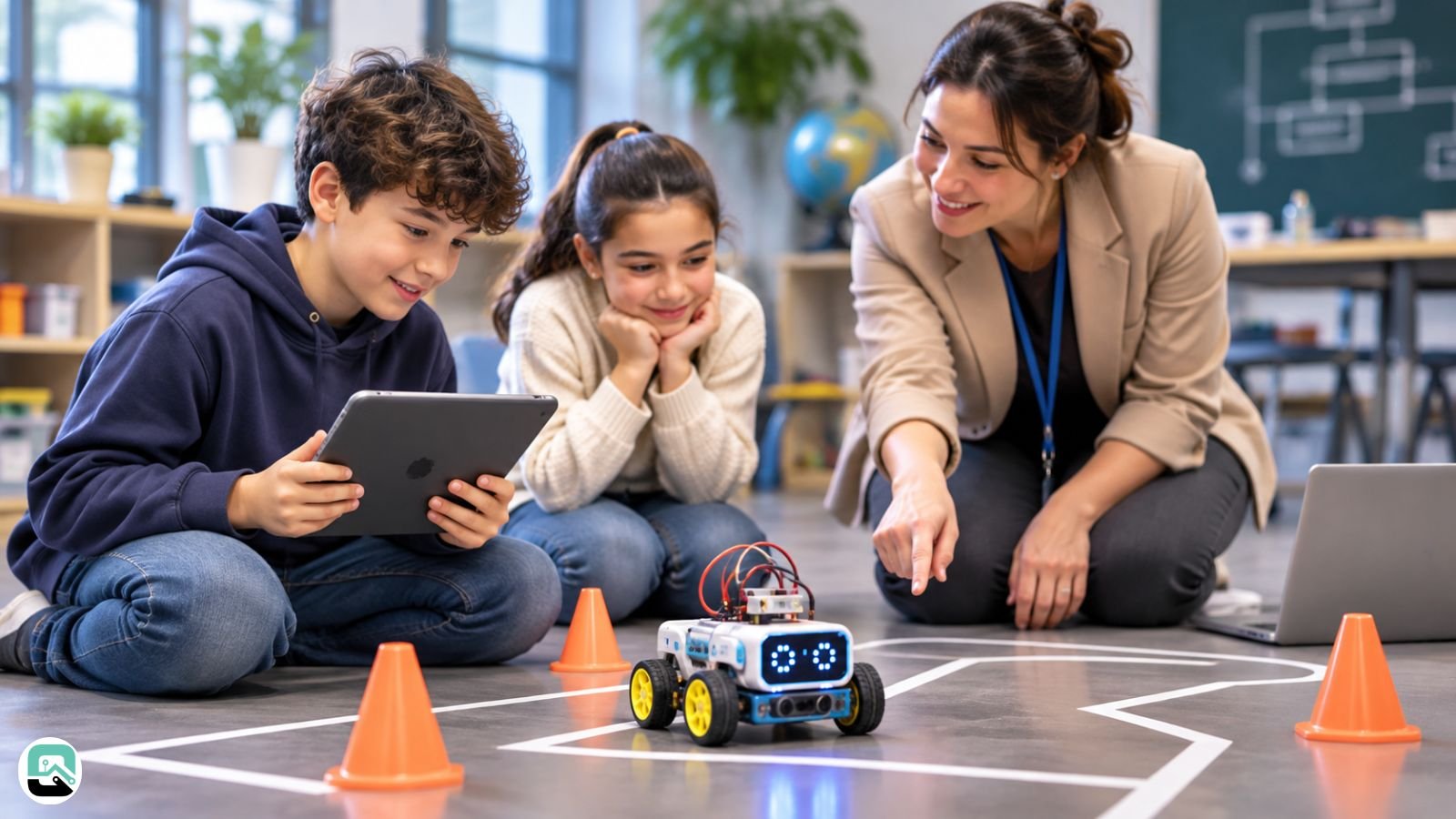
Here’s an illustrative example, not a tested intervention. Students get a route taped on the floor and program a small robot to follow it. They run the code, spot where the robot drifts off course, and fix the sequence. The teacher uses those errors to introduce debugging and loops, then asks each student to explain why the final version works. The robot is the instrument; judging the reasoning stays with the teacher.
What are the trade-offs and common mistakes?
The core trade-off pits individual attention at scale against cost, data risk, and community trust. A robot can give one child focused practice while the teacher works with others, but each benefit depends on how the school sets things up. These mistakes come up again and again:
- Buying before defining the problem. Some Salamanca residents asked why the money didn’t go toward more staff. Expect that question.
- Reading averages as promises. A pooled g of 0.57 or 0.71 describes studies in aggregate, not your classroom.
- Scripting a fake personality. In the Chicago study, invented emotions drew less engagement with lesson language than plain talk.
- Informing the community instead of consulting it. Technical safeguards alone didn’t save Salamanca’s pilot.
- Ignoring the novelty curve. De Winter’s team notes, citing earlier research, that a robot’s motivational boost usually fades fast. Wang et al. found no significant difference by treatment length, across studies running from under an hour to 25 weeks.
Robots fit best in schools with a clear tutoring or coding goal, a teacher who champions the project, and a signed data agreement. They fit poorly where a district hopes a machine will fill a staffing gap.
Next steps for teaching with robots
The evidence backs robots as helpers, not replacements. Write down one role and one measurable outcome, settle the data terms, then pilot small.
FAQs
Q. What does a robot teacher do?
It depends on the setup. In research, robots usually tutor individual students or run practice beside a teacher. Salamanca pitched its robot as a STEAM assistant that would not deliver instruction.
Q. What are the disadvantages of robot teachers?
Documented concerns include student data privacy, cost, community distrust, and weak results when a robot replaces a teacher. Teachers’ unions also argue that robots can’t offer human connection. Some of these concerns rest on evidence and others on values, so weigh them separately.
Q. How much does a robot teacher cost?
Real 2026 prices run from $11,950 for a Realbotix Series 1 Tabletop to $500,000 for two Ameca robots in San Diego. Salamanca paid $57,590 for one humanoid plus AI assistant software.
Q. Can New York schools use a humanoid robot teacher?
No ban is law yet. Bill S.10671 would bar AI-enabled humanoid robots from instructional roles in public and charter schools, and lawmakers are expected to take it up in January 2027.
Related: Will Robots Take My Job? What 2026 Data Really Reveals
| Disclaimer: This article is based on publicly available research and reports and is intended for informational purposes only. We strive for accuracy, but findings, costs, and regulations may change. Readers should consult original studies and official sources before making decisions. AI-generated images are used for illustration and may not depict actual events or equipment. |