

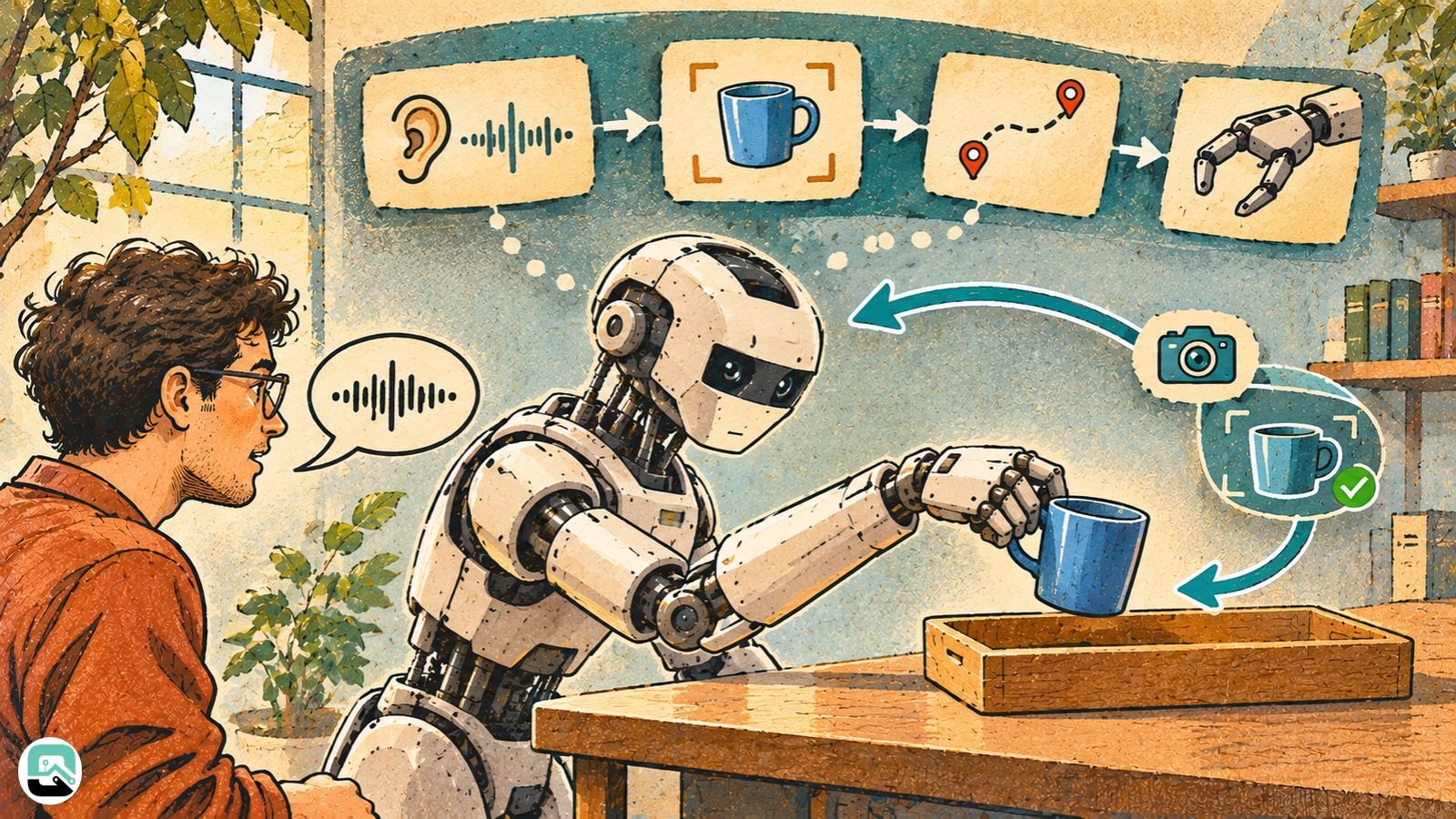
A robot follows a command by turning it into a goal or an action it can carry out. Some commands trigger a programmed routine. A vision-language-action (VLA) model takes the instruction and the camera view and predicts the actions that follow.
Knowing what someone wants and physically delivering it are separate problems.
One command, start to finish
Say someone tells a robot, “Put the blue mug in the tray.” This walkthrough is a simplified illustration, not a recorded run.
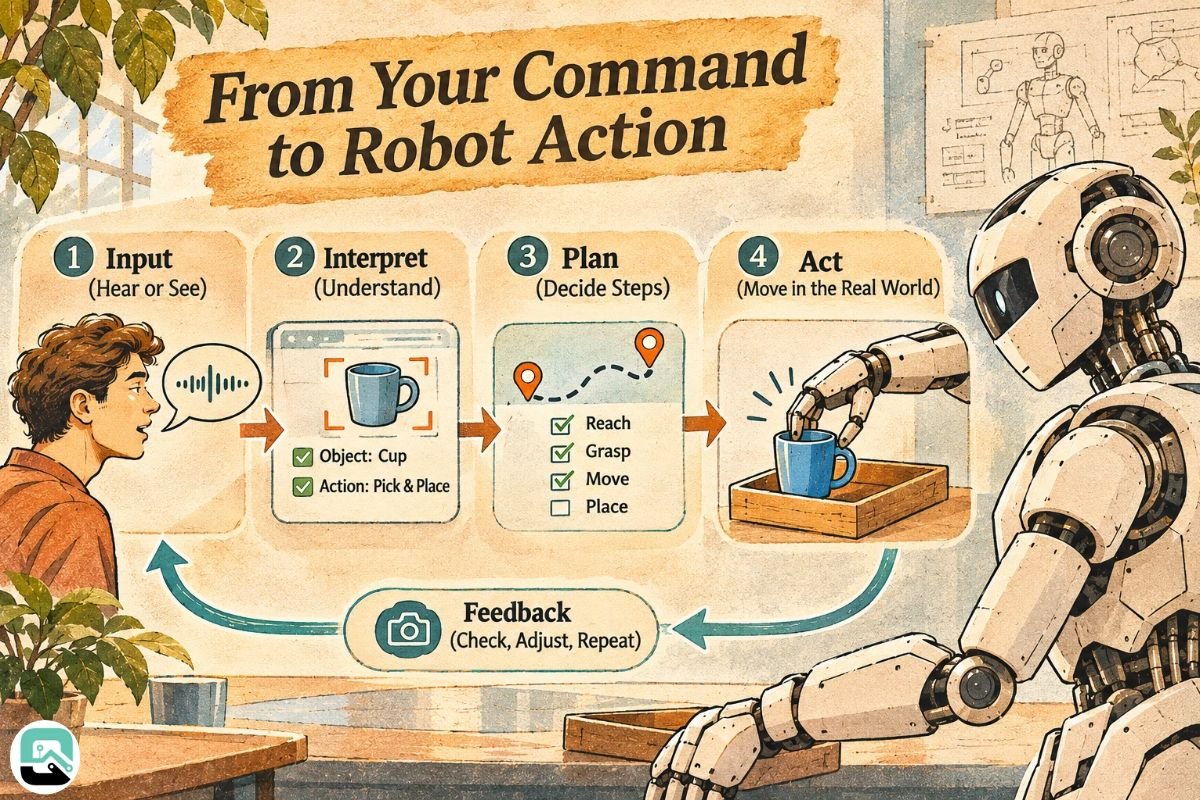
- Input. Some systems transcribe speech to text first. That is one design, not a requirement.
- Interpretation. The robot finds a blue mug and a tray in its camera view.
- Action. The robot’s controller turns the chosen target into instructions for the arm and gripper motors.
- Feedback. New sensor readings let the robot adjust its reach and grip as it moves.
Mishearing the words is an input error, picking the wrong mug is an interpretation error, and dropping the right mug is an execution error. To the person who gave the command, all three look like the robot failed.
Three ways language becomes action
These approaches can coexist with lower-level controllers, and none of them replaces the whole control system.
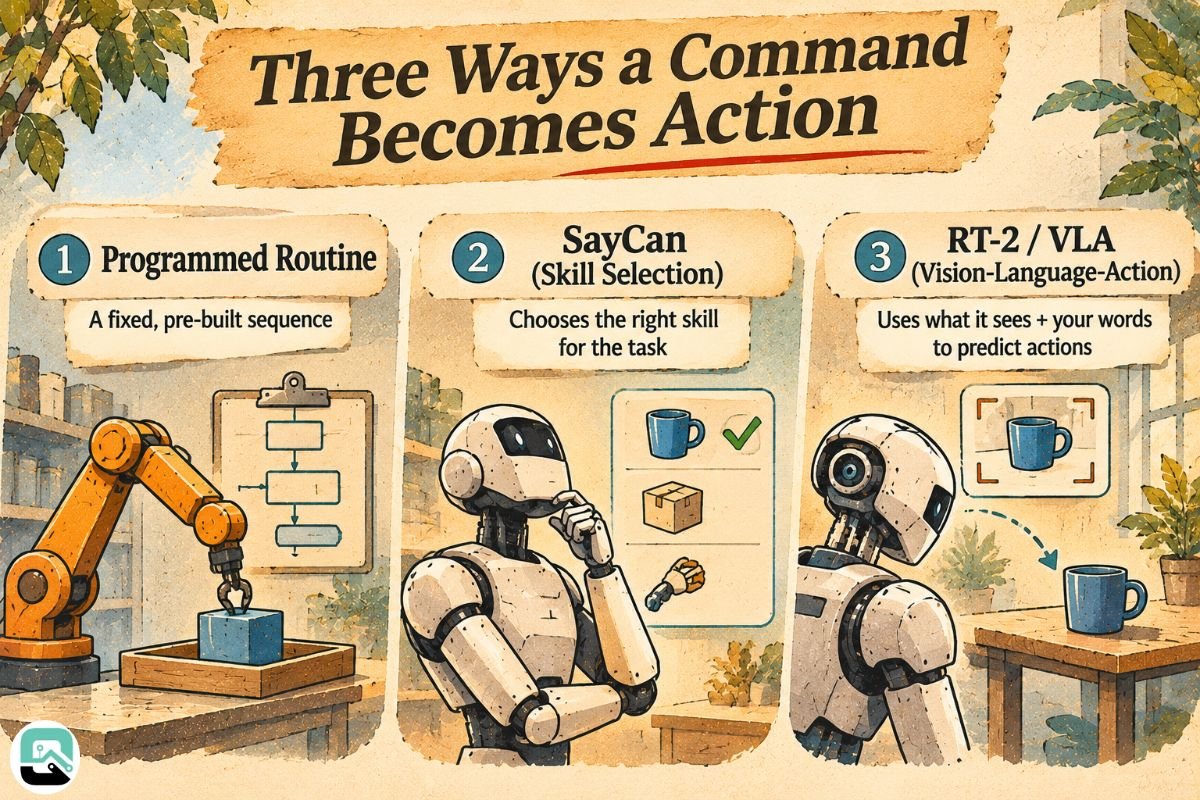
A programmed routine. A fixed command triggers a predefined sequence that the robot repeats the same way each time.
Skill selection. Google’s SayCan lets a language model propose steps, then uses learned “affordance” scores to favor the steps the robot is more likely to perform. On 101 instructions in a mock kitchen, PaLM-SayCan chose a correct plan 84% of the time and finished the task 74% of the time. In a separately tested real kitchen, those figures dropped to 81% and 60%. PaLM without affordance scoring planned correctly 67% of the time, and the researchers reported no execution rate for it. The authors found that the robot’s available skills limited performance more than its language understanding did.
Predicted actions. A VLA predicts movement straight from instructions and images. RT-2 writes small changes in the gripper’s position, rotation and opening as tokens, and the system decodes them into robot commands. DeepMind showed it following prompts like “move banana to the sum of two plus one” as an example of carrying web knowledge into the physical world. On unseen scenarios, RT-2 reached 62% success against 32% for its predecessor, RT-1.
Whether a model that maps words to actions truly understands them remains debated, and the research doesn’t settle it.
How a humanoid turns a decision into motion
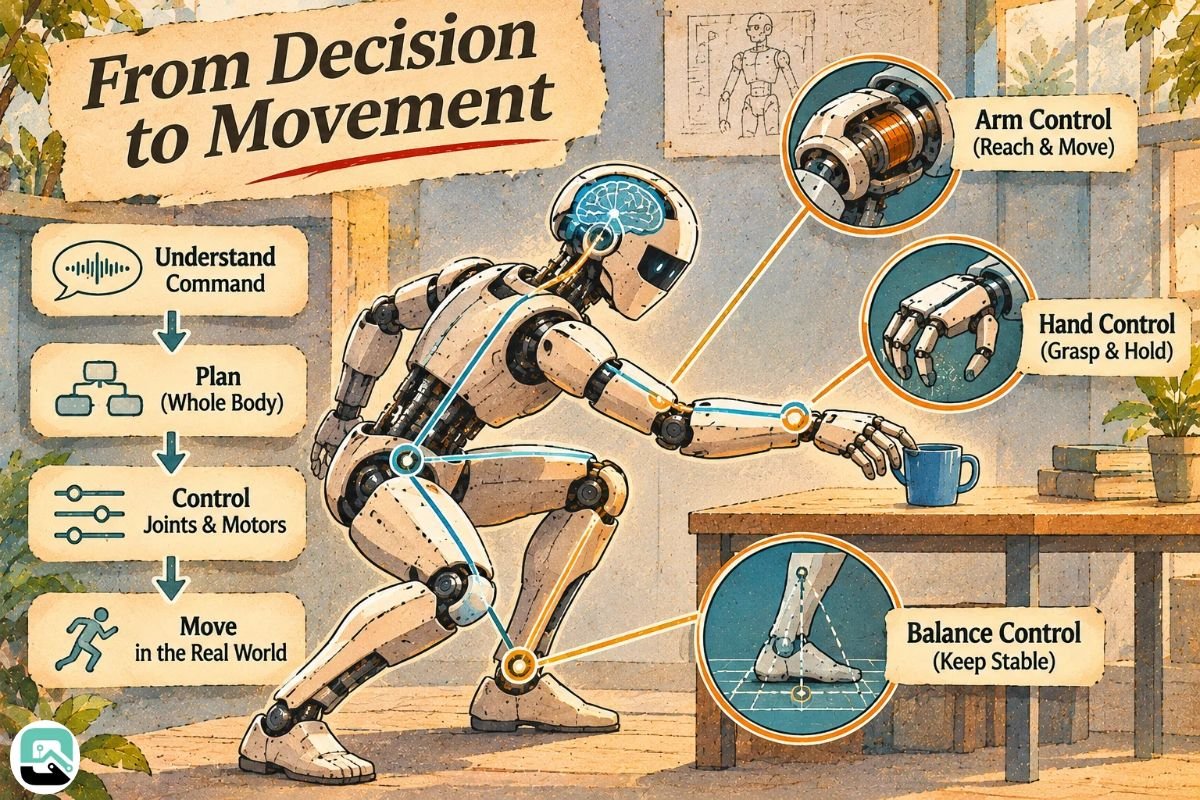
A humanoid that picks the right mug still has to stay upright while it reaches. Some systems split that work across models that run at different speeds.
Figure’s original Helix paired a language-and-vision model running at 7–9 Hz with a faster policy that produced upper-body motion at 200 Hz. Helix 02 later added System 0, a learned whole-body controller running at 1 kHz that handles balance and contact.
Google DeepMind divides the job another way. In Gemini Robotics 2, an embodied reasoning model plans the steps and tracks progress while a separate VLA produces the actions. DeepMind announced the Gemini Robotics 2.5 action model on November 10, 2026, and said it was rolling out to robotics partners. In a Mercedes-Benz parts-sorting trial, the reasoning model tracked the workflow while the 2.5 model controlled the arms and hands.
What a demo actually proves
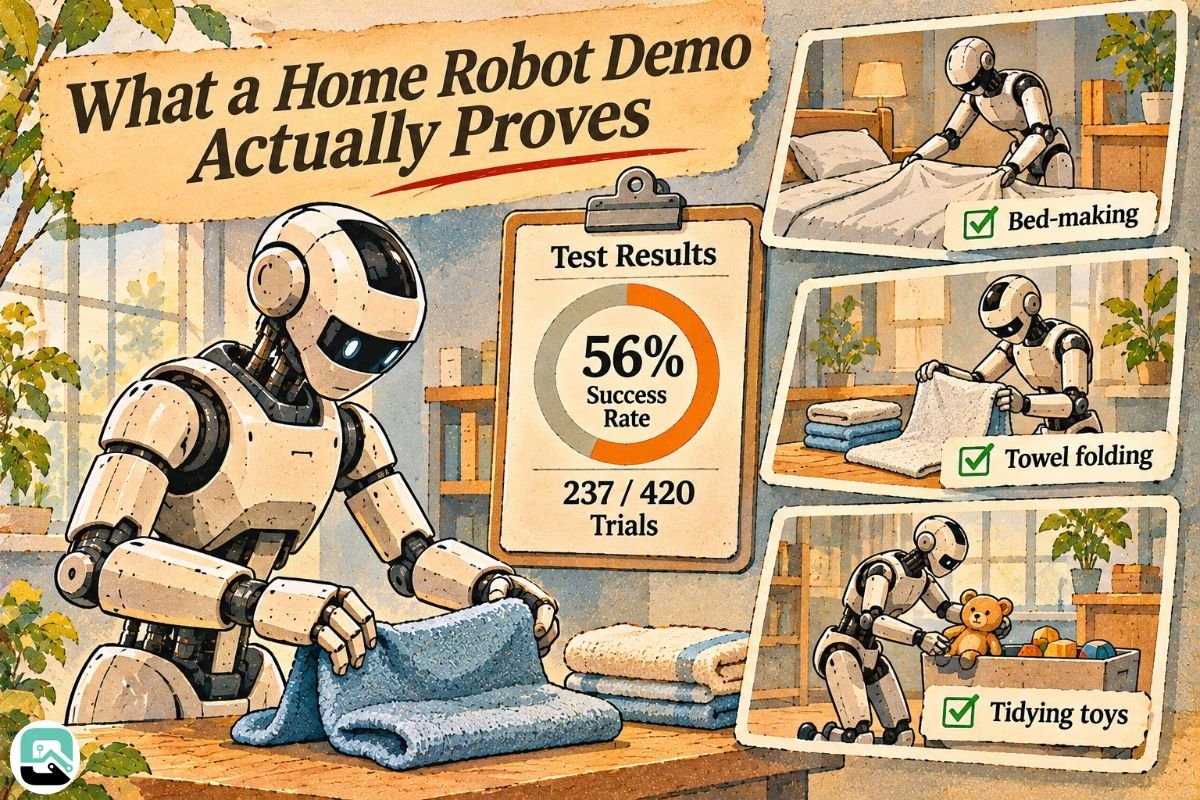
Figure’s Helix 2.5 evaluation shows how a measurement differs from a demo. In a company-run test across 30 unfamiliar homes, the robot completed 237 of 420 trials (56%) across three chores: making beds, folding towels and tidying toys. A comparison policy trained on the same task data without Index pretraining succeeded in fewer than one in ten trials. Figure gave no partial credit, and toy tidying proved hardest at 56 of 140 trials (40%).
Figure did not collect training data in the evaluation homes, and the evaluation objects were absent from the task-specific training data. The chores themselves weren’t new, because Figure trained the policies on those tasks with data collected elsewhere. The result shows that trained skills can transfer to unfamiliar homes. It doesn’t show that a robot can learn a new chore from a spoken command. Other makers teach chores through remote human guidance or video of people, as this look at how five home robots learn chores shows.
Safety raises a separate question. DeepMind says it tests whether its reasoning model refuses unsafe tool calls from a VLA and asks a human for help when it’s unsure. Those are things the benchmark tests, not guarantees about how the robot will behave in use.
Refusing an instruction and physically limiting or stopping motion are different safeguards. University of Pennsylvania researchers found that language-model safeguards could fail in specific robotics experiments. Those experiments don’t establish a failure rate for humanoid VLAs.
Five questions to ask of any “it understands you” demo
- What was new? Check which objects, rooms or instructions were missing from the training data.
- How many trials, and what counted as success? Google reported 96% success for the Mercedes-Benz parts-sorting proof of concept, but coverage of the announcement gave no trial size, failure criteria or intervention count. The figure alone doesn’t show how reliably the robot could work unattended.
- Did a human step in? At a robotics conference in Austin in November, Tesla’s Optimus handed out snack packets, and reporting says a human operator controlled it remotely. The clip shows the robot handling an object. It doesn’t show that the robot chose or carried out the handoff on its own.
- Where did it fail? Look for whether the miss came from hearing, identifying the object, planning, grasping or stopping safely.
- What happens when the robot is unsure or can’t finish? The answer tells you whether it stops, asks for help or keeps going.
FAQs
Q. How are humanoid robots controlled?
Some run autonomously on learned policies, using layers like the ones above. Others rely on a human operator, and teleoperation also produces training data. Check which mode a demo uses.
Q. Can a robot follow commands offline?
It can if every component it needs for that command runs locally. An on-device action model covers only one part of that.
Related: How Do Robots Grip Objects? Inside Humanoid Robot Hands
| Disclaimer: This article is for informational and educational purposes only. Robot capabilities, performance figures, and safety claims are based on publicly available research, company reports, and demonstrations. Results may vary in real-world conditions. We are not affiliated with or endorsed by any robotics companies mentioned. |