

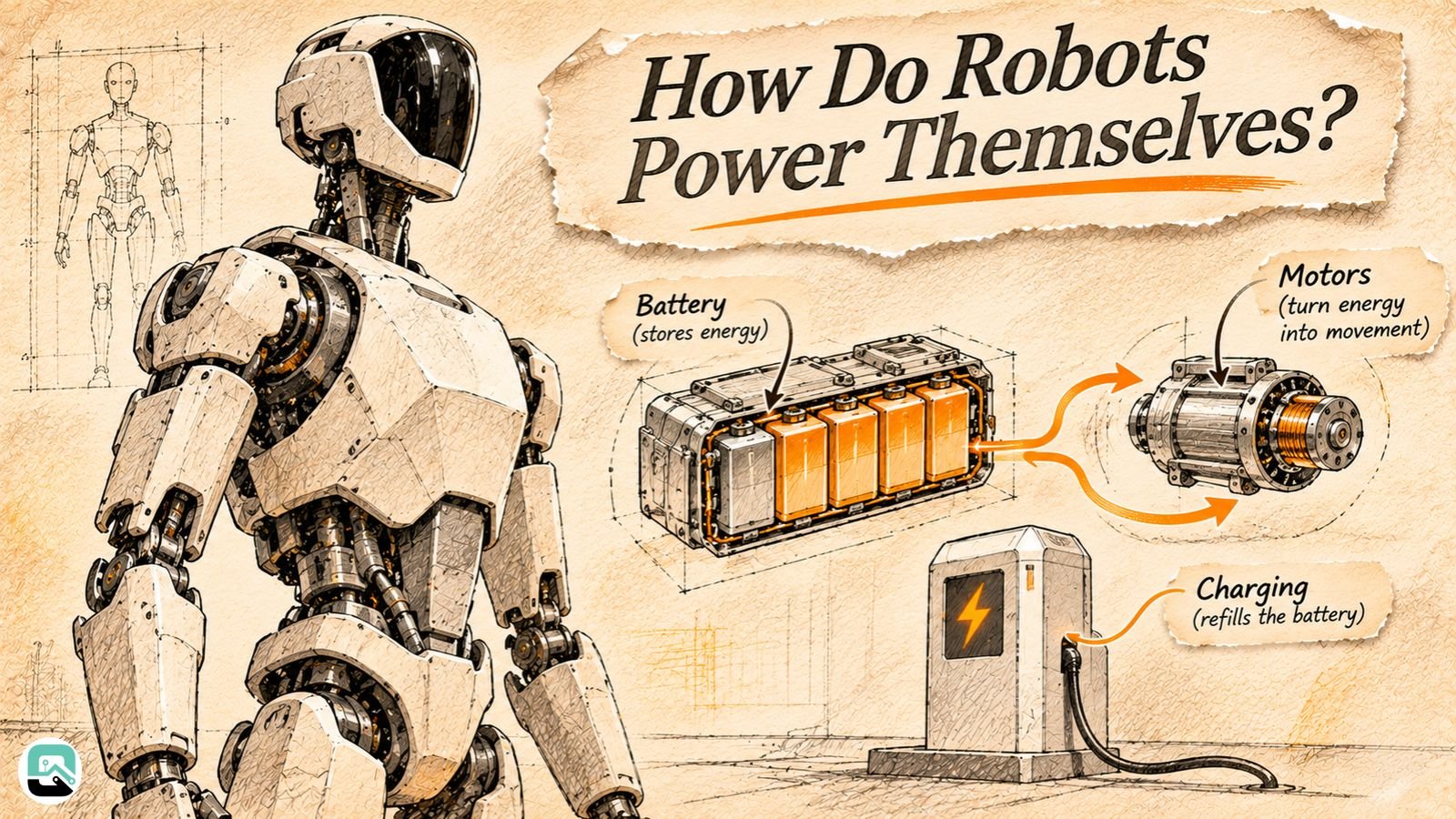
Boston Dynamics’ spec sheet for the production Atlas lists a 4-hour battery life, 2 hours with heavy lifting, and a 3-minute autonomous battery swap. That pairing captures the core problem. A robot only earns its keep if it can refill its energy and get back to work.
The short answer:
- Mobile robots carry rechargeable batteries.
- Fixed factory robots draw power from the building.
- Space robots carry a nuclear generator, as NASA’s Perseverance does, or rely on solar panels.
The right choice depends on how far the robot moves and how long it must work.
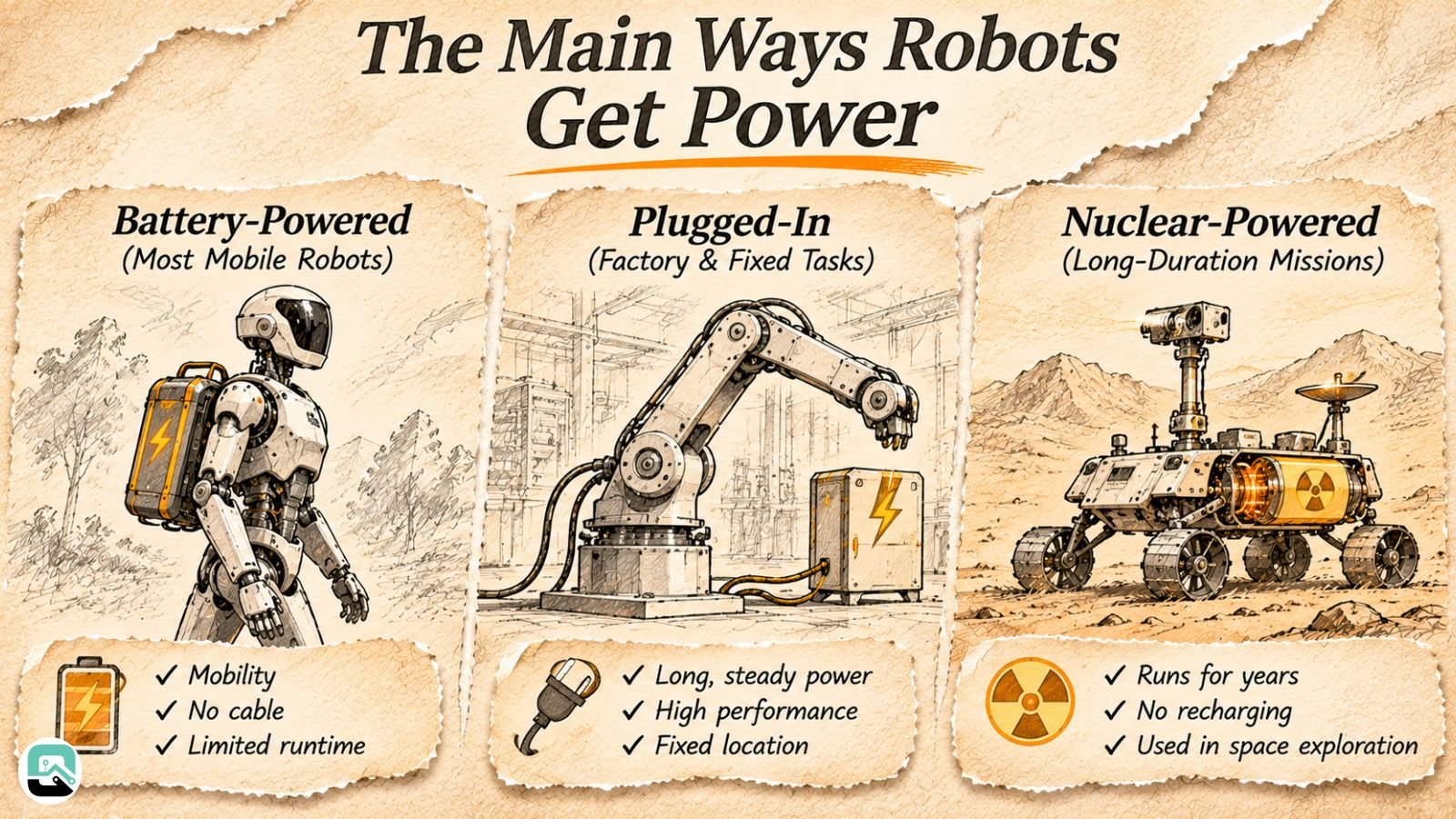
The main ways robots get power
| Approach | How it works | Typical examples | Main limit |
|---|---|---|---|
| Stored energy | The robot carries a battery, fuel, or hydrogen | Humanoids, quadrupeds, most mobile robots | Weight and runtime |
| External supply | Mains power or a cable feeds the robot | Factory arms, tethered drones | Reach, or the length of the cable |
| Onboard generation | The robot collects or produces its own power | Perseverance (radioisotope generator), solar-powered rovers | Low output; mission-specific |
Within stored energy, most robots use batteries. Some use ordinary fuel, and some research robots run on hydrogen fuel cells, covered below. A radioisotope generator carries its own fuel and turns decay heat into electricity. It does not harvest anything from the environment. Tethered drones are powered and controlled via a tether from a ground-based power source.
Why most mobile robots carry batteries
Away from mains power, most autonomous robots rely on batteries, and lead-acid and lithium-ion packs have met that need so far. A battery management system monitors the pack.
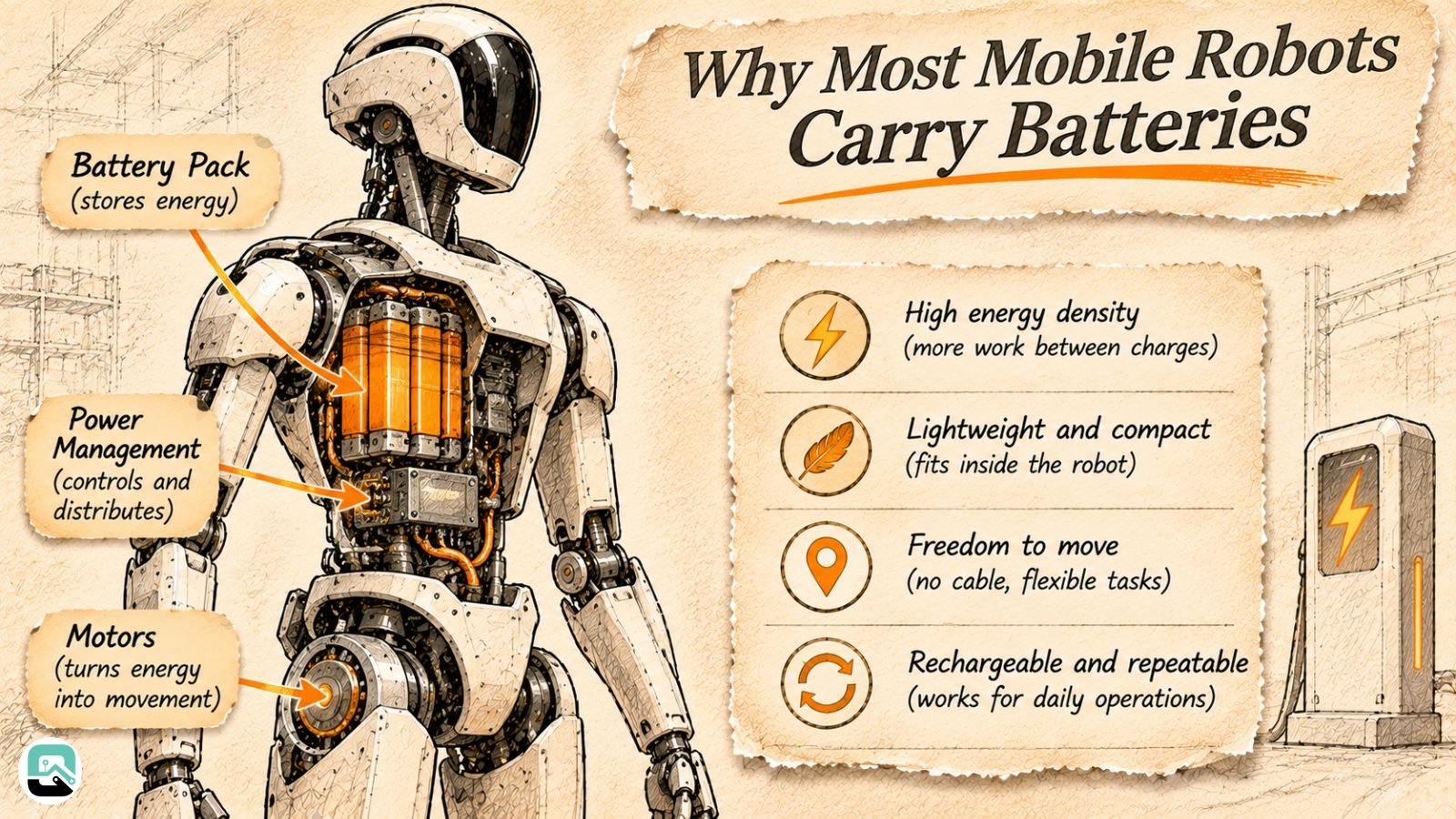
The main trade-off is weight:
- A bigger pack stores more energy.
- A bigger pack also adds mass, and moving that mass takes more power.
- Penn engineers describe this as a scaling problem for small devices: adding a bigger battery won’t let a robot last longer, because the added mass takes more energy to move.
- Designers therefore balance pack size against payload, mobility and runtime rather than fitting the biggest pack that will go in.
Energy versus power
| Term | Unit | What it tells you |
|---|---|---|
| Energy (capacity) | Wh or kWh | How much a pack stores |
| Power | W or kW | How fast a robot uses energy, or a charger delivers it |
A large battery can still drain quickly if the motors draw heavily. A high-power charger refills a pack faster without making it any bigger.
Why factory robots plug in
A robot bolted to a floor has no reason to carry a battery. Its controller takes AC from the facility, though requirements vary. ABB’s IRC5 datasheet lists a 3-phase 200–600 V supply, and 1-phase 220/230 V for the Compact Controller only. Inside the cabinet, that AC is converted to DC for the drive electronics.
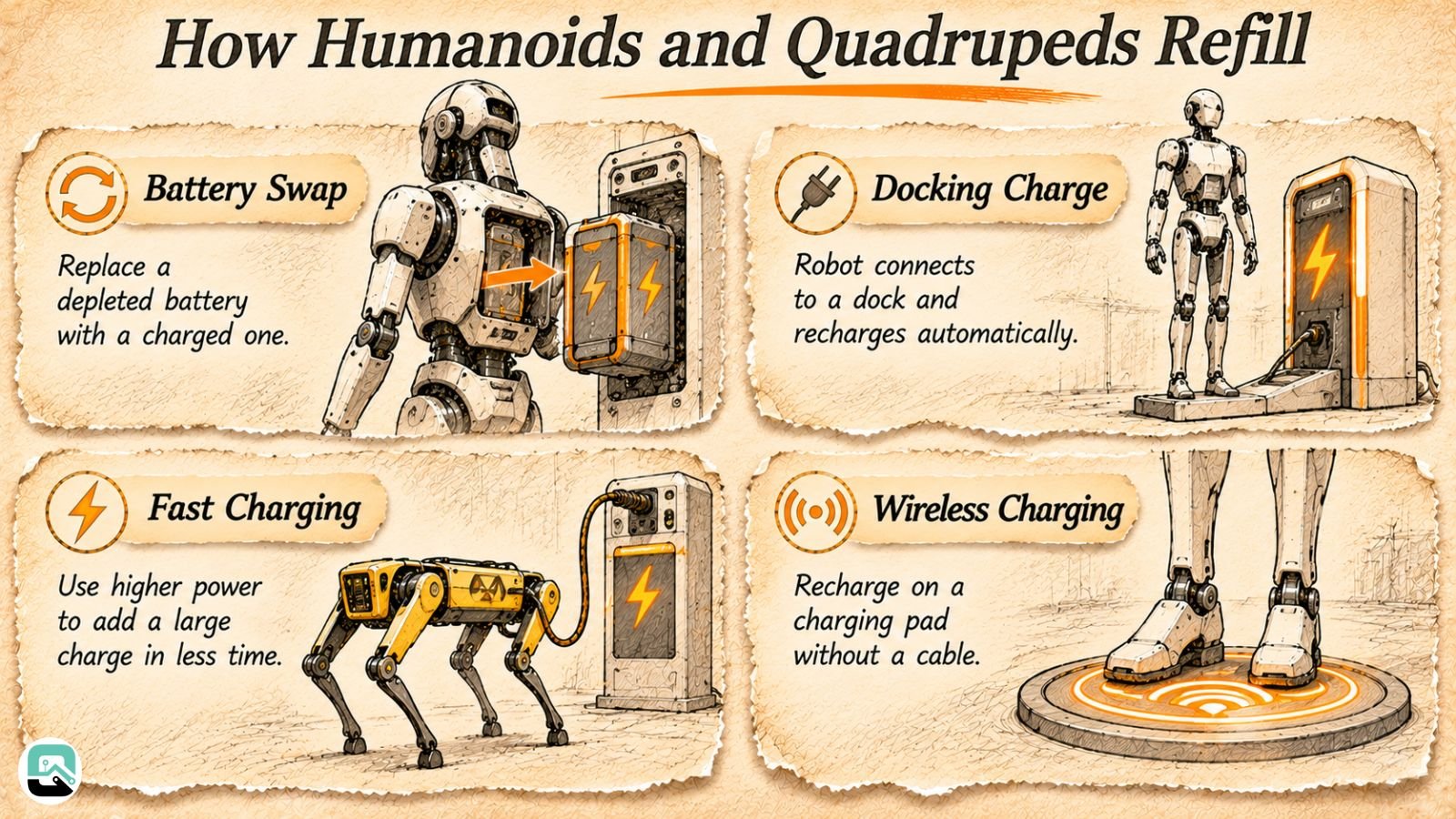
How humanoids and quadrupeds refill
These are manufacturer-stated figures. Spot and the G1 are on sale; Atlas has entered production with 2026 deployments committed to Hyundai and Google DeepMind, and Digit 5’s numbers are announced targets.
| Robot | Refill method | Stated runtime | Swap or charge time |
|---|---|---|---|
| Atlas | Autonomous battery swap | 4 hours; 2 hours with heavy lifting | 3-minute swap; 1.5-hour charge |
| Spot | Self-docking charger; removable battery | About 90 minutes; about 60 with payloads | About 2 hours to full on the dock at 25°C; about 1 hour on the power supply |
| Unitree G1 | Quick-release pack | About 2 hours | Not stated here |
| Digit 5 | Fast charging (announced) | 90 minutes | 9 minutes |
| Figure 03 | Wireless charging, reported via foot coils | 5 hours at peak performance | 2 kW fast charge |
Four ways to refill, compared
| Method | What it does | Example | Trade-off |
|---|---|---|---|
| Battery swap | Replaces a depleted pack with a charged one | Atlas; G1 (a person swaps it) | Cuts downtime, but needs spare packs and a station |
| Docking | The robot returns to a charger | Spot | The robot waits while it charges |
| Fast charging | Shortens the charging stop | Digit 5 (announced) | Cycle life matters for a pack charged many times a day |
| Wireless charging | Charges through coils, with no plug | Figure 03 | Depends on mats or pads where the robot works |
What each method looks like in practice:
- Swapping. Atlas swaps its own battery, and the swap, along with the shift from hydraulics to electric actuators, is central to its industrial pitch. The G1’s pack is quick-release, so a person changes it, and its roughly two-hour runtime is a practical limit for lab sessions.
- Docking. Spot navigates to an available dock when its battery runs low, then carries on with its work. Boston Dynamics’ Spot specifications show how much the wait depends on dock temperature: about 2 hours to full at 25°C, and about 3.5 hours at 35°C.
- Fast charging. Agility says Digit 5’s 90-minute runtime and 9-minute charge give a 10:1 run-to-charge ratio, up from Digit 4’s 2:1, as reported at the battery partnership announcement. Early access is expected in the first half of 2027, so these are specifications and projections until then. The companies have not quantified battery cycle life. Agility has also demonstrated one Digit taking over while another charges, so part of a fleet stays on task. How Digit handles charging is covered in our review of the current model.
- Wireless charging. Launch coverage says Figure 03 has charging coils integrated into its feet, so it can step onto a charging mat. Figure’s battery page confirms a 2 kW fast charge with active cooling, and a requirement that the battery must not emit flames if a single cell fails catastrophically. Charging then fits into the working day, as RoboPulse’s review of Figure 03’s wireless charging explains.
Warehouse robots and battery chemistry
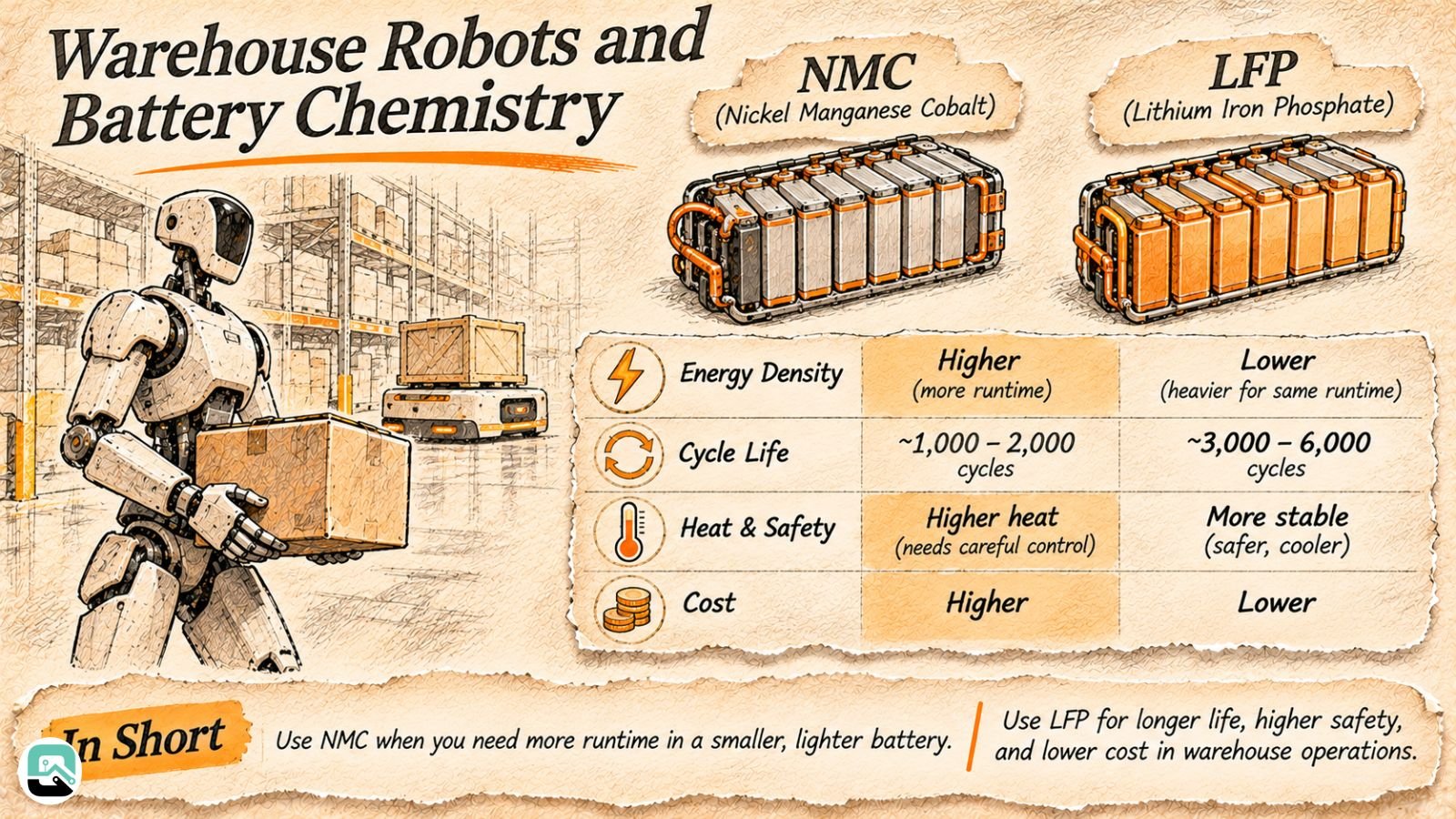
Humanoids get the attention, but wheeled warehouse robots (AMRs and AGVs) are the everyday users of these charging ideas. Their usual approach is opportunity charging: rather than waiting for a full depletion cycle, robots top up during natural workflow pauses such as loading, unloading or waiting for a mission.
Chemistry differs by job. LiFePO4 (LFP) is the preferred choice for 24/7 industrial AMRs because of its intrinsic safety, while NMC offers higher energy density where size and weight are constrained. Humanoids sit on the weight-constrained side: IDTechEx says NMC-based lithium-ion batteries are currently the most common technology in humanoid robots, in its November 2026 overview.
| Chemistry | Energy density | Cycle life | Where it fits |
|---|---|---|---|
| NMC | 200–280 Wh/kg | About 1,500–2,000 cycles | Weight-sensitive robots such as humanoids |
| LFP (LiFePO4) | 140–180 Wh/kg | About 3,000–6,000 cycles | 24/7 warehouse AMRs and AGVs |
Figures are from a battery supplier’s guide, not independent testing. Cycle life is quoted to 80% remaining capacity.
What the runtime numbers imply
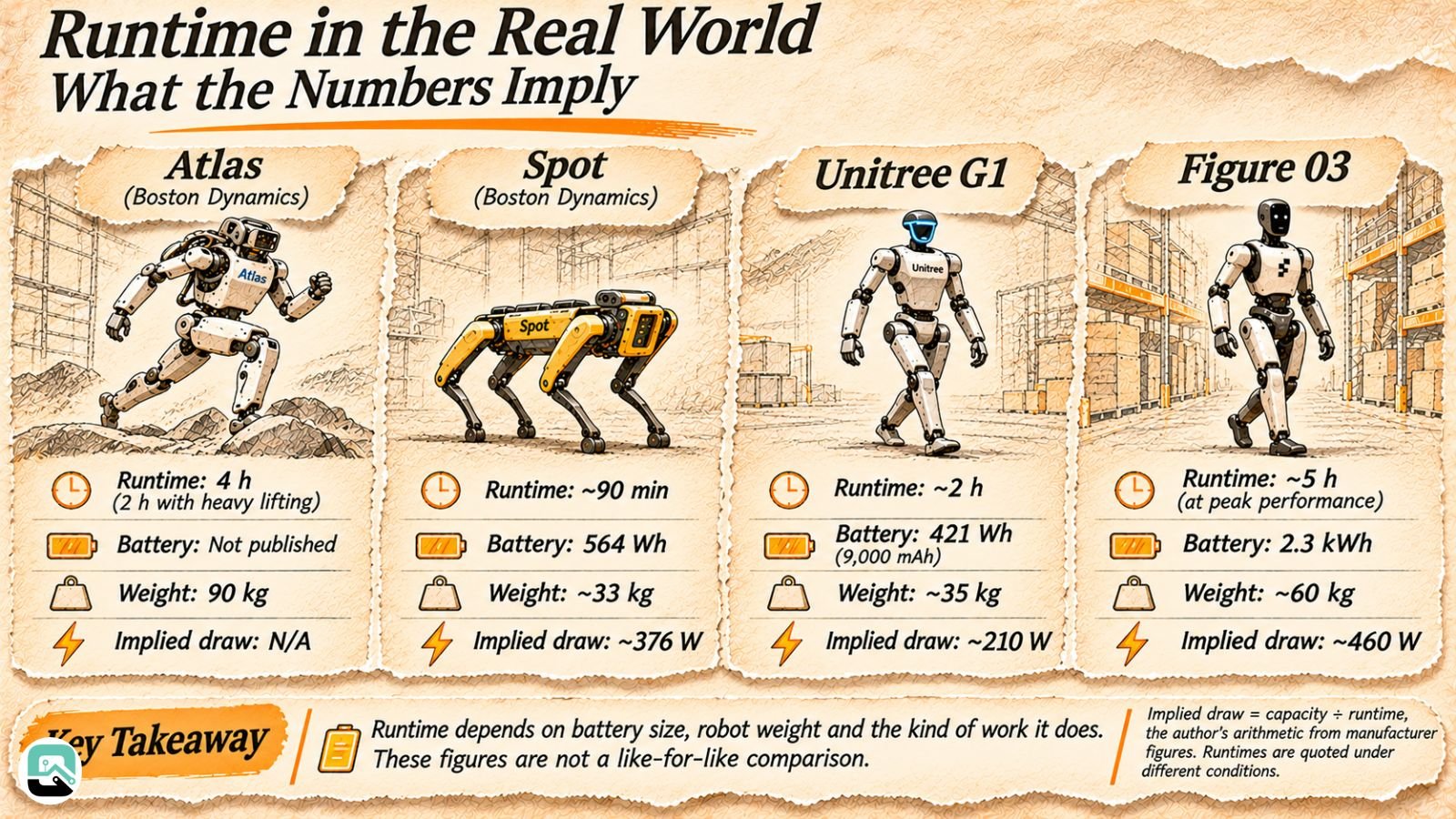
Dividing capacity by runtime gives a rough average draw. This is my arithmetic from manufacturer figures, not a measurement. Runtimes are quoted under different conditions, so don’t compare the robots directly.
| Robot | Stated capacity | Stated runtime | Implied average draw |
|---|---|---|---|
| Unitree G1 | 421 Wh (9,000 mAh) | About 2 hours | Roughly 210 W |
| Figure 03 | 2.3 kWh | 5 hours at peak performance | Roughly 460 W |
| Spot | 564 Wh | About 90 minutes | Roughly 376 W |
| Atlas | Not published | 4 hours | Not calculable |
The capacity figures come from Unitree’s G1 brochure, Figure’s battery page and Boston Dynamics’ Spot specifications.
Perseverance works differently. According to NASA, its generator produces about 110 watts at the start of the mission:
- Output declines a few percent each year in a very predictable way.
- The generator charges two lithium-ion batteries, and power demand can reach 900 watts during science activities. The batteries cover that peak, not the generator.
- The rover’s dry mass is 1,025 kilograms, and its maximum wheel speed is 4.2 cm/sec, so its top speed is just under 0.1 mph.
These are different energy designs, not an efficiency comparison. Perseverance needs a small, steady supply that runs for years, and its waste heat keeps the rover’s electronics warm through cold Martian nights. A humanoid needs hours of much higher draw.
Fleet math: how charging time changes the robot count
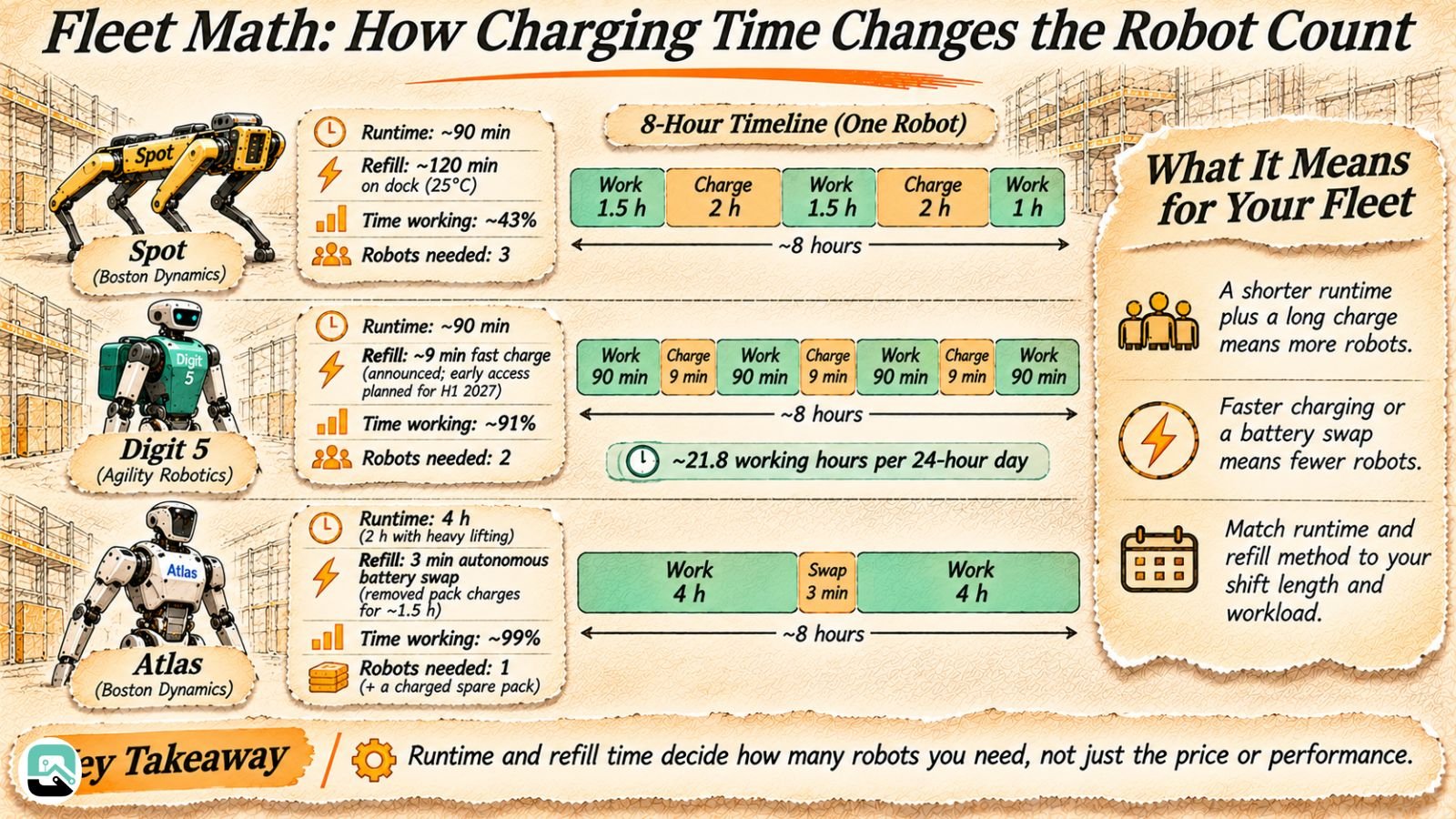
Charging time decides how many robots a site must own to keep one working at all times. This is my arithmetic from the stated figures. It is idealized and ignores heavy lifting, payloads, and cycle-life wear.
| Robot and method | Work, then refill | Share of time working | Robots needed to cover one continuous slot |
|---|---|---|---|
| Spot, dock at 25°C | 90 min, then about 120 min | About 43% | 3 (2.3 rounded up) |
| Digit 5, fast charge (announced) | 90 min, then 9 min | About 91% | 2 (1.1 rounded up) |
| Atlas, battery swap | 240 min, then 3 min | About 99% | 1, if a charged spare pack is waiting |
For Digit 5, the idealized 90-to-9-minute ratio implies about 21.8 hours of runtime and 2.2 hours of charging in a day, which matches Agility’s “more than 20 hours” framing.
Can robots run on hydrogen?
Some research robots do. A 2025 study describes Hygrobot, a ground robot powered by a hybrid of a PEM fuel cell and LiPo batteries. In experimental tests, it achieved a continuous operating time of over 8 hours.
- How it works: a fuel cell converts hydrogen’s chemical energy into electricity. In the hybrid, the battery supplies high power, and the fuel cell supplies energy density.
- Humanoids: none of the humanoids above uses one.
Robots that generate or collect their own energy
- Radioisotope generator. Perseverance uses a multi-mission radioisotope thermoelectric generator, which converts heat from the natural radioactive decay of plutonium-238 into electricity. NASA says the system is identical to the one on Curiosity.
- Metal-air scavenger. Penn Engineering’s scavenger reported 13 times the energy density of lithium-ion batteries. It is a 2020 lab result, and the researchers see the near-term uses in internet-of-things technologies. It is not a power source for walking robots.
Which power source fits which job?
| If the robot… | It needs… |
|---|---|
| Stays in one place | Mains power |
| Roams and can return to a base | A battery, plus swapping, docking, or fast charging |
| Must fly or work for long periods near a fixed point | A tether to a ground power source |
| Works where nothing can be plugged in | A generator, solar panels, or a fuel cell |
Untethered humanoids still trade operating time against charging downtime. Swapping and faster charging narrow the gap, but neither matches the uninterrupted supply of a fixed or tethered machine. To compare battery life and other specs across models, use RoboPulse’s side-by-side humanoid comparison tool.
FAQs
Q. Do robots use AC or DC power?
Both, at different stages. A plugged-in industrial robot takes AC from the building, and its controller converts it to DC for the drive electronics. Battery-powered robots work from DC from the start.
Q. Can robots recharge or swap batteries on their own?
Some can. Spot returns to its dock when its battery runs low, and Atlas swaps its own battery at a charging station. The G1 uses a quick-release pack that a person changes.
Q. Do any robots use nuclear power?
Some NASA rovers do. Perseverance and Curiosity use radioisotope generators. None of the humanoid or industrial robots covered here do.
Q. What kind of batteries do humanoid robots use?
Mostly NMC-based lithium-ion. IDTechEx says LFP is considered not energy-dense enough for the general demands of humanoids. Warehouse AMRs more often use LFP, which trades energy density for safety and cycle life.
Q. Do walking robots use regenerative braking like electric cars?
Researchers continue to explore regenerative braking in walking robots, but manufacturers have yet to confirm its use. A patent describes how legged robots can recover energy through their hydraulic systems when a limb slows down, while a robotics review examines actuators that recycle energy through mechanical compliance. Atlas, Figure 03, and Digit manufacturers have not confirmed using this technology or quantified its energy savings.
Related: How Do Robots Grip Objects? Inside Humanoid Robot Hands
| Disclaimer: This article is for informational and educational purposes only. Robot battery specifications, charging times, and runtimes vary by model, workload, and operating conditions. Some figures are manufacturer-reported estimates, while illustrations and calculations are explanatory examples. Verify technical specifications with official manufacturer sources before making purchasing or operational decisions. |