

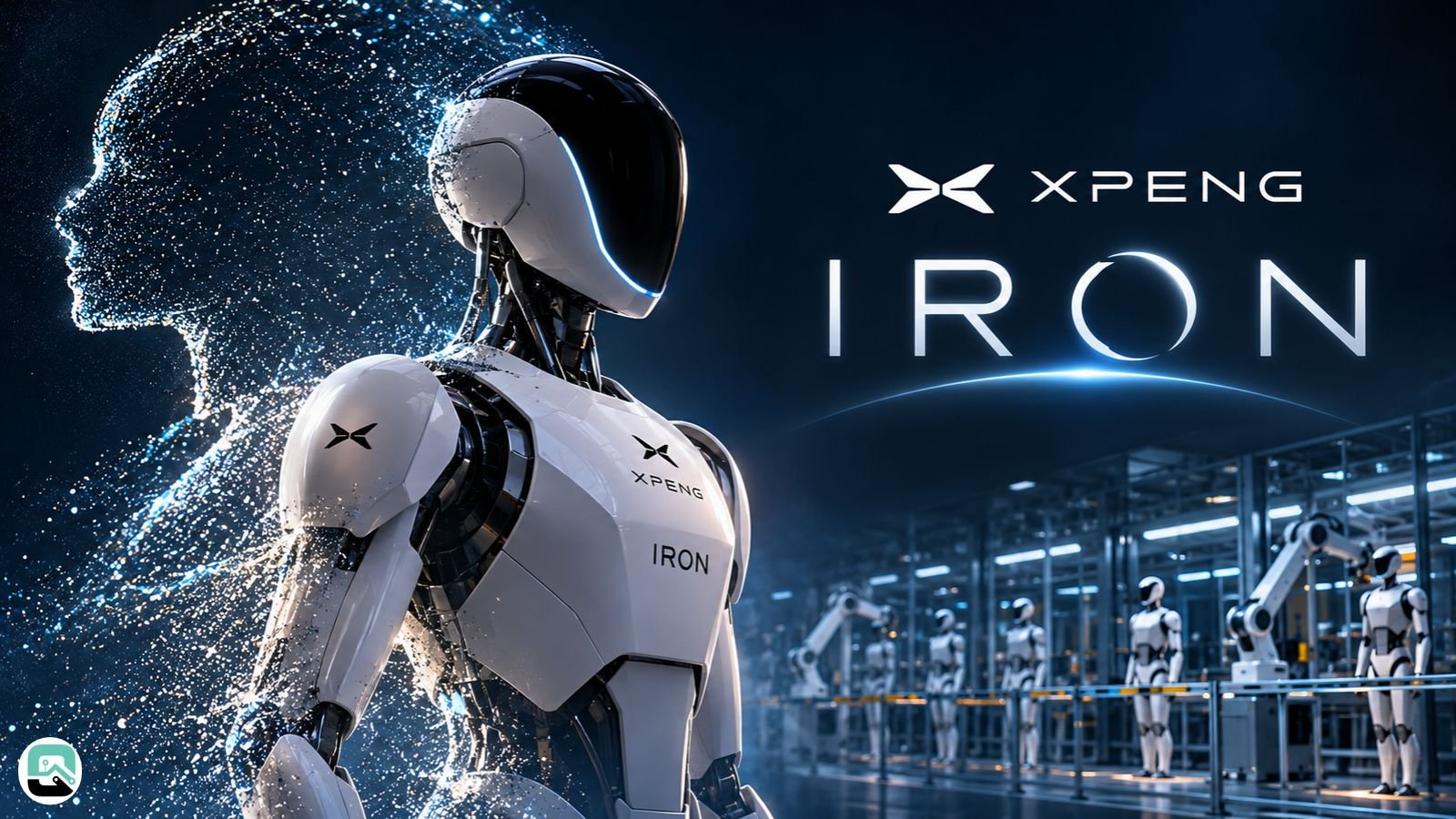
XPENG’s humanoid has a production line, fresh funding, and a delivery window. On November 25, the company has to show the robot can earn them.
XPENG will hold its eighth AI Day in Guangzhou on November 25. The event carries the theme “ORIGIN.” The company will put IRON, its general-purpose humanoid, in front of the audience. Visitors can also try driver assistance, a Level 4 robotaxi, and a flying-car update.
Past AI Days sold ideas. This one needs to sell a product. The official announcement says earlier previews have since moved into real-world use. IRON now has to join that list.
What IRON brings on stage
The robot is compact and dense. IRON stands about 170 cm tall, with 76 degrees of freedom in the body and 21 in each hand. Three Turing chips handle the compute. The robot runs XPENG’s Physical AI model on the machine itself, so no remote operator steers it.
That last claim carries the most weight. A teleoperated demo can look flawless and prove nothing. A robot that decides on its own, live, proves a lot more.
The spec sheet got smaller
Compare this year’s numbers with last year’s launch.
| Spec | 2025 launch | 2026 preview |
|---|---|---|
| Body degrees of freedom | 82 | 76 |
| Hand degrees of freedom | 22 | 21 |
| Compute (three Turing chips) | Reports differ: 2,250 to 3,000 TOPS | Up to 2,250 TOPS |
At the 2025 launch, XPENG described 82 degrees of freedom across the body and 22 in the hand. The new figures run lower. The two builds may differ, and XPENG hasn’t explained the gap.
My read: engineers cut complexity when a prototype becomes a product. Fewer joints mean fewer failure points and cheaper repairs. Hands matter most here. They pack the most joints into the smallest space, and the tendon and motor choices behind humanoid hand design decide how often a hand breaks. A robot built for a factory line makes different trade-offs than one built for a keynote.
The calendar now backs the pitch
The timeline looks real. XPENG started running its humanoid production line in September. The latest IRON rolled off that line on September 8, 2026. XPENG says the robot took eight years of R&D to reach that point.
Money followed. XPENG’s robotics unit raised more than $900 million in August, at a post-money valuation above $6.3 billion. The company calls it the largest single private round in China’s embodied AI industry.
Management also set a date. Chairman He Xiaopeng told investors on the November 16 earnings call that he expects mass production by the end of this year or in January, with deliveries starting in the second quarter of next year. The battery work supports that claim. XPENG’s vice president said in October that IRON’s solid-state battery had entered small-batch production.
Where IRON will work first
Forget the home helper. XPENG plans to deploy the robot first in commercial settings such as stores and shopping malls. Last year, Electrek reported that XPENG saw no near-term commercial scenario for home or factory robots.
The choice makes sense. Shoppers forgive slow, simple tasks. Greeting and guiding don’t demand the reliability a production line does.
The gaps XPENG hasn’t filled
Three answers are still missing. The company’s release does not name a customer who has ordered IRON, say when volume production begins, or give a price.
Price decides everything. Agility Robotics shows why. Its own figures suggest a Digit pays for itself only if it works close to a 20-hour day, according to the utilization math behind humanoid payback. A single eight-hour shift stretches payback far beyond that. A mall greeter will not run 20 hours of paid work. XPENG needs a business case that survives that reality.
Tesla looms in the background
The timing adds pressure. Tesla will bring Optimus to the Humanoids Summit in San Mateo on December 1 and 2, but the announcement doesn’t say which generation will appear. Tesla’s Optimus Gen 3 specs point to a 22-DoF hand, one joint ahead of IRON’s. XPENG gets to go first. If IRON performs live, XPENG sets the benchmark that Tesla then has to beat.
What to watch on November 25
- Unscripted tasks. Look for changes mid-demo. Choreography proves nothing.
- A named buyer or a price. One signed customer beats any spec sheet.
- Live audience contact. He Xiaopeng said IRON will interact with the audience live. Crowds are messy. Messy is the test.
- Data from the field. If deployed robots feed the next model, that loop is XPENG’s real edge.
The bottom line
Humanoid robotics has produced plenty of stages and few shipments. XPENG now claims a line, a war chest and a delivery window. November 25 shows whether IRON can keep to that schedule.
FAQs
Q. When is XPENG AI Day 2026?
November 25, 2026, in Guangzhou. The event runs under the theme “ORIGIN.”
Q. How tall is the IRON humanoid?
About 170 cm, with 76 degrees of freedom in the body and 21 in each hand.
Q. Does IRON need a human operator?
XPENG says no. The robot runs its Physical AI model on the machine itself.
Q. When will IRON enter mass production?
He Xiaopeng says production starts at the end of 2026 or in January, with deliveries in the second quarter of 2027.
Q. How much does IRON cost?
XPENG hasn’t published a price.
Related: Boston Dynamics’ Atlas Is Heading Into a Chip Factory—But Nobody Knows Its Job Yet