

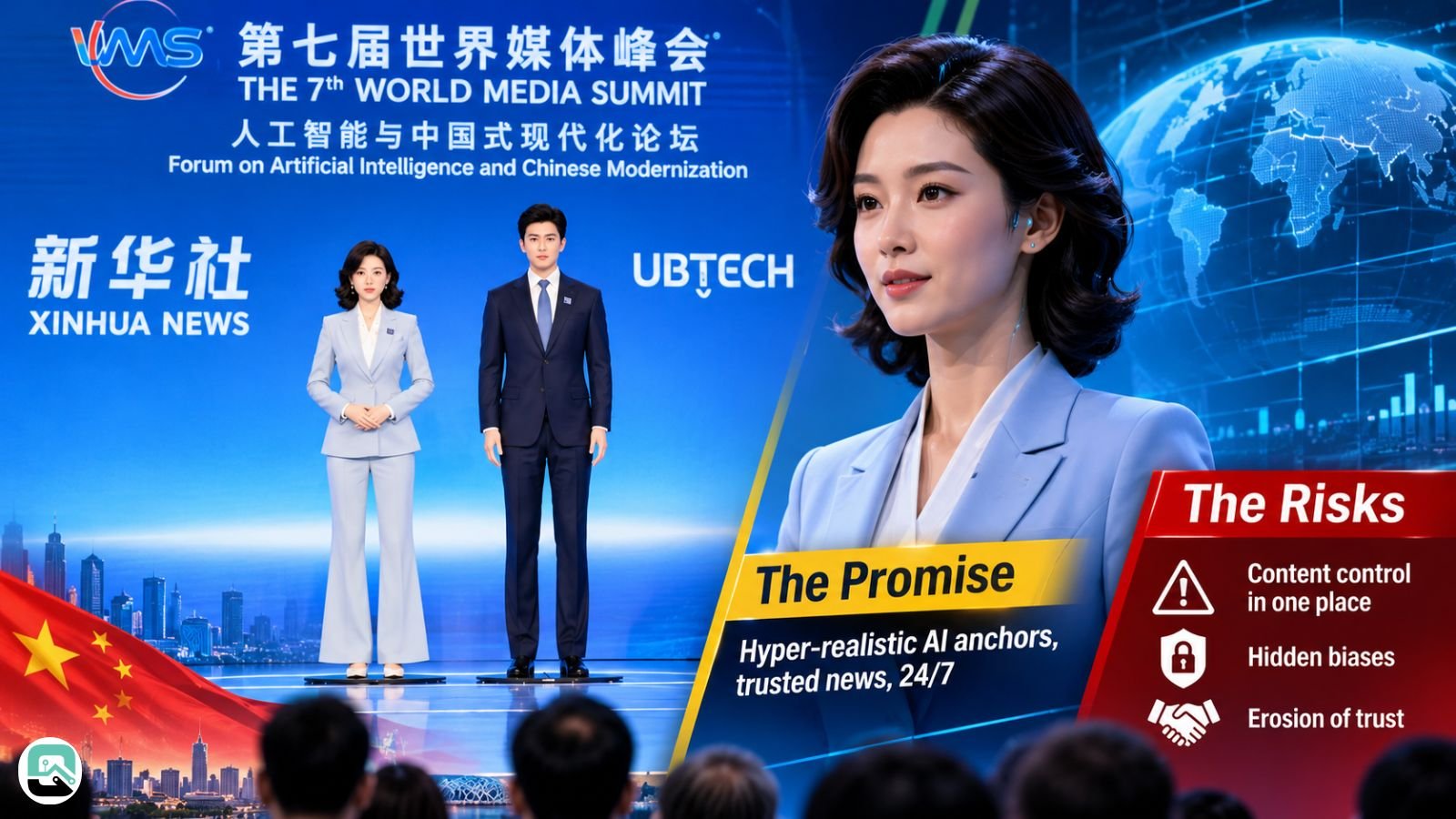
Xinhua put two life-sized humanoid anchors on stage at the World Media Summit in Beijing on Thursday, one male and one female. The female unit, Xinyan, greeted the room and read the opening news.
Xinhua calls them the world’s first bionic humanoid anchors. That label comes from the agency itself, and nobody has verified it independently. Coverage of the Xinhua and UBTECH unveiling lists the same claims.
The stage moment looks like a robotics story. It works better as a story about who controls what a machine says on air.
The robot is the interface
Xinhua wired both anchors into Xinhua Yudian, its AI news platform and agent, which launched in June. The agency says this keeps content “traceable, secure and controllable.”
UBTECH chairman Zhou Jian pitched the setup as a hallucination fix. The robot’s “brain–expression–control” system pulls vetted news in real time. It does not improvise.
So the humanoid works as a front end. A curated feed decides what it says, and the body only delivers it.
That moves control to a new place. Hardware makers and AI model developers already compete over who controls a humanoid’s intelligence. Xinhua sidesteps that fight by owning the content layer. The agency also says it holds full property rights to the robots.
Where the hallucination argument stops
A vetted feed cuts one risk. The robot cannot invent a quote or a statistic that no editor approved.
It does not cut every risk. The anchor is only as reliable as the feed behind it. If the feed carries an error, the robot repeats it with the same calm face and the same steady voice.
The design also hides editorial choices. Someone decides which stories enter the feed and which stay out. Viewers watching a polished humanoid will not see that decision.
Casting the machine
Director Zhang Yimou served as chief image designer. He led the visual and physical design. His goal was to match broadcast conventions, not just look human.
That is art direction applied to the uncanny valley. The team built a recognizable on-air persona instead of chasing a perfect face.
UBTECH supplied the rest: bionic skin, an operating system, an emotional large language model, and embodied-intelligence hardware. The company also pairs lifelike skin with emotional AI in its U1 companion robots, which debuted in Shenzhen on June 30.
Why UBTECH fits this job
UBTECH pitches itself as a full-stack humanoid developer. Its company profile claims 2,985 granted patents as of December 2025, the most valid humanoid patents worldwide. It also says its Walker S series runs on most of the production lines at the vehicle makers it works with.
Those are company claims, so treat them with care. They do show where UBTECH comes from. Its core business is industrial work, and it scaled that into a new plant built for more than 10,000 humanoids a year.
A news anchor sits far from a car factory. The same company now builds both. That tells you how fast humanoid makers are pushing into new jobs.
From glitchy screen to full body
Xinhua’s 2018 AI anchor used digital composites of human presenters and synthesized voices. Viewers spotted flaws in the original AI anchor video fast. One side of the mouth moved alone, and expressions stayed limited.
Eight years later, the anchor has a body, skin, and the ability to react to a live audience.
The jump matters less for realism than for presence. A screen anchor stays on a screen. A humanoid can stand in a lobby, greet a visitor, and answer a question face to face.
The multilingual play
Xinhua says the anchors will deliver multilingual content. For a state agency with a global audience, that is the practical payoff.
One robot can read the same vetted story in many languages. It can do so on stage, at an exhibition, or at a partner event. A human anchor cannot match that range without a team of presenters.
Assistant, not author
Will robots replace journalists? Xinhua says no. The anchors present information, deliver multilingual content, and interact with audiences in real time. They do not write the news they read.
Qian Tong, director of Xinhua’s New Media Center, said journalists and editors stay central. Forum participants backed a human-led, machine-assisted model. They argued that judgment, field reporting, and fact-checking should stay with people.
The line is clear for now. The harder test comes when a robot delivers a breaking story and an editor has seconds to approve it.
What to watch
An anchor sells trust. A familiar face makes a broadcast feel credible, and a physical body adds to that effect.
Pair that body with a closed, pre-vetted feed and you get a messenger that never tires, speaks many languages, and cannot go off script. That helps accuracy and consistency. It also moves the trust question to a layer viewers cannot see.
Some makers outsource that layer. Realbotix, for example, sells a $60,000 humanoid that runs on a rented AI brain. Xinhua keeps its news brain in-house.
Three questions matter next. Who controls the feed? How do corrections work? Will audiences know exactly what they are watching?
The summit runs through November 9. Live, unscripted demos should show how the anchors handle pressure.
Related: Realbotix Echo: A $60,000 Humanoid Robot With a Rented AI Brain