

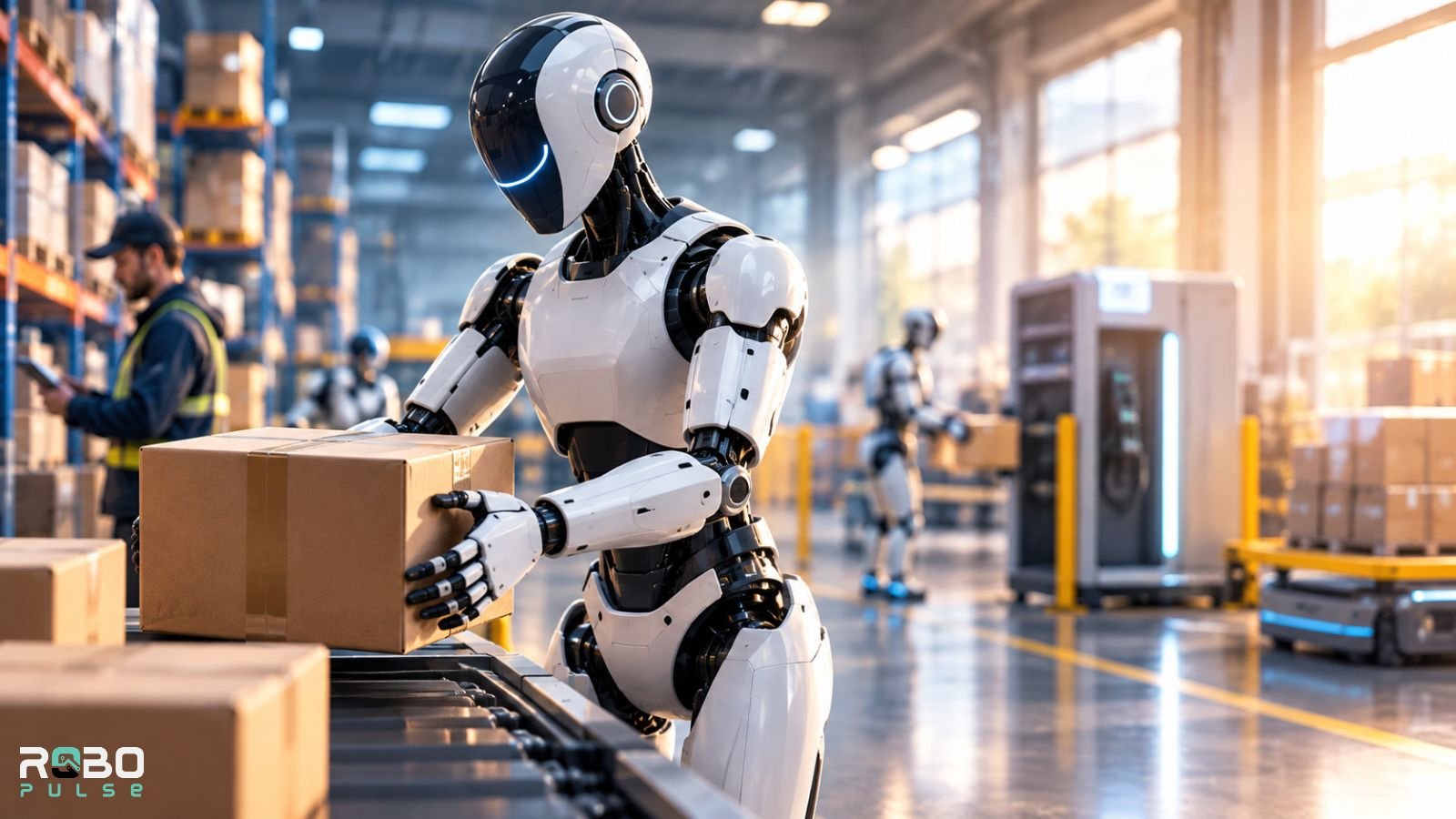
JPMorgan put a price tag on humanoid labor this month: roughly $10 to $12 an hour to operate a robot inside a warehouse or factory, against about $30 an hour for a human doing comparable work.
The number travelled fast, because it is clean and it is shocking and it fits in a headline. It is also the wrong comparison.
Run the arithmetic the way a plant manager would
JPMorgan’s own model undercuts the easy version of the story. It takes about two humanoids today to match the output of one human worker.
So the honest current math looks like this: two robots at $10 to $12 an hour cost $20 to $24 for the output one person delivers at $30. A discount, yes. Not a revolution.
Now start subtracting. Integration engineering. Workflow redesign. Charging infrastructure. Spare parts. Software licences. Someone on staff who knows what to do when a robot stops at 3 a.m. None of that appears in an hourly operating figure, and all of it lands in year one.
Net out those costs and the 2026 humanoid roughly matches human labor on price. The bank expects the productivity ratio to tighten to 1.2 or 1.3 robots per worker by 2030, pulling effective cost toward $12 to $16 an hour. That is the year the spreadsheet stops being close and starts being obvious.
The real competitor is a vacancy, not a wage
Here is what the hourly comparison misses entirely.
JPMorgan counts roughly 462,000 unfilled U.S. manufacturing jobs right now, with the gap potentially reaching 1.6 million by 2030. The bank thinks humanoids could cover about 25% of those openings with current technology, and closer to half by decade’s end.
A job nobody takes has no hourly rate. It has an opportunity cost — a line that runs slower, a shift that does not run at all, an order that ships late. Against that, $24 an hour for two mediocre robots looks entirely different than it does against a $30 worker who already exists.
That is why the first mass market for humanoids will not be the day shift at a well-staffed plant. It will be the night shift nobody wants, in buildings that are hot, loud and repetitive, doing material handling, machine tending, parts transfers and bin sorting.
Robots do not need to beat people. They need to beat an empty chair.
What BMW’s numbers actually prove
Figure’s ten-month deployment at BMW’s Spartanburg plant produced the first set of receipts worth citing. Figure 02 supported production of more than 30,000 X3 vehicles, moved over 90,000 components, and logged around 1,250 hours of real factory work.
Read that carefully: 1,250 hours across ten months. That is not a robot working shifts. That is a robot working a supervised, bounded task inside a live plant without breaking anything or anyone.
Which is the correct first milestone. Safety and repeatability come before utilisation.
BMW has now put Figure 03 on a harder job — picking unsorted components, sequencing them, staging them for the line. Variation goes up. Whole-body coordination matters. The task starts to resemble work rather than demonstration.
Hyundai is aiming at volume from the other direction, targeting production of as many as 30,000 Boston Dynamics Atlas units annually by 2028, starting with parts sequencing before touching assembly. Meta is testing machines inside its own data centers to move equipment and reset servers, which removes people from hot aisles as much as it removes payroll.
The pattern repeats across every serious deployment: pick tasks with a known hourly cost and a chronic staffing problem. Skip everything else.
Fingers, not legs
Balance is close to solved. Vision is good. Hands remain the bottleneck, and they are a harder problem than either.
Factory work runs through fingertips. Grip the part. Adjust the angle. Sense whether it seated correctly. Apply pressure without crushing. Tactile sensing and durable multi-finger actuation are where most platforms still lose time, and they are the components most likely to come from outside specialists rather than the robot maker itself.
Pricing sits in a similar limbo. JPMorgan pegs a capable humanoid near $120,000 today. Tesla talks about $20,000 to $30,000 for Optimus eventually. Buyers evaluating real deployments care about neither figure in isolation — a $120,000 machine running two shifts for four years beats a $25,000 machine that fails weekly, and anyone running total cost of ownership comparisons across platforms reaches that conclusion quickly.
Specs tell part of the story. Payload, runtime, and degrees of freedom across the tracked humanoid fleet vary enormously, and the machines already clocking factory shifts — UBTech’s Walker S2 among them — tend to win on uptime rather than on the impressive line items.
The data problem chatbots never had
Language models inherited the internet. Robots inherit nothing.
No corpus exists showing how a hand grips a slipping cup, threads a cable, or corrects a part that shifts mid-transfer. That data lives in the physical world and someone has to go collect it.
Figure launched a large-scale capture program called Index to do exactly that. Contributors across more than 100 countries have uploaded over 16 million videos of human tasks. Figure has paid out $15 million so far and says it will spend more than $1 billion on data and compute over the coming year.
Company-reported numbers, and volume alone, guarantee nothing. But the direction matters: teaching machines about physical reality is becoming its own industry, with its own labor market.
Nvidia is selling the tooling around it — Isaac and Cosmos for simulation, synthetic data generation and pre-deployment testing — while working alongside ABB, Agility, Figure, KUKA, Teradyne and Yaskawa.
Where the money actually sits
Jensen Huang’s $50 trillion figure describes the manufacturing activity intelligent machines could eventually touch, not a robot sales forecast. Treat it as a direction, not a target.
The narrower point holds up better. Every humanoid needs onboard compute, cameras, depth sensors, tactile arrays, actuators, power-management silicon, batteries, memory and connectivity. Work down the body and a supplier sits at nearly every joint.
Robot brands will rise and fall. Buyers running head-to-head comparisons today will shortlist different names in three years. The component demand curve barely cares which logo wins.
What to watch
Forget the $10 headline. Three numbers will tell you whether the economics turned.
Utilisation hours per robot per week, because 1,250 hours in ten months has to become 1,250 hours in three months. The robots-per-worker ratio, because 2.0 falling to 1.3 is the entire thesis. And repeat orders from plants that already ran a pilot, because a second purchase is the only evidence that the first one paid.
Everything before that is a very expensive experiment with excellent PR.
Related: Humanoid Has 34,000 Robot Pre-Orders. How Many Will Actually Ship?