

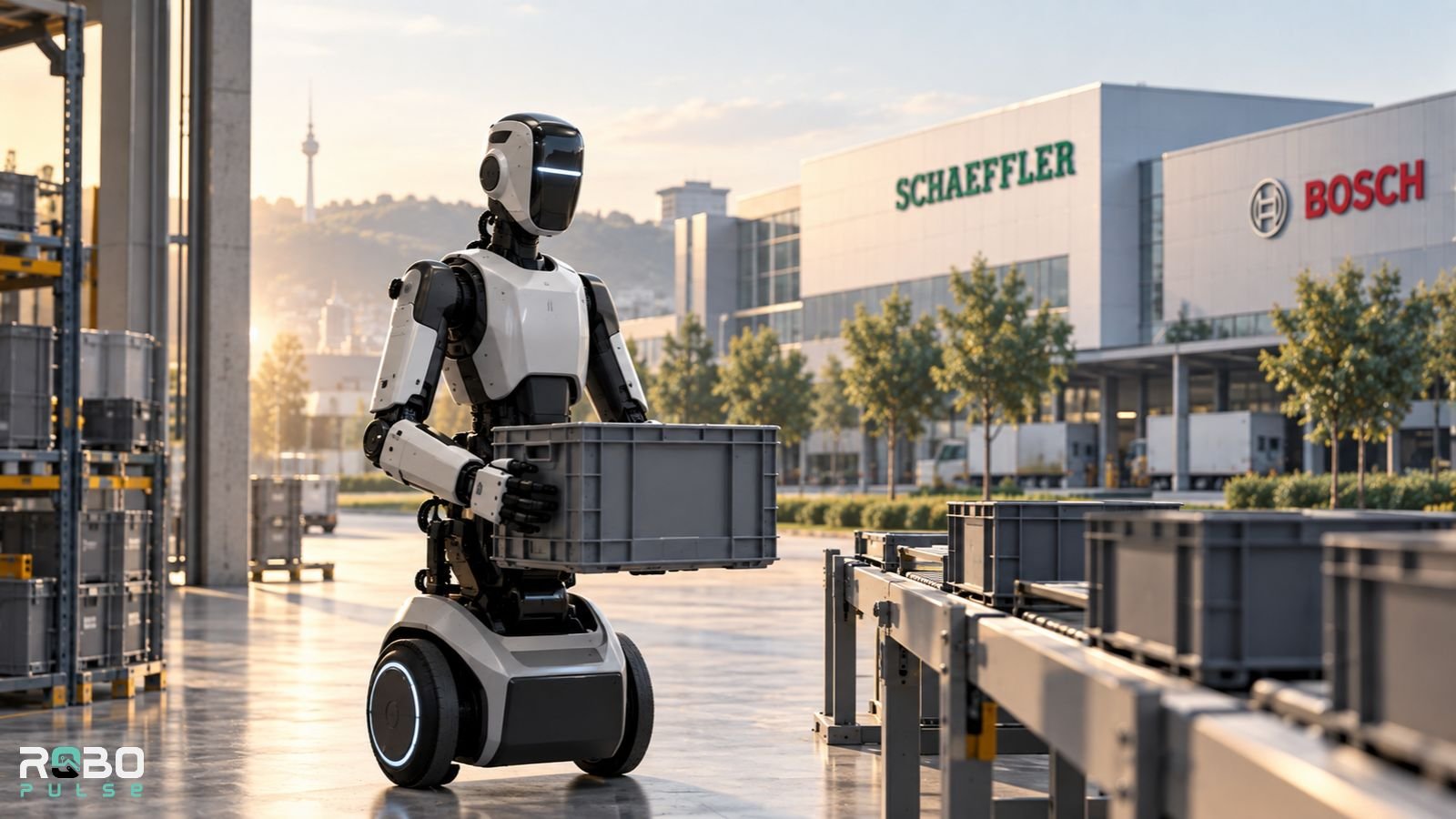
Humanoid says customers have reserved more than 34,000 wheeled industrial robots, worth roughly $2.4 billion in pipeline. Founder and CEO Artem Sokolov confirmed the figure to Forbes this week, then immediately qualified it: the orders are non-binding.
Keep that qualifier in view. It is the most honest sentence in the whole announcement, and it points at where the real story lives — not in the pre-order book, but in three contracts the company signed earlier this year.
The number that actually has teeth
Strip out the reservations, and one commitment remains: Schaeffler.
In May, the two companies signed a binding, phased deployment and supply agreement covering a four-digit fleet across Schaeffler’s global plants by 2032. First systems go live in Germany before the end of 2026. Herzogenaurach handles box handling inside live production. Schweinfurt runs a six-month validation phase aimed at continuous operation near full production scale.
Schaeffler wears three hats here. It invests. It supplies more than half of Humanoid’s joint actuator demand through 2031. And it buys the robots.
That circularity cuts both ways. A supplier who also owns equity and also deploys the product has every reason to make the thing work. It also means one relationship carries an outsized share of Humanoid’s credibility. Lose Schaeffler and the $2.4 billion pipeline turns back into a spreadsheet.
Wheels, deliberately
Humanoid leads with a torso, a head, two arms and wheels. No legs.
Sokolov argues the configuration covers about 90% of industrial use cases without importing the cost and failure modes of bipedal locomotion. Alpha units lift roughly 10 kg total, five per arm. Beta doubles that when it ships in Q4 2026.
The argument holds up better than it sounds. Factory floors are flat. Warehouses are flat. Legs solve stairs and rubble, and almost nothing in a Schaeffler plant is stairs or rubble. Wheels also clear European safety certification faster, which matters enormously when your anchor customer operates inside EU machinery directives.
The trade-off arrives later. A wheeled platform competes directly with mobile manipulators and AMRs that industrial buyers already understand and already price aggressively. It also sits awkwardly next to bipedal rivals filling out most humanoid spec sheets, where the marketing runs on human-shaped novelty. Humanoid has chosen utility over spectacle. Procurement teams will reward that. Investors sometimes don’t.
Outsourcing the part everyone else insists on owning
Here is the genuine divergence from the field. Humanoid does not plan to build robots itself at scale.
Robert Bosch Robotics GmbH acts as a contract manufacturer for Europe, bringing design-for-manufacturing discipline and supply chain reach, with the option to drop Bosch actuators and sensors into later versions. Bosch also invested in the $152 million Series A that valued the company at $1.35 billion post-money and pushed total funding to about $270 million.
Tesla, Figure, and most Chinese entrants took the opposite path and built their own lines. Their reasoning: hardware margin and iteration speed both live on the factory floor.
Humanoid’s counter-reasoning is that Europe already has factories, and they belong to people who have run them for a century. Sokolov keeps the AI, the hardware design, and the software in-house, then rents the industrial muscle. Execute that well, and you skip several years of capex and painful yield learning. Execute it badly, and you own a roadmap you cannot personally accelerate.
The AI claim, and how to read it
KinetIQ is Humanoid’s four-layer stack. An agentic coordinator ingests tasks from a customer’s WMS or ERP, a vision-language model decomposes each task into checkable steps, and a proprietary model executes them. The reinforcement learning layer, KinetIQ Ascend, reportedly runs some tasks at 1.5x human speed with success rates up to 99%.
Read “some tasks” carefully. Narrow, repetitive, heavily trained motions beat humans routinely — that has been true in industrial robotics for decades. The hard part was never speed on a single task. It was the switching cost when the pallet sits at a different angle or the box arrives dented.
Humanoid’s early field evidence is more persuasive than the benchmark. During a pilot at automotive supplier Martur Fompak, the robot pulled instructions straight from the customer’s own enterprise software and worked an order-fulfilment cycle without human intervention. Locating pallets and moving 8 kg loads is unglamorous. It is also exactly the kind of boring integration that separates a pilot from a purchase order.
Pricing: the one-year payback promise
Humanoid will sell outright and also offer Robot-as-a-Service, with deployment support and remote teleoperators on standby. Sokolov targets roughly a one-year payback across both models.
That number does real work. It sidesteps the Chinese price war entirely, because a plant manager comparing a $30,000 robot against a $70,000 robot stops caring about sticker price once payback lands inside a fiscal year. Buyers running head-to-head comparisons increasingly weigh integration time, uptime and support the same way they weigh hardware.
The catch: a one-year payback assumes near-continuous utilisation and very few surprises. Rivals already inside factories — UBTech’s Walker S2 among them, running shifts in Chinese auto plants — will test that assumption with their own operating data.
The 2030 arithmetic
Humanoid plans several hundred units with Bosch in 2027, then 150,000 in 2030.
Bank of America expects the global market to approach a million units annually in the early 2030s. Humanoid’s target therefore implies capturing something like 15% of worldwide humanoid production within three years of shipping its first few hundred robots. Against Tesla, Figure, UBTech, Unitree and AgiBot.
Call that aspirational. Bosch has reportedly committed capacity for up to 100,000 units over five years, so the manufacturing story is not fantasy. The demand story still needs 34,000 reservations to become invoices.
What to watch
Q4 2026 settles more than any funding round will.
Beta ships. Schaeffler’s German sites switch on. A robot that handles boxes in a two-week proof of concept proves very little. A fleet that keeps handling them across three shifts, with crooked trolleys and battered packaging and a maintenance window that nobody scheduled, proves the business.
Sokolov built the company after watching his own factory employees do work he thought nobody should have to do. That origin story is sincere, and it is also irrelevant to the next twelve months. Schaeffler’s plant managers will judge uptime, not motive.
Related: Agility Digit v5 Costs $200K — Can It Really Break Even in 1.1 Years?