

Synchronized choreography proves coordination under controlled conditions. Useful robot teams need much more.
One humanoid robot dancing draws a crowd. Put 151 on the same street, and the show becomes a public coordination test.
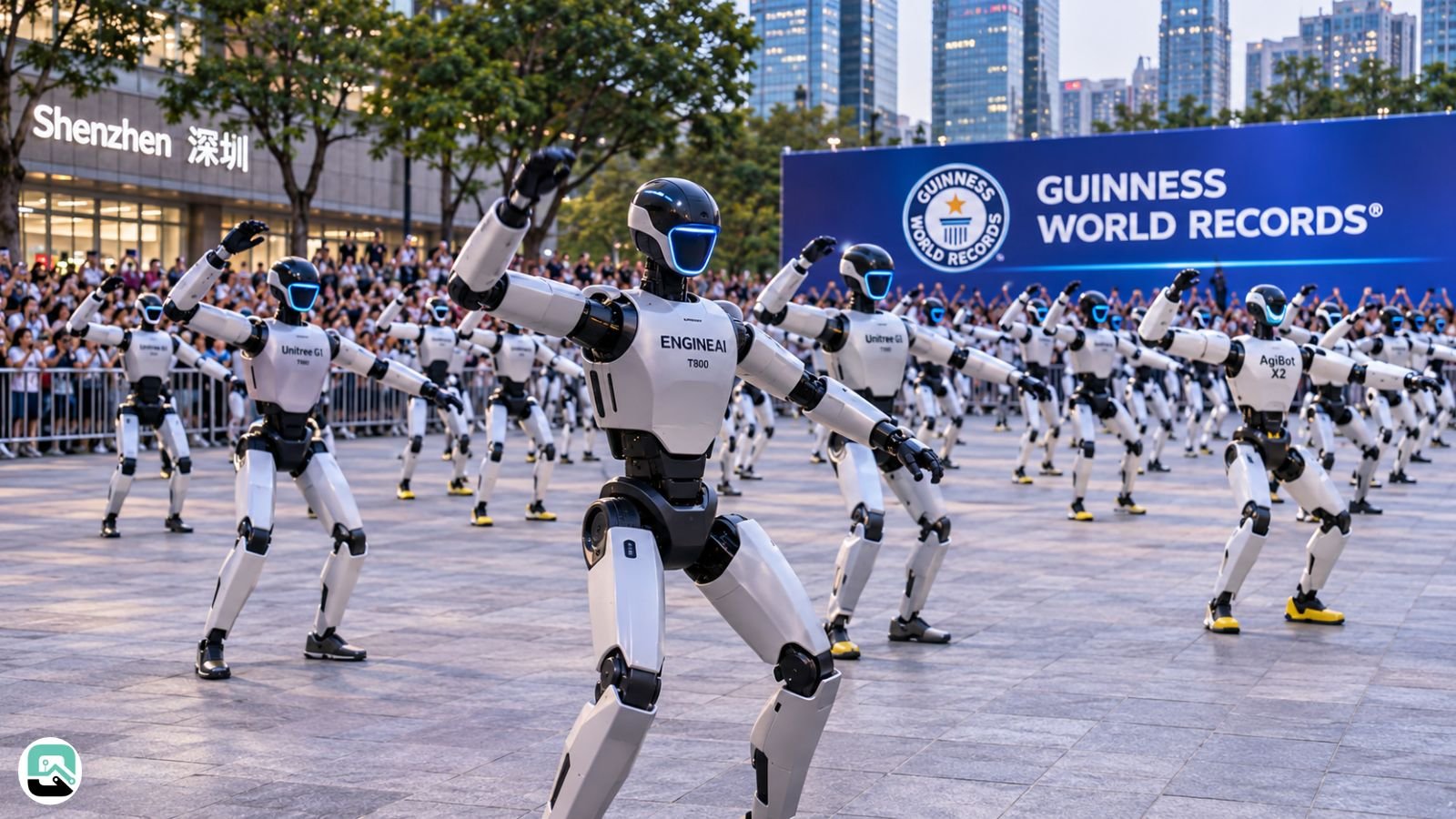
That happened in Shenzhen on November 17. The robots took part in a Guinness World Records challenge days before the APEC Economic Leaders’ Meeting. A Guinness adjudicator confirmed that all 151 robots finished the routine. The target was 110.
What the record covers
Xinhua describes the challenge as the most humanoid robots dancing within one hour.
The 110 target has a history. AgiBot’s 110 robots danced in Jinan on October 24 and earned a Guinness title. Shenzhen beat that mark by 41 robots in under four weeks.
Older records used far larger crowds. A Guangzhou performance reached 1,069 robots. Headcount alone does not rank records. Category rules matter.
Who danced
The Shenzhen Longgang District Artificial Intelligence (Robotics) Bureau led the event. ENGINEAI and other robotics companies joined it.
The lineup included 20 full-size T800 humanoids from ENGINEAI. Groups of Unitree G1 and AgiBot X2 robots joined them. ENGINEAI says the T800 stands 1.73 meters tall, weighs about 75 kilograms and delivers 450 newton-meters of torque.
ENGINEAI used the show to demonstrate its swarm control. The company claims millisecond-level synchronization. Those figures come from the company. The reporting does not verify the timing or explain how operators controlled every robot.
Choreography is not autonomy
Group dancing demands a lot. Each robot must hold its own balance. The whole group must also keep one shared beat.
But a synchronized routine runs on preparation. It shows what a coordinated system can repeat in a planned setting. It does not show robots deciding how to cooperate.
Viewers should keep that gap in mind. Tesla’s Optimus recently handed out snacks in Austin, and a human was steering the robot. Polished public demos often hide how much control sits behind the performance.
From stage to workplace
Developers want humanoids in factories, warehouses and public spaces. Coordination will matter there.
Picture a warehouse fleet. The robots must avoid collisions and share routes. They must also recover when one machine stops. That takes sensing, adaptation and safety controls around people. A dance routine tests none of those.
Real deployments move slowly. Boston Dynamics will send Atlas into a GlobalFoundries plant in 2027, yet nobody has said what job the humanoid will do. Chinese firms already pay workers to train humanoids on everyday trades, from stocking shelves to making coffee.
Shenzhen also used the week as a showcase. Visitors to the summit met robots handing out ice cream and sparring in a cage. ENGINEAI’s T800 and PM01 robots also appeared in reception and traffic-management demonstrations.
The open question
The robots moved together in public. That part works.
The next step is harder. Coordinated machines must finish useful work, safely, around people, when plans change. A memorable performance does not prove that.
Related: China Is Paying Workers to Teach Robots Their Jobs. What Happens Next?