
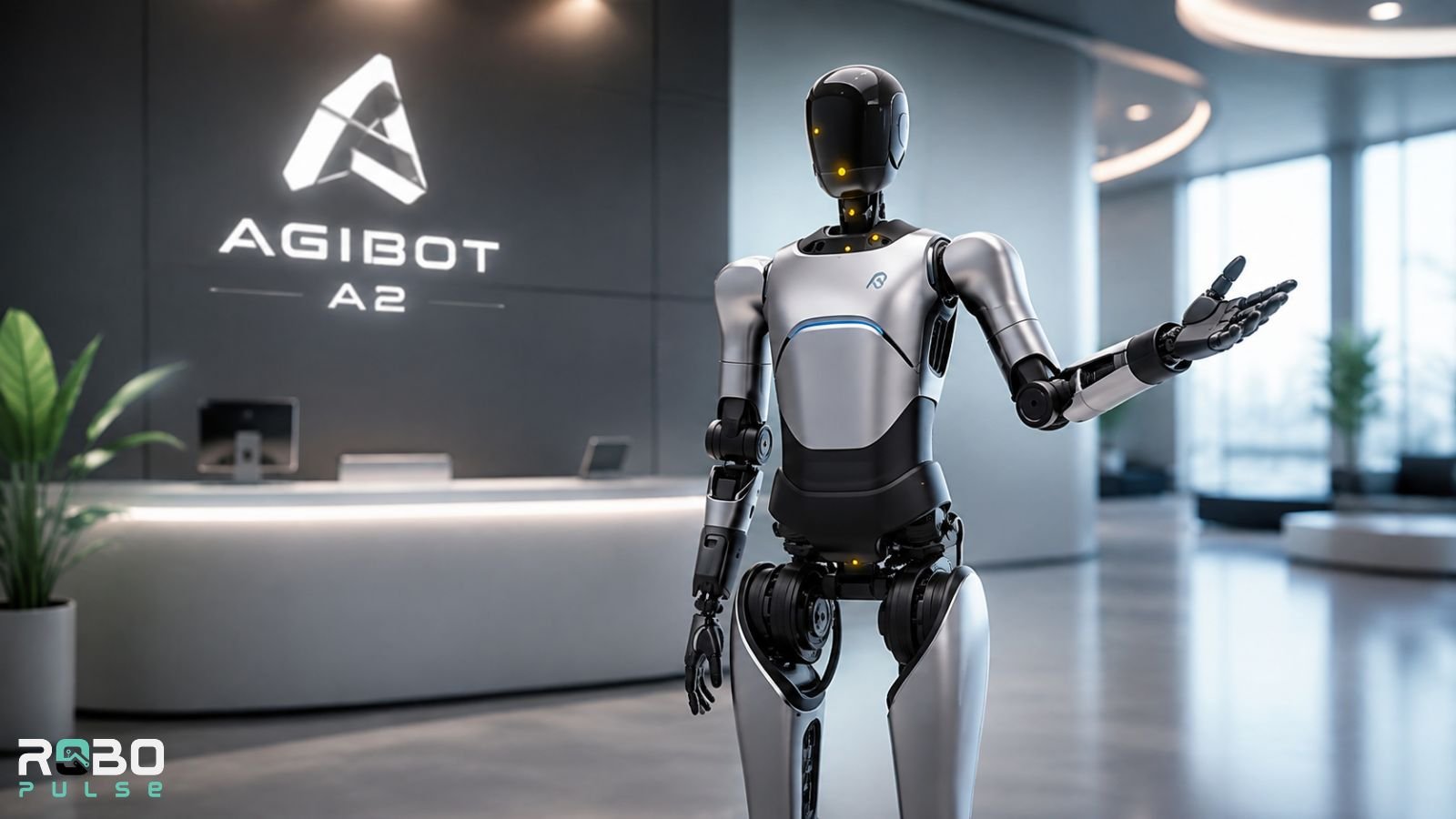
AgiBot’s A2 is a 169 cm, 69 kg humanoid built for front-of-house work. It handles reception, exhibition halls, and retail guidance — not factory floors. That front-of-house role is narrower than most coverage gives the AgiBot A2 credit for. Here’s what the specs actually say, what a unit costs, and where the marketing gets ahead of the documentation.
The name “AgiBot A2” can refer to five different robots in AgiBot’s current A-series lineup: the base A2, the entertainment-focused A2 Lite, the reception-oriented A2 Ultra, the wheeled industrial A2-W, and the heavy-payload A2 Max. That ambiguity is why specifications and prices get mixed across coverage so often. This review covers the standard A2 as specified on AgiBot’s own product page, and flags where other sources blend in numbers that belong to a different variant.
| Variant | Primary role | Pricing status |
|---|---|---|
| AgiBot A2 (base) | Interactive service/reception | Quote-only |
| AgiBot A2 Lite | Entertainment / light service | $44,560 — confirmed public price |
| AgiBot A2 Ultra | Advanced service; record-setting variant | Quote-only |
| AgiBot A2-W | Wheeled industrial / manufacturing | Quote-only |
| AgiBot A2 Max | Heavy-payload industrial | Quote-only |
What Are the AgiBot A2’s Real Specifications?
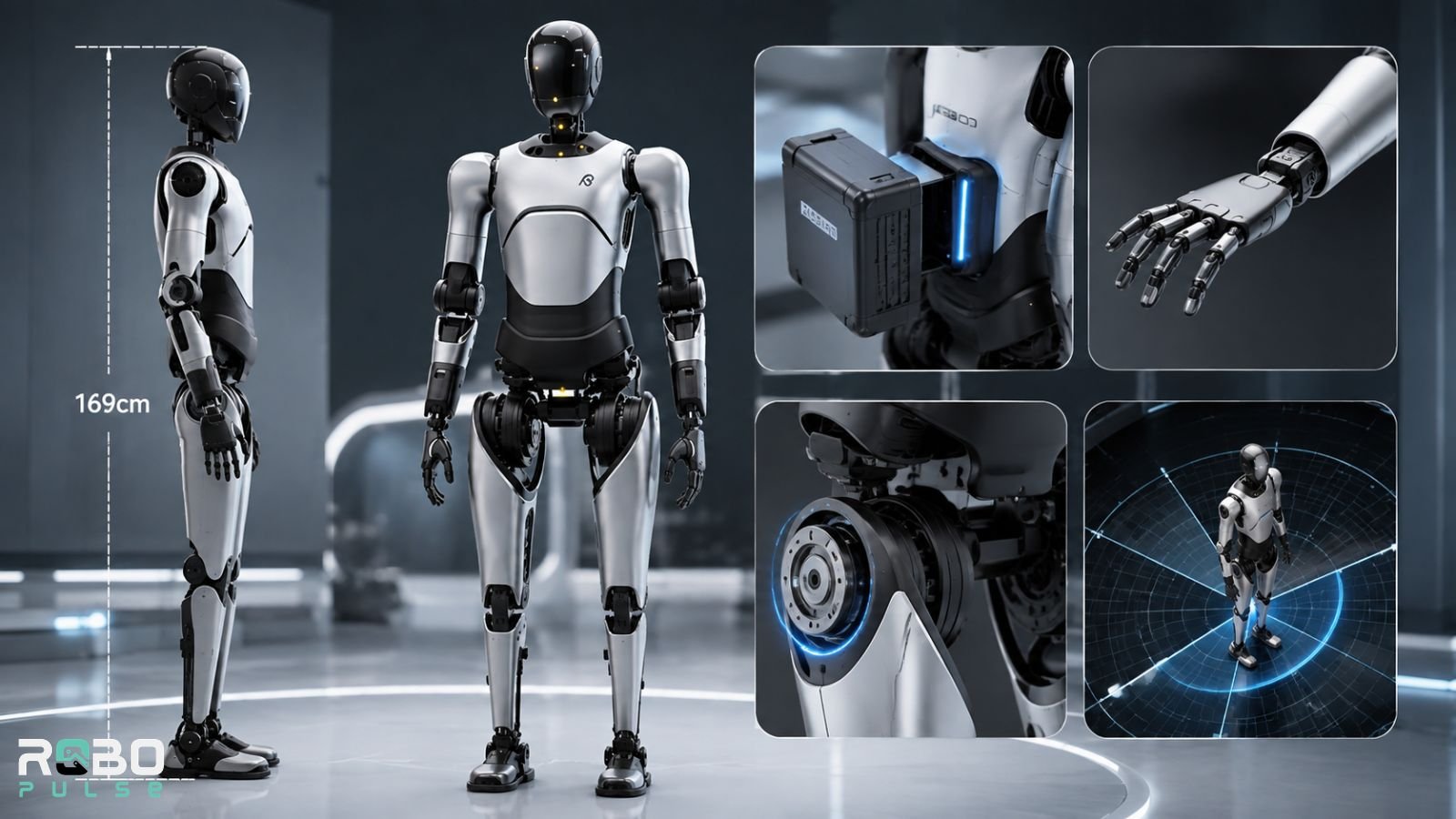
AgiBot’s official spec sheet lists the base A2 at 169 cm tall and 69 kg. It runs on a 700 Wh swappable battery rated for about two hours per charge, with 40-plus active degrees of freedom and a 60 cm turning radius.
| Specification | AgiBot A2 (base) |
|---|---|
| Height | 169 cm |
| Weight | 69 kg |
| Battery | 700 Wh, swappable |
| Runtime | ~2 hours per charge |
| Degrees of freedom | 40+ active |
| Turning radius | 60 cm |
| Peak joint torque | 512 Nm |
| Navigation | HIMUS 3D-SLAM + VectorFlux |
| Primary role | Interactive service |
| Source | AgiBot official product page (checked August 2026) |
Older press coverage from 2024–2025 lists 175 cm and 55 kg for the A2. Flag that gap if you’re cross-referencing an older article — AgiBot’s current product page reflects a revised production spec. Use 169 cm and 69 kg as the current reference point.
AgiBot’s own integrated actuators power the A2’s joints. The company builds them with high slot-fill-rate winding and rates them for a peak torque of 512 Nm. AgiBot markets these actuators as mass-produced rather than hand-built, which matters for repair-parts availability compared to boutique competitors.
AgiBot’s HIMUS 3D-SLAM mapping system handles navigation, paired with a VectorFlux planning-and-control stack. AgiBot calls this combination L4-level autonomous mobility — low latency, minimal drift, stable operation in dynamic environments. That’s a manufacturer classification, not an independently verified rating. No third-party navigation benchmark for the A2 exists publicly.
What Is the AgiBot A2 Actually Built to Do?
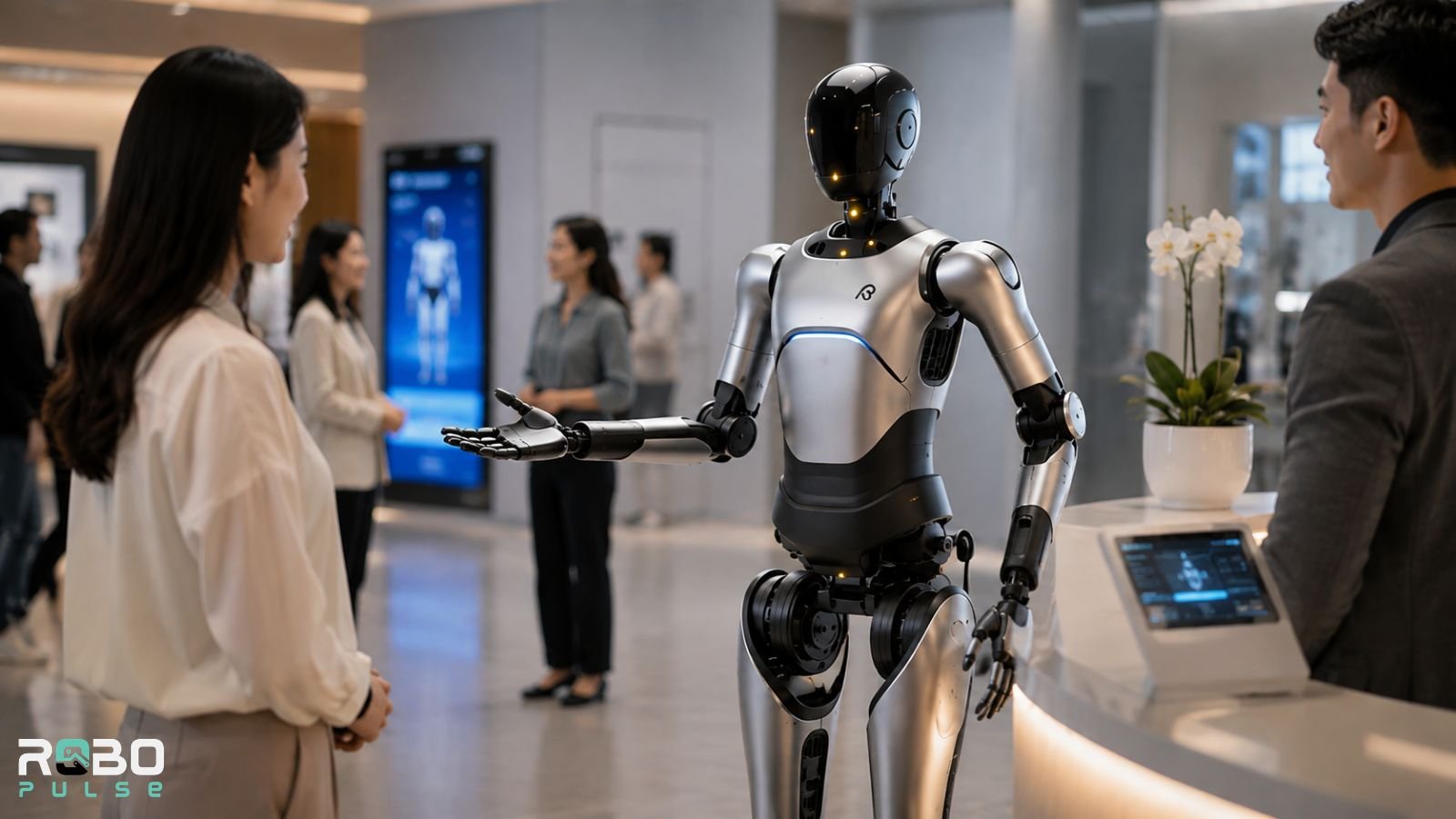
AgiBot markets the base A2 as an “Interactive Service Robot.” It targets customer service, exhibition-hall presentations, supermarket guidance, front-desk reception, and business inquiries. AgiBot does not market it for industrial or manufacturing work — that role belongs to the A2-W and A2 Max variants.
Aggregator coverage frequently blurs this distinction. Many sites describe “the A2” doing warehouse picking, industrial assembly, and logistics work in the same breath as front-desk greeting. Those industrial use cases are real for AgiBot’s A-series — they just belong to different SKUs, not the base model.
The A2’s interaction layer runs on large language models for conversation, full-duplex dialogue, and edge deployment, plus retrieval-augmented generation for enterprise-specific knowledge bases. AgiBot cites 96% accuracy on multi-modal interaction — sound localization, facial recognition, lip-reading in noisy environments — and a 99% face wake-up rate. Both figures are manufacturer-reported, with no independent verification available.
How Much Does the AgiBot A2 Cost?
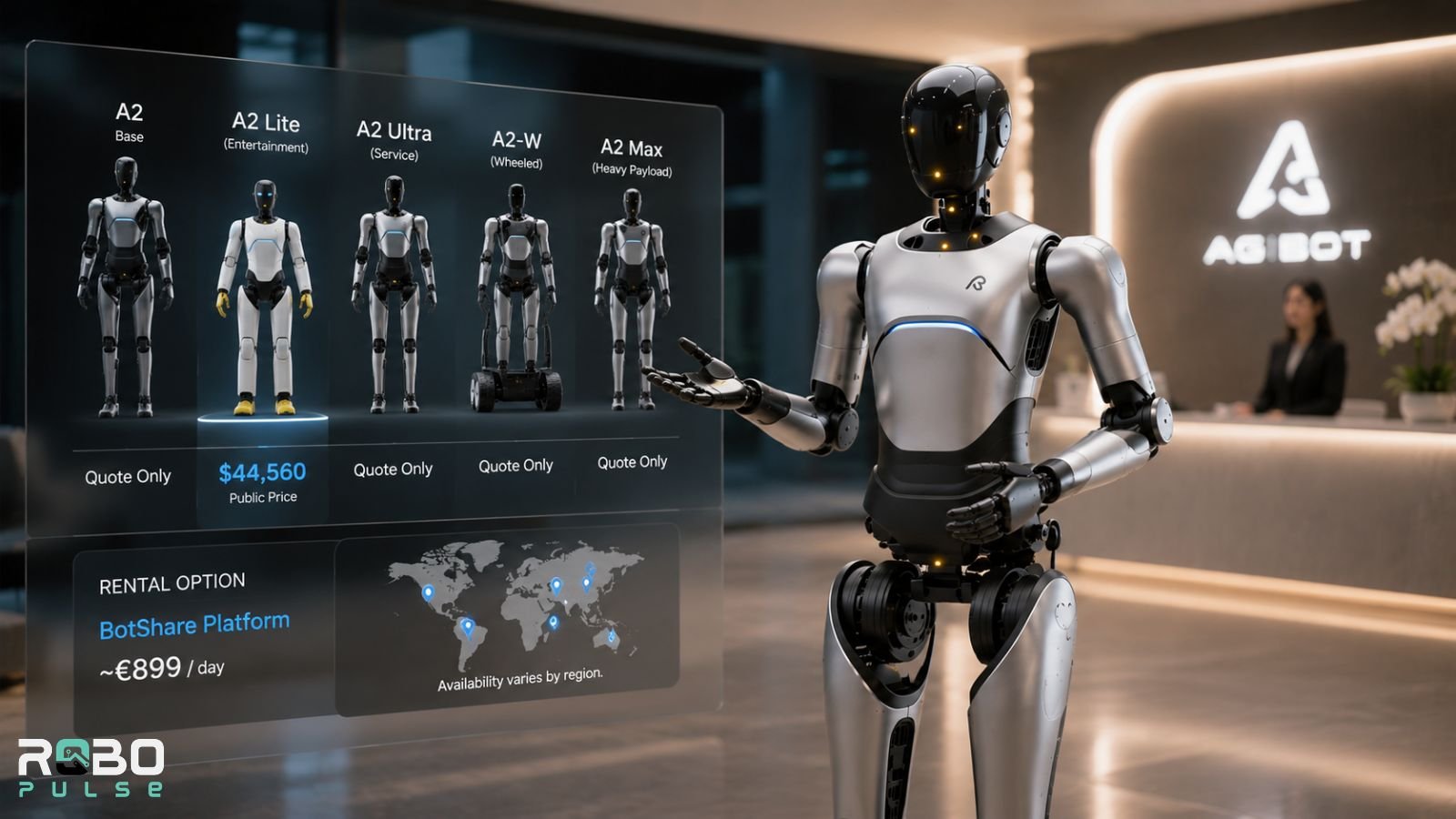
AgiBot A2 pricing is the least reliable figure circulating online, and it’s worth explaining why.
Only one robot in the A2 line carries a confirmed public price: the A2 Lite, listed at $44,560 on AgiBot’s own global store as of mid-2026. The equivalent configuration reportedly lists domestically in China around ¥168,000–¥198,000, putting the export markup at roughly 1.6–1.9x. That ratio is plausible given shipping, duties, and international support overhead, though AgiBot hasn’t confirmed it directly.
The base A2 and the wheeled A2-W remain quote-only. The “$100,000–$190,000” figure circulating across comparison sites and buyer’s guides doesn’t trace to a primary source for either model — it appears to have propagated from one aggregator to the next without a checkout page or press release behind it. Until AgiBot lists a public price for the standard A2, treat any specific dollar figure for it as an estimate, not a fact.
AgiBot’s BotShare platform offers a lower-commitment rental option, priced at roughly €899 per day. Reported country coverage for the program varies between sources — figures range from five to seventeen countries — so confirm current availability directly with AgiBot or a regional distributor before budgeting around it.
Is AgiBot the Largest Humanoid Robot Maker by Volume?
AgiBot reports shipping 5,168 humanoid units in 2025, a figure the company attributes to Omdia and describes as the largest share of any manufacturer that year. AgiBot also reports reaching its 10,000th cumulative unit by March 2026.
Independent corroboration is directional rather than exact. TrendForce projects Unitree and AgiBot combined will account for roughly 80% of China’s 2026 humanoid output — consistent with AgiBot’s claimed lead, but not an independent confirmation of the specific unit counts. Treat the volume numbers as company-reported and Omdia-estimated, not third-party audited.
What’s the Real Story Behind the 106 km Walking Record?
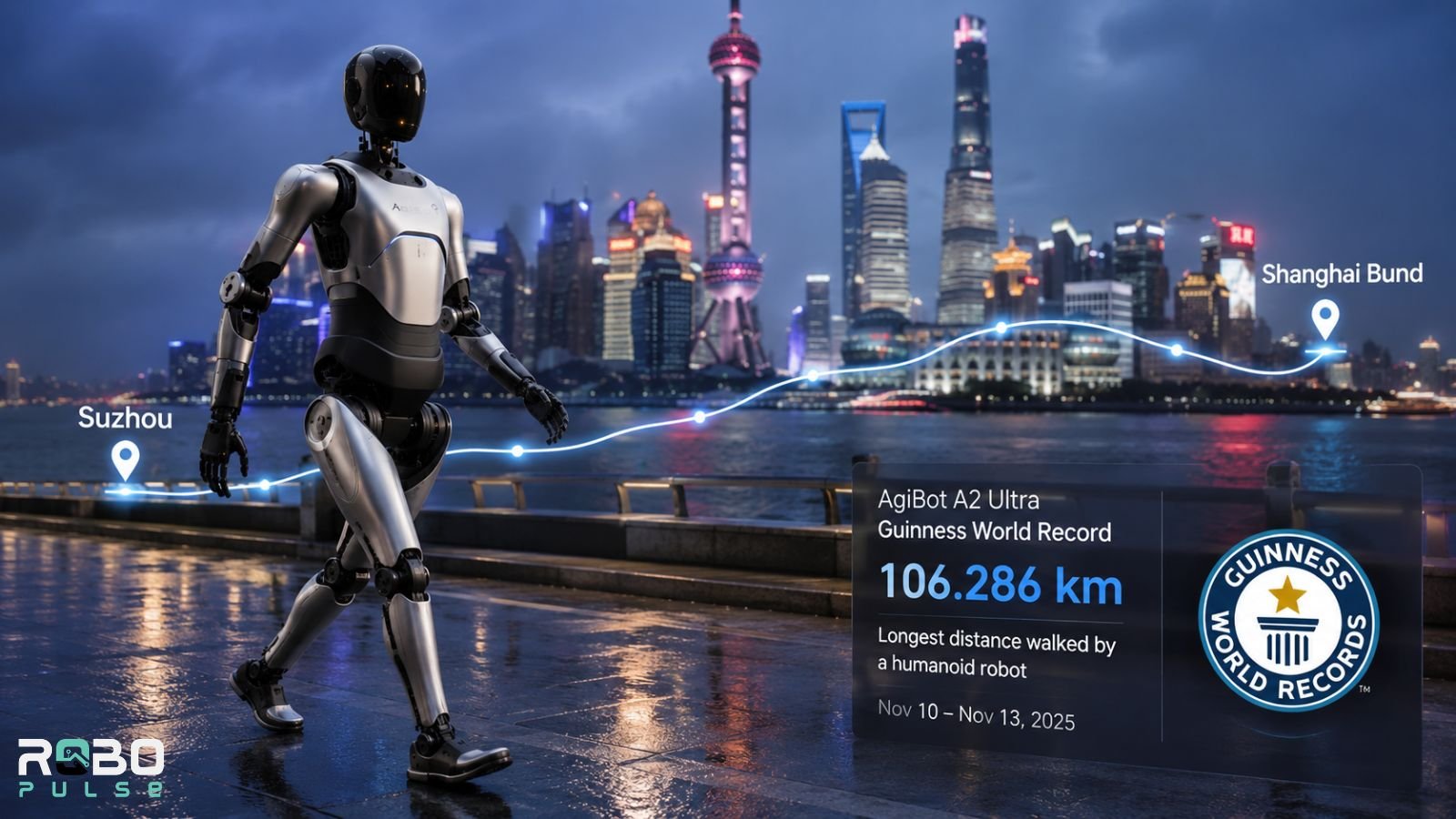
AgiBot’s A2 Ultra set a Guinness World Record for the longest distance walked by a humanoid robot, covering 106.286 km on a route from Suzhou to Shanghai’s Bund. The attempt ran from the evening of November 10 to the morning of November 13, 2025, and Guinness World Records certified it. CBS News and China Daily both reported the result independently.
AgiBot’s hot-swappable battery system kept the robot moving across the roughly three-day attempt without powering down. AgiBot has not published the exact number of battery swaps used during the run. Some secondary coverage cites a specific swap count — commonly 15 — but that figure doesn’t trace back to AgiBot or Guinness directly. Treat any precise swap count you see elsewhere as unconfirmed.
The 106.286 km figure describes total distance covered across a multi-day, battery-supported attempt. It doesn’t describe continuous unassisted operation on a single 700 Wh charge. That distinction matters if you’re estimating real-world single-charge runtime from the record.
Can You Buy AgiBot Stock?
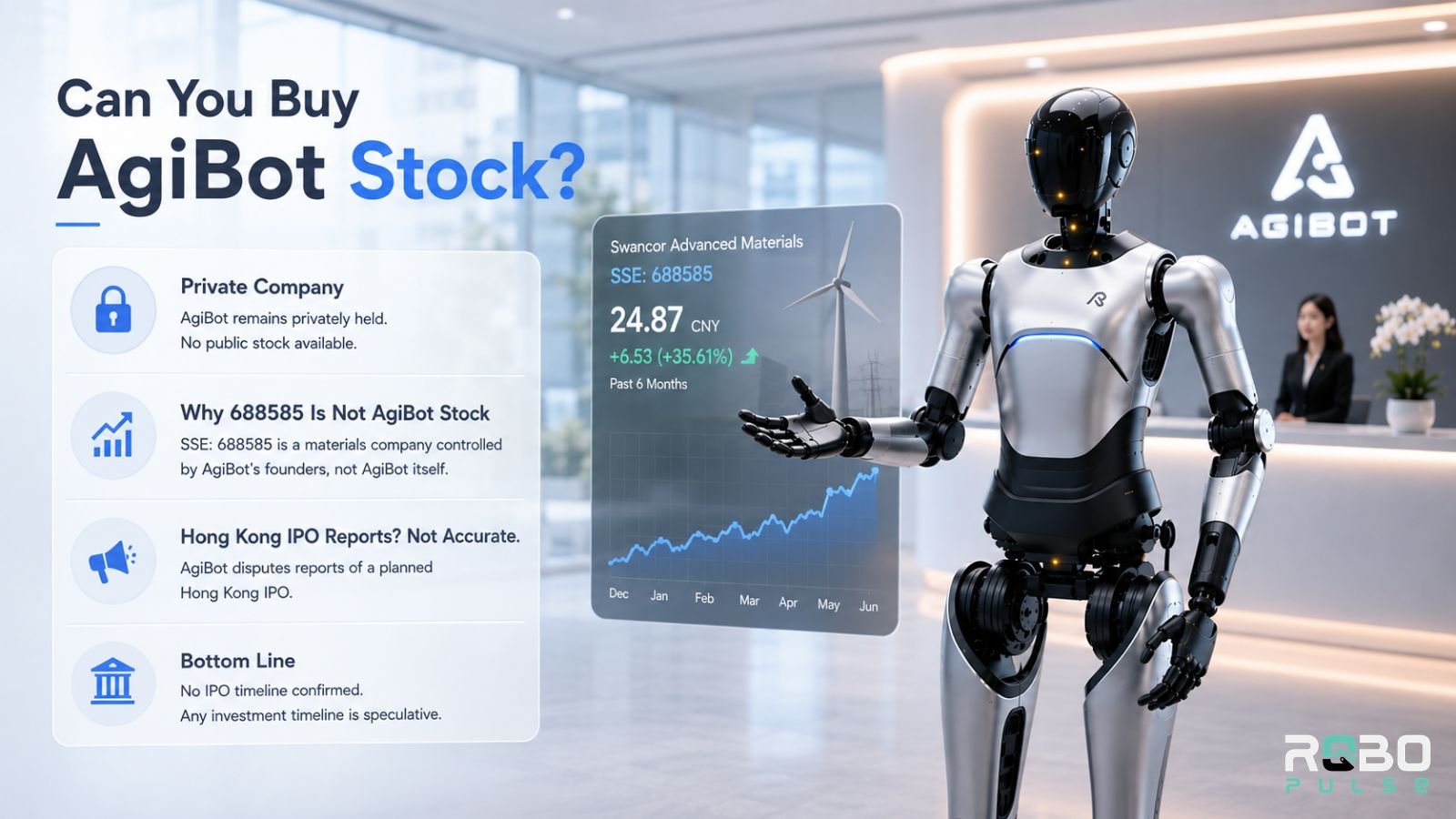
No. AgiBot remains privately held, and this is a genuinely confusing area of its coverage. In 2025, a company controlled by AgiBot’s founders took a majority stake in Swancor Advanced Materials, a Shanghai-listed materials company (SSE: 688585), and that stock subsequently rose sharply. AgiBot states this is not a backdoor listing and that the company hasn’t injected any robot-related assets into Swancor. Buying 688585 buys a stake in a wind-turbine-materials company controlled by AgiBot’s founders — not a stake in AgiBot’s robotics revenue.
Reports of a planned Hong Kong IPO for AgiBot itself have circulated, but AgiBot publicly disputes their accuracy. As of the most recent reporting available, AgiBot remains a private company (see AgiBot’s company background on Wikipedia for the founding and funding history). If you’re tracking this for investment purposes, treat any IPO timeline as speculative until AgiBot confirms one directly.
AgiBot A2 vs. the Competition: Where It Actually Stands Out
Unitree’s G1 and H2 both sell for well under $50,000 through more established consumer-facing channels. The A2’s advantage over them isn’t affordability — it’s the interaction stack. The LLM-driven conversation layer, RAG-based enterprise knowledge integration, and reception-specific tuning (face wake-up rate, noisy-environment voice recognition) target a job Unitree’s more general-purpose platforms don’t specifically address.
Agility Robotics’ Digit runs roughly €230,000 in European enterprise pricing, and AgiBot’s A2 Lite undercuts it significantly on cost. But Digit is built and marketed for warehouse logistics — a different job than the A2’s front-of-house positioning — so this comparison is closer to cross-shopping than a direct swap.
AgiBot combines unusually high production scale with a more explicitly enterprise-focused conversational-AI layer in this price bracket. Pricing transparency on its flagship configuration still lags well behind Unitree’s, though, and third-party validation of its performance claims — L4 mobility, 96% voice accuracy — remains thinner than the marketing suggests.
Is the AgiBot A2 Worth It?
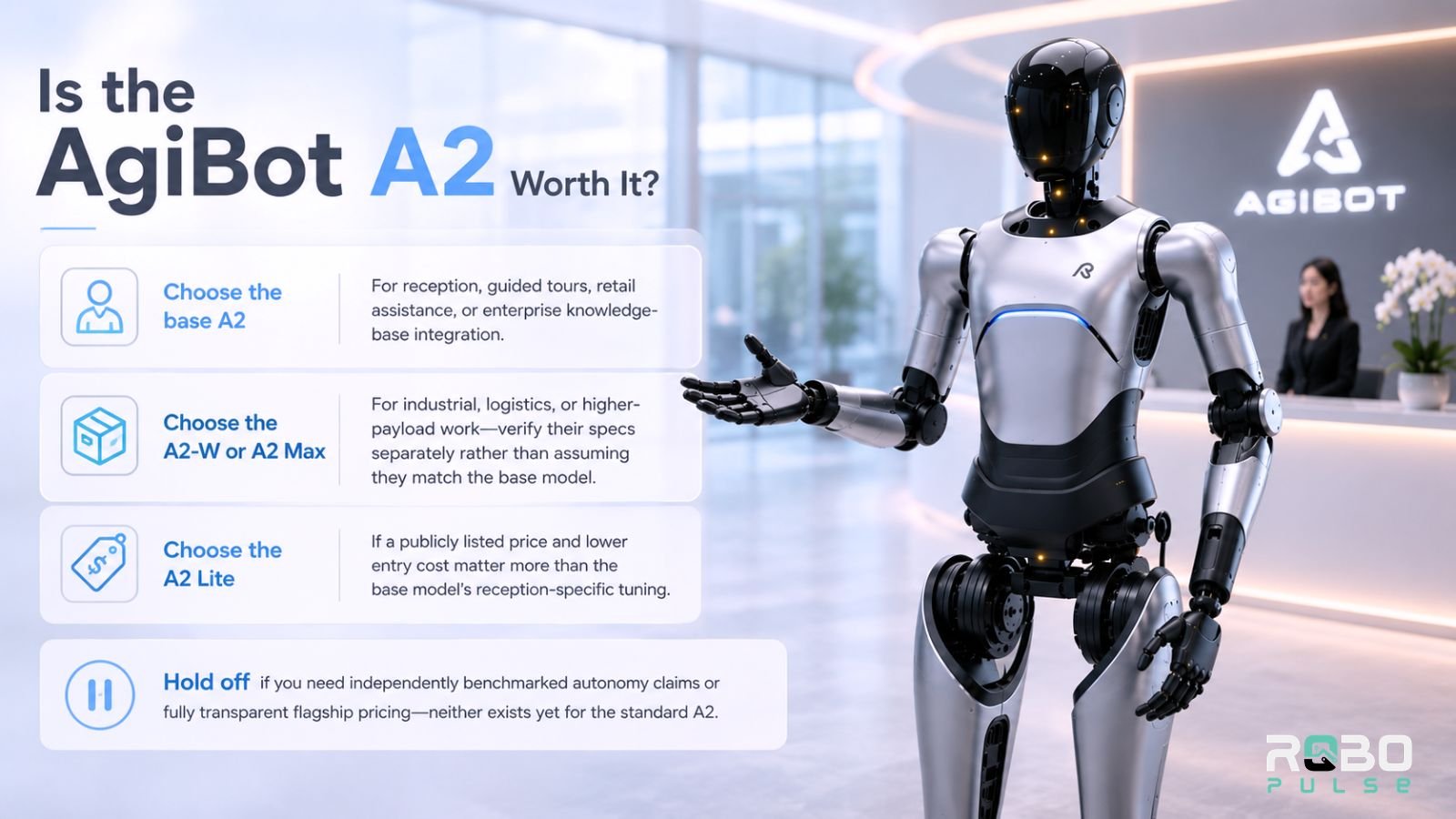
Businesses that need reception, guided-tour, or retail-interaction robots get more built-out conversational and knowledge-base tooling from the A2 than from most competitors at this size. That comes at the cost of an enterprise sales cycle instead of a checkout-page purchase. Anyone who needs industrial payload capacity should skip the base A2 entirely — check the A2-W or A2 Max instead, and verify their specs separately rather than assuming they match the base model’s numbers.
Buyers who want price certainty before committing budget should start with the A2 Lite, the only variant with a confirmed public price. Treat any quote for the standard A2 as a starting point for negotiation, not a fixed number.
- Choose the base A2 for reception, guided tours, retail assistance, or enterprise knowledge-base integration.
- Choose the A2-W or A2 Max for industrial, logistics, or higher-payload work — and verify their specs separately rather than assuming they match the base model.
- Choose the A2 Lite if a publicly listed price and lower entry cost matter more than the base model’s reception-specific tuning.
Hold off if you need independently benchmarked autonomy claims or fully transparent flagship pricing — neither exists yet for the standard A2.
FAQs
Q. What is the price of the AgiBot A2?
The standard AgiBot A2 does not have a confirmed public price and is sold on a quote-only basis. The A2 Lite is the only A2-series variant with a verified public price, listed at $44,560 on AgiBot’s global store as of mid-2026. Do not confuse the A2 Lite’s price with the standard A2.
Q. How much does the AgiBot A2 cost in 2026?
The AgiBot A2’s 2026 price has not been publicly disclosed. AgiBot sells the standard A2 through a quote-based enterprise process, while the A2 Lite has a confirmed public price of $44,560. Online estimates of $100,000 to $190,000 for the standard A2 are not backed by a primary AgiBot source and should not be treated as confirmed pricing.
Q. How tall is the AgiBot A2?
The AgiBot A2 is 169 cm (about 5 ft 6.5 in) tall and weighs 69 kg (152 lb), according to AgiBot’s current product specifications. Older coverage lists the robot at 175 cm and 55 kg, but those figures refer to an earlier production specification.
Q. What is the AgiBot A2 designed to do?
The AgiBot A2 is designed primarily as an interactive service and reception humanoid robot. Its target applications include front-desk reception, customer service, exhibition presentations, supermarket guidance, and business inquiries. AgiBot does not position the standard A2 as an industrial manufacturing robot; industrial applications are handled by variants such as the A2-W and A2 Max.
Q. How many degrees of freedom does the AgiBot A2 have?
The AgiBot A2 has more than 40 active degrees of freedom (DoF), according to AgiBot’s official specifications. Its current product specifications also list a 512 Nm peak joint torque and a 60 cm turning radius.
Q. How long can the AgiBot A2 run on one charge?
The AgiBot A2 runs for about two hours per charge using its 700 Wh swappable battery, according to AgiBot’s specifications. The battery can be swapped to extend operating time, so the roughly two-hour figure should be understood as single-battery runtime rather than a limit on total operating uptime.
Q. Can you buy AgiBot stock?
No, you cannot currently buy AgiBot stock because AgiBot remains a privately held company. A publicly traded company called Swancor Advanced Materials, listed on the Shanghai Stock Exchange as SSE: 688585, is controlled by AgiBot’s founders, but buying its shares does not represent a direct investment in AgiBot’s robotics business. AgiBot has also disputed claims that the arrangement is a backdoor listing.
Q. Did the AgiBot A2 really walk 106 km?
Yes. The AgiBot A2 Ultra completed a Guinness-certified 106.286 km humanoid robot walking record from Suzhou to Shanghai’s Bund in November 2025. The attempt ran from November 10 to November 13 and used hot-swappable batteries. The 106.286 km figure represents total distance across the multi-day attempt, not continuous walking on a single 700 Wh battery charge.
Q. How far did the AgiBot A2 walk in its world record?
The AgiBot A2 Ultra walked 106.286 km in total, traveling from Suzhou to Shanghai’s Bund between November 10 and November 13, 2025. Guinness World Records certified the achievement. AgiBot has not publicly confirmed the exact number of battery swaps used during the attempt, so specific swap counts reported by secondary sources should be treated as unverified.
Q. How does the AgiBot A2 compare with Unitree humanoid robots?
The AgiBot A2 competes with Unitree humanoids by emphasizing enterprise interaction rather than low price. Unitree’s G1 and H2 are available at substantially lower prices and through more direct consumer-facing channels, while the A2 focuses on conversational AI, enterprise knowledge integration, reception, and customer-facing service. The A2’s main differentiation is therefore its service and interaction stack rather than affordability.
Q. Is the AgiBot A2 a good choice for industrial work?
The standard AgiBot A2 is not the right A-series model for industrial or manufacturing work. AgiBot positions the base A2 for reception, customer service, exhibitions, and retail guidance, while the A2-W and A2 Max are designed for industrial, logistics, and higher-payload applications. Buyers should compare the specifications of those variants separately rather than assuming they match the base A2.
Q. What is the difference between the AgiBot A2 and A2 Lite?
The standard AgiBot A2 is the reception and interactive-service model, while the A2 Lite is a lower-cost variant focused on entertainment and light service applications. The standard A2 is quote-only, whereas the A2 Lite has a confirmed public price of $44,560. AgiBot’s A-series also includes the A2 Ultra, A2-W, and A2 Max, each targeting different use cases.
Q. Is the AgiBot A2 available to buy?
The AgiBot A2 is available through an enterprise quote process rather than a public online checkout. AgiBot has not published a confirmed retail price for the standard A2. Businesses interested in the robot therefore need to request pricing rather than relying on the $44,560 figure associated with the A2 Lite.
Q. What is the AgiBot A2 battery capacity?
The AgiBot A2 uses a 700 Wh swappable battery and is rated for about two hours of runtime per charge. Its hot-swappable battery design can extend operating time without requiring the robot to remain powered down for conventional charging.
Related: Tesla Optimus Gen 3 Explained: Real Specs, Price, AI5 Chip & 2026 Release