

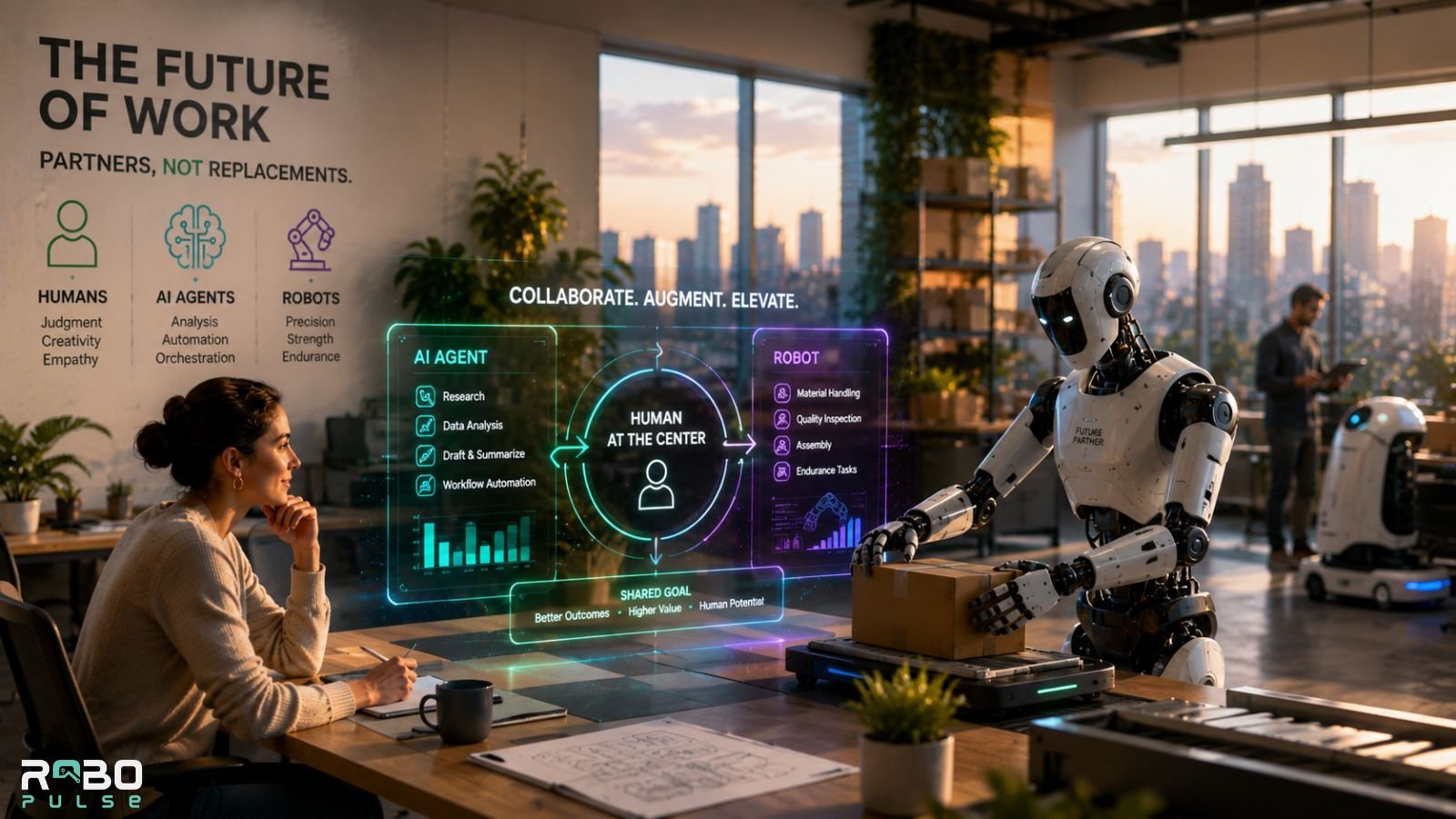
Most articles about robots and jobs pick a side. Either automation guts the workforce, or nothing really changes. Both miss the point. McKinsey Global Institute’s November 2025 analysis of the US labor market found something more specific: current technology could automate around 57% of work hours today. That’s technical potential, not a forecast. Adoption moves slowly. It reshapes roles far more often than it erases them.
The real shift is structural. Work no longer organizes around individual tasks. It organizes around three actors sharing the load: people, software agents handling nonphysical work, and robots handling physical work. Companies that get this partnership right — not just bolt AI onto an old workflow — capture most of the coming economic value.
Here’s what’s actually changing, which skills carry the most exposure, and what this partnership looks like once it leaves the slide deck.
What Does “Working With Robots” Actually Mean in 2026?
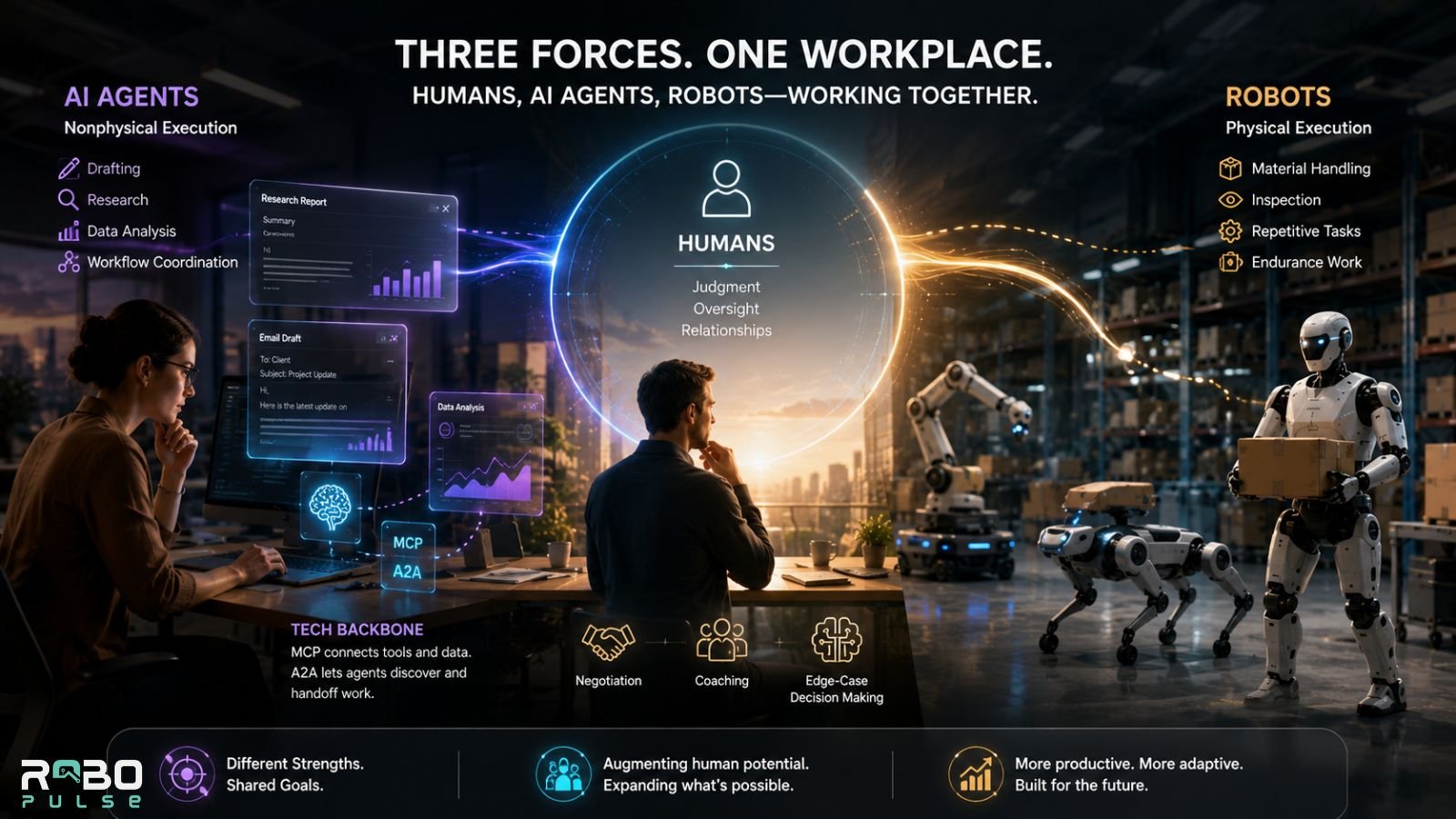
It rarely means a humanoid robot standing next to you at a desk. McKinsey draws the line differently: agents handle cognitive and digital tasks, robots handle physical ones. Most near-term change is happening on the agent side, inside ordinary office workflows.
Physical robots are advancing too, but unevenly. Industrial adoption is moving well past the factory floor into logistics, retail, and inspection work. Warehouse robots, delivery robots, and rugged quadrupeds already handle real shifts in these settings. One industrial humanoid built for repetitive, physically demanding work shows what today’s generation can actually do.
General-purpose humanoids that handle flexible, human-like manual tasks remain in an earlier stage. Regions leaning hardest into rental-based deployment are already hitting the practical limits of unsupervised autonomy. The bigger near-term shift stays nonphysical: AI agents draft documents, summarize data, and handle first-pass research, freeing people for the judgment calls software can’t make.
Two technical developments are accelerating this. Multimodal AI now works across text, images, audio, and video. And interoperability standards — Model Context Protocol (MCP) and Agent2Agent (A2A) — let AI tools coordinate instead of operating as isolated point solutions. MCP connects one agent to its own tools and data. A2A goes further: it lets independent agents discover each other and hand off work through machine-readable “agent cards,” which is what keeps multi-agent workflows from stalling out.
| Actor | Role in the workplace | Core capability | Technical backbone |
|---|---|---|---|
| Humans | Judgment, oversight, relationships | Negotiation, coaching, edge-case calls | Experience and context |
| AI agents | Nonphysical execution | Drafting, research, workflow coordination | MCP, A2A |
| Robots | Physical task execution | Material handling, inspection, repetitive labor | Embedded AI, sensors |
Which Jobs and Skills Are Actually at Risk?
Routine, highly codified skills face the most disruption. McKinsey points to accounting processes and specific programming tasks as examples. Interpersonal and caregiving skills — negotiation, coaching, coordinating with people — change the least. They depend on trust and context that’s hard to automate.
More than 70% of the skills employers seek today show up in both automatable and non-automatable work. Most people won’t lose their whole job. They’ll see the task mix inside it shift. A researcher or writer, for example, may spend less time on first drafts and more time framing questions and checking output.
McKinsey’s Skill Change Index quantifies this across occupations. Under a faster-adoption scenario, the most exposed skills could see up to 60% of related work hours automated within five years. The midpoint scenario lands closer to a quarter or a third. Either way, most occupations shift. They don’t disappear.
Is Demand for “AI Skills” Actually Growing, or Is That Hype?
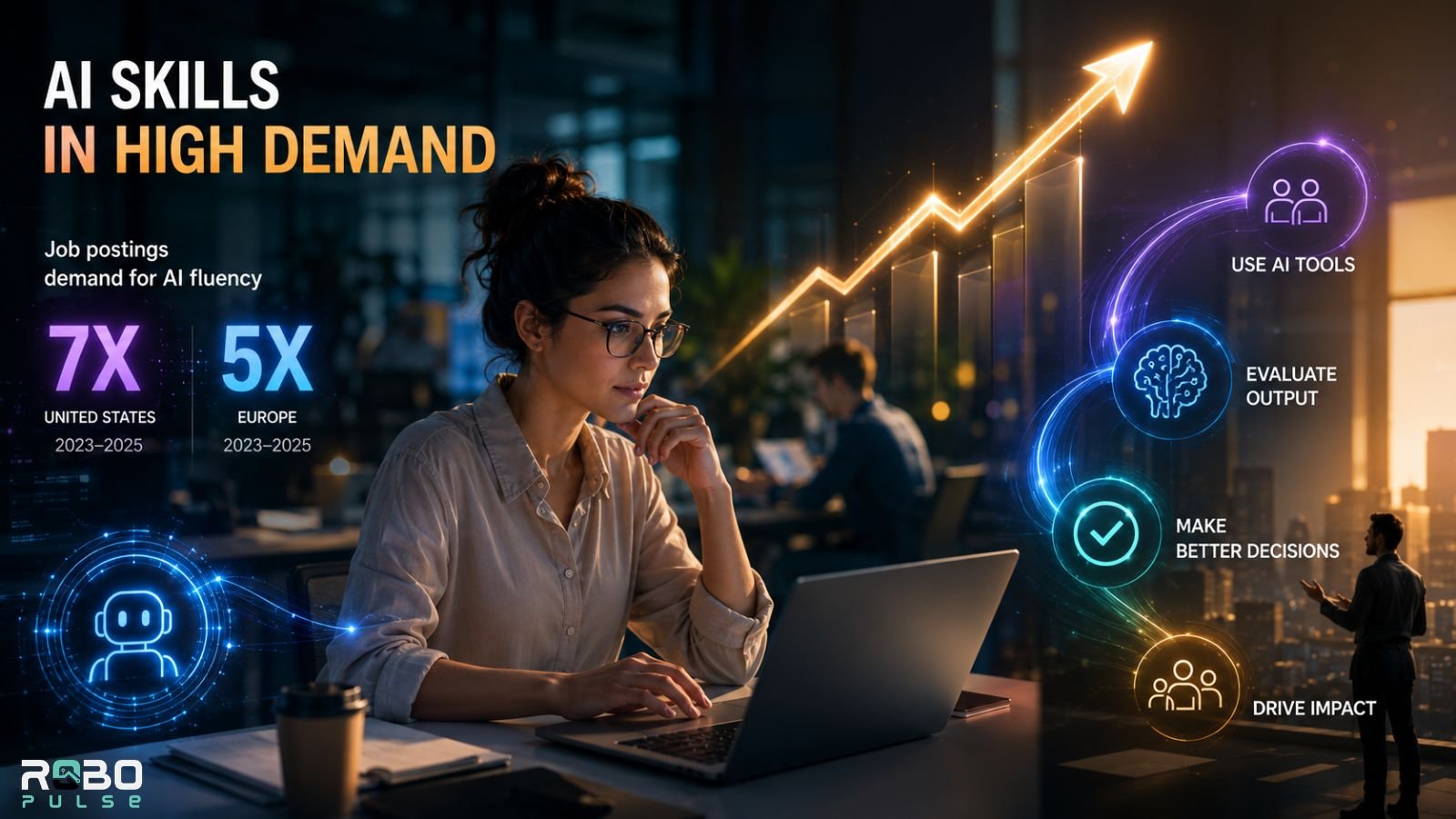
It’s real. It’s one of the fastest-moving labor market signals available. AI fluency — the practical ability to use and manage AI tools, not build them — is the term McKinsey uses for this skill. Demand for it grew roughly sevenfold in US job postings between 2023 and 2025, faster than any other tracked skill category. A parallel European report found AI fluency demand growing about fivefold over a similar period, while technical AI-building skills grew more slowly than in the US.
That gap matters for how people prioritize learning. Most workers don’t need to become AI engineers. They need to become confident, critical users of AI tools inside their existing role: able to direct an agent, judge its output, and know when to override it.
What Does This Look Like in Practice, Not Theory?
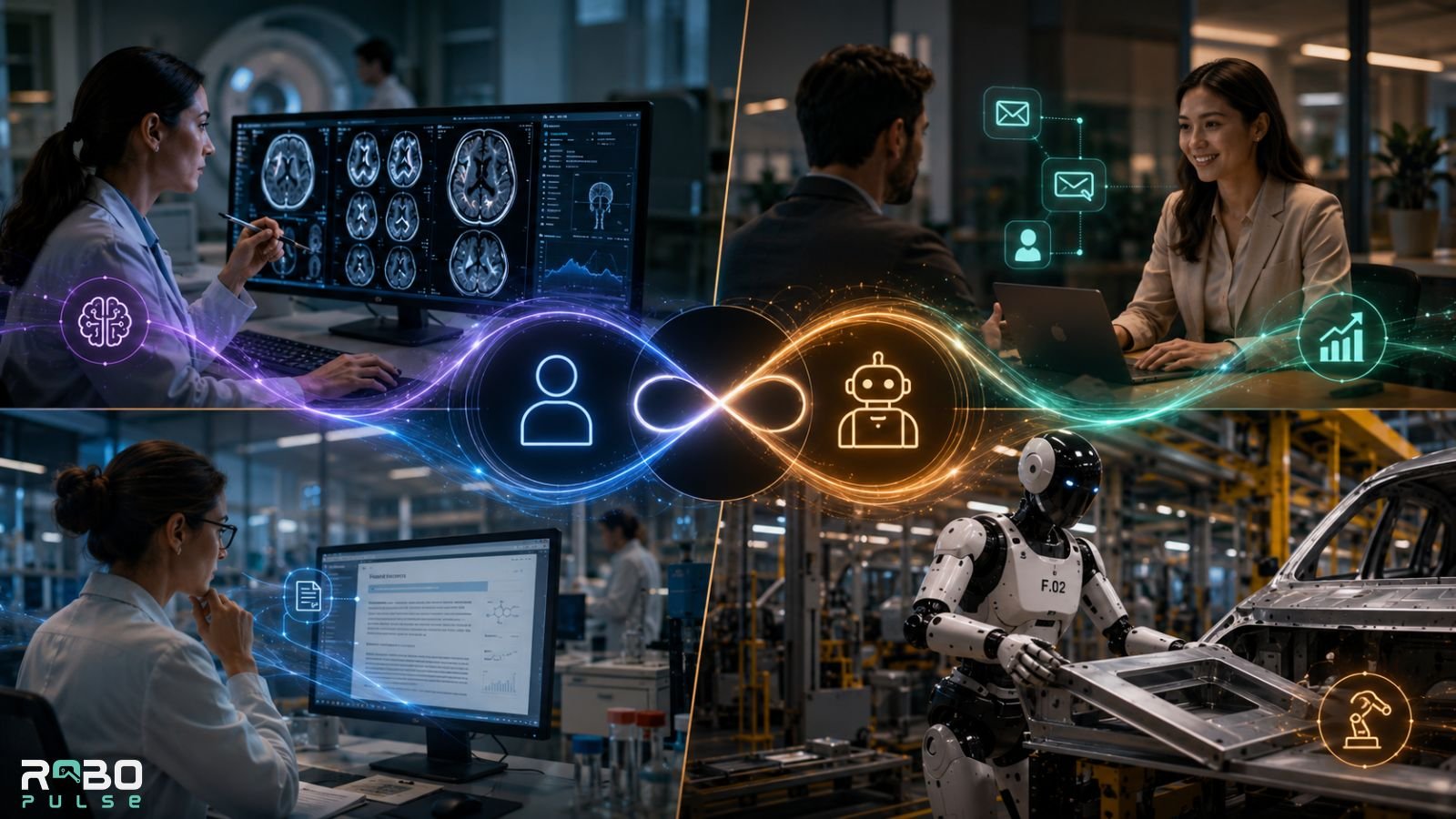
In radiology, AI has analyzed images for years. Yet US radiologist employment grew, not shrank, between 2017 and 2024. AI took over parts of image review. Radiologists shifted toward complex diagnosis and patient-facing decisions. One major US health system expanded its radiology staff by more than 50% over roughly the same period, while deploying AI tools broadly across its imaging work.
In enterprise settings, McKinsey’s European research describes AI agents automating early-stage sales tasks: lead qualification, initial outreach drafts. Sales staff spend more time on relationship-building and closing complex deals. In pharma, AI produces first-draft clinical documentation. Medical writers shift from drafting into review, refinement, and compliance checking.
On the physical side, BMW ran an 11-month pilot with Figure AI’s Figure 02 humanoid at its Spartanburg plant, using it to insert sheet-metal parts for welding. The robot supported production of more than 30,000 X3 vehicles. BMW has since moved to Figure AI’s next-generation robot for logistics sequencing work at the same plant.
Four different sectors. One repeating pattern: AI absorbs the repeatable front end of a workflow. Human work concentrates at the judgment-heavy back end. A recently opened, fully robot-run convenience store is testing whether that pattern holds in a physical, customer-facing environment too, not just a back-office one.
What’s the Hidden Risk Nobody’s Pricing In?
As human-agent-robot teams scale, the biggest operational risk isn’t downtime. It’s silent drift.
When an AI agent handles first-pass drafting or data filtering without a human checking its work, small errors compound downstream. Nobody notices until the output reaches a customer, a regulator, or a balance sheet. Industry practitioners increasingly call this “agent drift” or “shadow AI” — automation quietly operating outside its intended guardrails.
Liability doesn’t disappear when a task moves from a person to an agent or a robot. It moves to whoever deployed it. Companies that treat AI as a governance problem, not just a productivity one, build checkpoints where a human reviews agent reasoning before anything ships. That’s slower than full automation. It’s also what keeps automation from becoming a liability nobody planned for.
What Should Workers and Leaders Actually Do About It?
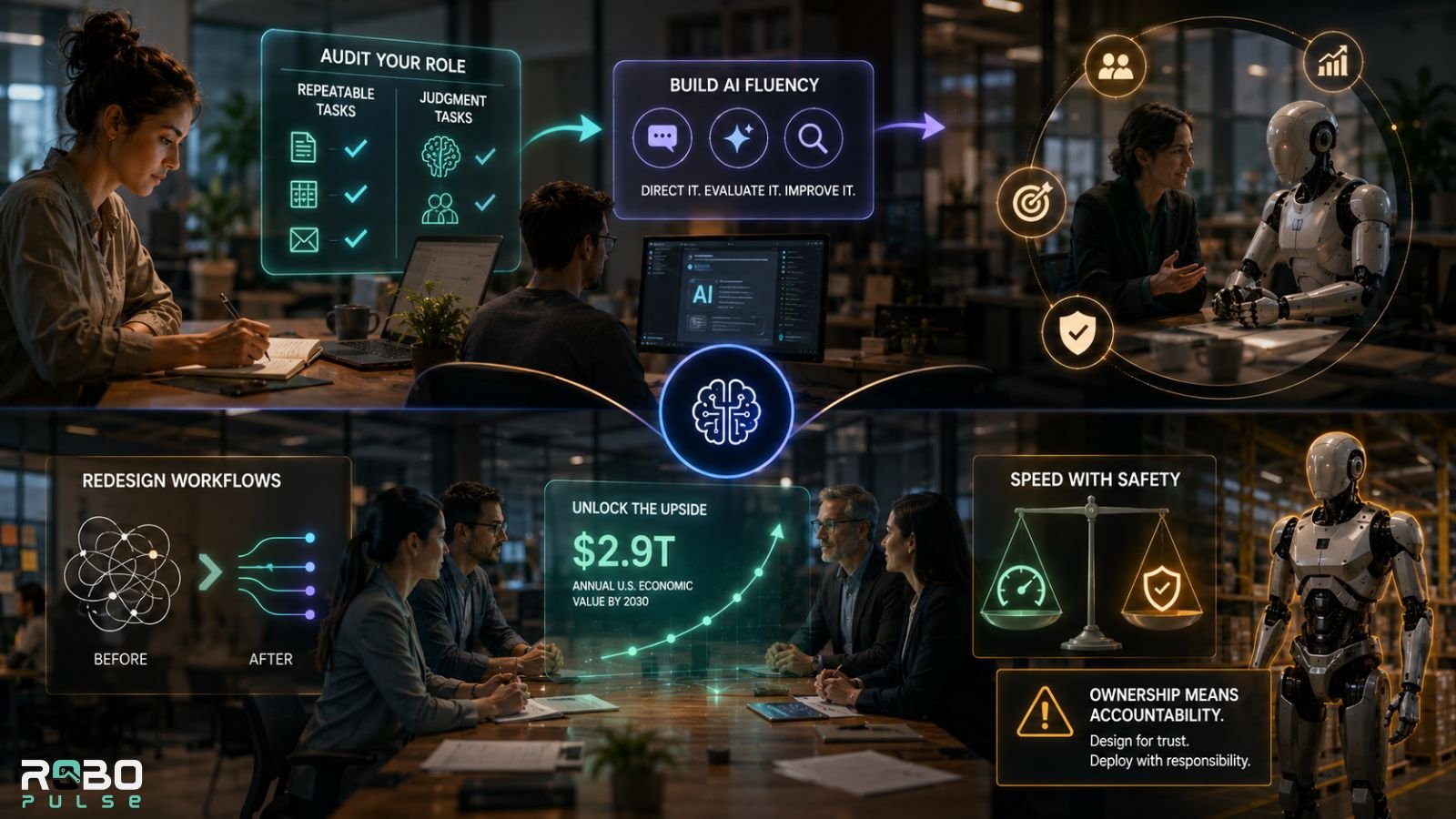
For workers: audit your own role. Which tasks are repeatable? Which depend on judgment? Then build fluency with whatever AI tools touch your field. You don’t need to master the technology. You need to direct it and catch its mistakes.
For leaders, McKinsey’s research is blunt about the biggest risk: treating AI adoption as a tool rollout instead of a workflow redesign. Bolting an AI agent onto an unchanged process captures only a fraction of the value. McKinsey estimates roughly $2.9 trillion a year in US economic value by 2030 under a midpoint adoption scenario. Capturing that upside means redesigning roles, culture, and how you measure success, not just adding software.
Leaders also need to engage with AI directly instead of delegating the decision to IT or a vendor. Weigh speed against safety, oversight, and trust. The same automation that saves time can remove the human checks that catch errors. Recent acquisitions in the humanoid space make this concrete: whoever owns the robot ends up owning its failures too. That’s an accountability question workflow redesign has to answer before deployment, not after.
FAQs
Q. Will robots and AI actually replace most jobs by 2030?
No — current technology could theoretically automate a majority of work hours, but McKinsey’s research frames that as technical potential, not a job-loss forecast. Adoption is slow and mostly reshapes roles rather than eliminating them outright.
Q. What jobs are safest from AI and robot automation?
Roles built on social and emotional skills — negotiation, coaching, hands-on caregiving, and complex interpersonal judgment — are expected to change the least, since these depend on trust and context that’s hard to automate.
Q. What’s the difference between an “AI agent” and a “robot” in this context?
In this research, agents refer to AI systems that automate nonphysical, cognitive work — drafting, analysis, coordination — while robots refer to machines that automate physical tasks, from warehouse automation to humanoid platforms still in earlier stages of general capability.
Q. What skill should I actually build first for this shift?
AI fluency — the practical ability to direct AI tools, evaluate their output, and know when to step in — not deep technical skill in building AI systems. Demand for this fluency has grown far faster than for any other tracked skill category.
Q. Is this only happening in the US?
No. A follow-up McKinsey study found a similar pattern across ten European economies, with around 58% of current work hours theoretically automatable and AI fluency demand growing roughly fivefold — though demand for deeper technical AI skills is growing faster in the US than in Europe.
Q. How much economic value is actually at stake?
McKinsey’s midpoint adoption scenario estimates roughly $2.9 trillion in annual US economic value by 2030 — but only if organizations redesign workflows around people, agents, and robots together, rather than simply adding AI tools to unchanged processes.
Related: Synthetic Humanoids Explained: Can Artificial Muscles Beat Traditional Robots?