

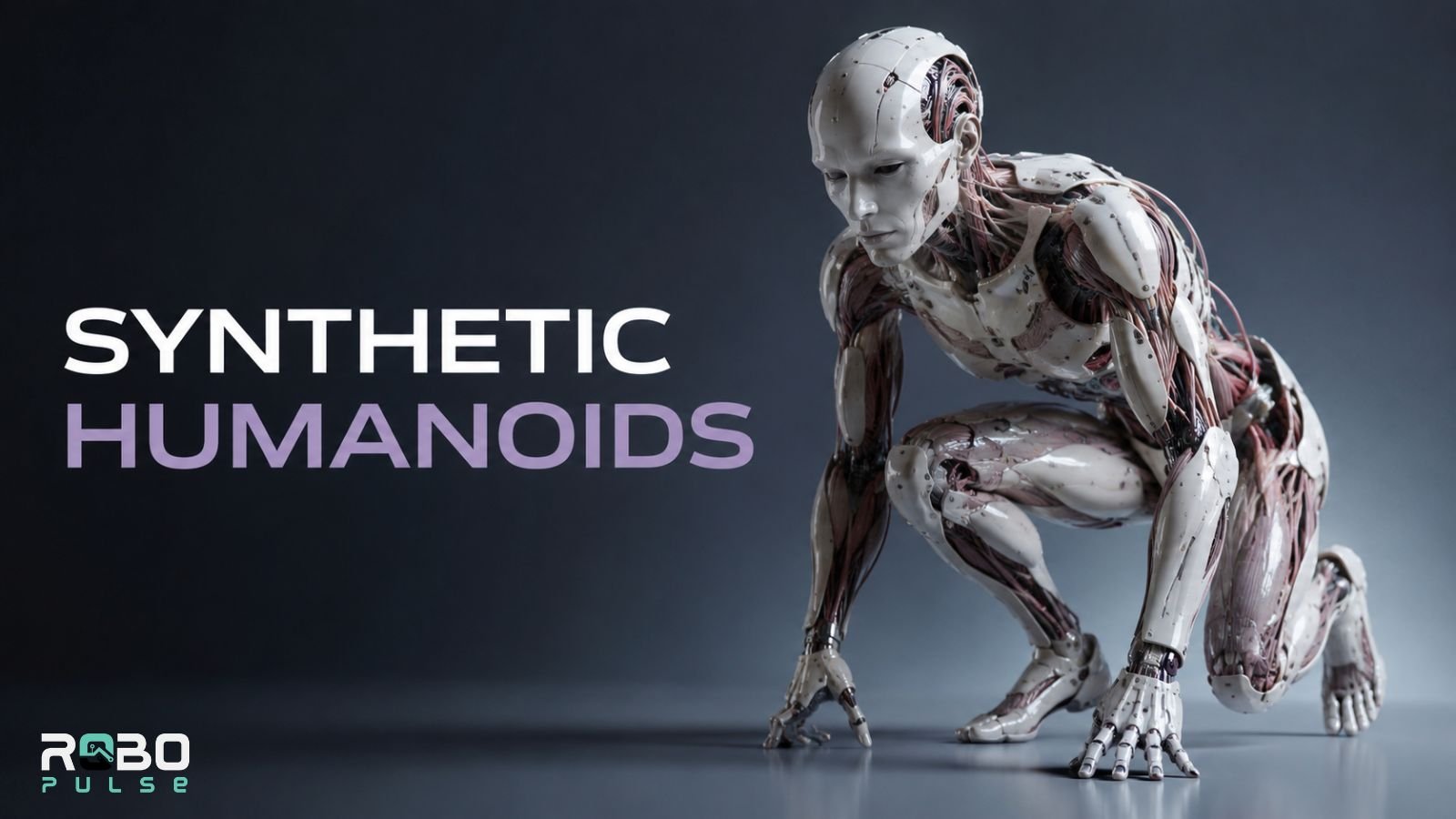
As Figure 03 rolls off BotQ’s assembly line at one robot per hour and Apptronik Apollo runs shifts on Mercedes-Benz assembly lines, a quieter counter-revolution is building inside research labs: a robot that discards electric motors entirely and reaches back to human biology for its engineering answers.
These are synthetic humanoids — and the question they force is one the robotics industry has debated for decades:
Should robots be built like machines, or built like bodies?
Quick Answer: A synthetic humanoid is a robot built with artificial muscles, tendons, and an anatomy-modelled skeleton that replicates biological movement — rather than relying on electric motors and gearboxes. The defining difference is not how it looks. It is how it moves, how it absorbs force, and how it fails.
Synthetic Humanoid vs Conventional Humanoid
| Feature | Conventional Humanoid | Synthetic Humanoid |
|---|---|---|
| Primary actuation | Electric motors + harmonic drives | Fluid-driven artificial muscles |
| Structural design | Rigid mechanical frame | Anatomy-modelled polymer skeleton |
| Compliance | Software + series elastic actuators | Built into the material itself |
| Energy efficiency | ~80–95% to load | ~44% to load (hydraulic) |
| Failure mode | Predictable — locks or goes slack | Less characterised at the commercial scale |
| Manufacturing maturity | Commercial scale today | Research prototype stage |
| Best environment | Structured, controlled | Unstructured, high-contact |
| Known examples | Unitree G1, Figure 03, Apptronik Apollo | Clone Robotics Protoclone, research platforms |
This table captures the trade-off. Everything below explains why each gap exists — and whether it actually matters.
The Origins of Synthetic Humanoids
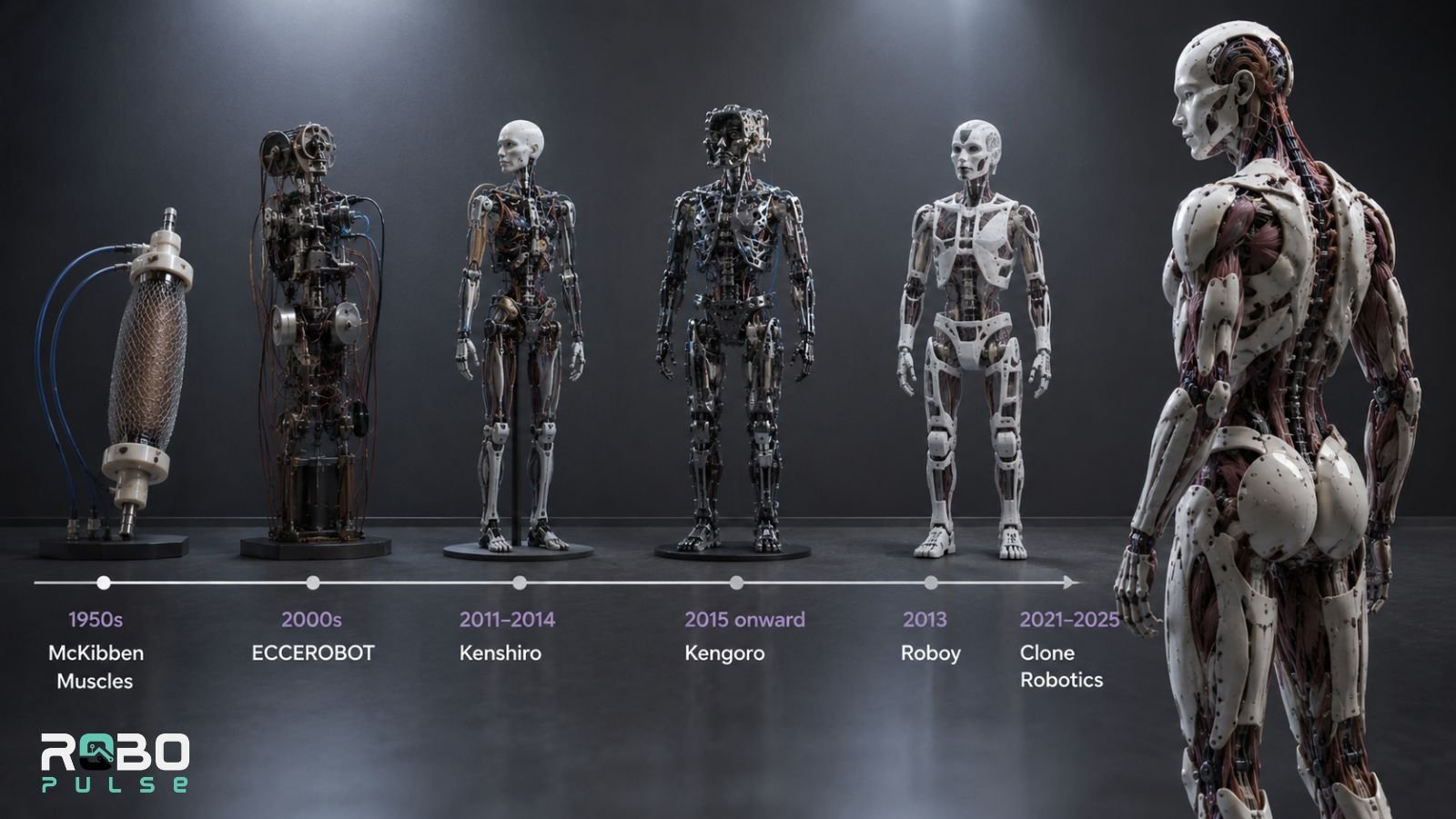
Clone Robotics did not invent biomimetic robotics. They are the most recent — and most viral — chapter in a lineage stretching back 70 years.
1950s — McKibben Muscles Joseph McKibben developed pressurised mesh-tube actuators for polio rehabilitation. The McKibben artificial muscle — a balloon inside a woven mesh tube that contracts when inflated — is the direct ancestor of every fluid-driven synthetic actuator built since.
2000s — ECCEROBOT The EU-funded ECCE project produced the first full-torso anthropomimetic robot: compliant tendons, antagonistic muscle pairs, and a human-derived skeleton. It established the research framework that later projects would follow.
2011–2014 — Kenshiro Developed at the University of Tokyo, Kenshiro was a 1.58m tendon-driven humanoid modelled on a human, 12-year-old, 64 joint degrees of freedom, 160 wire-driven muscles. The stated goal: replicate human anatomy as closely as possible and learn from what breaks.
2015 onward — Kengoro Kenshiro’s successor pushed further: 114 joint degrees of freedom. Its most unusual innovation was a porous aluminium frame that allowed water to seep through and evaporate — a synthetic equivalent of sweating, solving thermal management through structural design rather than added components.
2013 — Roboy, developed at the University of Zurich, Roboy used tendon-driven locomotion in a fully 3D-printed body. It proved that soft-bodied humanoid structures were manufacturable with existing prototyping technology.
2021–2025 — Clone Robotics Founded to commercialise synthetic humanoid technology, Clone developed the Myofiber actuator and built Protoclone V1 — the first full-body synthetic humanoid to go viral, generating millions of views hours after its January 2025 release.
Each generation exposed a problem that the next had to solve. Clone inherited that accumulated knowledge — and the same unsolved challenges: control complexity, energy efficiency, valve density, and manufacturing reproducibility.
Inside Clone Robotics’ Protoclone

Protoclone V1 is the clearest current implementation of synthetic humanoid design. Here is the architecture, broken down.
Skeleton 3D-printed polymer modelled on human anatomy, with 206-bone-equivalent components and full joint articulation.
Myofibers — the core innovation Over 1,000 proprietary fluid-driven actuators. Each is a pressurised mesh tube with an internal balloon: hydraulic fluid pumps in, the balloon expands radially, and the mesh contracts longitudinally. Every fibre is a monolithic musculotendon unit — muscle and tendon in one component, with no separate attachment points.
Per-fibre performance:
- 3 grams of weight
- Sub-50ms response time
- 30%+ contraction when unloaded
- 1 kg+ force output
Circulatory system: A 500-watt pump circulates hydraulic fluid at 40 litres per minute. The microchannels double as cooling infrastructure — the functional equivalent of a vascular and perspiration system.
Sensory network 4 skull-mounted depth cameras · 70 inertial sensors · 320 pressure sensors · 500+ total
Degrees of freedom 200+ full-body. Upper torso alone: 164.
Brain NVIDIA Jetson Thor GPU running Clone’s Cybernet foundation model, trained in physics-based simulation before transfer to hardware.
Production plan 279: Clone Alpha units as the first limited batch, priced at approximately $20,000.
The Hidden Valve Density Problem
Most coverage focuses on Myofibers. The harder engineering problem is upstream of the muscles: valve density.
Coordinating 1,000+ Myofibers in real time requires a matrix of proportional micro-valves controlling fluid flow to each actuator individually — opening and closing hundreds of times per second across the entire body, at precise pressure levels, inside a human-scale frame.
Think of it like an automatic transmission, but with a thousand shift actuators running simultaneously. A single clogged valve degrades the muscle group it feeds. A cluster failure in a critical region can take an entire limb offline.
The fluid infrastructure also adds weight that the per-fibre specs do not capture. Myofibers are 3 grams each. But the manifold blocks, hydraulic fluid volume, pump assembly, pressure regulators, and routing lines that support them add mass that substantially changes the net power-to-weight ratio.
This is the “hardware hell” experienced hydraulics engineers refer to when discussing biomimetic systems. It is not a software problem. It is a plumbing problem — with no established solution at the density a full-body synthetic humanoid requires.
The Three Actuation Technologies
Generating movement that approximates biological muscle remains the central unsolved engineering problem in this field. Three main approaches are active.
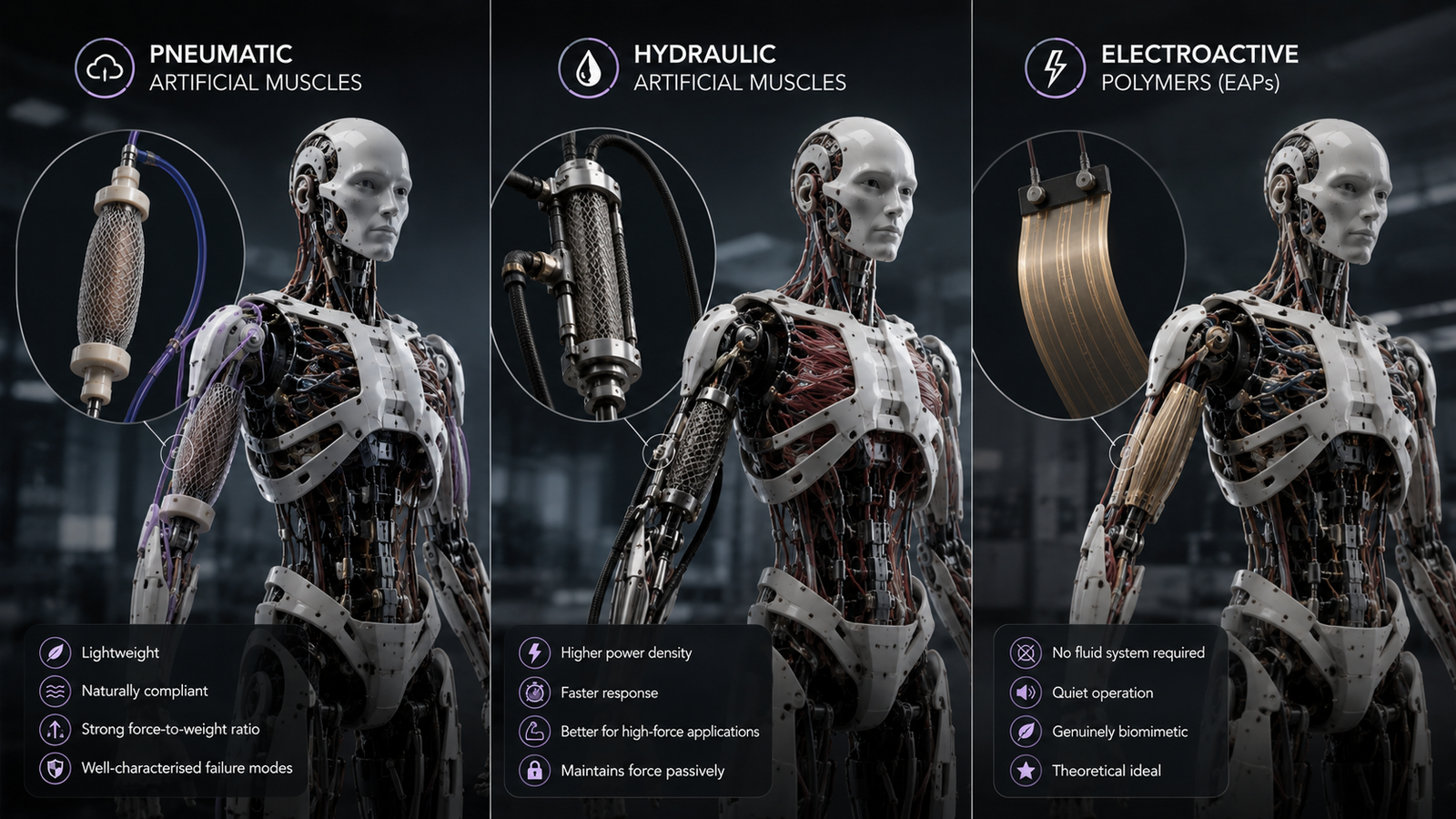
Pneumatic Artificial Muscles
Air-driven McKibben-style mesh tubes. The oldest approach and still one of the best mechanical approximations of biological muscle behaviour.
| Strengths | Limitations |
|---|---|
| Lightweight | Requires onboard compressors |
| Naturally compliant | Air compressibility makes precision control difficult |
| Strong force-to-weight ratio | Slower response than hydraulic |
| Well-characterised failure modes | Energy-inefficient overall |
Protoclone V1 currently uses pneumatic actuation. Future versions will transition to hydraulics.
Hydraulic Artificial Muscles
Fluid replaces air. Incompressibility enables faster response and higher force output — critical for a full-body system coordinating hundreds of actuators simultaneously.
| Strengths | Limitations |
|---|---|
| Higher power density | Fluid circuits add weight and plumbing complexity |
| Faster response than pneumatic | Seal degradation under continuous duty cycles |
| Better for high-force applications | Thermal management required at sustained load |
| Maintains force passively under static load | ~44% system efficiency vs ~80–95% for electric drives |
Clone’s commercial direction points toward hydraulics as the mature form of their actuation architecture.
Electroactive Polymers (EAPs)
Materials that contract directly under electrical stimulation — no fluid circuits, no compressors. Often described by researchers as the theoretical ideal.
| Strengths | Limitations |
|---|---|
| No fluid system required | Cannot yet generate sufficient force for load-bearing joints |
| Quiet operation | Durability under high-cycle operation unproven |
| Genuinely biomimetic operating principle | Full-body scalability has not yet been demonstrated |
EAPs are a research technology. No current synthetic humanoid uses them for primary actuation.
The Compliance Argument — and Its Limits
Think about elder care. If an electromechanical arm miscalculates torque by even a fraction, it risks transmitting unexpected force to a fragile patient. A synthetic muscle system does not need a software safeguard to prevent that — the material itself gives way. It yields naturally before software even registers the contact.
That physical compliance — built into the actuator’s material properties rather than mediated by sensor-and-software chains — is the strongest commercial argument for synthetic humanoid design.
Research in collaborative and rehabilitation robotics consistently shows that physically inherent compliance reduces injury risk in human-contact scenarios compared to software-mediated alternatives. Series elastic actuators in conventional humanoids narrow this gap, but there is a meaningful difference between compliance designed into material properties and compliance computed from sensor data.
That difference matters most in:
- Elder care — constant, unpredictable contact with people who cannot tolerate unexpected force
- Rehabilitation — robots that must match patient effort levels dynamically
- Household assistance — manipulating objects whose fragility varies unpredictably
One important qualification: physical compliance reduces the probability and severity of certain failure modes. It does not eliminate them. A compliant system that loses control of its actuation can still fail unsafely.
The Energy Efficiency Challenge
Electric motors deliver 80–95% of input power to the load. Hydraulic systems deliver roughly 44% — the rest dissipated through fluid compression losses, heat, and pressurisation overhead. Pneumatic systems are worse.
There is a partial counterargument. Electric motors waste significant energy holding static positions under load, generating heat that requires active cooling. Pressurised fluid maintains force passively — no continuous electrical input required. For robots holding positions for extended periods (gripping, supporting weight during slow manipulation), fluid-driven systems can be competitive or better.
The honest summary: in tasks requiring continuous dynamic actuation, electromechanical systems win on energy efficiency. In static or quasi-static holding tasks, fluid-driven systems can compete. A general-purpose synthetic humanoid will do both — and the overall energy picture depends on specific task distribution, which no synthetic humanoid prototype has characterised at the system level yet.
Battery life implications for a mobile synthetic humanoid are significant, and this problem has not been solved.
Why Synthetic Humanoids Are Harder to Control
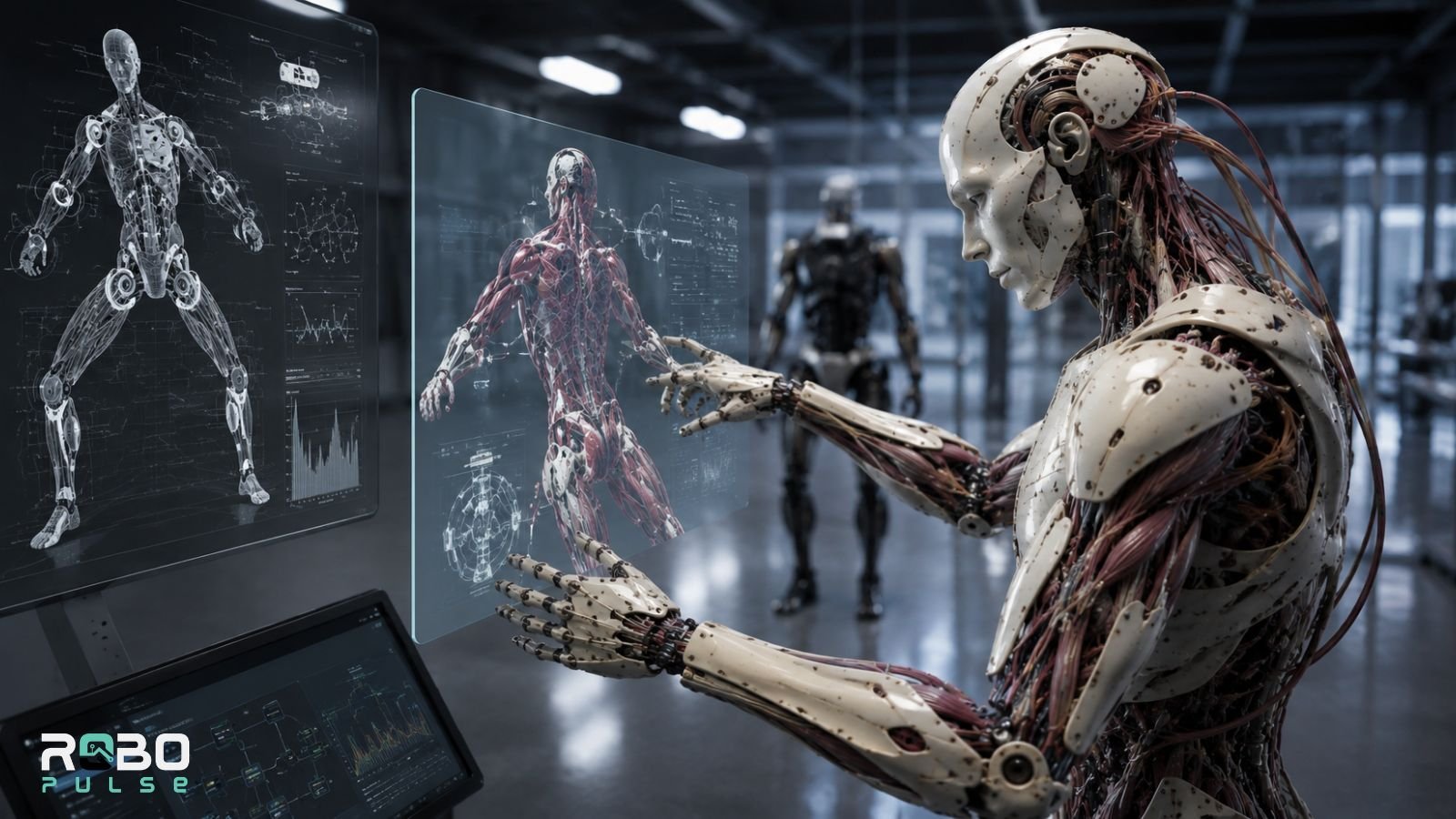
Coordinating hundreds of antagonistic muscle pairs — where each joint’s position emerges from the balance of forces across multiple actuators simultaneously — requires a fundamentally different control architecture than commanding joint positions in a motor-driven system.
Both Apptronik Apollo and Clone’s Protoclone run on NVIDIA compute stacks. Both use reinforcement learning in simulation before hardware transfer. The AI infrastructure is converging. The gap is not capability — it is physics simulation accuracy.
Simulating rigid joints and known motor characteristics is a solved problem in physics engines. Simulating hundreds of elastic mesh tubes filled with pressurised fluid, each with its own deformation characteristics, interacting through compliant skeletal connections with accurate soft-body physics — that is not a solved problem. The sim-to-real gap for synthetic humanoids is measurably wider than for electromechanical platforms, and closing it requires simulation infrastructure that does not yet exist commercially.
This is what engineers informally call the “soft-body simulation nightmare” — and it is the primary reason that the AI sophistication argument (“both sides use NVIDIA”) does not resolve the control challenge for synthetic humanoids.
Why Commercial Companies Are Not Building Synthetic Humanoids
Figure AI’s BotQ facility now produces one Figure 03 per hour. That production velocity is possible because electric motors, harmonic drives, and electronics slot into manufacturing processes with decades of industrial precedent. No synthetic humanoid company is within years of that production ramp.
Beyond manufacturing, commercial buyers need reliability guarantees. A motor-driven humanoid fails predictably — a joint locks or goes slack, a technician diagnoses and replaces the component using standard tooling. When a Myofiber micro-valve clogs or a seal degrades in a hydraulic circuit, no established service protocol, no trained technician workforce, and no replacement supply chain exists outside the original manufacturer.
The commercial companies are not ignoring biomimetics. They are choosing a deployment path that exists today.
Can Clone Alpha Really Cost $20,000?
The Unitree G1 starts at $16,000 using commodity electric motors, established supply chains, and electronics architectures that any robotics technician can service.
Clone Alpha offers 1,000+ custom-engineered fluid actuators, a bespoke hydraulic circuit, 500 sensors, and an NVIDIA Jetson Thor compute stack — for $20,000.
Clone CEO Dhanush Radhakrishnan addressed this at the March 2026 Abundance Summit, claiming Clone can build Myofibers “by the kilometer” — manufacturing fabric-like actuators at scale in a way that could dramatically reduce per-unit cost. The analogy to textile manufacturing rather than motor winding is genuinely interesting. Whether that supply chain exists at the required quality and volume is a different question.
Treat $20,000 as a research-investment figure. Comparing it directly to the Unitree G1’s price — as if both represent equivalent commercial products — is a mistake that distorts the analysis.
Where the Two Paths Are Actually Heading
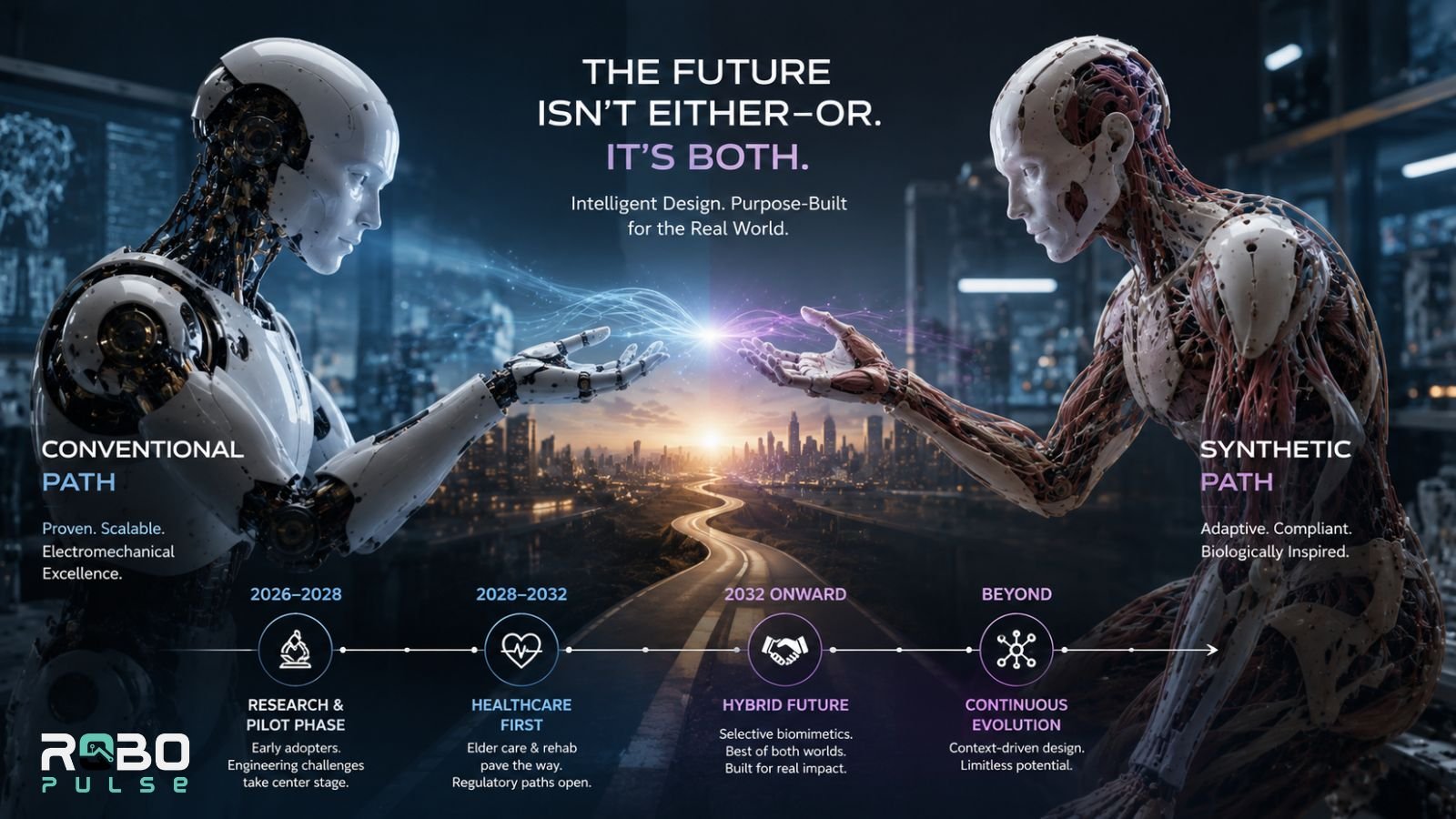
The “machines versus bodies” framing is useful for understanding where the field came from. It is probably too clean for where it is going.
Conventional humanoids are incorporating physical compliance through series elastic actuators. Synthetic humanoid projects are adopting digital twin training environments and modular electronics architectures built by the industrial sector. The sharpest engineers in both camps read the same research.
The most commercially rational near-term synthesis is probably selective biomimetics — electromechanical platforms that adopt synthetic actuation in end effectors and contact surfaces, where compliance and tactile sensitivity matter most, while retaining proven motor drives in load-bearing structural joints. Several research groups are already exploring this architecture.
The 2026 humanoid robot mountain test — where electromechanical platforms attempted extreme terrain — already illustrated the limits of rigid actuation in unstructured environments. Synthetic humanoids have not been tested at comparable extremes. Neither side has a complete answer.
A realistic roadmap:
2026–2028 — Synthetic humanoids remain research and limited-pilot platforms. Clone Alpha reaches early adopters in R&D contexts. The valve density and soft-body sim-to-real problems dominate engineering attention.
2028–2032 — If reliable operation in elder care or rehabilitation settings is demonstrated, regulatory pathways begin to form. Healthcare contact robotics may prove the fastest commercial path because the compliance argument is strongest and the performance requirements are most specific.
2032 onward — Hybrid architecture platforms — electromechanical chassis with synthetic actuation in end effectors and contact surfaces — become the most commercially rational synthesis. The binary debate between machines and bodies resolves into context-specific design choices.
Key Architectural Differences at a Glance
| Dimension | Electromechanical | Synthetic / Biomimetic |
|---|---|---|
| Actuation | Rotary electric motors | Fluid-driven muscle contraction |
| Control paradigm | Joint position commands | Antagonistic muscle coordination |
| Compliance source | Software + series elastic actuators | Material properties of actuators |
| Sim-to-real complexity | Moderate (rigid body physics) | High (soft-body + fluid dynamics) |
| Energy efficiency | ~80–95% to load | ~44% to load (hydraulic) |
| Valve infrastructure required | No | Dense micro-valve matrix |
| Manufacturing readiness | Commercial scale | Research prototype only |
| Historical lineage | Industrial robotics (decades) | McKibben 1950s → research labs → Clone |
Key Takeaways
On Myofiber performance specs: Figures like 3g weight, 1kg force, and sub-50ms response describe individual fibre behaviour under ideal conditions. Sustained force under duty cycle and fatigue life across 10,000+ cycles in a full-body deployment are what matter commercially. Clone has not published those figures.
On the $20,000 price: A research-subsidised figure, not a commercial price signal. Compare it to what the Unitree G1 delivers at $16,000 with commodity components before concluding cost competitiveness.
On energy efficiency: The ~44% hydraulic system efficiency is a genuine constraint for mobile deployment. Battery life for a fluid-driven synthetic humanoid will be meaningfully shorter than for an electromechanical equivalent performing the same tasks. This has not been solved.
On the compliance advantage: Real, and most significant for elder care and rehabilitation specifically. Less relevant for the warehouse and logistics applications, where Figure 03 and Apollo already operate at commercial scale.
On the valve problem: The micro-valve matrix required to coordinate 1,000+ Myofibers is the constraint that receives the least public attention — and may be the hardest to solve at commercial deployment scale.
Frequently Asked Questions
Q. What is a synthetic humanoid?
A synthetic humanoid is a robot that mimics human anatomy using artificial muscles, tendons, and a skeleton, instead of electric motors and rigid joints, to move fluid-based contraction systems.
Q. How is Protoclone different from Unitree G1 or Apptronik Apollo?
Unitree G1 and Apptronik Apollo use electric motors in rigid joints. Protoclone uses 1,000+ pressurised artificial muscles on a human-like skeleton, making its movement system fundamentally bio-inspired rather than motor-driven.
Q. Are artificial muscles more energy efficient than electric motors?
Generally no. Electric motors are more efficient (around 80–95%), while fluid or hydraulic muscle systems are lower (around 40–45%), though they can hold static loads with less continuous energy use.
Q. Why aren’t Tesla, Figure AI, and Apptronik building synthetic humanoids?
Because motor-based humanoids are easier to scale, manufacture, and maintain. Their components are standardized, supply chains are mature, and failure modes are predictable compared to complex synthetic muscle systems.
Q. Who built synthetic humanoids before Clone Robotics?
Key predecessors include Joseph McKibben (1950s), ECCEROBOT (2000s), University of Tokyo robots like Kenshiro and Kengoro, and Zurich’s Roboy project.
Q. Will synthetic humanoids reach commercial deployment?
Yes, but first in niche areas like elder care, rehab, and home assistance. Broader adoption will likely take years due to cost, complexity, and manufacturing challenges.
Related: BMW’s Figure 03 Deployment Signals a New Era for Factory Humanoids