

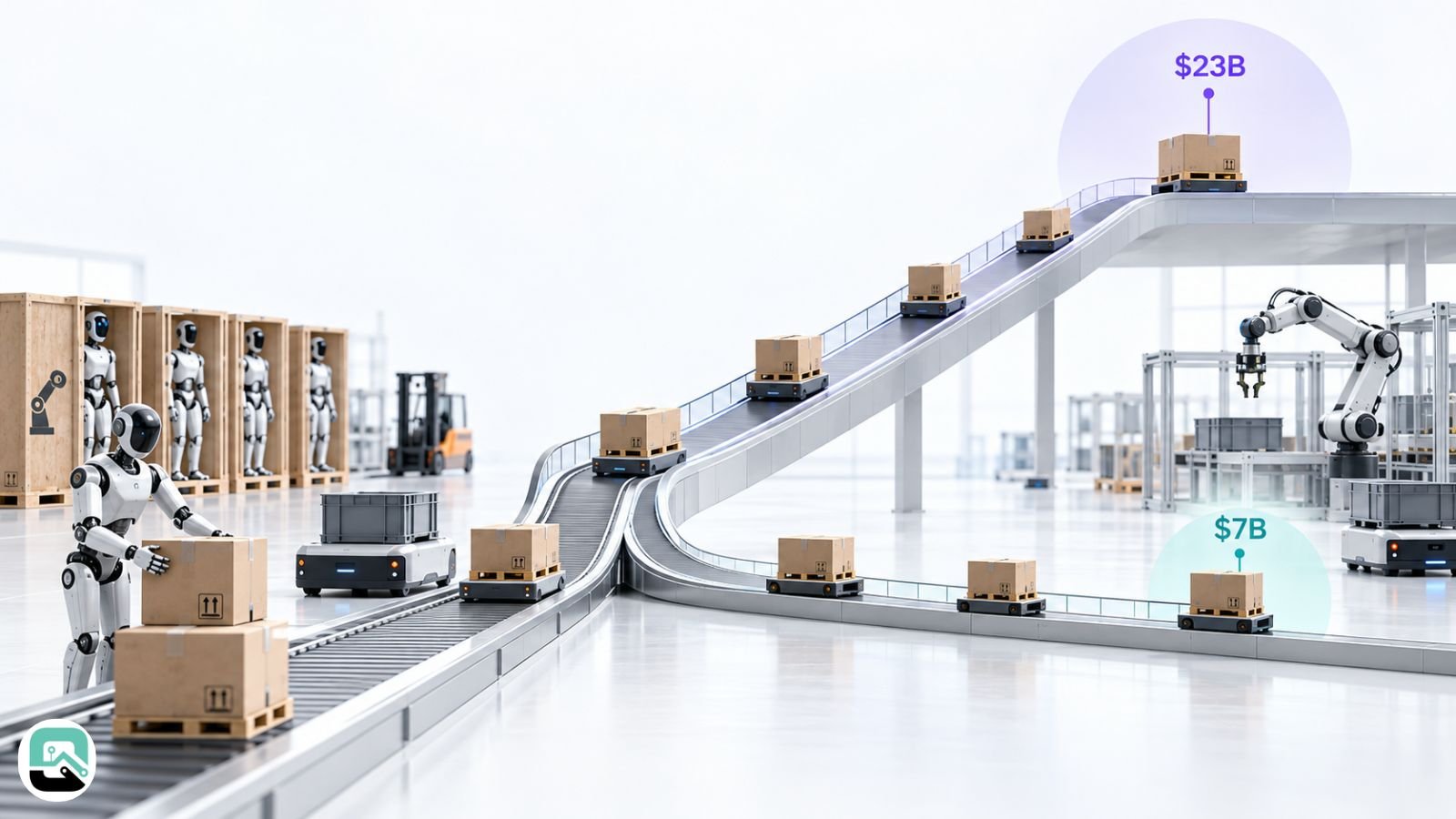
Ask several research firms what embodied AI will be worth in 2030, and the answers land between $7.24 billion and $23.06 billion. The Business Research Company anchors the bottom of that range. MarketsandMarkets holds the top, projecting $23.06 billion from a 2025 base of $4.44 billion at a 39.0% CAGR.
A 3.2x gap isn’t a rounding issue. The reports aren’t measuring the same thing.
Some count humanoids and nothing else. Others fold in exoskeletons, delivery vehicles, and smart appliances. Some report revenue, some report units shipped, some report robots actually running in the field. Base years differ, and so do editions of the same report.
What follows sets each forecast beside its scope and source, keeps revenue, shipments and installed base in separate boxes, and checks all of it against what actually shipped in the first half of 2026. The last section is a short set of rules for citing any of these numbers.
Snapshot taken September 2026. Publishers revise definitions and base years often.
The numbers at a glance
- Embodied AI, 2030 endpoint: $7.24B to $23.06B among the forecasts examined here. Later endpoints stretch from $10.75B (2034) to $99.8B (2035).
- Humanoid revenue, 2030: $6.5B (ABI Research) to $11B (BCC Research).
- Humanoid shipments per year, 2030: 195,000 (ABI Research) to 1.2 million (Bank of America) among forecasts that publish an explicit 2030 figure. Goldman Sachs projects 890,000. Interact Analysis takes a more conservative near-term view, with a commercial inflection expected in 2032.
- Humanoid robots in operation, 2030: 248,000, up from 24,000 in 2025 (ABI).
- First-half 2026 shipments: about 19,100 (Smart Analytics Global) to more than 22,000 (Counterpoint Research).
Which number answers which question?
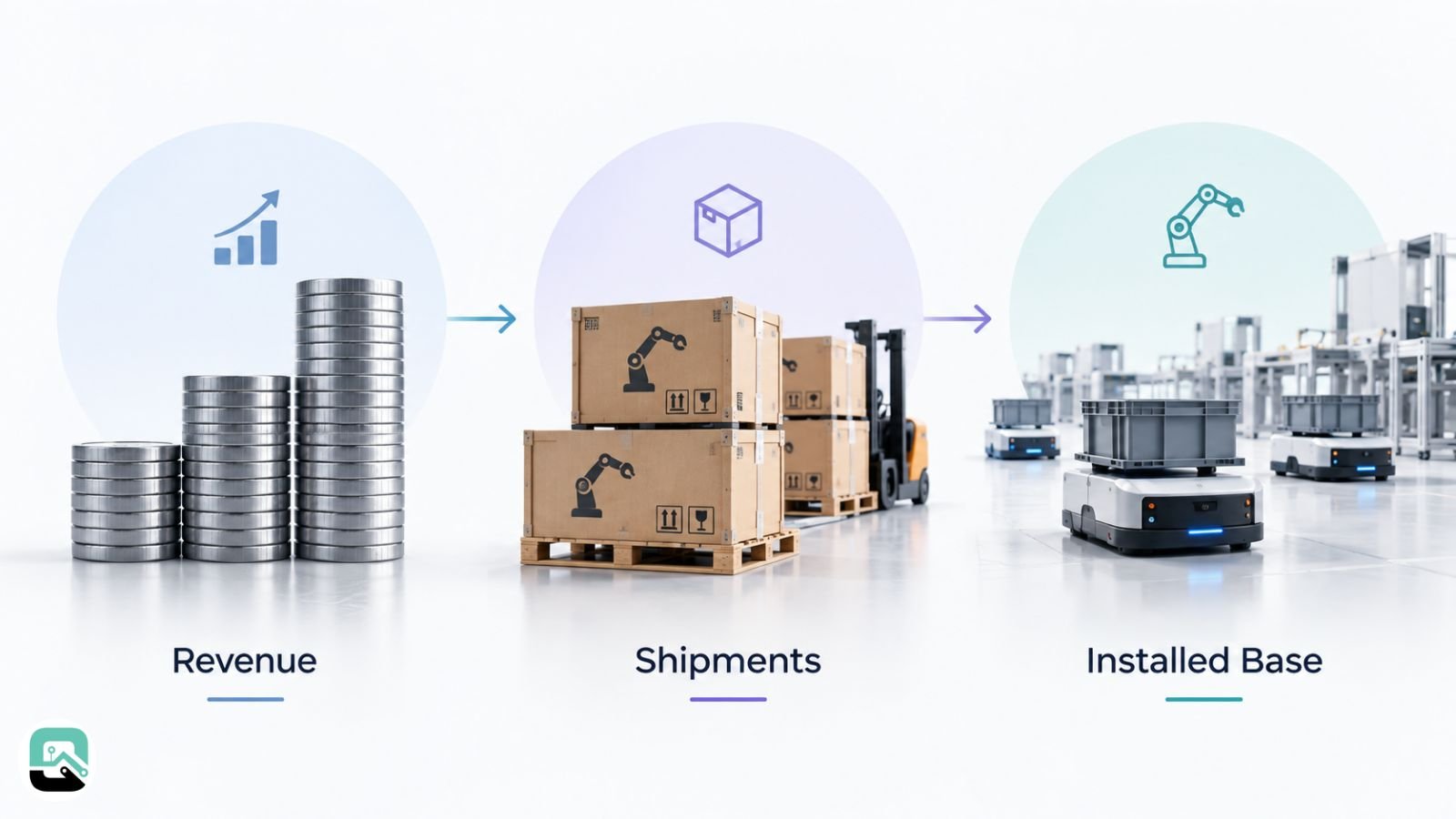
This is the part most coverage skips. A broad embodied AI estimate, a humanoid revenue forecast, a shipment forecast, and an installed-base forecast are four separate measurements, and substituting one for another is how most bad market copy gets written.
| Figure | Useful for | Main limitation |
|---|---|---|
| $23.06B (2030) | Broad embodied AI opportunity | Wide category, single publisher |
| $7.24B (2030) | Lower broad estimate | Public summary shows no methodology |
| $11B / $6.5B (2030) | Humanoid revenue | Humanoid only; scopes differ |
| 195K–1.2M units (2030) | Shipment trajectory | Forecast, not robots in operation |
| 248K installed base (2030) | Robots in operation | Not comparable to annual shipments |
| 19.1K–22K+ (H1 2026) | Reality check on shipments | Trackers disagree |
What counts as embodied AI?
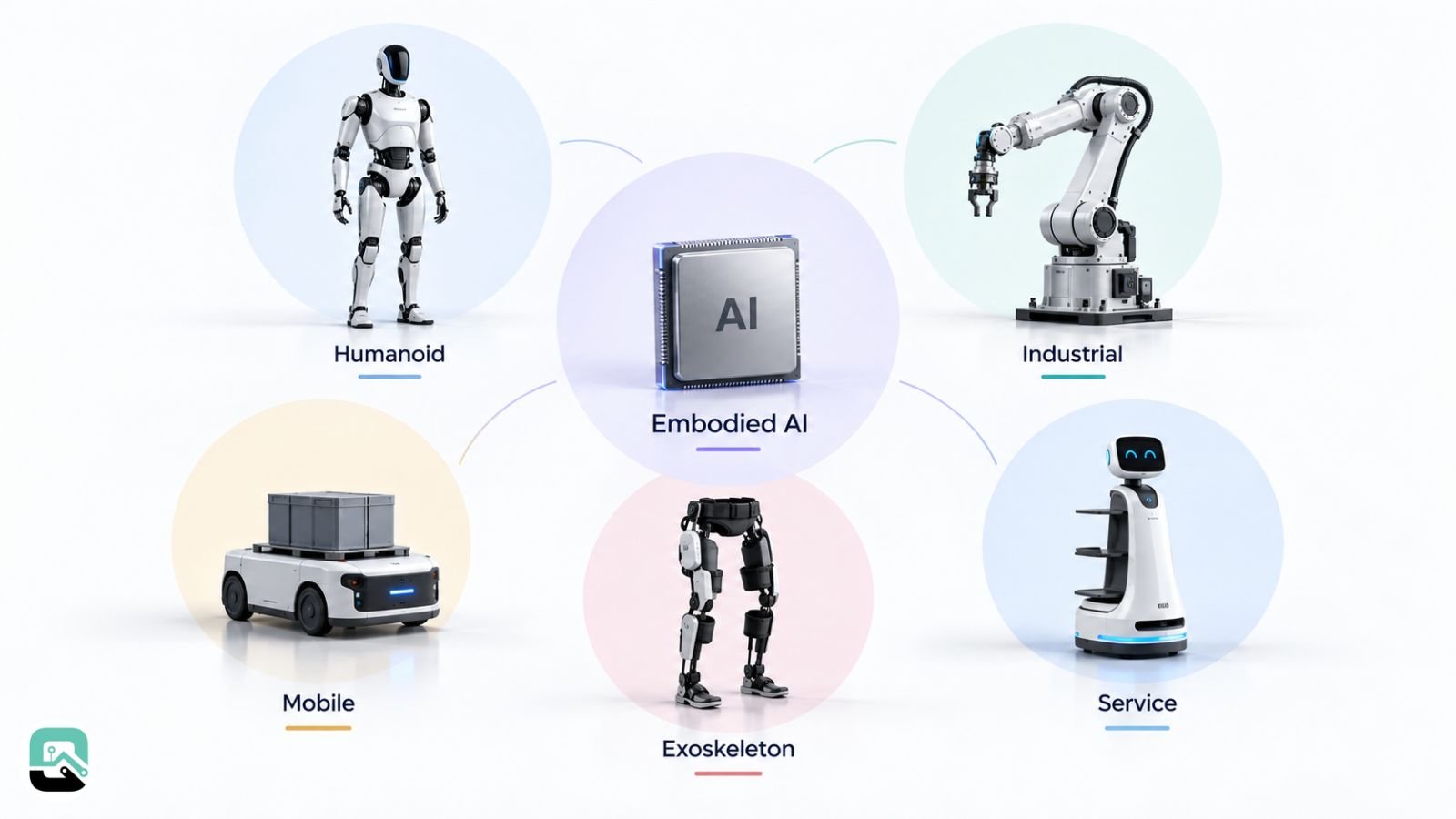
Embodied AI is artificial intelligence built into a physical machine that senses and acts in the real world. Simple enough as a definition. The trouble starts at the edges.
MarketsandMarkets segments its embodied AI report into robots (humanoid, mobile, industrial, service and collaborative), exoskeletons, autonomous systems and smart appliances. That’s a wide net. BCC Research goes the other way for humanoids, restricting its count to commercially deployed hardware and explicitly excluding pilots, demos and prototypes.
Then there’s “physical AI”, a third label that can shrink the number instead of growing it. The same publisher values its physical AI market at $0.89 billion in 2025 — a fifth of its own embodied AI figure for the same year. Goldman Sachs, meanwhile, uses physical AI expansively, covering autonomous vehicles, warehouse robots and anything else that gives AI a body.
Who the reports think the market is
Look at the company lists and the scope question answers itself.
MarketsandMarkets names SoftBank Robotics, ABB, Toyota, KUKA and Boston Dynamics as key players. The firms actually leading humanoid shipments are a completely different cohort: AgiBot, Unitree, Galbot, UBTECH and Leju Robotics. Broad embodied AI forecasts are mostly sizing established industrial automation vendors. Humanoid forecasts are sizing Chinese startups. Treating either as a proxy for the other will send you wrong.
Hardware, software, or both
Worth checking what part of the stack you’re buying into. Grand View Research puts hardware at 51.2% of 2025 embodied AI revenue, so software and services are in there. Globe Market Research is similar, with hardware at 53.2%. BCC’s humanoid number is hardware-focused. Same label, different denominators.
Embodied AI market forecasts: 2025 to 2035
Labels used below: Reported means a publisher stated it. Calculated means arithmetic on reported figures, using growth rate = (end ÷ start)^(1 ÷ years) − 1. Observation means editorial judgment.
| Publisher | Forecast | What it counts |
|---|---|---|
| MarketsandMarkets | $4.44B (2025) → $23.06B (2030), 39.0% | Robots, exoskeletons, autonomous systems, smart appliances |
| The Business Research Company | $3.8B (2026) → $7.24B (2030), 17.5%; 2025 base $3.22B | Robots, exoskeletons, autonomous systems, smart appliances |
| Market.us | $2.5B (2024) → $10.75B (2034), 15.7% | Robots segment 40.9% of 2024 revenue |
| Dimension Market Research | $3.29B (2026) → $11.58B (2035), 15.0% | Autonomous systems fastest-growing segment |
| SNS Insider | $3.48B (2025) → $14.34B (2035), 15.22% | Robots and exoskeletons among segments |
| Grand View Research | $4.6B (2025) → $6.5B (2026) → $67.6B (2033), 39.7% | Hardware: 51.2% of 2025 revenue |
| Globe Market Research | $4.8B (2026) → $99.8B (2035), 40.2% | Hardware, software and services |
One thing the table can’t show: the MarketsandMarkets report was published in June 2025 on a 2024 base year. A 2030 endpoint doesn’t tell you when the work was done, and several of these are older than they look. At the other end of the range, the Business Research Company listing lays out the full path — $3.22 billion in 2025, $3.8 billion in 2026, $7.24 billion in 2030.
Why the forecasts disagree
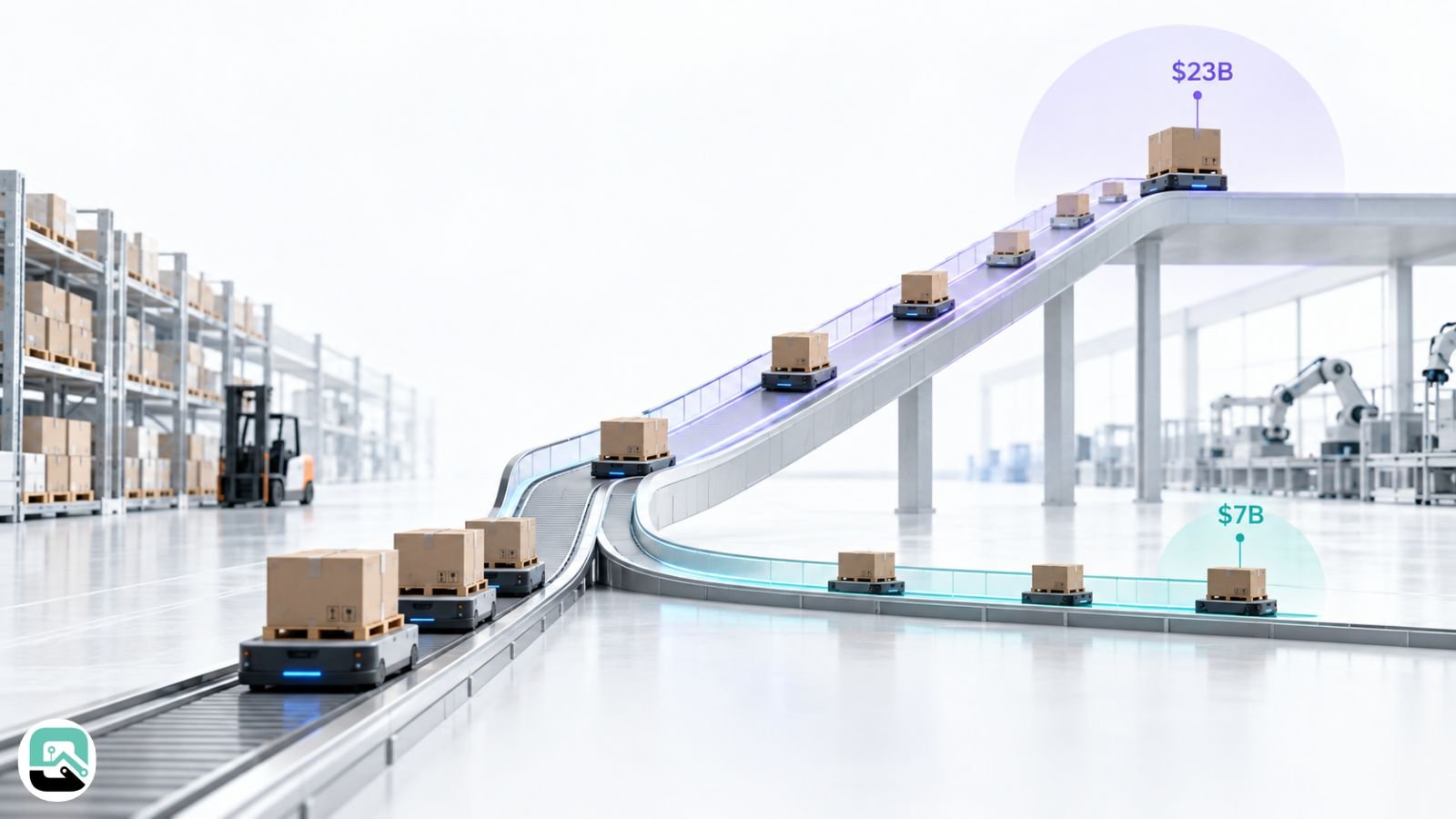
Start with the obvious: the 2030 endpoints differ by about 3.2 times. Less obvious, and more damaging, is that the publishers can’t agree on the present either. Grand View’s $6.5 billion for 2026 is roughly 1.7 times The Business Research Company’s $3.8 billion for the same year. Forecasting uncertainty doesn’t explain a disagreement about today.
The growth rates cluster into two camps with almost nothing between them — a fast group around 39–40% and a slow group around 15–17.5%. No public summary explains what separates the camps.
The tempting conclusion is that scope does it. But The Business Research Company’s taxonomy already includes exoskeletons and autonomous systems, so it isn’t visibly narrower than the MarketsandMarkets one. The public summaries simply don’t contain enough methodological detail to say how much of the difference comes from taxonomy, valuation method, product coverage or something else. That inability to reconcile them is the finding, and it’s worth more than a confident guess would be.
Humanoid robot market size by 2030
The humanoid revenue forecasts for 2030 sit between $6.5 billion and $11 billion.
| Publisher | Forecast | What it counts |
|---|---|---|
| BCC Research | $1.9B (2025) → $11B (2030); 42.8% CAGR reported by BCC | Commercially deployed hardware, wheeled and bipedal |
| ABI Research | $6.5B by 2030, 138% (2024–2030) | Humanoid form factor |
| MarketsandMarkets† | $5.41B (2026) → $50.27B (2035), 28.1% | Biped, wheeled and stationary humanoids |
The higher figure belongs to BCC Research, which models growth from $1.9 billion in 2025 to $11 billion by the end of 2030 on a 2024 base of $1.4 billion. ABI Research lands lower and steeper at once: $6.5 billion by the end of the decade, but a 138% CAGR from 2024 to get there.
Observation: ABI’s humanoid-only 2030 number sits just under The Business Research Company’s $7.24 billion for the whole of embodied AI. Those two reports cannot be drawing the same boundary, and no amount of careful reading will make them agree.
The bank numbers are a different animal. They’re scenarios; they run further out, and they should be labelled as such. Goldman Sachs sees 6.5 million units by 2035 against a $138 billion opportunity, led by logistics, warehousing and automotive. Morgan Stanley headlines $5 trillion by 2050; underneath that sits roughly a billion robots in use generating $4.7 trillion of annual revenue — and only about 13 million in use by 2035.
Shipments are not robots in operation
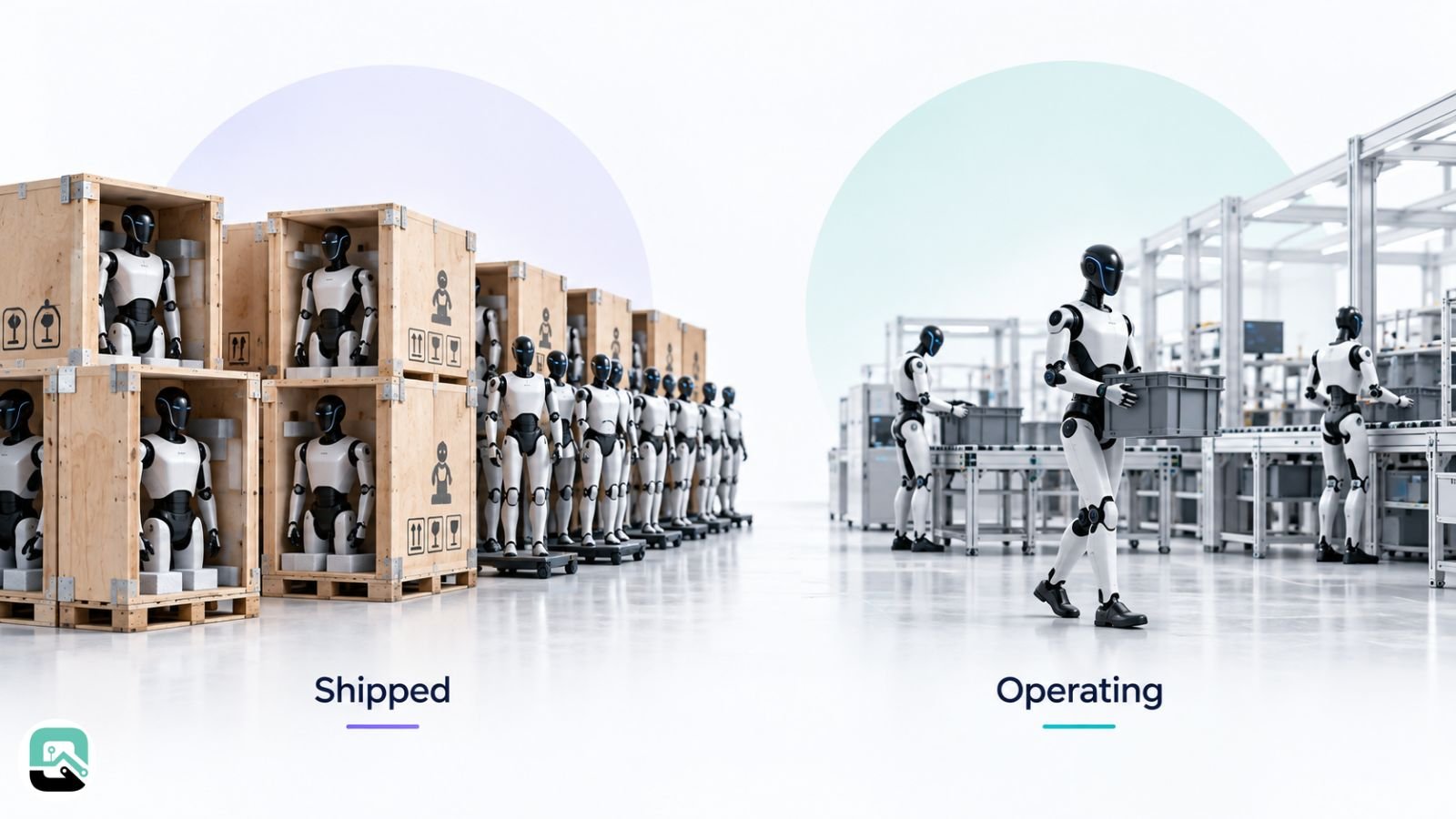
Shipments count units sent to customers during a period. Installed base counts units still running at a point in time. Mix them up, and you inflate the deployed fleet several times over.
| Source | 2026 | 2030 | Later |
|---|---|---|---|
| Goldman Sachs (Sept 2026) | ~75,000 | 890,000 | 6.5M (2035) |
| Bank of America (Mar 2026) | 90,000 | 1.2M | 10M (2035) |
| Smart Analytics Global (Aug 2026) | ~60,000 | 500,000 | — |
| Counterpoint Research (Aug 2026) | 50,000+ | — | — |
| ABI Research | — | 195,000 | — |
| Interact Analysis (May 2026) | — | 700,000+ (2035) |
Interact Analysis is the outlier in the other direction, describing near-term annual shipments as below 100,000, putting the commercial turning point around 2032, and projecting more than 700,000 annual shipments by 2035.
Now set all that against ABI’s installed-base forecast: 24,000 humanoids in operation in 2025, reaching 248,000 by 2030. China’s share of deployments falls from 97% to 72% across that period, with North America at 45,000 by 2030, Asia-Pacific excluding China at 11,000, Europe at 10,000, and the rest of the world at 4,000.
Goldman’s own numbers show how unstable this all is. Within a single revision, the bank moved 2030 from 256,000 to 890,000 units, 2026 from 51,000 to 75,000, and 2035 from about 1.4 million to 6.5 million, citing faster AI progress, cheaper hardware, and heavier investment.
Calculated: getting from 75,000 in 2026 to 890,000 in 2030 needs about 86% growth every year for four years running. Smart Analytics Global’s path from 60,000 to 500,000 needs about 70%.
What 2026 actually delivered
Shipments are growing quickly. Revenue isn’t keeping up with the bigger forecasts.
Smart Analytics Global counted roughly 19,100 shipments in the first half of 2026, more than triple the 5,100 units of a year earlier. It expects around 60,000 units for the full year, worth about $1.6 billion, rising to almost $3 billion in 2027. MarketsandMarkets, for the same year, puts the humanoid market at $5.41 billion.
Calculated: more than three times the tracker’s estimate. Before either figure gets used as a market-wide revenue number, both methodologies deserve a look.
There’s a tempting piece of arithmetic here, so let’s defuse it. Smart Analytics Global’s figures imply a revenue-to-unit ratio near $27,000 for 2026, and Goldman’s $138 billion across 6.5 million units implies about $21,000 per projected unit. Neither is a price. They’re ratios between two forecast aggregates. Morgan Stanley’s actual cost estimate for a humanoid in a high-income country was around $200,000 in 2024, falling to roughly $150,000 by 2028 and $50,000 by 2050.
Why units aren’t turning into revenue
Mostly it’s what’s being shipped. Counterpoint Research found entertainment, performance, data production and research humanoids still accounting for more than 60% of H1 2026 shipments, with intelligent manufacturing at 13% and warehousing and logistics at 5%. Smart Analytics Global reads it differently, putting industrial and commercial applications above 70%, up from about 50% a year earlier. Different category definitions, so don’t compare the percentages directly.
The vendor data makes the same point more bluntly. Both trackers rank the same top five in the same order, yet Counterpoint credits AgiBot with about 9,700 units on a global total above 22,000, while Smart Analytics Global credits it with 8,400 on a total of 19,100. Nobody has an audited count of this industry. If you want a sense of what a single unit in those tallies looks like in practice, our UBTECH Walker S2 review covers one of the five at the model level.
Scale check: the rest of robotics

The International Federation of Robotics counted 542,000 industrial robot installations worldwide in 2024, more than double the figure from a decade earlier. It expects 575,000 in 2025 and more than 700,000 by 2028.
Humanoids ship in the tens of thousands. Goldman’s 890,000 in 2030 would exceed every industrial robot installed worldwide in 2028.
That isn’t a like-for-like comparison — it sets humanoid shipments in one year against all industrial installations in another — but it gives you a feel for how steep the forecast really is.
What could knock the forecasts off course?
Cost is the pacing item. Goldman Sachs is reported to estimate $3,000 to more than $6,000 of semiconductor content per humanoid, covering compute, analog and mixed-signal chips, and edge storage. Bank of America puts a China-built bill of materials at about $35,000 in 2025 and below $17,000 by 2030, while pilot-stage Western units still run $90,000 to $100,000. The compression still ahead is large, and most forecasts assume it happens on schedule.
Then there’s the engineering. Reliability, real-world training data, and autonomy remain unsolved; Goldman lists them as obstacles while treating them as solvable ones. Interact Analysis is more explicit, making its outlook conditional on economic viability thresholds, breakthroughs in embodied AI for autonomous task execution, clearer regulation, and acceptable efficiency rates.
Trade policy is the wildcard nobody can model. Smart Analytics Global flags regulatory and geopolitical risk as a threat to overseas market access and deployment requirements, which is about as specific as anyone can currently be.
How to quote an embodied AI forecast
Attach the publisher, the category, the years and the metric to every figure. Then run five questions past it: what does it count, revenue or units, which years, which region, which edition. If the summary doesn’t answer one of them, say so rather than filling the gap yourself.
Three traps come up again and again.
One estimate, many pages. The MarketsandMarkets embodied AI figure appears on the publisher’s own report page, in a syndicated GlobeNewswire release, and in a ResearchAndMarkets.com listing. Its July 2026 humanoid release has been republished word for word across regional business sites. That’s one estimate wearing three hats.
Editions drift, and not only between publishers. SNS Insider’s July 2025 release put embodied AI at $9.34 billion by 2032 from a $3.02 billion 2024 base; the current report page shows $14.34 billion by 2035 from $3.48 billion in 2025. MarketsandMarkets is the sharper case. It currently publishes a humanoid figure of USD 2.92 billion in 2025, reaching USD 15.26 billion by 2030 at 39.2%, alongside a July 2026 release of USD 5.41 billion in 2026 reaching USD 50.27 billion by 2035 at 28.1%. Observation: nothing in either summary reconciles them, so the page you happen to land on decides your answer.
Last one, and the easiest to get right: scenarios are not forecasts. Label the 2035 and 2050 bank figures as scenarios, because that’s how the banks publish them.
Frequently asked questions
Q. What is the embodied AI robotics market size in 2025?
Published estimates for the embodied AI market in 2025 range from about $3.22 billion to $4.6 billion. MarketsandMarkets estimates $4.44 billion, Grand View Research $4.6 billion, SNS Insider $3.48 billion, and The Business Research Company $3.22 billion. The figures differ because each research firm uses its own market definition and methodology.
Q. What is the embodied AI robotics market size forecast for 2030?
Published 2030 embodied AI market forecasts vary significantly. Estimates examined in this analysis range from about $7.24 billion to $23.06 billion. The difference reflects varying definitions of embodied AI, product coverage, base years, and forecasting methodologies.
Q. Why do embodied AI market forecasts differ so much?
Embodied AI market forecasts differ because research firms do not measure the same market. Some include humanoid robots, industrial robots, mobile robots, exoskeletons, autonomous systems, and smart appliances, while others use narrower definitions. Reports may also measure revenue, annual shipments, installed robots, or total market opportunity, which makes direct comparisons difficult.
Q. Is embodied AI the same as physical AI?
No. Embodied AI and physical AI overlap, but market researchers do not always define them the same way. For example, MarketsandMarkets estimates the embodied AI market at $4.44 billion in 2025 while estimating the physical AI market at $0.89 billion for the same year. The difference comes mainly from category scope and methodology.
Q. How many humanoid robots could ship by 2030?
Published forecasts suggest annual humanoid robot shipments could reach roughly 195,000 to 1.2 million units by 2030. ABI Research projects about 195,000 units, Smart Analytics Global about 500,000, Goldman Sachs about 890,000, and Bank of America about 1.2 million. These figures represent annual shipments, not the total number of humanoid robots operating worldwide.
Q. What is the difference between humanoid robot shipments and installed base?
Humanoid robot shipments measure how many robots are delivered during a specific period. Installed base measures how many robots are actually operating at a given point in time. ABI Research forecasts about 248,000 humanoid robots in operation by 2030, which is not directly comparable with annual shipment forecasts.
Q. How much does a humanoid robot cost?
Humanoid robot costs vary widely by design, production scale, and country. Morgan Stanley estimated a humanoid robot could cost about $200,000 in high-income countries in 2024, falling to around $150,000 by 2028 and potentially $50,000 by 2050. Bank of America estimated the bill of materials for a China-built humanoid at about $35,000 in 2025, potentially falling below $17,000 by 2030.
Q. Are humanoid robot market forecasts the same as embodied AI market forecasts?
No. The humanoid robot market is only one segment of the broader embodied AI market in many research reports. Embodied AI forecasts may also include mobile robots, industrial robots, service robots, autonomous systems, exoskeletons, and smart appliances. A humanoid robot forecast therefore should not be used as a direct substitute for the overall embodied AI robotics market size.
Related: Agents, Robots, and Us: Why 57% of Work Doesn’t Mean 57% of Jobs
| Disclaimer: The market figures and forecasts in this article come from third-party research firms and public sources. Estimates may differ because of varying definitions, methodologies, base years, and market scope, and future results may change as new data becomes available. This article is for informational purposes only. |