


A stat like “AI could automate 57 percent of work” goes viral every few months. It gets stripped of context fast. Then it turns into a headline that sounds like a countdown clock on your job.
That number comes from a real report: Agents, Robots, and Us: Skill Partnerships in the Age of AI, published by the McKinsey Global Institute in November 2025. McKinsey qualifies that number carefully. Most secondhand coverage doesn’t bother.
The more interesting number isn’t 57 percent. It’s what happens to the skills inside that 57 percent — and to the more than 70 percent of skills the report says already straddle both automatable and non-automatable work. That’s the part most summaries skip. It’s also the part that decides whether your job changes at the edges or changes at the core.
Key takeaways:
- McKinsey’s 57% figure is a technical ceiling for US work hours — not a jobs forecast. Adoption lags far behind capability.
- Agents (software) account for 44 of those percentage points; robots (physical machines) account for 13, held back by dexterity, safety, and cost.
- More than 70% of employer-demanded skills already show up in both automatable and non-automatable work — the skill usually survives even as the job’s tasks shift.
- The $2.9 trillion figure is a midpoint 2030 estimate (~27% of hours automated), separate from the $6.4 trillion full technical potential.
- Europe (~58%) and Latin America (~57%) show similar technical potential to the US; adoption speed is where regions actually diverge.
What Did McKinsey Actually Find?

McKinsey’s “Agents, Robots, and Us” analyzes roughly 800 US occupations, 11 million job postings, and 190 business workflows to show how AI-powered “agents” (software automating cognitive tasks) and “robots” (machines automating physical tasks) will change the content of jobs and the skills they require — not simply how many jobs disappear.
The goal wasn’t counting jobs gained or lost. It was tracking how work itself shifts as agents and robots take on more of it.
One callout matters here. McKinsey’s “agent” isn’t the same thing most 2026 tech coverage means by “AI agent.” The report uses “agents” and “robots” as broad terms for any technology, AI-based or not, that automates nonphysical or physical work. A basic chatbot and a fully autonomous multistep system both count as “agents” in this framework. Keep that distinction in mind whenever the report’s language sounds more futuristic than its actual claim.
57% of Work Hours Isn’t 57% of Jobs
McKinsey estimates that today’s technology could theoretically automate about 57 percent of US work hours. Agents account for 44 percentage points of that; robots account for 13. That’s a technical ceiling — what’s possible given current capability, not a forecast of what companies will actually do.
The report backs this up with its own history lesson. As recently as 2023, only about one in five companies ran most of their applications in the cloud, despite cloud computing being mainstream since the mid-2000s. Electricity took over three decades to spread through industry. Technical potential and real-world adoption run on different clocks.
Nonphysical work makes up roughly two-thirds of US work hours. About a third of that draws on social and emotional skills — reading a room, building trust, judgment under ambiguity — that stay mostly outside AI’s reach for now. Physical work combining cognitive demand with fine motor skill and situational awareness resists automation for a similar reason: robots move slower toward that frontier than software does toward office work.
Robots make up only 13 of the 57 automatable percentage points. McKinsey attributes that gap to dexterity, mobility, and safety constraints on physical automation, plus cost: the report puts today’s per-unit price for advanced humanoid models at $150,000 to $500,000 in the US, needing to fall to roughly $20,000 to $50,000 before large-scale adoption becomes realistic — with publicly listed specs and pricing across current humanoid models still sitting well above that lower band.
The 7 Types of Jobs McKinsey Identified
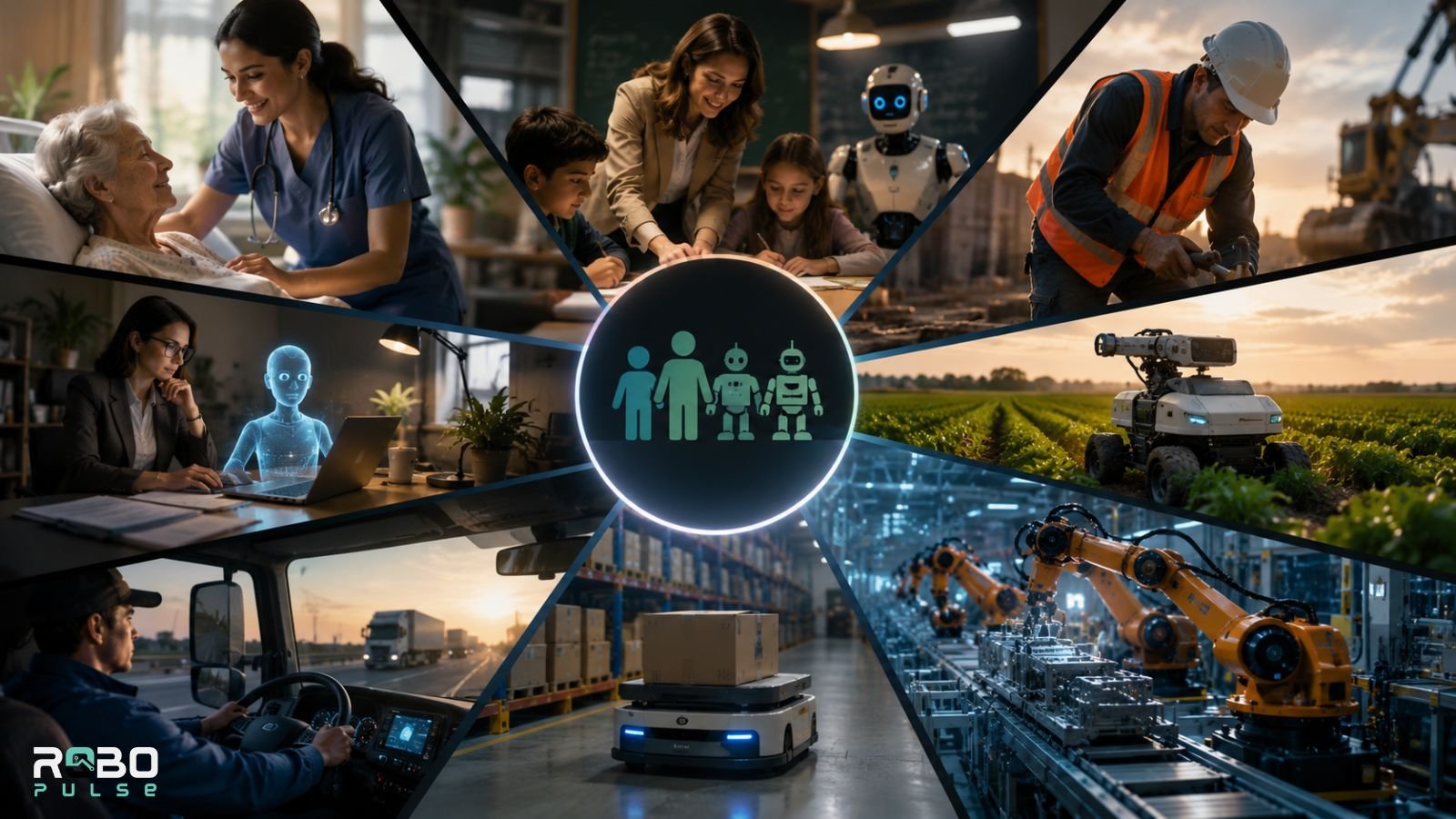
McKinsey sorts its 800 occupations into seven archetypes, based on how much of the work people, agents, or robots could handle. (The report’s exhibits label the combined category “agent–robot-centric”; the body text shortens this to “agent–robot roles” — same group, either name.)
| Archetype | Example roles | Avg. pay | Share of US workers |
|---|---|---|---|
| People-centric | Healthcare, building/maintenance | $71,000 | ~1 in 3 |
| People–agent | Teachers, engineers, financial specialists | $74,000 | ~1 in 5 |
| People–robot | Maintenance, construction | $54,000 | Under 1% |
| People–agent–robot | Transportation, agriculture, food service | $60,000 | ~5% |
| Agent-centric | Legal, administrative services | $70,000 | Part of ~40% combined |
| Robot-centric | Drivers, machine operators | $42,000 | Part of ~40% combined |
| Agent–robot-centric | Automated manufacturing, logistics | $49,000 | ~2% |
Agent-centric and robot-centric roles together make up about 40 percent of total US jobs — the highest automation potential of any group, split between the two rows above. High potential doesn’t mean imminent disappearance, though. People still guide, supervise, and verify this work, and cost plus practical constraints tend to keep humans involved well past the point something becomes technically automatable.
Your Job Title May Survive. Your Skill Stack Won’t
Here’s the report’s least-quoted, most important finding. Nearly every occupation has at least one “highly disrupted” skill — one landing in the top quartile of projected change by 2030. Roughly a third of occupations will see more than 10 percent of their skills highly changed.
That reframes the whole debate. Most workers won’t lose their job. They’ll keep the title while the tasks inside it shift, the tools change, and the skill mix required to stay “qualified” moves under their feet. Someone can hold the same title for five years and do meaningfully different work by the end of it — work that increasingly means directing and checking AI output instead of producing everything from scratch.
Radiology makes the point without the doom framing. Despite rapid advances in medical-imaging AI, US radiologist employment grew about 3 percent a year from 2017 to 2024. AI took on more image-analysis support work. Physicians kept the complex decisions and patient care. The job endured; what radiologists spend their time on shifted.
What This Looks Like Job by Job

McKinsey’s report doesn’t break its findings down profession by profession — it works at the skill and occupation-archetype level. But applying its core logic (routine, digital, rules-based tasks carry the highest exposure; judgment, relationships, and physical unpredictability carry the lowest) to roles readers ask about most gives a useful, if informal, picture:
| Role | What tends to shift toward AI | What tends to matter more |
|---|---|---|
| Accountant | Routine processing, reconciliation | Judgment, advisory work |
| Developer | Boilerplate coding, testing, documentation | Architecture, code review, system design |
| Marketer | Research, first-draft production, reporting | Strategy, positioning, judgment calls |
| Teacher | Lesson prep, admin, basic content | Instruction, relationships, classroom judgment |
| Healthcare worker | Documentation, information processing | Care, diagnosis, patient interaction |
| Lawyer | Research, first-pass document review | Interpretation, negotiation, client judgment |
| Manager | Analysis and reporting | Leadership, decision-making, coordination |
This is independent interpretation of the report’s framework, not a McKinsey-published table — treat it as a starting point for thinking about your own role, not a verdict on it.
What Should Organizations Actually Do About This?
Reading the report as a leader raises a different question than reading it as a worker: not “is my job exposed,” but “what do we do at each level of the organization?” Again, this is an independent application of the report’s own emphasis on workflow redesign and reskilling, not a McKinsey-published matrix:
| Organizational tier | Primary risk | Near-term priority |
|---|---|---|
| Entry-level workers | Hiring slowdown in routine roles | Shift from pure task execution toward reviewing and directing AI output |
| Mid-level managers | Workflow fragmentation from bolt-on tools | Redesign end-to-end processes instead of automating isolated tasks |
| Executives | Low realized ROI (McKinsey: under 40% report measurable results) | Reallocate budget from tool licenses toward workflow redesign and reskilling |
Which Skills Are Least Exposed to AI?
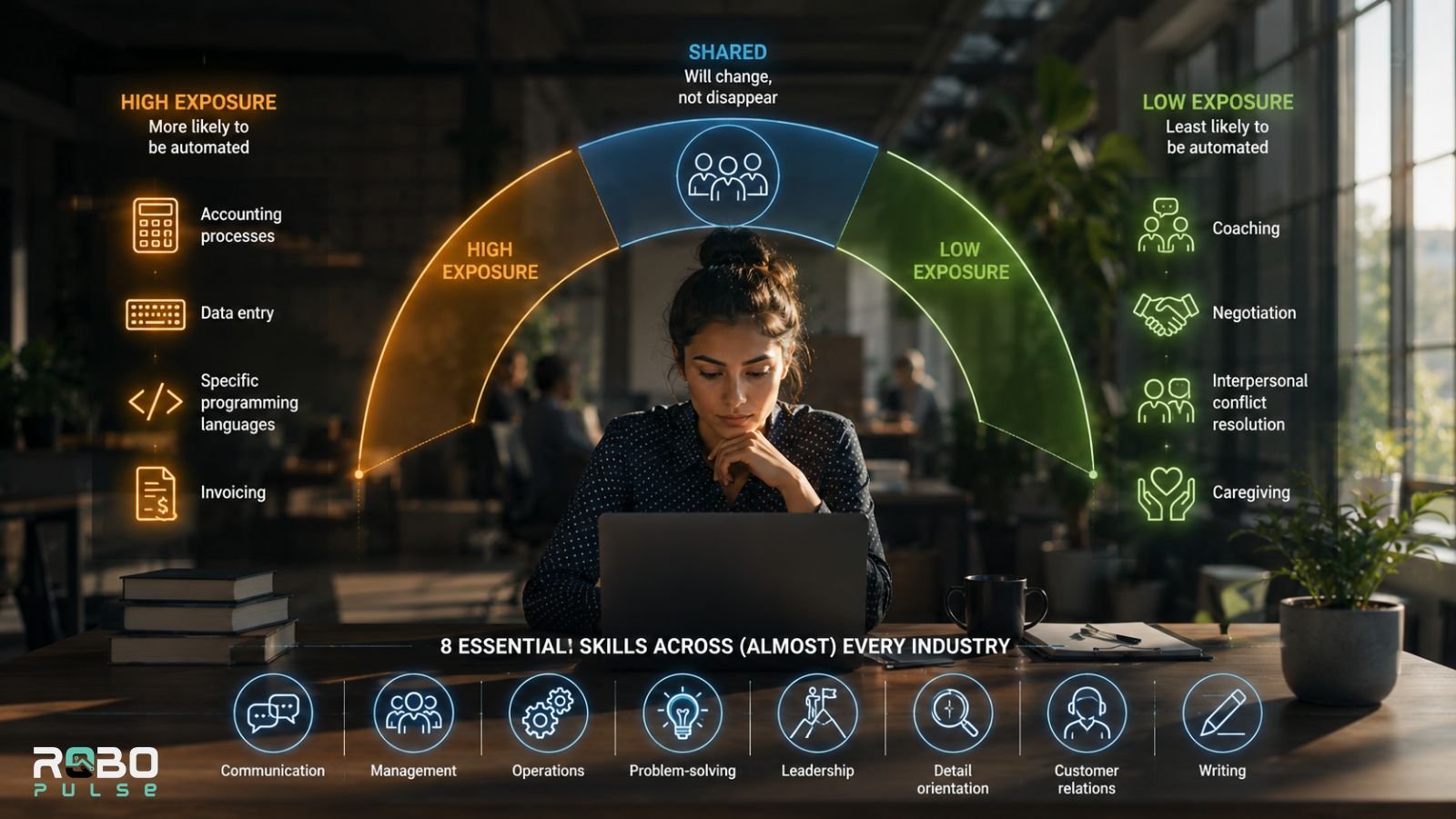
“Safest” overstates what McKinsey actually measures. The report tracks exposure to change, not a guarantee that a skill stays valuable forever. With that caveat in place, McKinsey’s Skill Change Index scores roughly 6,800 skills on how exposed each one is over the next five years.
Digital and information-processing skills rank highest for exposure: accounting processes, data entry, specific programming languages, invoicing. These are specialized and rules-based, and AI already handles versions of them well.
Skills built on social and emotional intelligence rank lowest: coaching, negotiation, interpersonal conflict resolution, caregiving. The largest group sits in between — a “shared” category where writing, research, and quality assurance don’t disappear but change in how people apply them, shifting from producing the work to directing and refining what AI produces.
Eight skills came up as essential across almost every industry, regardless of exposure level: communication, management, operations, problem-solving, leadership, detail orientation, customer relations, and writing. McKinsey treats these as the labor market’s connective tissue — worth building because they transfer, even as the tools around them keep changing.
AI Fluency Grew Nearly 7×. What Does It Actually Mean?
Demand for AI fluency — the practical ability to use and manage AI tools, not build them — grew nearly sevenfold in job postings over two years through mid-2025. Occupations requiring it now cover about seven million US workers, up from roughly one million in 2023. It’s spreading beyond tech into management, finance, marketing, and education.
In practical terms, AI fluency goes past prompting. It looks more like knowing when a task actually fits AI, giving a system the right context, evaluating whether output is correct, catching errors before they compound, folding AI into an existing workflow rather than bolting it on, and knowing when not to use it at all.
Demand still concentrates in a few places. Three occupational groups — computing and math, management, and business/finance — account for about three-quarters of all AI-skill demand today. Real shift, not yet a universal one.
Why Workflow Redesign Beats Adding an AI Tool

McKinsey analyzed 190 business processes and found roughly 60 percent of potential productivity gains concentrated in workflows specific to a sector’s core activities — supply chain in manufacturing, clinical diagnosis in healthcare, regulatory compliance in finance. Generic, cross-cutting tasks account for the rest.
That helps explain a separate McKinsey finding: nearly 90 percent of companies say they’ve invested in AI, but fewer than 40 percent report measurable results. Companies that add AI to individual tasks inside an unchanged process see limited returns. Companies that redesign the whole workflow see much larger ones — in the report’s own case studies, 30 to 50 percent time savings for sales teams, and roughly a 50 percent drop in cost per customer-service call, once the process itself got rebuilt.
What Does the $2.9 Trillion Number Mean?
The $2.9 trillion figure is McKinsey’s estimate of the annual US economic value AI-powered agents and robots could unlock by 2030, under a “midpoint” adoption scenario — about 27 percent of current work hours automated, ranging from 20 percent in healthcare to 31 percent in manufacturing. It’s not the technology’s full technical potential, which McKinsey separately puts at $6.4 trillion if adoption hit its theoretical ceiling.
It isn’t $2.9 trillion of new revenue appearing from nowhere. McKinsey is estimating the economic value tied to work hours that could be automated and redirected toward other productive uses — and how much of that gets captured depends on adoption speed, the relative cost of technology versus labor, and whether organizations rebuild workflows or just add a tool to an old process.
What the 2026 Follow-On Reports Add
The original report focused on the US. McKinsey has since published regional versions covering Europe (May 2026) and Latin America (July 2026).
Europe found about 58 percent of work hours across ten countries theoretically automatable. Latin America found about 57 percent. Both land close to the US figure — technical potential looks similar across advanced and developing economies alike.
Adoption is where the regions actually diverge. McKinsey puts Latin American AI adoption at roughly 14 percent of work hours, versus about 27 percent in the US and 25 percent in Europe. Labor costs, industry mix, regulation, infrastructure, and organizational readiness all shape how fast a region moves — even when the underlying technical potential looks similar.
So, Will AI Take Your Job?
McKinsey’s research suggests some part of the work in most roles is likely to be affected by automation, to varying degrees. The more useful question isn’t whether that’s true — it’s whether you can move toward the parts of your role built on judgment, relationships, and effective use of AI, since those are the parts the report consistently finds hardest to automate and slowest to lose value.
What Workers Should Do Now
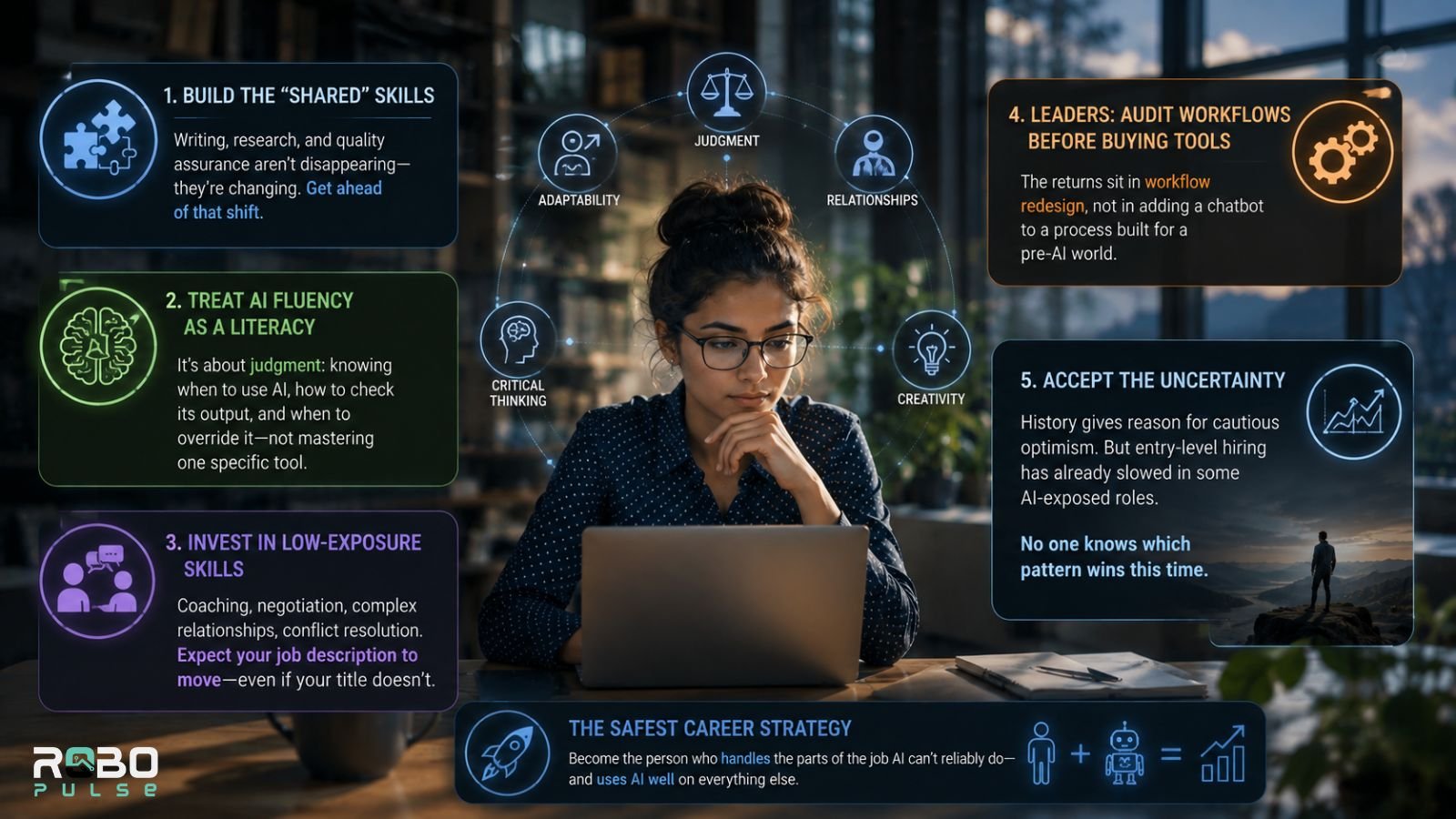
Build the “shared” skills, not just technical AI skills. Writing, research, and quality assurance aren’t disappearing — they’re changing in how people apply them. Get ahead of that shift instead of assuming these skills are obsolete.
Treat AI fluency as a literacy, not a certification. It’s about judgment: knowing when to use AI, how to check its output, and when to override it — not mastering one specific tool.
Invest in low-exposure skills if your role already leans on them: coaching, negotiation, complex client or patient relationships, conflict resolution. Expect your job description to move even if your title doesn’t; the realistic planning question is what you’ll be doing differently in two years, not whether the job still exists.
Leaders should audit workflows before buying tools. McKinsey’s own data says the returns sit in workflow redesign, not in adding a chatbot to a process built for a pre-AI world.
None of this settles the report’s own open question: whether a more AI-centric economy creates new jobs fast enough to absorb the ones it changes or displaces. McKinsey points to history — the Industrial Revolution, the spread of the internet — as reason for cautious optimism. It also notes that hiring has reportedly already slowed for entry-level programmers and analysts, the workers whose tasks AI currently handles best. The report is honest that it doesn’t know which pattern wins this time.
The safest career strategy, then, isn’t hunting for a job AI can never touch. It’s becoming the person who handles the parts of the job AI can’t reliably do — and uses AI well on everything else.
FAQs
Q. What is McKinsey’s “Agents, Robots, and Us” report?
McKinsey’s “Agents, Robots, and Us” is a November 2025 McKinsey Global Institute report about how automation could reshape US jobs, work tasks, and skills. The report analyzes roughly 800 occupations, 11 million job postings, and 190 business workflows to examine how software-based agents and physical robots could change the way work is performed.
Q. Does McKinsey’s “Agents, Robots, and Us” report say AI will eliminate 57% of jobs?
No. McKinsey’s 57% figure refers to the theoretical share of US work hours that could be automated, not 57% of jobs that will disappear. The 57% figure represents technical automation potential based on what current technology could theoretically handle. Actual job losses depend on factors such as technology adoption, costs, regulation, labor markets, and how companies redesign workflows.
Q. What does the 57% AI automation figure from McKinsey actually mean?
McKinsey estimates that about 57% of current US work hours could theoretically be automated using today’s technology. Software-based agents account for 44 percentage points of that potential, while robots account for 13 percentage points. The figure is a technical ceiling, not a prediction that 57% of US jobs will be replaced by AI.
Q. What is the difference between AI automation potential and actual job losses?
AI automation potential measures what technology could technically automate, while actual job losses depend on whether businesses adopt that technology and change their workflows. Adoption can be slowed by technology costs, regulation, safety requirements, infrastructure, organizational readiness, and the need for human judgment. This is why McKinsey’s 57% automation-potential figure should not be interpreted as a 57% job-loss forecast.
Q. Which jobs are most exposed to automation according to McKinsey?
McKinsey identifies agent-centric and robot-centric occupations as having some of the highest technical automation potential. Agent-centric work includes areas such as legal and administrative services, while robot-centric work includes drivers and machine operators. Together, these two categories represent about 40% of US jobs. High automation potential does not necessarily mean those jobs will disappear because humans can continue to supervise, verify, and manage automated work.
Q. Which skills are least exposed to AI according to McKinsey?
McKinsey finds that social and emotional skills generally have lower exposure to AI-driven change than routine digital and information-processing skills. Examples include coaching, negotiation, interpersonal conflict resolution, and caregiving. McKinsey does not describe these skills as “AI-proof”; rather, they are less exposed to automation than highly specialized, rules-based tasks such as data entry, accounting processes, and some programming tasks.
Q. What is McKinsey’s Skill Change Index?
The McKinsey Skill Change Index measures how exposed roughly 6,800 skills are to potential change from automation over the next five years. The index helps show which skills are likely to change significantly as agents and robots take over parts of existing work. Digital and information-processing skills tend to have higher exposure, while social and emotional skills tend to have lower exposure.
Q. What skills will become more important as AI changes jobs?
McKinsey identifies eight skills as essential across almost every industry: communication, management, operations, problem-solving, leadership, detail orientation, customer relations, and writing. These skills can remain valuable even when AI changes the tasks people perform because they support judgment, coordination, communication, and the effective use of technology.
Q. What is AI fluency, according to McKinsey’s “Agents, Robots, and Us” research?
AI fluency is the practical ability to use, evaluate, and manage AI effectively rather than simply knowing how to prompt an AI system. McKinsey reports that demand for AI fluency in US job postings grew nearly sevenfold over two years through mid-2025. AI fluency includes knowing when to use AI, providing the right context, checking AI outputs for errors, integrating AI into workflows, and recognizing when AI should not be used.
Q. What does McKinsey’s $2.9 trillion AI figure mean?
McKinsey’s $2.9 trillion figure represents estimated annual US economic value that AI-powered agents and robots could unlock by 2030 under a midpoint adoption scenario. That scenario assumes about 27% of current US work hours become automated. It is separate from McKinsey’s estimated $6.4 trillion of full technical potential, which assumes adoption reaches the theoretical automation ceiling.
Q. Has McKinsey published “Agents, Robots, and Us” research outside the US?
Yes. McKinsey published follow-up “Agents, Robots, and Us” research covering Europe and Latin America in 2026. The Europe report, published in May 2026, estimated that about 58% of work hours across ten countries were theoretically automatable. The Latin America report, published in July 2026, estimated about 57%. McKinsey found that technical automation potential is similar across regions, while actual AI adoption rates differ because of labor costs, industry mix, regulation, infrastructure, and organizational readiness.
Q. Will AI take my job according to McKinsey’s “Agents, Robots, and Us” report?
McKinsey’s “Agents, Robots, and Us” report does not predict that AI will simply eliminate most jobs; it shows that AI and automation are more likely to change the tasks and skills inside many jobs. The report finds that routine, digital, and rules-based tasks generally have greater automation potential, while judgment, relationships, social intelligence, and physical tasks requiring adaptability remain harder to automate. For workers, the bigger issue may be how their job changes rather than whether their job title disappears.
Related: The More Human a Robot Acts, the Faster People Lose Trust When It Fails