

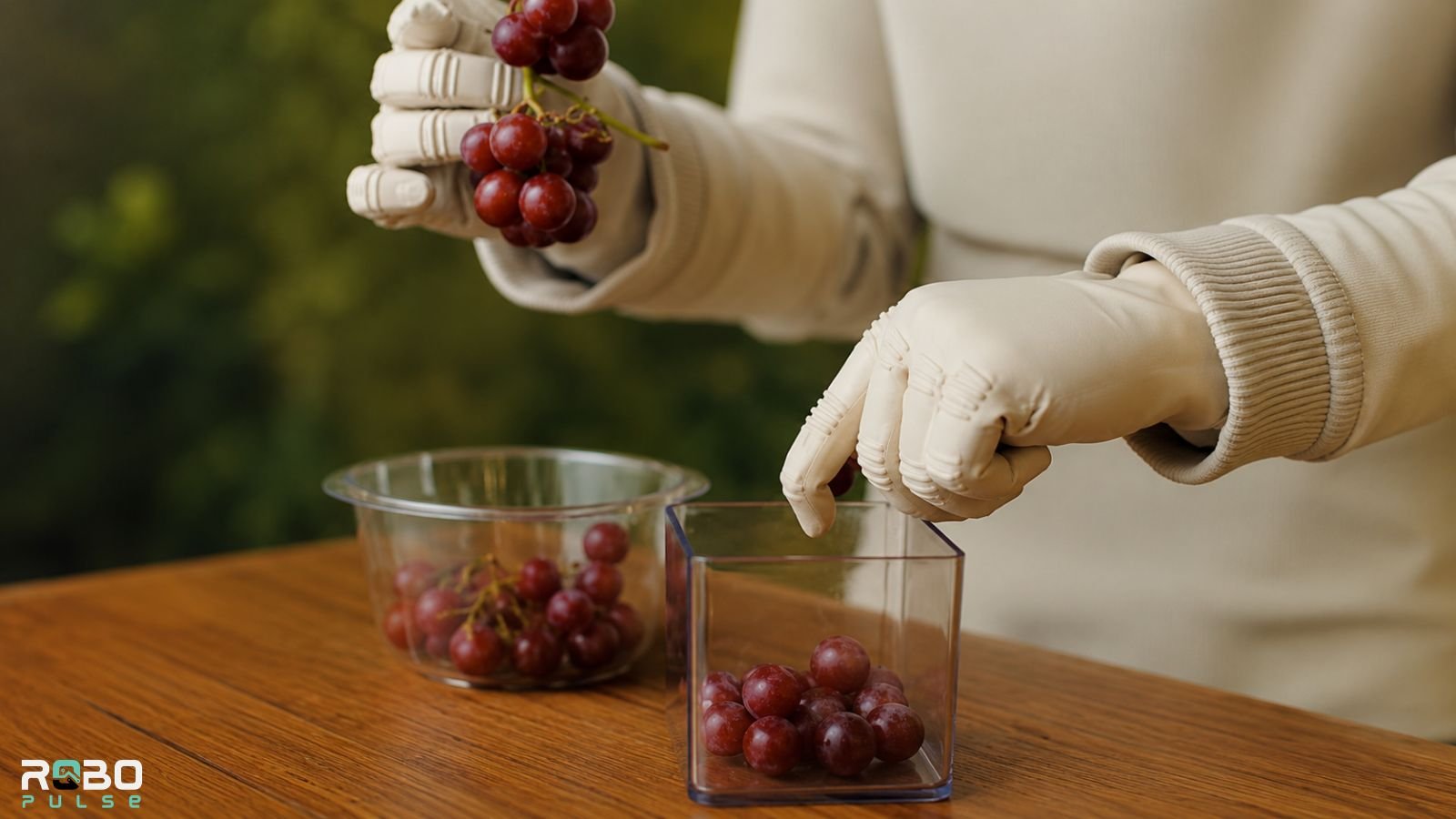
Tesla and Figure are racing to prove humanoids can work a factory floor. OpenAI-backed 1X Technologies just made a different bet. On July 9, 2026, the company unveiled 25-degree-of-freedom tendon-driven hands for its NEO platform. And it framed them as the last real barrier between humanoids and general household usefulness.
1X isn’t shy about the stakes here. A two-finger gripper limits a robot to three verbs: pick, place, push. Every task built on that hardware inherits the same ceiling, no matter how smart the AI model running it gets.
The Hardware, Verified
The new hands carry 25 total degrees of freedom. That breaks down to 22 fully actuated joints across the fingers and palm, plus 3 at the wrist. Each joint runs on 1X’s Tendon Drive system at gear ratios of roughly 5:1 to 15:1 — far below the 100:1 to 200:1 ratios most humanoid hands use today.
That low ratio is the entire pitch. High-ratio transmissions absorb contact forces before they reach the motor. So most robotic hands can act, but they can’t feel anything back. 1X calls the alternative “force transparency.” Push on a finger, and the joint reports exactly how hard you pushed.
Peak torque hits 3.5 Nm at the thumb CMC joint and 2.6 Nm at the finger MCP joints. Distal flexion forces reach up to 45N. The wrist alone delivers 17.75 Nm of torque, and positioning accuracy holds to ±0.2 mm.
Tactile skin adds a second sensing layer on top of that joint-level feedback. It tracks normal force, contact location, and slip across the fingertips in real time. 1X argues this closes a gap cameras can’t: vision-only systems struggle with small, transparent, or occluded objects.
The hands are IP68-rated and built with food-safe materials, so NEO can wash its own hands at a sink. Wrist joints are rated beyond 2 million cycles under high load. Still, these are 1X’s internal numbers, not independently audited ones.
The Factory Behind the Numbers
The hand release lands three months after 1X’s biggest operational milestone yet. In April 2026, the company opened a 58,000-square-foot factory in Hayward, California, and began full-scale NEO production. Unlike many competitors, 1X builds its motors, batteries, structures, and tendon systems in-house instead of outsourcing to external suppliers.
That vertical integration explains why hundreds of the new hands have already shipped off a dedicated production line. Capacity now sits at 10,000 units this year. And demand backs up the bet: NEO’s entire first-year production run sold out within five days of pre-orders opening in October 2025, at $20,000 outright or $499 a month on subscription.
For context on how that compares to the rest of the field, RoboPulse’s humanoid robot database tracks pricing and specs across every major platform, and the compare tool lets you weigh NEO’s hands against rivals like the Unitree G1, Apptronik Apollo, and Figure 03 side by side.
The OpenAI Connection
1X’s AI credibility traces back to a 2023 investment from the OpenAI Startup Fund. Samsung NEXT and EQT Ventures joined in later rounds. The company has used OpenAI’s models for NEO’s voice and reasoning stack, while building its own Redwood AI system in parallel — a dual-track approach that’s becoming common among humanoid makers courting foundation-model partners.
What the Hands Can’t Do Yet
1X’s demo reel shows NEO assembling LEGO, sorting grapes by color, and threading a USB-C cable. But the demos don’t emphasize one detail: NEO ships with an estimated 60-70% autonomy at launch. A human “Expert” fills the rest in through scheduled teleoperation, covering anything the AI hasn’t learned yet.
That’s not really a hardware problem — it’s a data problem, and 1X has said as much. Other humanoid markets are running into the same wall. China’s humanoid rental boom, for instance, is hitting similar autonomy ceilings even as hardware costs drop. Teleoperation, in that sense, is the bootstrap mechanism feeding the World Model that’s supposed to close the gap over time.
Why It Matters
The hand release sharpens an argument that’s been building all year: perception and planning may no longer be the bottleneck. Dexterity is. 1X is staking its entire home-robot thesis on that claim, and it’s backing the bet with a factory, not just a spec sheet.
Whether these hands become the industry baseline or stay a 1X differentiator depends on how fast rivals respond. Tesla Optimus Gen 3, Boston Dynamics’ Atlas Electric, and Agility Robotics’ Digit will need to match the sensing, not just the joint count, in their next hardware cycles.
Related: Why a $375,000 Robot Can’t Replace a $42,000 Worker