

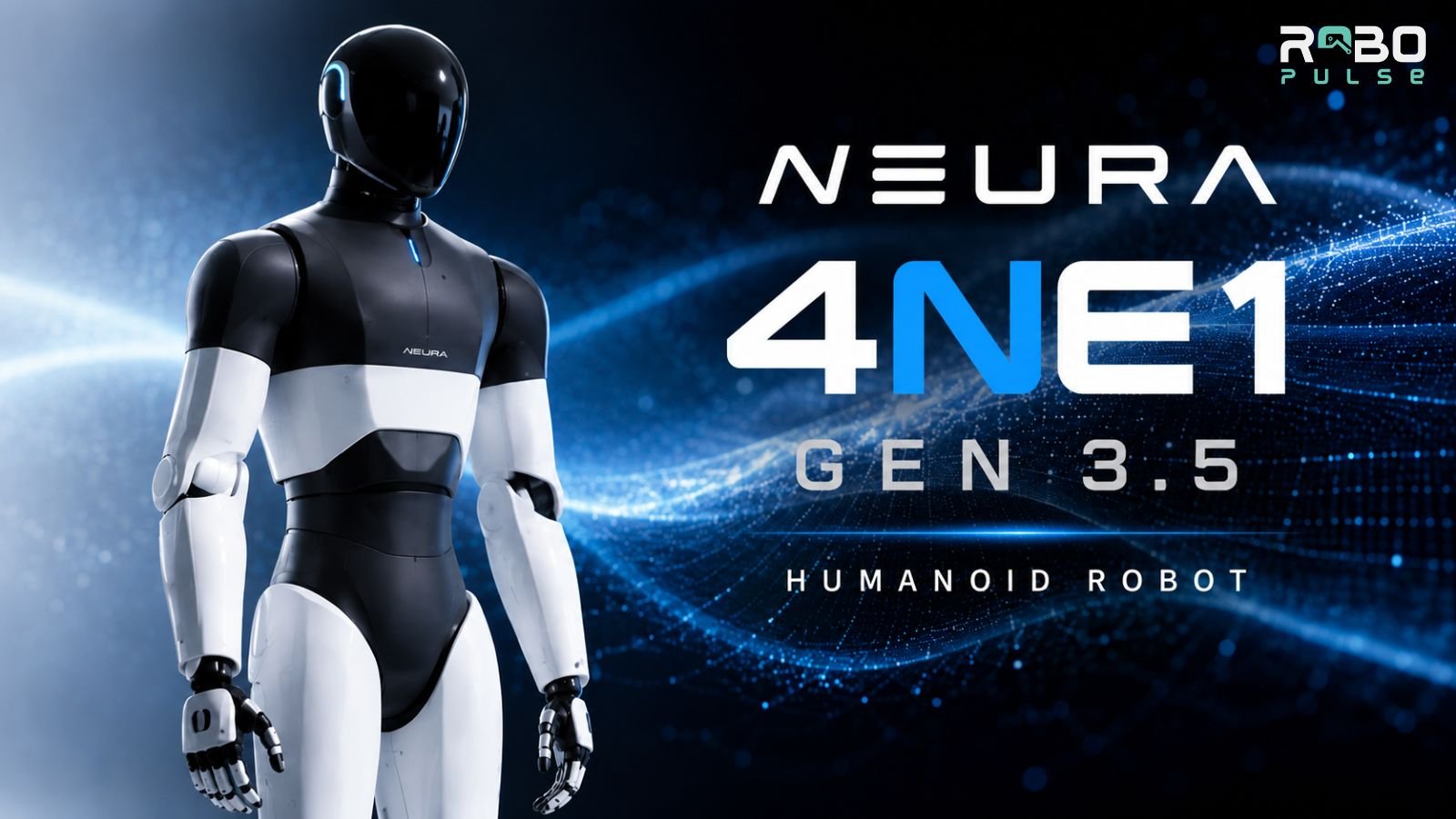
NEURA’s 4NE1 Gen 3.5 reservation costs €100 and is fully refundable. It holds a place in the delivery queue — it does not buy a robot today. NEURA prices the unit itself at €98,000 for 1–19 units or €60,000 per unit for 20 or more, excluding tax and shipping. Delivery targets the end of 2026.
What Is the NEURA 4NE1 Gen 3.5?

NEURA Robotics builds the 4NE1 Gen 3.5, a full-size humanoid robot standing 180 cm tall and weighing 80 kg. NEURA designed it to work alongside people in factories now, and in homes eventually. The robot is open for reservation today, not direct purchase.
NEURA Robotics is headquartered in Metzingen, Germany. CEO David Reger founded and leads the company. NEURA builds its products around “cognitive robotics” — robots that perceive and adapt in real time instead of running fixed scripts.
Studio F.A. Porsche designed the Gen 3.5’s exterior. Porsche’s design house also created the Porsche 911. NEURA confirmed the partnership at its CES 2026 unveiling.
NEURA has also described the compute stack in press interviews. CEO David Reger told IIoT World at Hannover Messe 2026 that the 4NE1 runs on an NVIDIA Thor T5000 processor paired with NVIDIA’s Isaac GR00T foundation model. NEURA’s Neuraverse platform handles fleet coordination across connected units. NEURA hasn’t added these two details to its product or datasheet pages yet, but independent reporting backs them up, so they’re solid enough to include here.
What Changed in the 4NE1 Gen 3.5?
The Porsche design partnership is the clearest confirmed change in Gen 3.5. NEURA showed earlier 4NE-1 prototypes back in mid-2024, covered at the time by TechCrunch and New Atlas. NEURA hasn’t published a spec-by-spec comparison between that early prototype and Gen 3.5, so treat any claimed generational upgrade beyond the design and pricing as unconfirmed. What’s actually new and verifiable: the Porsche exterior, the €98,000/€60,000 pricing structure, and a live reservation program.
What Is the 4NE1 Built to Do?
NEURA groups its broader robot applications around gluing and dosing, sanding and polishing, quality inspection, and welding across food and beverage, logistics, medical, metal and machining, and transportation industries — the same markets it serves with its MAiRA and LARA cobot arms. For now, however, NEURA views home assistance as a longer-term goal rather than a current use case.
How Much Does the 4NE1 Gen 3.5 Cost?
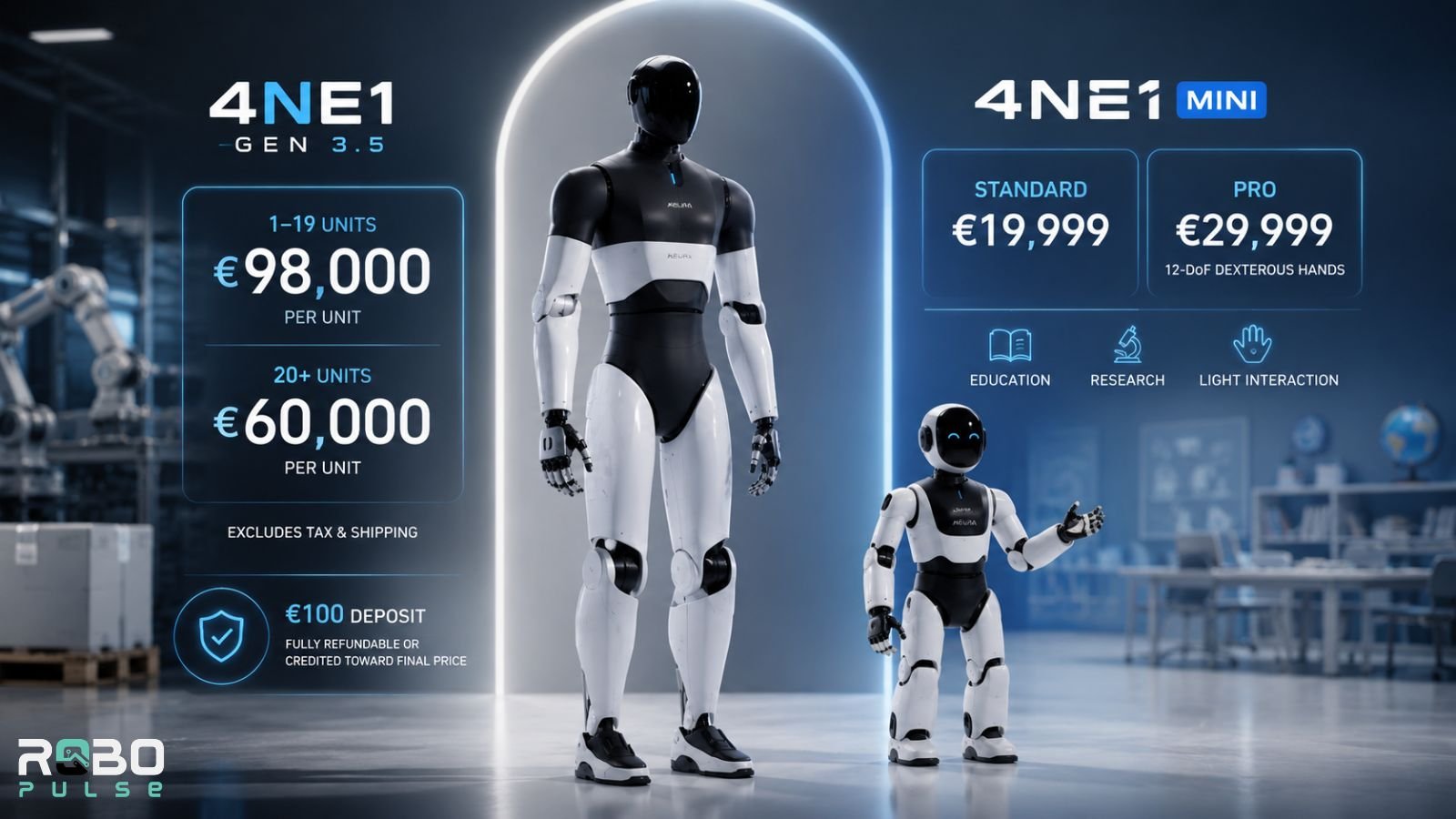
NEURA prices the 4NE1 Gen 3.5 at €98,000 per unit for orders of 1–19 units. Fleet orders of 20 or more drop to €60,000 per unit. Both prices exclude tax and shipping. A €100 deposit reserves a unit, and NEURA fully refunds it or credits it toward the final price.
The €38,000 gap between single-unit and fleet pricing signals NEURA’s real target market: industrial and commercial buyers ordering in volume, not individual households. A single unit at roughly $105,000 sits well above most collaborative robot arms and squarely in heavy-industrial pricing territory.
NEURA also sells a smaller, cheaper sibling. The 4NE1 Mini starts at €19,999 for the Standard configuration and €29,999 for the Pro configuration, which adds 12-DoF dexterous hands. Both Mini tiers carry the same €100 refundable reservation fee and target education, research, and light interaction rather than industrial payload work.
What Does the €100 Reservation Actually Buy?
A €100 reservation does not buy a robot that ships today. It secures a place in NEURA’s delivery queue for a unit currently targeted for end of 2026. NEURA refunds the fee at any point before you sign a final purchase agreement — otherwise the fee credits toward the total unit price.
What’s Included in the €98,000 Price — and What Costs Extra?
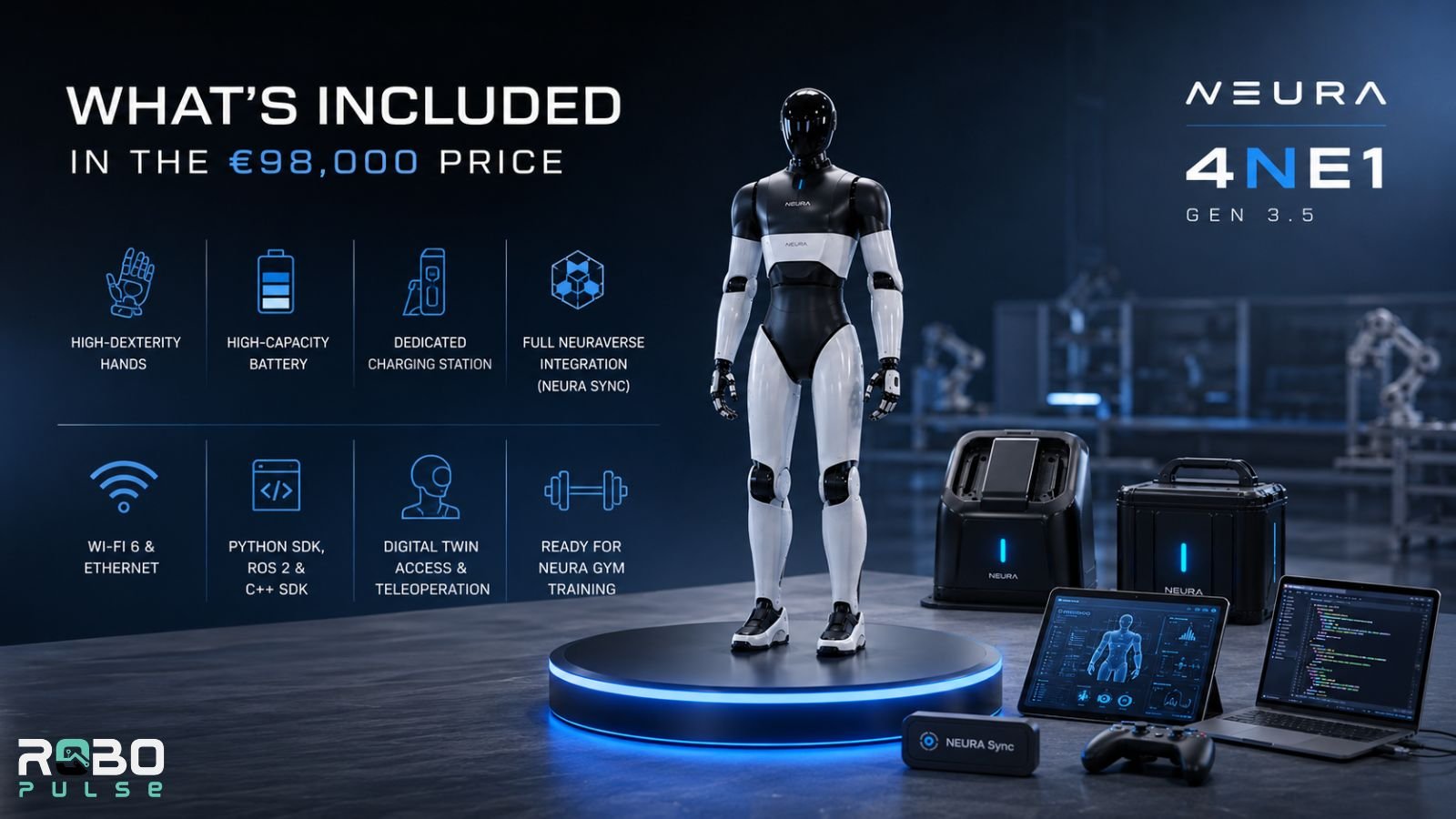
NEURA ships the 4NE1 Gen 3.5 as a complete, operational unit. The base price includes:
- Integrated high-dexterity hands
- A high-capacity battery
- A dedicated charging station
- Full Neuraverse integration via NEURA Sync
- Wi-Fi 6 and Ethernet connectivity
- Python SDK, ROS 2 interface, and C++ SDK
- Digital twin access and teleoperation
- Readiness for NEURA Gym training
NEURA doesn’t include specialized or third-party end effectors — those cost extra. The €98,000 price also excludes shipping, applicable taxes, and the cost of integrating the robot into an existing MES/ERP or factory floor system. NEURA hasn’t published a figure for any of these, so budget for them separately.
You’re also not locking in a finished product today. NEURA says the 4NE1 will keep its “signature design philosophy and core technical specifications,” but hardware and aesthetic refinements are still possible before the late-2026 release. That’s a normal caveat for pre-production hardware. It also means a reservation buys deposit-and-wait pricing for a spec sheet that could still shift.
4NE1 Gen 3.5 Specifications
| Spec | 4NE1 Gen 3.5 | Source status |
|---|---|---|
| Height | 180 cm | NEURA-published |
| Weight | 80 kg | NEURA-published |
| Payload | 10–100 kg | NEURA-published |
| Walking speed | 5 km/h | NEURA-published |
| Design | Exterior co-designed with Studio F.A. Porsche | NEURA-confirmed at CES 2026 |
| Compute/AI | NVIDIA Thor T5000 processor, NVIDIA Isaac GR00T | Reported by NEURA at press events; not on datasheet page |
| Manipulation | Integrated high-dexterity hands | NEURA-published |
| Connectivity | Wi-Fi 6, Ethernet | NEURA-published |
| Software interfaces | Python SDK, ROS 2, C++ SDK | NEURA-published |
| Platform integration | Full Neuraverse connection via NEURA Sync | NEURA-published |
| Extras | Digital twin access, teleoperation, Neura Gym training-ready | NEURA-published |
| Configurations | Wheeled industrial variants and 7th-axis versions for extended reach, available on inquiry | NEURA-published |
What Does the 10–100 kg Payload Range Actually Mean?
NEURA publishes 4NE1’s payload as a 10–100 kg range, not a single fixed number. Most coverage of this robot rounds that up to a flat “100 kg” figure, which overstates what the robot lifts in typical use. Treat 100 kg as a ceiling across configurations, not a normal working load. NEURA hasn’t published a separate sustained or continuous payload figure, so don’t trust any specific number you see claiming otherwise.
How Long Does the 4NE1’s Battery Last?
NEURA hasn’t published a battery runtime or charging-time figure for the 4NE1 on its current product or datasheet pages. Event coverage has widely reported hot-swap battery capability, but NEURA hasn’t confirmed it in writing, so it’s left out here rather than repeated as fact.
How Many Degrees of Freedom Does the 4NE1 Have?
NEURA hasn’t published a single authoritative degrees-of-freedom figure for the 4NE1. Third-party listings range from roughly 25 to 45, with no NEURA source to check any of them against. Treat all of those numbers as unconfirmed. For background on what DoF actually measures, and why it isn’t a clean apples-to-apples spec across manufacturers, see our degrees of freedom explainer.
What Hasn’t NEURA Publicly Confirmed?
- Sustained or continuous payload (only the 10–100 kg range is published)
- Battery runtime and charging time
- Degrees of freedom and joint torque
- Safety certification status, including collaborative-robot standards and CE marking specifics
- Maintenance, warranty, and service terms
- Total deployment cost beyond the unit price
- A guaranteed, contractual delivery date
This list doesn’t mean the 4NE1 lacks these things. NEURA already sells OmniSensor and Sensor Skin safety hardware as standalone products. It means NEURA hasn’t put a specific number or certification on the record for the 4NE1 yet. Read vendor silence as “not yet published,” not as “doesn’t exist.”
Is the Late-2026 Release Date Realistic?
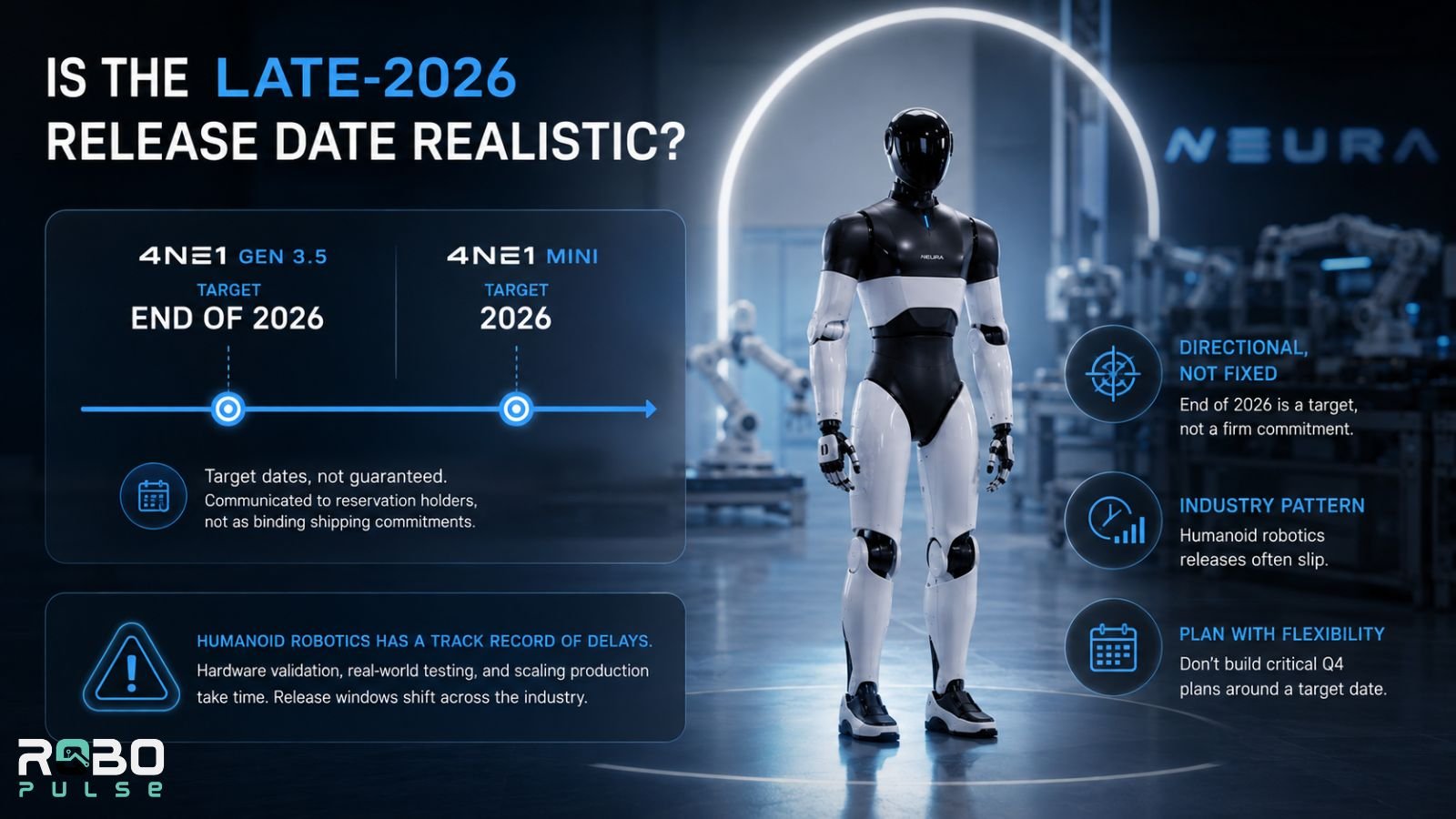
NEURA targets the end of 2026 for the 4NE1 Gen 3.5 and 2026 for the 4NE1 Mini. Neither date is contractually guaranteed. NEURA communicates both as targets to reservation holders, not as shipping commitments tied to a purchase agreement.
Humanoid robotics has a well-documented pattern of slipping release windows industry-wide. Read NEURA’s “end of 2026” target as directional, not fixed. If you’re weighing a deposit, treat the date the way you’d treat any pre-order timeline from a company still finishing hardware validation: plausible, but not something to build a Q4 business plan around.
4NE1 Gen 3.5 vs. 4NE1 Mini: Which One Fits Your Use Case?
| 4NE1 Gen 3.5 | 4NE1 Mini (Standard / Pro) | |
|---|---|---|
| Price | €98,000 (1–19 units) / €60,000 (20+) | €19,999 / €29,999 |
| Height | 180 cm | Compact form factor |
| Target use | Industrial manipulation, transport, logistics | Education, research, interaction, entertainment |
| Manipulation | Integrated high-dexterity hands | Not included (Standard) / 12-DoF hands (Pro) |
| Expected delivery | Late 2026 | 2026 |
Choose the Gen 3.5 for industrial deployment — machine tending, palletizing, logistics — since it’s the only variant built for that payload range. Choose the Mini for research, classroom use, or early hands-on time with NEURA’s cognitive AI stack on a smaller budget. The Standard tier works well if you don’t need manipulation.
The Mini can’t do Gen 3.5’s industrial work. NEURA positions the Mini for education, research, and light interaction, not high-payload manipulation.
Check our compare tool and full robot database for a side-by-side against other humanoid platforms before committing a deposit to any one company. We’ve also reviewed several of 4NE1’s likely cross-shopped competitors individually, including Unitree G1, Apptronik Apollo, and Figure 03 — useful reading if you’re weighing 4NE1 against robots that ship today rather than one still on reservation.
Should You Reserve the 4NE1 Gen 3.5?
Reserve now if:
- You’re evaluating humanoids for 2026–2027 deployment and want an early queue position
- €100, fully refundable, is an acceptable cost to hold that place
- You’re comfortable committing to a pre-production spec sheet that may still shift
- You’re planning a volume order, where the €60,000 fleet price applies
Wait if:
- You need a firm, contractually guaranteed delivery date
- Your deployment plan depends on today’s exact specifications not changing
- You want independently verified payload, battery, or performance data before committing
- You’re still comparing 4NE1 against other humanoid platforms on the market
Frequently Asked Questions
Q. Is the NEURA 4NE1 Gen 3.5 available to buy?
No. NEURA Robotics does not sell the 4NE1 Gen 3.5 for immediate delivery yet. NEURA accepts €100 fully refundable reservations for a place in the delivery queue and targets deliveries for the end of 2026. The reservation does not mean the robot ships today.
Q. How much does the NEURA 4NE1 Gen 3.5 cost?
The NEURA 4NE1 Gen 3.5 costs €98,000 per unit for orders of 1–19 robots and €60,000 per unit for orders of 20 or more. Both prices exclude taxes and shipping. NEURA also charges a €100 refundable reservation fee. The smaller 4NE1 Mini starts at €19,999.
Q. What is the difference between the NEURA 4NE1 Gen 3.5 and 4NE1 Mini?
The 4NE1 Gen 3.5 serves industrial applications, while the 4NE1 Mini targets education, research and lighter interaction. The Gen 3.5 stands 180 cm tall, weighs 80 kg and handles tasks such as machine tending, palletizing, logistics and material handling. The 4NE1 Mini costs much less, starting at €19,999, and NEURA does not position it for the Gen 3.5’s high-payload industrial work.
Q. Is the €100 NEURA 4NE1 reservation fee refundable?
Yes. NEURA refunds the €100 reservation fee if you cancel before signing the final purchase agreement. If you proceed with the purchase, NEURA credits the €100 toward the robot’s final price.
Q. What is the NEURA 4NE1 Gen 3.5 payload capacity?
NEURA lists a 10–100 kg payload range for the 4NE1 Gen 3.5. The company does not give one fixed working payload, so you should treat 100 kg as the upper end of the published range, not as the robot’s normal sustained lifting capacity. The actual payload depends on the task and configuration.
Q. Who makes the NEURA 4NE1 humanoid robot?
NEURA Robotics makes the 4NE1 Gen 3.5. The German robotics company operates from Metzingen, and CEO David Reger leads the company. NEURA develops humanoid and collaborative robots around its “cognitive robotics” approach.
Q. Does the NEURA 4NE1 Gen 3.5 come with hands and a battery?
Yes. The NEURA 4NE1 Gen 3.5 includes integrated high-dexterity hands, a high-capacity battery, and a dedicated charging station. The package also includes Neuraverse integration, Wi-Fi 6, Ethernet, Python and C++ SDKs, a ROS 2 interface, digital twin access and teleoperation. Specialized or third-party end effectors cost extra.
Q. Who designed the NEURA 4NE1 Gen 3.5?
Studio F.A. Porsche designed the exterior of the NEURA 4NE1 Gen 3.5 with NEURA Robotics. NEURA confirmed the partnership at CES 2026. Studio F.A. Porsche also designed the Porsche 911.
Q. When will the NEURA 4NE1 Gen 3.5 launch?
NEURA targets the end of 2026 for 4NE1 Gen 3.5 deliveries. The company treats that date as a target rather than a contractual shipping commitment. Buyers should therefore view late 2026 as a provisional timeline.
Q. How tall and heavy is the NEURA 4NE1 Gen 3.5?
The NEURA 4NE1 Gen 3.5 stands 180 cm tall and weighs 80 kg. NEURA also lists a 5 km/h walking speed and a 10–100 kg payload range.
Q. What is the NEURA 4NE1 Gen 3.5 battery runtime?
NEURA has not published a confirmed battery runtime or charging time for the 4NE1 Gen 3.5. Some event reports mention hot-swappable batteries, but NEURA has not confirmed that feature on its current product or datasheet pages.
Q. How fast can the NEURA 4NE1 Gen 3.5 walk?
The NEURA 4NE1 Gen 3.5 can walk at up to 5 km/h according to its published specifications. NEURA lists the walking speed alongside the robot’s 180 cm height, 80 kg weight and 10–100 kg payload range.
Q. How many degrees of freedom does the NEURA 4NE1 Gen 3.5 have?
NEURA has not published an official degrees-of-freedom (DoF) figure for the 4NE1 Gen 3.5. Third-party sources give different numbers, so you should treat those figures as unconfirmed until NEURA publishes an official specification.
Q. Is the NEURA 4NE1 Gen 3.5 a home robot?
No. NEURA primarily targets the 4NE1 Gen 3.5 at industrial applications rather than current household use. The company focuses on machine tending, palletizing, logistics, and material handling. NEURA views home assistance as a longer-term goal.
Related: Sanctuary AI Phoenix Gen 7: Specs, Price & 2026 Status