

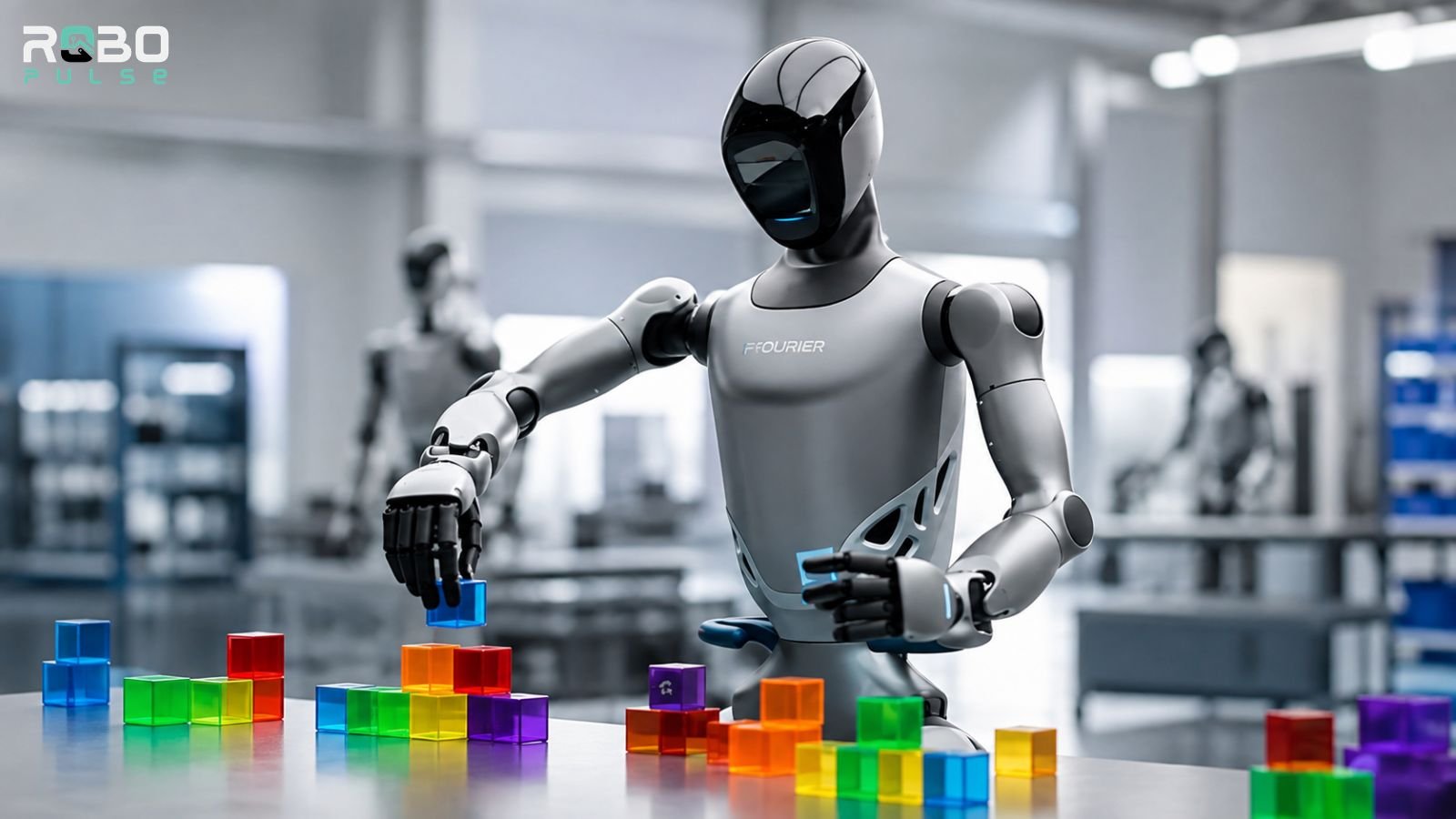
Fourier GR-2 is a 175 cm, 53-DoF humanoid robot from Fourier, launched in September 2024 as the successor to the GR-1. It targets research, healthcare, and industrial pilots rather than consumers. Fourier doesn’t sell it through a normal storefront, and the company has never listed an official purchase price.
GR-2 keeps the GR-1’s human-scale footprint but reworks the joints, hands, and power system around real deployments: hospital reception, academic labs, and manufacturing pilots. This review separates what Fourier has confirmed from what’s estimated, and shows where the robot fits against other humanoids in its class.
Fourier GR-2 at a Glance
| Question | Answer |
|---|---|
| What is it? | General-purpose humanoid robot |
| Who makes it? | Fourier |
| When did it launch? | September 2024 |
| Height/weight | 175 cm / ~63 kg |
| Degrees of freedom | Up to 53 (12-DoF hands) |
| Walking speed | 5 km/h |
| Battery | ~2-hour swappable pack |
| Official price | Not published by Fourier |
| Target users | Research labs, hospitals, industrial pilots |
What Is the Fourier GR-2?
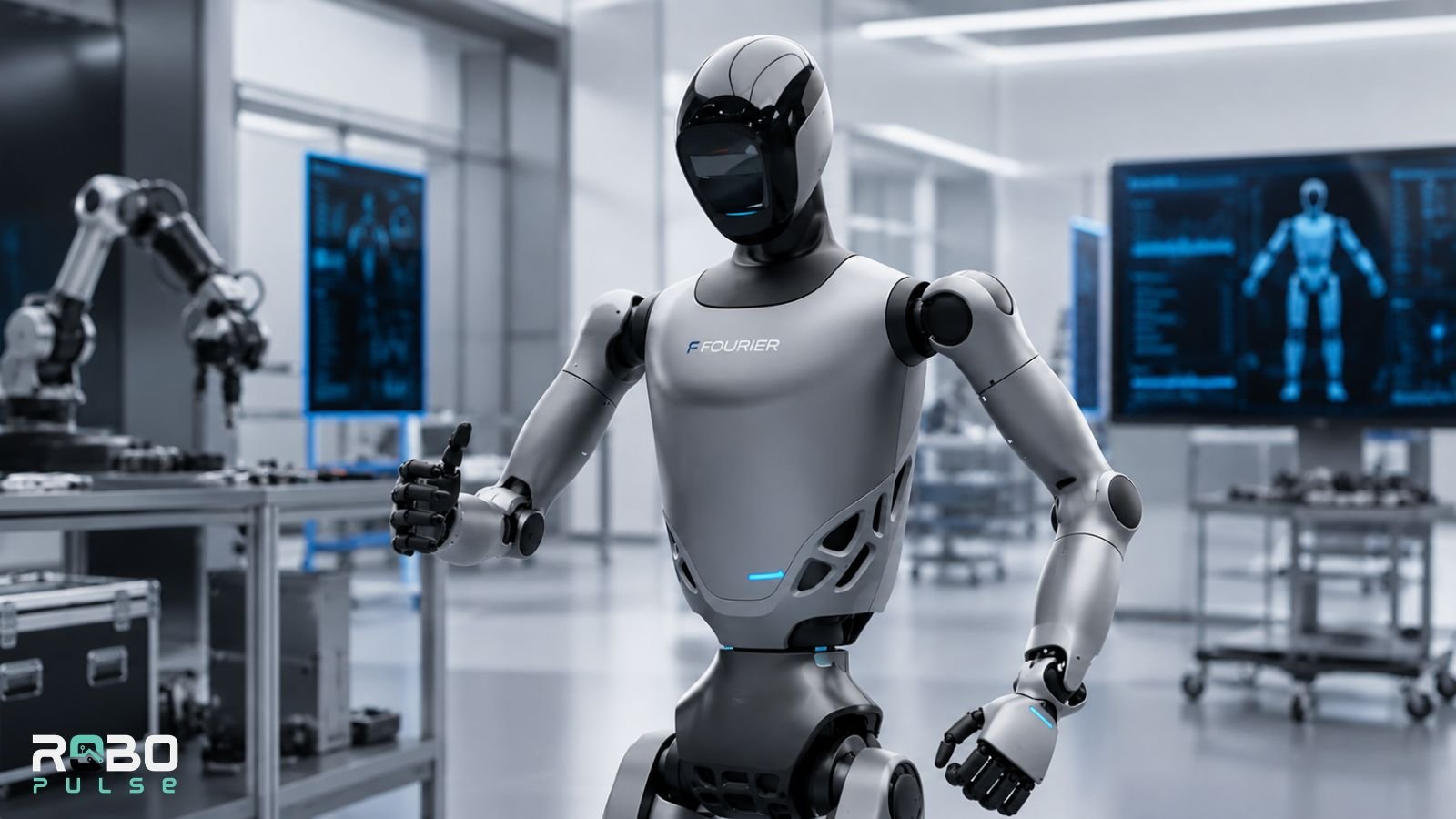
GR-2 is Fourier’s second-generation general-purpose humanoid, built to bridge lab research and practical deployment. It replaces the GR-1’s earlier actuators and hands with a stronger, more dexterous platform aimed at teams working on embodied AI, teleoperation, and manipulation research.
Fourier has built rehabilitation robots and exoskeletons since 2017, and that background shows up directly in GR-2’s design: force-sensing hands, compliant actuation, and an early focus on healthcare and rehab applications alongside industrial and research use.
What Are the Fourier GR-2’s Core Specs?
What Are the Fourier GR-2’s Core Specs?
The figures below come from Fourier’s official GR-2 specifications and its launch announcement.
| Spec | Value |
|---|---|
| Height | 175 cm |
| Weight | ~63 kg |
| Degrees of freedom | Up to 53 (body), 12-DoF hands |
| Peak torque | Exceeds 380 N·m (FSA 2.0 actuators) |
| Walking speed | 5 km/h |
| Single-arm payload | 3 kg |
| Battery | Detachable, ~2-hour average runtime |
| Tactile sensing | 6 array-type sensors per hand |
| Compute/software | ROS, NVIDIA Isaac Lab, MuJoCo |
| Control modes | VR teleoperation, lead-through programming, direct command |
A few third-party listings cite a slightly heavier weight (65 kg) or a higher torque figure. Those numbers aren’t in Fourier’s own materials, so they’re left out here rather than presented as fact.
What’s New in GR-2 Compared With the GR-1?
GR-2 is larger and more capable in joint torque, hand dexterity, sensing, and battery flexibility than the GR-1, although the published payload figures use different measurement definitions. Every figure below comes from Fourier’s own launch materials or contemporaneous reporting on the GR-1’s original release.
| Feature | GR-1 | GR-2 |
|---|---|---|
| Height/weight | 165 cm / 55 kg | 175 cm / ~63 kg |
| Degrees of freedom | 40 | Up to 53 |
| Hand dexterity | Fewer hand DoF, no tactile arrays | 12-DoF hands, 6 tactile sensors each |
| Peak torque | 300 N·m (hip joint) | Exceeds 380 N·m |
| Payload | 50 kg carry capacity | 3 kg per arm |
| Battery | Fixed, non-swappable | Detachable, ~2x capacity, hot-swappable |
Note the payload figures aren’t directly comparable: Fourier measured GR-1’s 50 kg as a whole-body carry rating, while GR-2’s 3 kg figure is a single-arm manipulation payload. The hands, not raw carry strength, are where GR-2 actually improved.
What Can the Fourier GR-2 Actually Do?
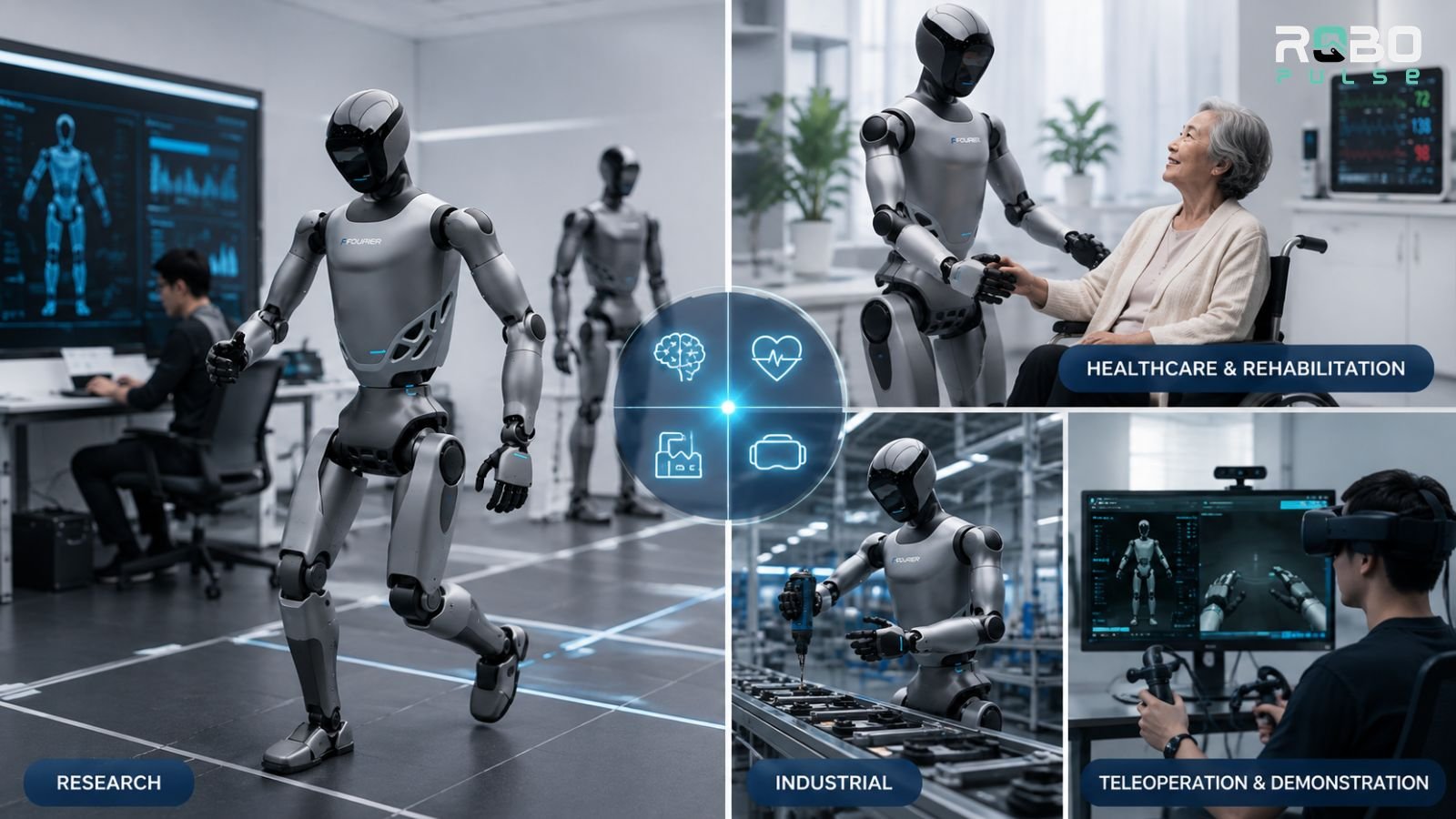
GR-2 supports research into locomotion, manipulation, and embodied AI, plus early pilots in healthcare and manufacturing — though most of what’s public comes from Fourier’s own marketing rather than independent case studies.
Research. Labs use GR-2 for manipulation, bipedal locomotion experiments, and embodied-AI training, aided by its ROS, Isaac Lab, and MuJoCo support.
Healthcare and rehabilitation. Fourier positions GR-2 for guidance, consultation, and rehab-adjacent roles, drawing on the company’s existing medical robotics business. This is a marketed application, not evidence of clinical deployment at scale.
Industrial. Fourier lists manufacturing as a target sector for GR-2, consistent with the broader push toward factory-floor humanoids across the industry. This is a target application rather than evidence that GR-2 has entered widespread factory deployment.
Teleoperation and demonstration. VR remote control and lead-through programming let operators drive the robot directly or teach it motions by hand — useful for data collection and live demos, distinct from independent task execution.
Is the Fourier GR-2 Autonomous?
GR-2 supports several control methods, but none of them amount to full autonomy. VR teleoperation, lead-through programming, and direct commands are all forms of human-guided control, not independent decision-making.
Control interfaces aren’t the same thing as autonomy. A robot that can be teleoperated or taught a motion by hand isn’t necessarily capable of planning and executing open-ended tasks on its own — and Fourier’s public materials don’t claim that GR-2 can.
What Makes the GR-2’s Hands and Actuators Different?
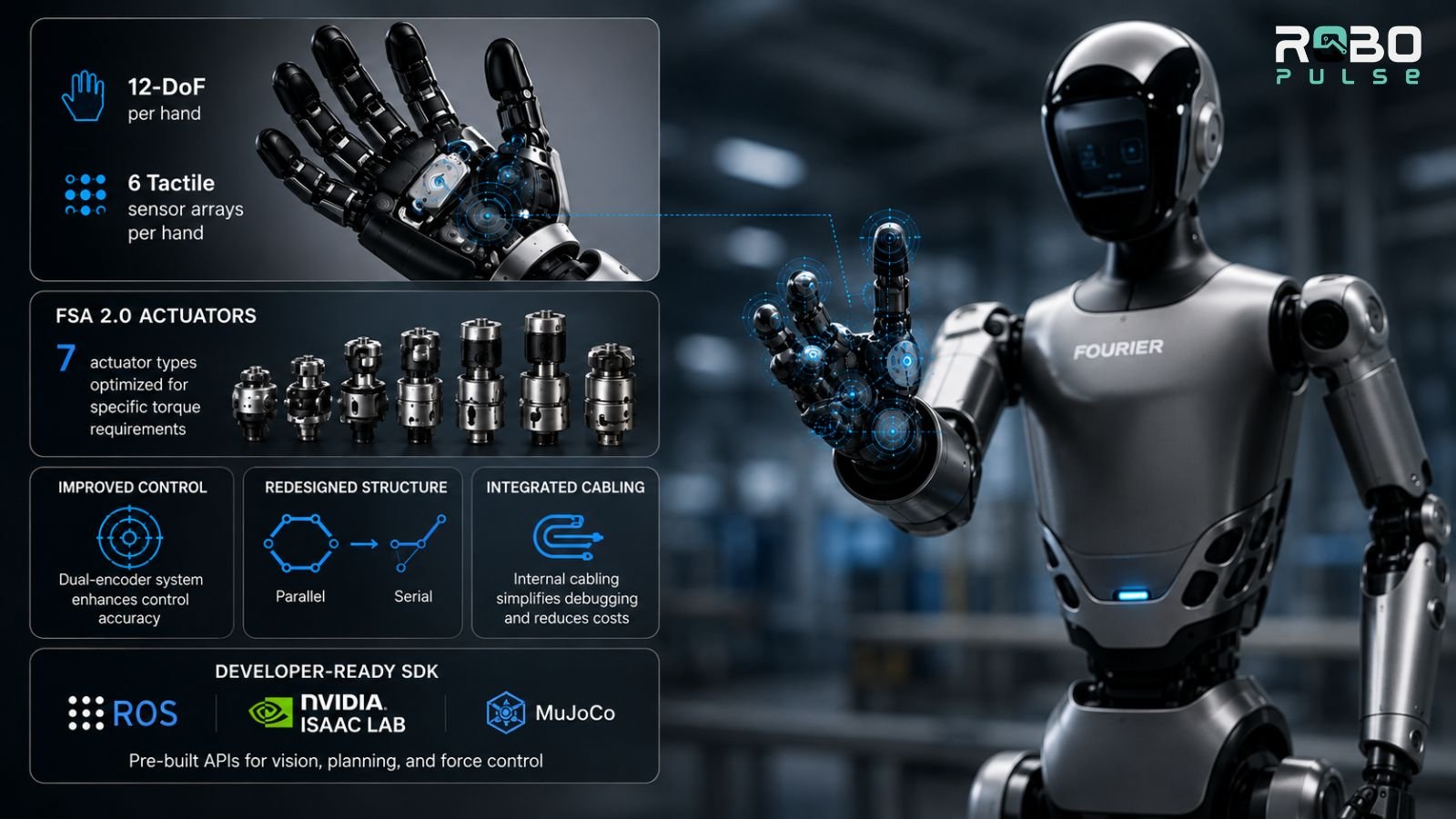
The hands are GR-2’s clearest hardware upgrade over the GR-1. Twelve degrees of freedom per hand, plus six tactile sensor arrays, give the robot contact and force-related sensing that can support more responsive manipulation than a purely position-controlled grasp. Fourier positions this as a dexterity upgrade; independent benchmarks of the closed-loop grip behavior aren’t publicly available yet.
Seven distinct FSA 2.0 actuator types drive the joints, each tuned to a specific torque requirement, with a dual-encoder system Fourier says improves control accuracy over the GR-1’s actuators. Fourier also redesigned the joint configuration from a parallel to a serial structure and moved to integrated internal cabling — changes the company and independent reporting both describe as simplifying debugging and lowering manufacturing and maintenance costs, though long-term reliability data isn’t public yet.
GR-2’s SDK supports ROS, NVIDIA Isaac Lab, and MuJoCo, with pre-built API modules for machine vision, path planning, and force-feedback control — aimed at developers who want to skip building those pipelines from scratch.
How Much Does the Fourier GR-2 Cost?
Fourier hasn’t published an official price for GR-2. Here’s how the available figures break down:
- Official Fourier price: Not published
- Third-party marketplace listings: Around $125,000
- Broader industry estimates for enterprise/institutional deals: $150,000-plus
Neither the $125,000 nor the $150,000-plus figure comes from Fourier directly, and they shouldn’t be read as interchangeable — one is a reseller listing, the other an industry estimate for direct enterprise deals.
Yes, you can technically buy a GR-2 — just not like a consumer product. Fourier sells GR-2 through enterprise and institutional deals rather than a public checkout, and the marketplace listings above appear to be resellers rather than Fourier’s own storefront. Anyone evaluating the robot for purchase still needs to contact Fourier’s sales team for an institutional quote.
Who Is Actually Using the Fourier GR-2?
Fourier markets GR-2 toward research institutions, healthcare and rehabilitation settings, and industrial pilots. Public information about specific commercial deployments is thinner than Fourier’s application claims.
On the confirmed side, secondary reporting has named research deployments at institutions including ETH Zurich and Carnegie Mellon University — those are third-party reported, not something RoboPulse independently verified with the institutions themselves. Beyond that, most of what’s public describes intended use cases rather than named, at-scale rollouts.
Fourier’s Rehabilitation Heritage: A Real Edge, With Limits
Fourier’s rehabilitation-robotics background gives GR-2 a more credible healthcare pathway than most newer humanoid startups. The company has spent nearly a decade building exoskeletons and rehab devices before entering humanoids, and that shows in the force-sensing hand design.
That heritage isn’t proof of widespread clinical deployment, though. It’s a plausible advantage in credibility and engineering direction, not evidence that hospitals are running fleets of GR-2 units today.
One related note: Fourier’s newer GR-3 “Care-Bot,” launched in August 2025, is a separate, softer-bodied platform built specifically for companionship and eldercare, distinct from GR-2’s higher-torque research and industrial focus. Readers comparing the two shouldn’t assume GR-3’s care framing carries over to GR-2’s spec sheet.
How Does GR-2 Compare With Other Humanoid Robots?
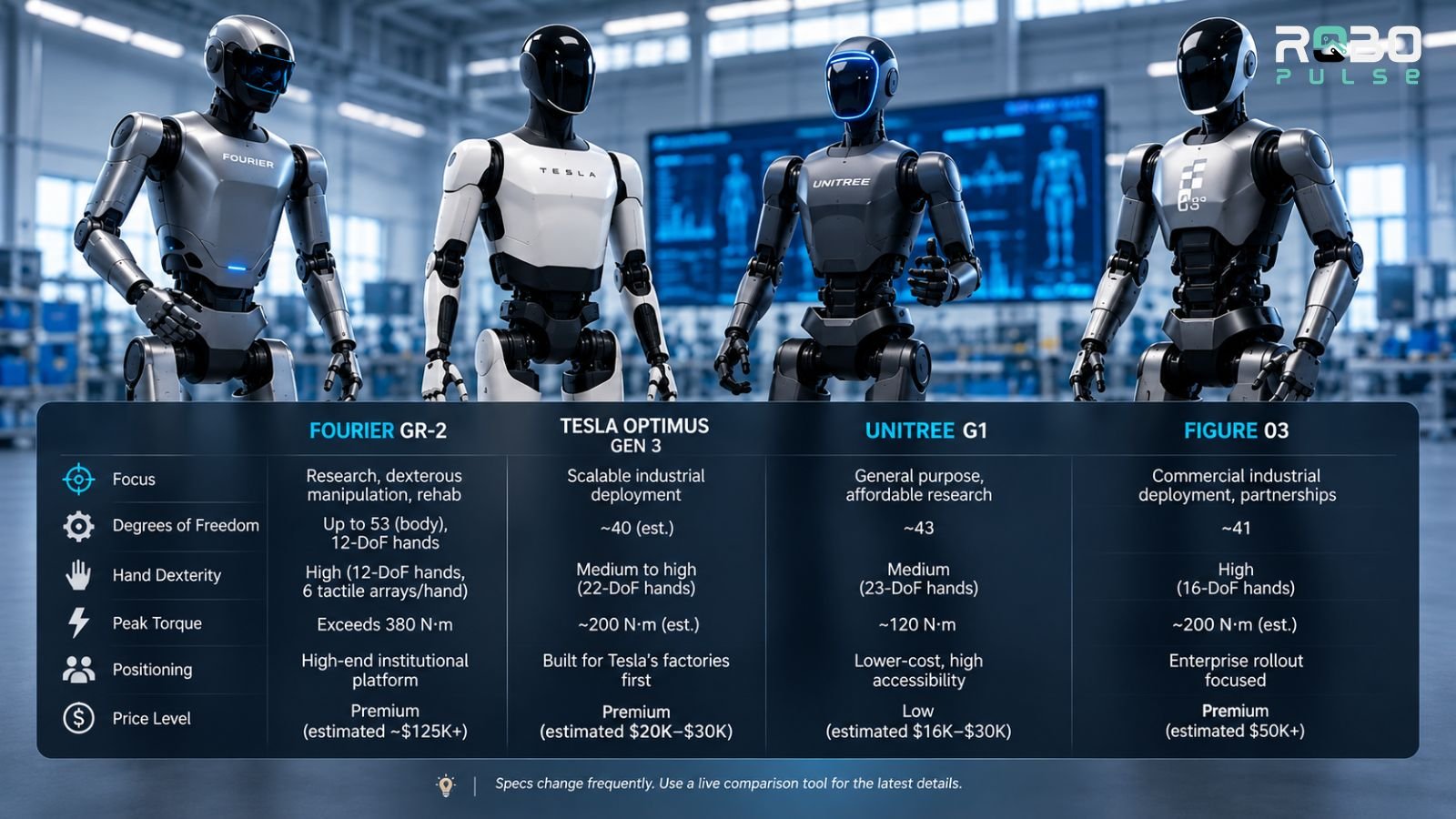
GR-2 sits toward the higher-DoF and higher-torque end of many research-oriented humanoid platforms, with hand dexterity as a particular strength — a trade-off against price and accessibility compared with lower-cost platforms.
- GR-2 vs. Tesla Optimus. GR-2 leans toward research and dexterous manipulation; Tesla Optimus Gen 3 is positioned more around scalable industrial deployment at Tesla’s own facilities first.
- GR-2 vs. Unitree G1. The G1 is positioned at a much lower entry price across its base configurations, while GR-2 emphasizes a higher-end institutional specification set and a more advanced tactile-hand setup. G1 pricing varies a lot by configuration, so treat this as a positioning difference rather than a spec-for-spec comparison.
- GR-2 vs. Figure 03. Figure has pushed harder toward commercial industrial deployment and embodied-AI partnerships; GR-2’s differentiator is its rehabilitation heritage rather than factory-scale rollout numbers.
The right choice depends less on maximum DoF and more on payload, hand capability, SDK access, price, and deployment support. A live comparison tool is a better fit than a static table here, since competitor specs shift often enough that a snapshot goes stale fast.
What Is the Fourier GR-2 Best For?
GR-2 makes the most sense for university labs, robotics research teams, healthcare and rehabilitation organizations exploring humanoid applications, and industrial groups running controlled pilots. It’s a poor fit for consumers, hobbyists looking for a low-cost platform, or buyers who need proven, large-scale autonomous deployment right now rather than a research and pilot platform.
Fourier GR-2: Strengths and Weaknesses
Strengths
- 53-DoF body with genuinely upgraded 12-DoF tactile hands
- Peak actuator torque exceeding 380 N·m
- Detachable, hot-swappable battery
- Strong research-software support (ROS, Isaac Lab, MuJoCo)
- Rehabilitation-robotics heritage that few competitors can match
Weaknesses
- No official published price
- ~2-hour runtime limits continuous operation
- Enterprise/institutional sales only — no consumer channel
- Limited independent, third-party benchmarking
- Real-world autonomy and deployment scale are less transparent than the spec sheet
Is the Fourier GR-2 Worth Considering?
GR-2 is worth a look for labs and institutions that need real manipulation capability and can work through an enterprise sales process. It’s not worth pursuing for anyone expecting a purchasable, consumer-priced robot.
The 12-DoF tactile hands and FSA 2.0 actuators are genuine upgrades over the GR-1, and Fourier’s rehabilitation-robotics background adds credibility in healthcare use cases specifically. Set against that: no public pricing, a 2-hour battery runtime that limits continuous operation, and a sales process that requires direct institutional engagement. For a university lab or hospital system already talking to Fourier, that’s a minor friction. For anyone comparison-shopping against off-the-shelf platforms, it’s a real barrier.
FAQs
Q. What is the Fourier GR-2?
The Fourier GR-2 is Fourier’s second-generation general-purpose humanoid robot. Fourier launched the GR-2 in September 2024 as the successor to the GR-1 for robotics research, healthcare and rehabilitation, and industrial applications.
Q. How tall is the Fourier GR-2?
The Fourier GR-2 stands 175 cm (5 ft 9 in) tall and weighs about 63 kg (139 lb). Its human-scale design supports research and practical humanoid-robot applications.
Q. How many degrees of freedom does the Fourier GR-2 have?
The Fourier GR-2 has up to 53 degrees of freedom (DoF) across its body, including 12-DoF hands. Each hand also uses six tactile sensor arrays to support more responsive manipulation.
Q. How much does the Fourier GR-2 cost?
Fourier does not publish an official price for the GR-2. Third-party marketplace listings put the robot at around $125,000, while broader industry estimates place enterprise and institutional deals at $150,000 or more. These figures come from resellers and industry estimates, not Fourier.
Q. Can you buy the Fourier GR-2?
Yes, but Fourier does not sell GR-2 through a standard consumer retail store. The company works with enterprise and institutional buyers, who need to contact Fourier for a quote. Some third-party resellers also list GR-2 units.
Q. How long does the Fourier GR-2 battery last?
The Fourier GR-2 runs for about 2 hours on average. Its detachable, swappable battery lets operators replace the pack instead of waiting for the installed battery to recharge.
Q. Is the Fourier GR-2 fully autonomous?
No. Fourier’s public materials do not establish GR-2 as a fully autonomous general-purpose humanoid. GR-2 supports VR teleoperation, lead-through programming, and direct commands. These features let humans control or teach the robot rather than demonstrate open-ended independent task execution.
Q. What is the Fourier GR-2 designed for?
The Fourier GR-2 targets robotics research, healthcare and rehabilitation, and industrial manufacturing. Its support for ROS, NVIDIA Isaac Lab, and MuJoCo also makes it useful for embodied-AI, locomotion, manipulation, and teleoperation research.
Q. What is the difference between Fourier GR-2 and GR-3?
The Fourier GR-2 focuses on research, manipulation, and industrial applications, while the Fourier GR-3 focuses on companionship and eldercare. Fourier launched GR-3 in August 2025 as a softer-bodied Care-Bot, giving the two robots different roles within Fourier’s humanoid lineup.
Related: Sanctuary AI Phoenix Gen 7: Specs, Price & 2026 Status