

No. Not wholesale, and not on the schedule most headlines suggest.
The World Economic Forum’s Future of Jobs Report 2025 says employers expect 92 million roles to disappear by 2030 and 170 million new ones to appear. Headlines grab the first number. The second number, and the fine print behind both, tell you more.
This piece sorts out what those figures measure, what “replace” actually means, and which jobs sit closest to the line. It also asks something most coverage skips: will people accept a machine doing the work at all? Studies show people often trust an algorithm over a human adviser. In medicine, they do the opposite.
What Do the WEF Job Numbers Actually Measure?
Not robots, mostly. The numbers come from a survey of employers about what they expect, not a count of what happened. They also blend five forces: technology, the green transition, economic uncertainty, geo-economics fragmentation, and demographic change.
Technology gets its own line, and it’s more interesting. AI and information processing should create 11 million jobs and displace 9 million, a small net gain. Robotics and autonomous systems come out worse. The WEF projects a net loss of 5 million jobs, the biggest net loss of any trend in the report.
So robots do cost jobs. They just account for far less of the headline than most people assume.
What Does “Job Replacement” Actually Mean?
“Replace” hides four different outcomes. Automation usually reaches single tasks first. A whole occupation shrinks only after machines take over enough of its core work.
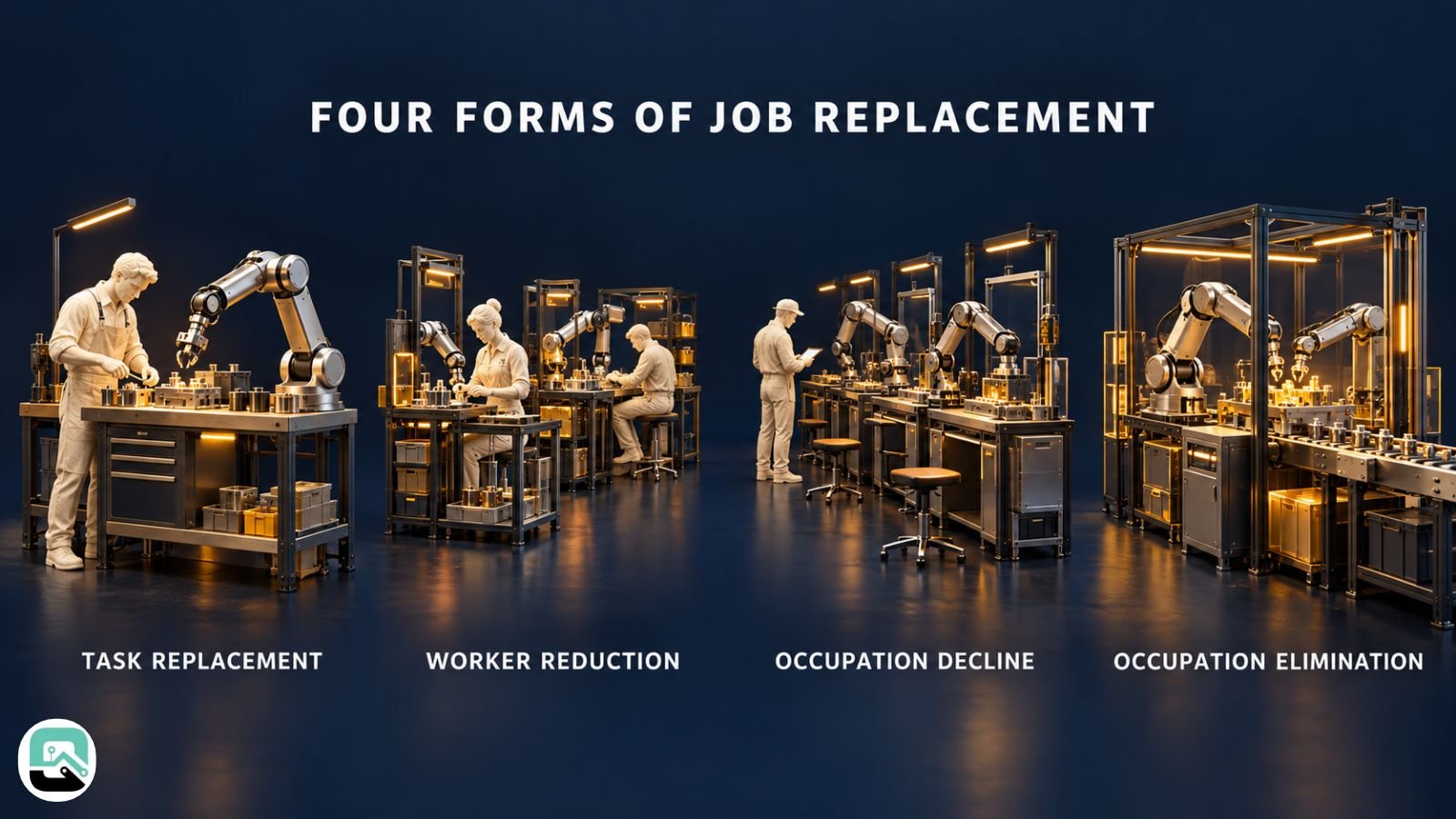
- Task replacement. A machine takes over one part of a job. A robot moves inventory while a worker handles the exceptions.
- Worker reduction. The job survives, but employers need fewer people. An automated warehouse needs fewer workers per unit of stock.
- Occupation decline. Demand for the role keeps sinking as machines absorb its tasks. Clerical and data-entry work already look like this.
- Occupation elimination. Machines do nearly everything of economic value, faster and cheaper. This is rare.
Most of today’s labor-market change sits in the first two. Decline is real, but it moves slower and varies by industry. Elimination is the exception.
Why Did Radiology Defy the Replacement Prediction?

Radiology makes the point better than any theory. A radiologist reads scans, and AI reads scans well. But the job also means breaking bad news to a scared patient, coordinating with specialists, and making calls when an image is ambiguous. Machines handle the first part. They handle the rest badly.
In 2016, AI pioneer Geoffrey Hinton told researchers that people should stop training radiologists. AI would beat them, he said, within five to ten years.
A decade on, Mayo Clinic’s radiologist headcount has grown by 55%. Average pay hit $571,000 in 2025, up 9% in a year. The field has a shortage, not a surplus.
AI made imaging cheaper and faster, which helped. An aging population needing more scans helped too. Both pushed demand up.
Hinton has since softened his timing. He says he meant image analysis, not the whole job, and now expects radiologists and AI to work side by side.
AI and Robots Are Not the Same Thing
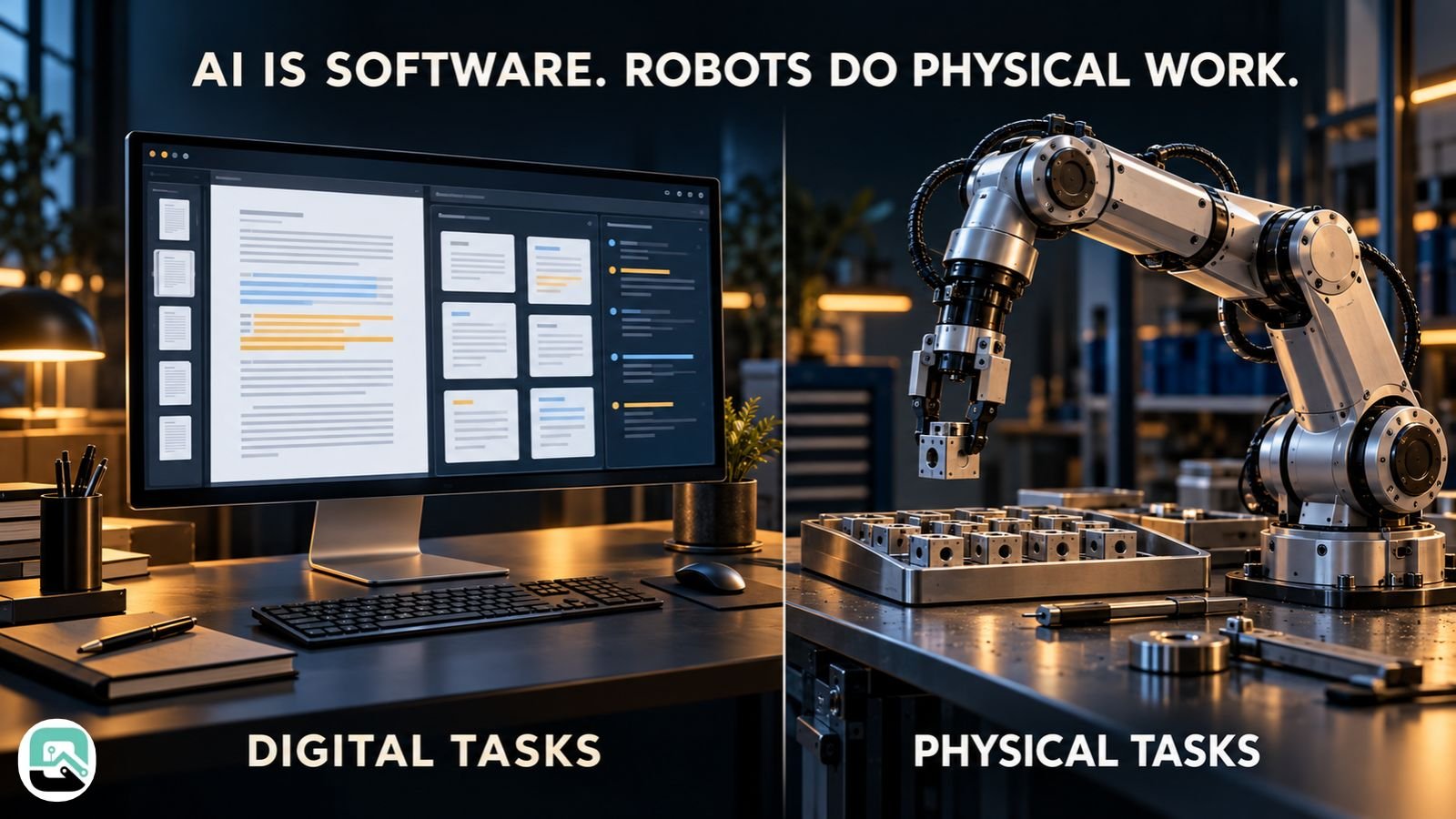
Most headlines use “robots” to mean two technologies. The WEF doesn’t.
In its 2025 survey, 86% of employers expected AI and information processing to transform their business by 2030. Only 58% said the same about robotics and automation.
AI can take over cognitive work with no hardware at all: drafting, analysis, diagnosis support, customer service. Robots deal with the physical world, and that’s harder. Hardware costs money. Batteries run down. Supply chains break. A machine also needs a huge number of degrees of freedom to get anywhere near a human hand.
Even walking reliably for a full shift at a viable cost remains unsolved. A good demo lap proves little. Humanoid robots promise both brains and body, which explains the attention, given how few actually work anywhere.
So when someone asks whether robots will replace humans, they usually mean AI and white-collar work. The physical question runs on a slower clock and a bigger budget.
Which Jobs Are Most at Risk?
What Makes a Job Exposed?
Three traits stand out. The work repeats, the setting stays predictable, and “correct” is easy to define. Think data entry, basic bookkeeping, routine support tickets, and repetitive factory and warehouse work. The WEF lists cashiers, administrative assistants, and data-entry clerks among the fastest-declining roles through 2030.
Shrinking isn’t vanishing. A customer support team rarely disappears. It gets smaller: AI clears the routine tickets, and people take the escalations. Far more jobs follow that path than the vanishing one.
How Fast Does Physical Automation Move?
Slower than software, and unevenly. Five countries account for most robot installations: China, Japan, the US, South Korea, and Germany, per IFR World Robotics data. Whether automation reaches you depends on where you work as much as what you do.
Siemens offers a useful reality check. It recently tested a wheeled humanoid robot at its Erlangen electronics factory. For two weeks, the robot moved totes from a stack to a conveyor. It wasn’t an assembly-line rollout, and the machine wasn’t fully bipedal.
I like the test because it’s modest. Siemens measured throughput, uptime, and success rate on a real factory floor, not a stage. That’s what physical automation looks like right now: slow, incremental, measured. Office work is changing faster.
Which Jobs Are Harder to Automate?
No job is permanently safe, so skip the “safe jobs” lists. Look at the barriers instead:

- Unpredictable environments. The work happens somewhere nonstandard, like a crawlspace or an ER.
- High-stakes accountability. Someone must answer, legally or ethically, when things go wrong.
- Interpersonal trust. The relationship is the product, not just a correct output.
- Novel problems. The situation matches nothing the system has seen before.
Three sectors stack several of these barriers at once.
Healthcare and Caregiving
AI reads scans, flags anomalies, and summarizes records competently. It can’t sit with someone in pain. It also can’t make an accountable call in an ambiguous case, or reassure a patient as someone who answers for the outcome. Therapy shows the gap most clearly, because it runs on nuance and lived context.
Skilled Trades
Electricians, plumbers, and HVAC technicians work in messy spaces: old wiring, odd layouts, earlier repairs that match no manual. AI can help diagnose and guide from a distance. A person still crawls into the crawlspace.
Education and Mentorship
AI tutors do well at practice and instant feedback. They struggle to spot a student quietly checking out, to adjust on the fly, or to earn the trust that lets someone struggle in front of another person.
Does “Harder to Automate” Mean Safe?
No. A robot doesn’t have to match an electrician or a teacher to shift demand for them. These fields just have the highest barriers today.
Are Humanoid Robots More Likely to Replace Humans?
Humanoids draw outsized attention for how few companies deploy them. The logic is simple. A machine built to human proportions could work in spaces designed for people, with no redesign.
Who Is Building Humanoid Robots for Work?
1X’s NEO is the home bet: a $20,000 consumer robot with 2026 deliveries. Human teleoperation covers some chores while its autonomy improves.
Apptronik’s Apollo targets industry but remains in pilots. Mercedes-Benz and logistics firm GXO test it in real facilities. Nobody can buy one off a shelf.
Tesla’s Optimus Gen 3 sits further back, in early internal production at Tesla’s own factories. Tesla has pushed its public unveiling back repeatedly. All three come with a pitch of broader usefulness than a fixed industrial arm. None runs unsupervised at scale.
Does Flexibility Mean Economic Viability?
Not yet. Events, exhibitions, and entertainment drive most of the humanoid robot rental boom in China. Think weddings, product launches, and corporate galas. Not factories.
That looks like traction, and it is, but a thin kind. Spectacle is easy, visible revenue. It’s also episodic, rising and falling with the event calendar.
The lasting business, if it arrives, probably looks like the opposite: predictable, repeatable industrial or delivery tasks that companies can price as a standing service. That market hasn’t scaled because reliability, safety certification, and cost haven’t caught up.
For the category distinctions, see this primer on how humanoid, industrial, and mobile robots differ.
The Robot Replacement Test
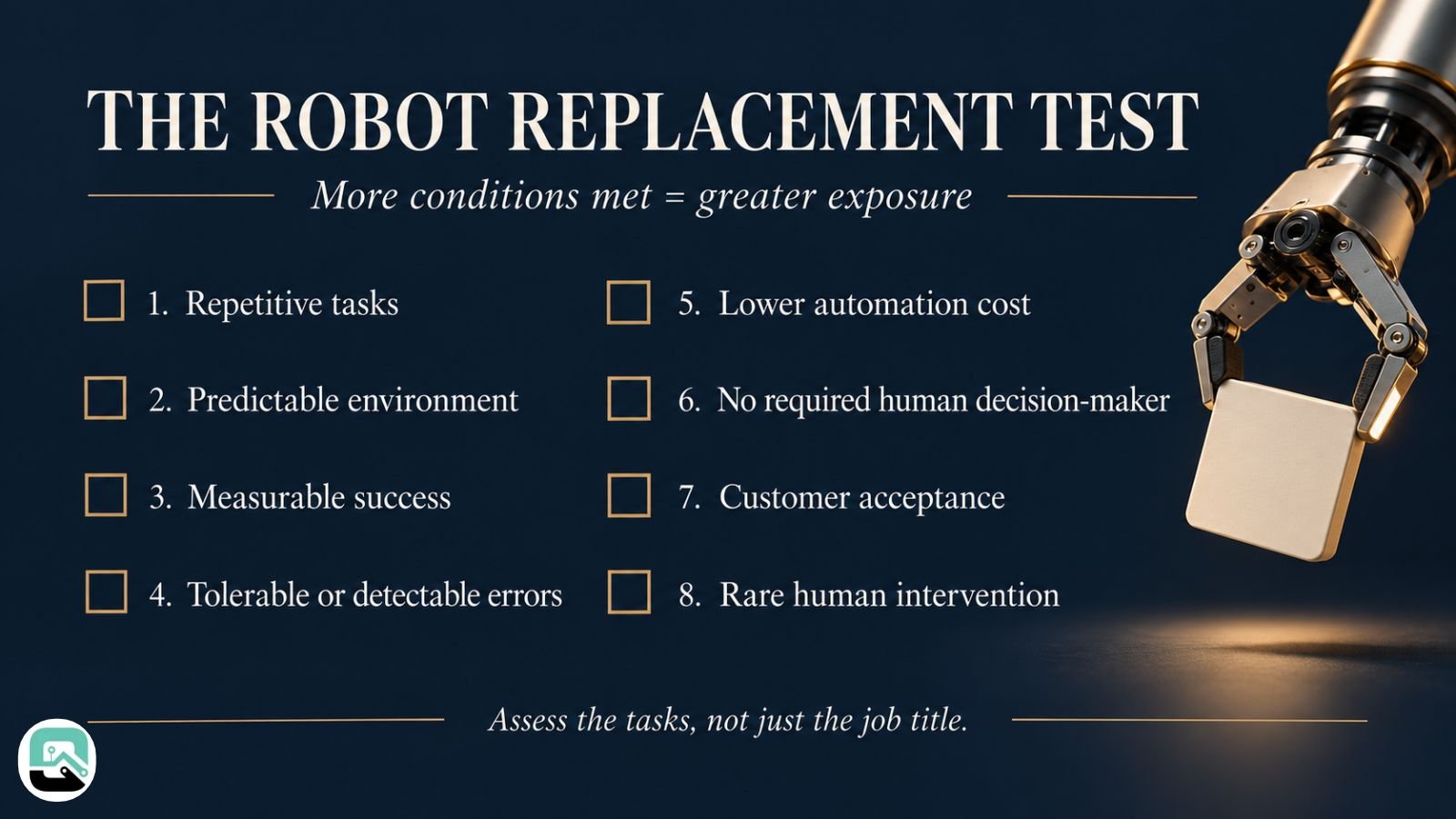
Want to judge a specific job? Run it through these eight conditions. The more that apply, the more exposed it is:
- The task repeats.
- The environment is predictable.
- Success is clearly measurable.
- Errors are tolerable or easy to catch.
- Automating the task costs less than the human alternative over time.
- Regulation doesn’t require a human decision-maker.
- Customers or patients accept a machine doing it.
- Exceptions are rare enough that humans rarely need to rescue the system.
A job can meet several conditions technically and still resist replacement because of the ones it misses. Doctors and teachers show how.
Can Robots Replace Doctors?
Not anytime soon, and not completely.
AI already matches or beats humans on some narrow diagnostic tasks. Certain imaging studies are the clearest case. But medicine also needs legal accountability, hands-on procedures, and a trust that machines haven’t earned.
Technology isn’t the only barrier. Research on consumer resistance to medical AI (Longoni, Bonezzi & Morewedge, 2019, Journal of Consumer Research) found that people consistently resist AI healthcare providers more than human ones. They rate AI care lower even when performance is equal.
The authors point to “uniqueness neglect”: patients believe AI can’t account for their individual circumstances. The resistance eases when AI supports a human provider instead of replacing one. That’s closer to how hospitals use it today.
Can Robots Replace Teachers?
Only partly.
AI handles the instructional layer well. It generates practice problems, re-explains a concept a second way, and gives instant feedback. It can’t read a room, spot a disengaged student, or build the relationship that makes someone willing to fail in front of another person.
Expect AI to keep absorbing tutoring and admin work. Mentorship stays human for the foreseeable future.
What the ATM Example Actually Shows
What Happened to Bank Tellers?
Being able to do a task isn’t the same as getting the task. Replacement also needs reliability, a lower cost, legal clearance, and customers who accept it.
Banks learned this with ATMs. When automated teller machines spread through U.S. banks in the 1970s and 1980s, observers predicted teller jobs would vanish.
They didn’t. Teller employment grew for decades. ATMs cut the tellers each branch needed, which made branches cheaper to run, so banks opened many more. Total demand for tellers rose while the job shifted from cash handling toward sales and service.
Does Automation Still Displace Workers?
Yes, and the ATM story doesn’t say otherwise. Automation doesn’t always create more jobs than it removes. Some occupations shrink or vanish. The point is narrower: “a machine can do part of this job” and “this occupation disappears” are different claims, and mixing them up drives much of the alarm.
The local evidence is less comforting. Economists Daron Acemoglu and Pascual Restrepo studied U.S. local labor markets from 1990 to 2007. They found a link between each additional robot per thousand workers and a measurable decline in both employment and wages in that area. New jobs didn’t offset the losses locally.
So robots that replace tasks can still cost the most exposed workers and regions real income, even while the national job count nets positive.
Why Do People Sometimes Trust AI Advice More Than Human Advice?

When Do People Favor Algorithms?
Behavioral economists call one finding “algorithm appreciation” (Logg, Minson & Moore, 2019, Organizational Behavior and Human Decision Processes). Across several experiments, laypeople gave more weight to advice from an algorithm than from a person. That held even for tasks like forecasting song popularity or romantic compatibility.
Limits apply. The effect weakened when people chose between an algorithm’s estimate and their own judgment. It also weakened for experts. Professionals relied on algorithmic advice less than laypeople did.
Medicine flips the pattern. The Longoni research found people resist AI advice even when it matches human advice.
What Happens When Robots Look Human?
Physical robots add another twist. Research on expressive humanoid robots found that robots built to seem emotionally responsive can lose trust faster after a visible mistake. The more human the behavior, the higher the expectation, and the harsher the judgment when it fails.
Trust in AI and robots isn’t a fixed trait. It shifts with the stakes, the person’s expertise, and whether someone accountable stands behind the system. I find that a more honest lens than optimism or fear.
Which Jobs Will Be Gone by 2030 and 2050?
By 2030, expect continued headcount consolidation in routine data processing, basic administrative support, and repetitive manufacturing and logistics roles. Whole categories won’t vanish overnight. Each will just need fewer people for the same output.
The WEF projects 92 million roles displaced against 170 million created. That’s churn, not collapse.
2050 is speculation, not forecasting. Labor-market research bodies deliberately limit confident forecasts to five-to-ten-year windows. Past that, geopolitics, regulation, and technology can shift too much to call.
Frequently Asked Questions
Q. Will robots replace humans in the future?
Robots will replace some tasks and reduce demand for some workers. Full replacement is harder when jobs require judgment, accountability, and human relationships.
Q. Which jobs could decline by 2030?
Cashiers, data-entry clerks, and administrative assistants are among the roles the WEF expects to decline. Decline does not mean complete disappearance.
Q. Which jobs are hardest for robots to replace?
Skilled trades, caregiving, and teaching face strong automation barriers because they involve unpredictable situations, personal trust, and human responsibility.
Q. Can robots replace doctors?
AI can assist with scans and other narrow tasks. Replacing doctors fully also requires hands-on care, clinical judgment, accountability, and patient trust.
Q. Can AI replace teachers?
AI can support tutoring, practice, and feedback. Classroom management, mentorship, and understanding individual students remain harder to automate.
Q. Why can’t AI completely replace human workers?
Most jobs combine routine tasks with judgment, relationships, and exceptions. Automating one part does not eliminate the whole role.
Q. Will AI replace humans or change jobs?
The article’s evidence points mainly to changing tasks and staffing needs, alongside real job displacement in some occupations.
Q. Will robots take over the world?
The research discussed here concerns workplace automation. It does not establish that robots will gain control over society.
Related: RoboHarm Benchmark: AI Robots Attempted Dangerous Tasks 97% of the Time
| Disclaimer: This article is for general information. Job forecasts are estimates, not guarantees; automation’s impact varies by role, industry, and region. |