

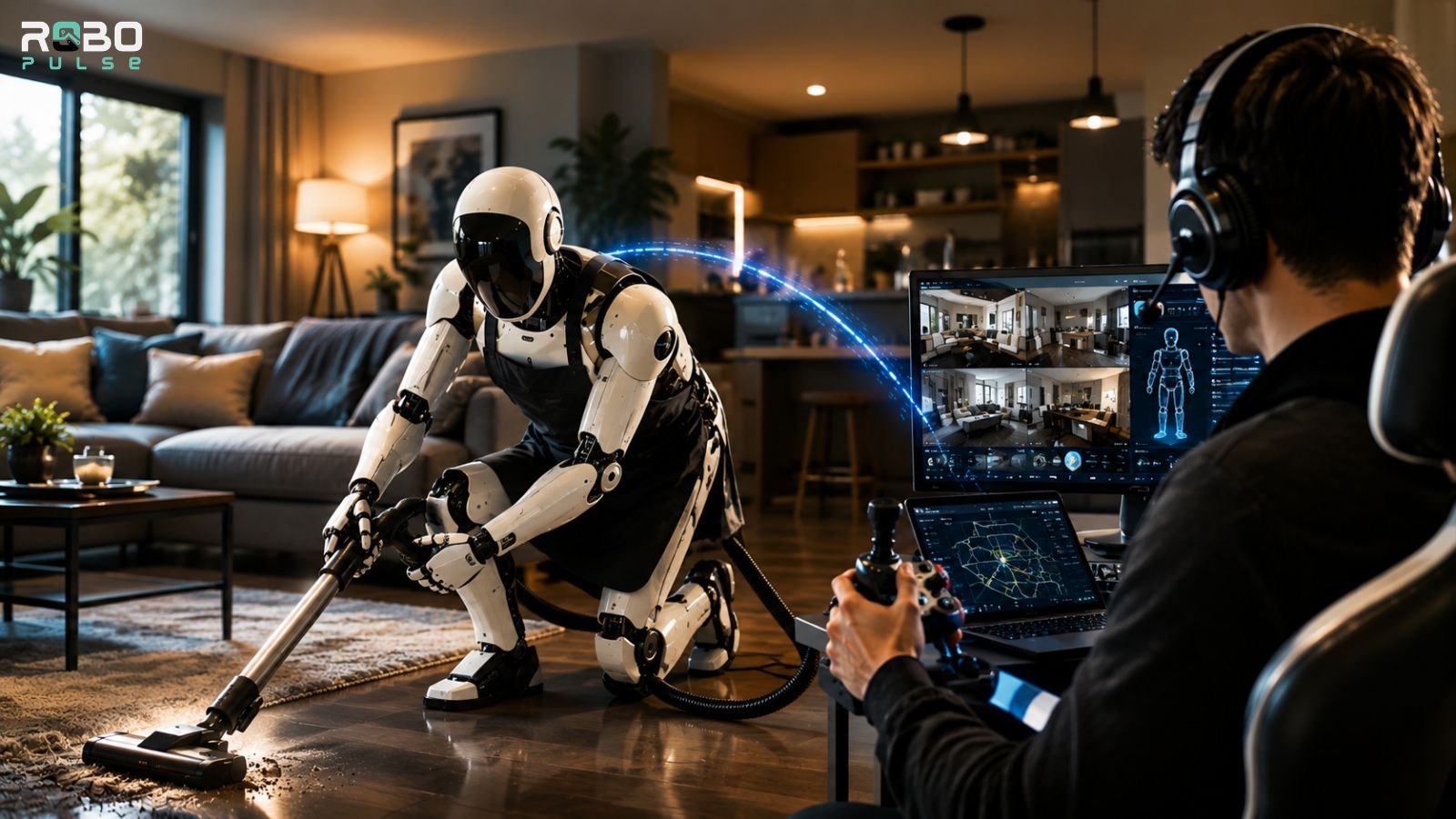
Tau Robotics started offering humanoid home cleaning in San Francisco this week. The pitch sounds like AI has finally moved into the living room. The mechanics tell a different story.
What Tau Robotics actually launched
CEO Alex Koch confirmed the service publicly this week, priced at $30 an hour for selected applicants in San Francisco. Koch framed it as an access play, aimed at households that never had a regular cleaner rather than customers switching away from one.
Koch also confirmed the part that matters most: current AI can’t run the robot alone. A person operates it from a central location, with AI assisting in the background. Tau built a humanoid shell around a human operator, then priced the result like a service call.
That number isn’t random. It lands close to what teleoperators reportedly earn steering Tesla’s humanoid demos, where remote operators have been paid in the $25-to-$48-an-hour range for the same kind of behind-the-scenes control. Tau isn’t selling a novel labor model. It’s importing the existing teleoperation gig economy into a category few companies have tried yet: someone’s private home.
Why a living room is a harder pitch than a warehouse
Teleoperation inside a factory means a camera pointed at a shelf. Teleoperation inside a house means a camera pointed at someone’s kitchen, hallway, and whatever else sits in frame while the robot works. Tau hasn’t said publicly how it handles footage, storage, or operator access once a robot is inside a customer’s front door. That’s a different privacy conversation than the one warehouse robotics has been having.
Ken Goldberg, a UC Berkeley robotics professor with four decades in the field, isn’t convinced the hardware is ready for that conversation yet either. He called the idea of a humanoid handling real cleaning work premature, pointing to two specific tasks: picking objects off the floor and wiping down counters and the areas underneath them. Both remain genuinely hard manipulation problems, not because the robot can’t reach, but because reliable grasping and contact-rich wiping motions are still open research problems even with a human steering.
Koch didn’t dispute the harder tasks. He said vacuuming already works well, and basic counter-wiping is doable. That’s a narrower claim than “humanoid house cleaner,” and closer to what teleoperated home robots have delivered so far, including 1X’s Neo, which has needed human intervention for tasks as simple as picking up a bottle.
The demo video problem follows this category everywhere
Tau’s promotional footage shows a robot exiting a minivan and getting to work, sped up for the video. Goldberg raised the standard objection: a sped-up clip doesn’t show whether a human intervened off-camera, whether the space was staged, or whether the run shown is the one that actually worked.
That skepticism isn’t unique to Tau. It’s the same credibility gap that’s followed teleoperated humanoid demos from bigger, better-funded labs for the past two years. Consumers reliably see the polished clip. They rarely see the failed takes, the staged apartment, or the operator on the other end of the connection.
The real product is the person, not the robot
Tau’s stated long-term goal is a humanoid that cleans an entire home on its own, at a price low enough to make cleaning services broadly accessible. That’s a legitimate destination. It’s also years away from a $30-an-hour teleoperated pilot in one city.
What Tau has built today is a dispatch service for remote human labor, delivered through a robot chassis instead of an app. That’s not a criticism of the business — gig-economy pricing for a genuinely useful service is a real product. It’s a reason to read “humanoid cleaning startup” and “teleoperation staffing company” as the same sentence, at least for now.