

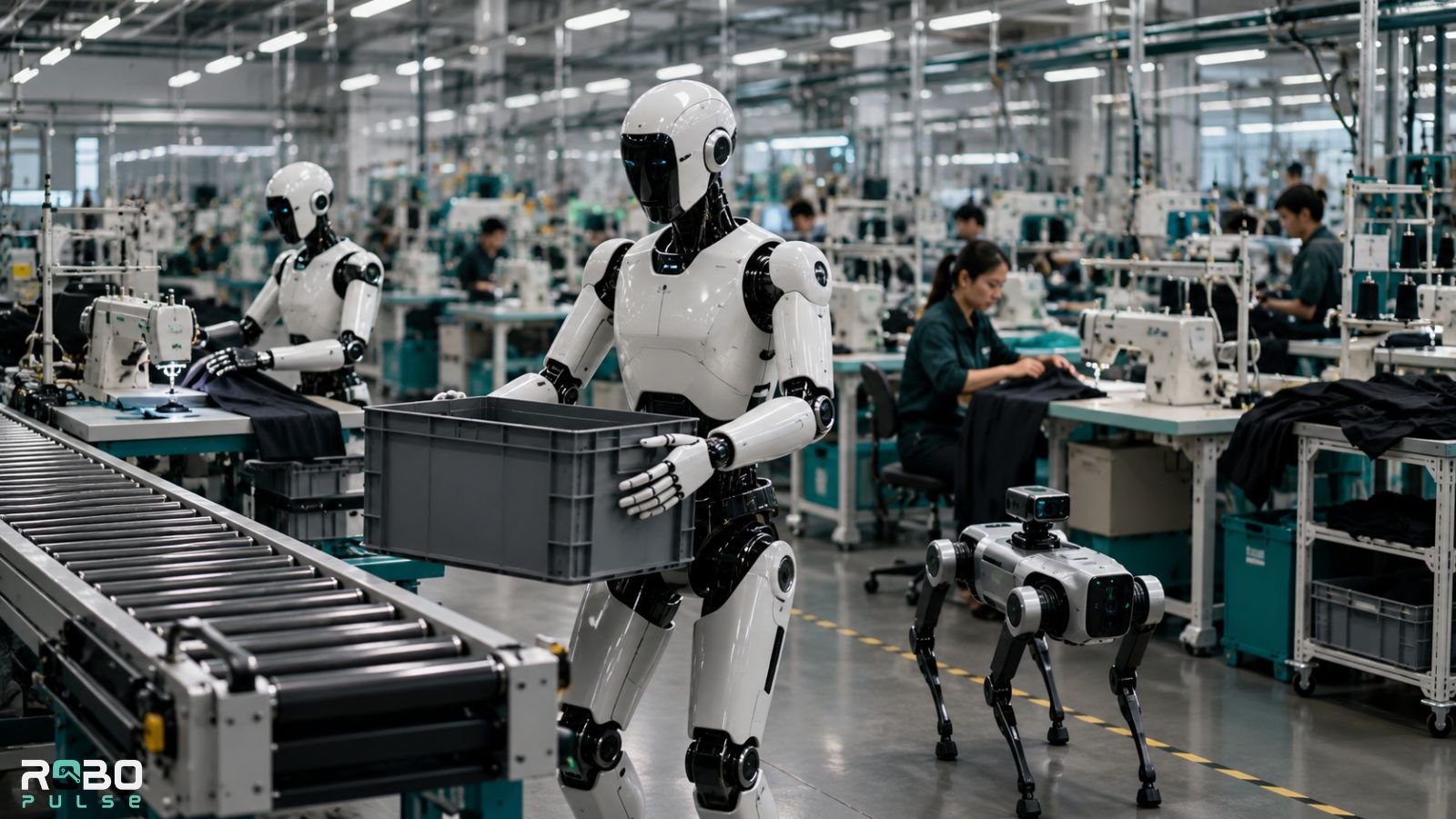
For the last two years, humanoid robots have mostly existed as a spectacle. A robot pours a drink at a press event. A robot does a backflip and also robot dances at a car reveal, and the clip earns millions of views before anyone asks whether it can do anything useful once the cameras stop rolling.
Siemens’ latest robotics update offers a useful corrective, mainly because it’s boring. It isn’t a demo reel — it’s a status report on robots handling crates, sewing garments, and sniffing out gas leaks inside working industrial sites. No stage, no applause, just throughput numbers from a live factory floor deployment.
That’s the more interesting story.
Where the Real Deployment Numbers Are
The headline figure here isn’t a viral clip — it’s a purchase order. Jack Technology, a China-based manufacturer of industrial sewing machines, has ordered 2,000 humanoid robots built specifically for apparel manufacturing this year. Siemens is supplying the software backbone: design, simulation, manufacturing, and a digital platform layer tying the whole workflow together. The stated target is at least a 30 percent efficiency gain.
Two thousand units isn’t a pilot program. It marks the first large-scale commercial rollout of humanoid robots in an industry automation has mostly skipped over, because sewing involves soft, deformable, irregular material — historically one of the hardest jobs to hand off to a machine.
If the deployment holds, it says more about where humanoids land first commercially than any warehouse demo has managed. It’s not the sectors with the most hype. It’s the sectors carrying the most labor pressure and the least existing automation, a pattern already visible in China’s broader push toward humanoid robot adoption and in growing debate over what these deployments mean for factory jobs and labor costs.
The Metric That Actually Matters: 90 Percent
Buried in the release is the number worth sitting with. During a two-week trial at Siemens’ Erlangen electronics plant, a wheeled humanoid called HMND 01 — built by British startup Humanoid, running on NVIDIA’s physical AI stack — moved crates from pickup to a conveyor handoff point, where human workers took over.
The results: 60 crates an hour, two different crate sizes handled without reconfiguration, more than 8 hours of daily operating time, and a success rate above 90 percent on fully autonomous grasp-and-place cycles. That last figure depends heavily on hand and gripper design, an area where dexterous end-effector development has moved fast recently.
Ninety percent doesn’t sound like a headline. It’s the whole story, though. A robot that performs flawlessly in a demo but fails one time in five on the floor isn’t a productivity tool — it’s a supervision burden. The gap between “impressive on stage” and “worth deploying” comes down almost entirely to that number, and it’s the number nobody puts in the highlight reel. For a broader sense of how wheeled and legged designs compare on tasks like this, the types of humanoid robots guide breaks down the trade-offs by form factor.
Robot Dogs Doing the Job Nobody Wants
The other deployment in the release is less flashy and arguably more consequential: ANYbotics’ four-legged ANYmal, working chemical and energy sites that span several square kilometers, covering the inspection rounds that are dangerous, dirty, or simply inconvenient for a person to walk.
ANYmal builds 3D models of a facility as it moves. It reads infrared to catch overheating pumps and motors before they fail, and it picks up acoustic signatures outside human hearing range to catch gas leaks early. None of that requires a humanoid shape — a quadruped with the right sensors and a staircase-capable gait, the kind of locomotion challenge legged robots are built to solve, covers more ground than a person walking the same route, in the dark, on a schedule, without needing PPE.
This is the unglamorous end of the robotics story: not “can it look human,” but “can it turn reactive maintenance into predictive maintenance” by feeding real-time data back to plant operators before something breaks.
The Part Everyone Skips: Integration, Not Intelligence
The release’s closing point explains why humanoid robotics has taken this long to reach a factory floor at all. A capable robot body is, on its own, a demo. What turns it into a production tool is the unglamorous infrastructure around it: digital twins, PLC-to-robot interfaces, fleet management, and workflows synchronized with other automated guided vehicles and human coworkers.
Without that layer, Siemens notes, even the most advanced robot remains an isolated island on the floor rather than part of a system. Readers comparing how different platforms handle this integration question can check the specs side by side in RoboPulse’s compare tool or browse the full robot database.
That’s the real barrier the industry has circled for years — not whether robots can move like humans, but whether they can talk to everything else already running the plant. The companies solving that integration problem quietly are likely to matter more, over the next five years, than the ones that win the next viral demo.
Related: Shanghai Electric’s WAIC 2026 Lineup Shows What Factories Actually Want From Humanoid Robots