

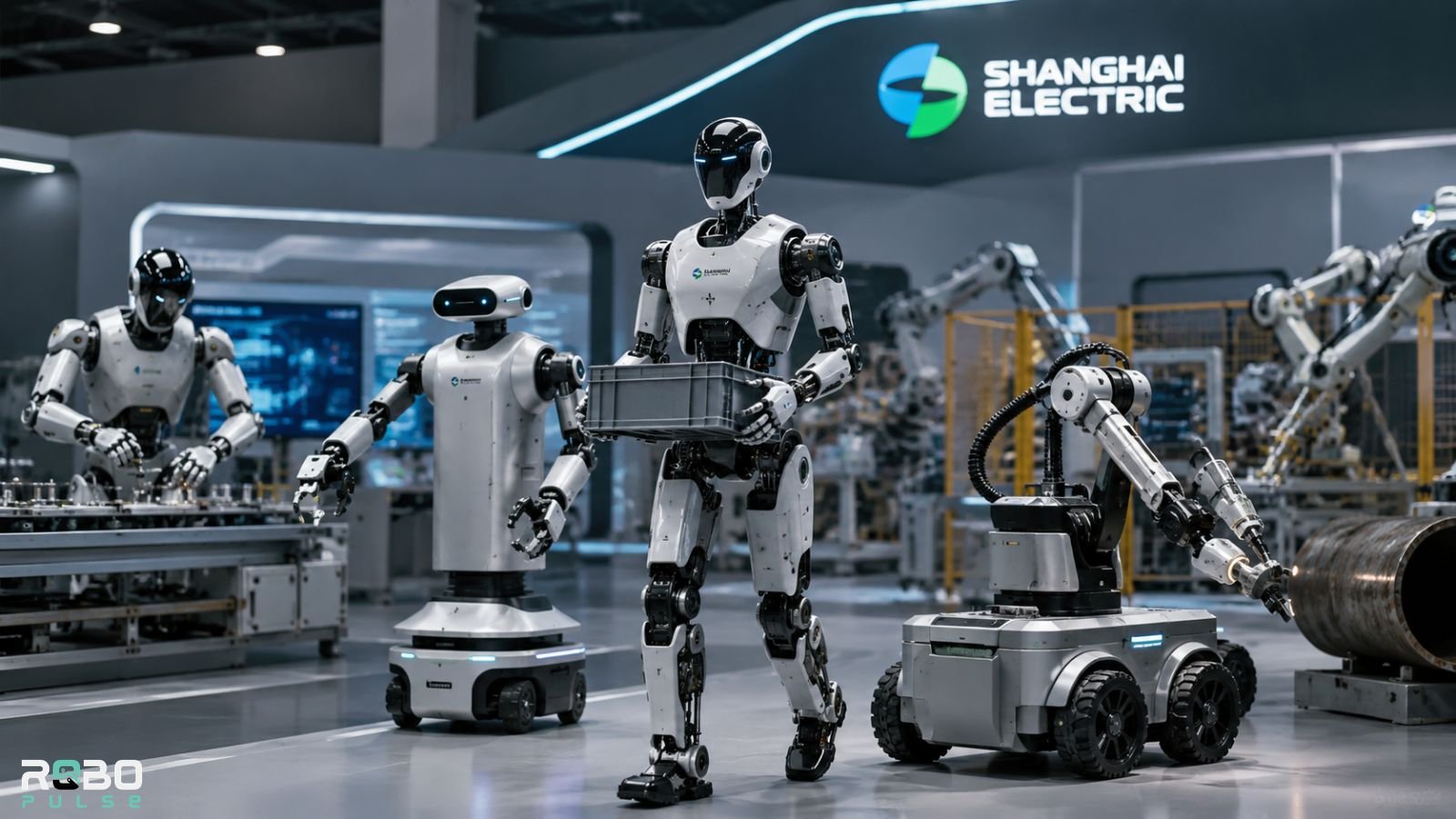
Most humanoid robot debuts chase one moment: a viral clip of a machine walking, folding laundry, or shaking hands with a CEO. Shanghai Electric skipped that script at WAIC 2026. The company brought a lineup instead. Bipedal, wheeled, and single-purpose machines, all backed by 51 AI models built to run a factory floor.
The message wasn’t “look what our robot can do.” It was closer to “here’s what a factory already needs.” Robot-shaped or not.
SUYUAN: the hot-swap detail that outweighs the spec sheet
Shanghai Electric’s flagship system, SUYUAN, is a bipedal humanoid. It has 41 degrees of freedom, a multimodal vision system, and a dual-battery hot-swap design that lets it keep working without downtime. Degrees of freedom describe how many independent joints or axes a robot can move. A count of 41 puts SUYUAN among the more mechanically complex humanoids built for industrial inspection, material transport, and assembly work.
The hot-swap battery reads like a footnote next to that DOF count. On a production line, it’s the opposite. Uptime, not agility, usually decides whether a robot earns a permanent spot next to human workers. Shanghai Electric designed around that constraint first.
Wheels, not just legs
That same pragmatism shows up in TUOYUAN, the company’s wheeled humanoid. It pairs an embodied AI foundation model with force-position hybrid control. The system handles multi-specification connector insertion, component sorting, and loading automotive sheet metal parts.
Bipedal locomotion solves for terrain a wheeled robot can’t cross. Factory floors are flat, mapped, and predictable. Wheels are a mundane, correct answer to a question most humanoid demos avoid asking: does this robot need legs at all?
For Shanghai Electric’s target tasks, the answer was often no. That distinction separates general-purpose designs from the wider range of purpose-built humanoid form factors now reaching factory floors.
Skipping the generalist pitch
A third robot, Mermaid, narrows the ambition further. It identifies switches, buttons, and control knobs, then generates its own operating path without manual programming. One job, done without a human coder in the loop.
A fourth system doesn’t bother with a humanoid shape at all. It’s an autonomous pipe-chamfering robot built for confined industrial spaces. The robot holds positioning accuracy within one millimeter and streams operating data in real time.
Seen together, the four systems push back against the “one humanoid to do everything” narrative that dominates the category. Wang Chunlei is deputy general manager of the Robotics Business Unit at Shanghai Electric Automation Group. He said the goal is pairing machine precision with human judgment to support closer human-robot collaboration. Not replacing the floor, but redrawing who does which part of the job.
The robots are the visible part of a bigger platform
The hardware is arguably the smaller story. Shanghai Electric’s StarCloud Intelligent Manufacturing platform brought 51 AI models and intelligent agents to WAIC. They span R&D, production scheduling, quality inspection, and predictive maintenance, including wind turbine servicing.
A companion AI-Native Smart Factory white paper outlines the architecture behind it. An AI “factory brain” coordinates operations, industrial agents and embodied robots execute tasks, and a digital twin mirrors the physical plant in real time. That structure is the actual bet.
Robots that walk or roll are the interface. The software layer that decides what they do next, and flags equipment failures before they interrupt production, is what makes or breaks the economics of factory automation. It’s a theme running through much of the broader push toward AI-driven manufacturing automation this year.
A planetary roller screw rounds out the component-level push. Shanghai Electric rates it at more than triple the load capacity of conventional ball screws. A new dexterous gripper called DexHand joins it. Dexterous end effectors have become their own competitive front in humanoid robotics — 1X’s redesigned robot hands are a recent example of manufacturers treating hand design as a bottleneck worth solving on its own.
Reading the timing
WAIC 2026 landed this showcase in the middle of a global conversation about manufacturing labor shortages. Shanghai Electric positioned its embodied AI push squarely inside that conversation rather than alongside it. The economics behind that positioning are already visible elsewhere in China’s robotics sector.
Rental and leasing models are emerging there for a simple reason. Few manufacturers want to own hardware that isn’t proven yet.
Shanghai Electric says deployment will expand as the technology matures. It’s an unglamorous roadmap for a category that usually promises the opposite.
The real takeaway isn’t that Shanghai Electric built a flashier robot than its competitors. The company built four different answers to four different factory problems. Then it wrapped them in a software layer meant to make the choice between them irrelevant to the plant manager signing the purchase order.
Related: Unitree’s Robot Sales Reveal Why AI Generalization in Robotics Is Still the Biggest Challenge