

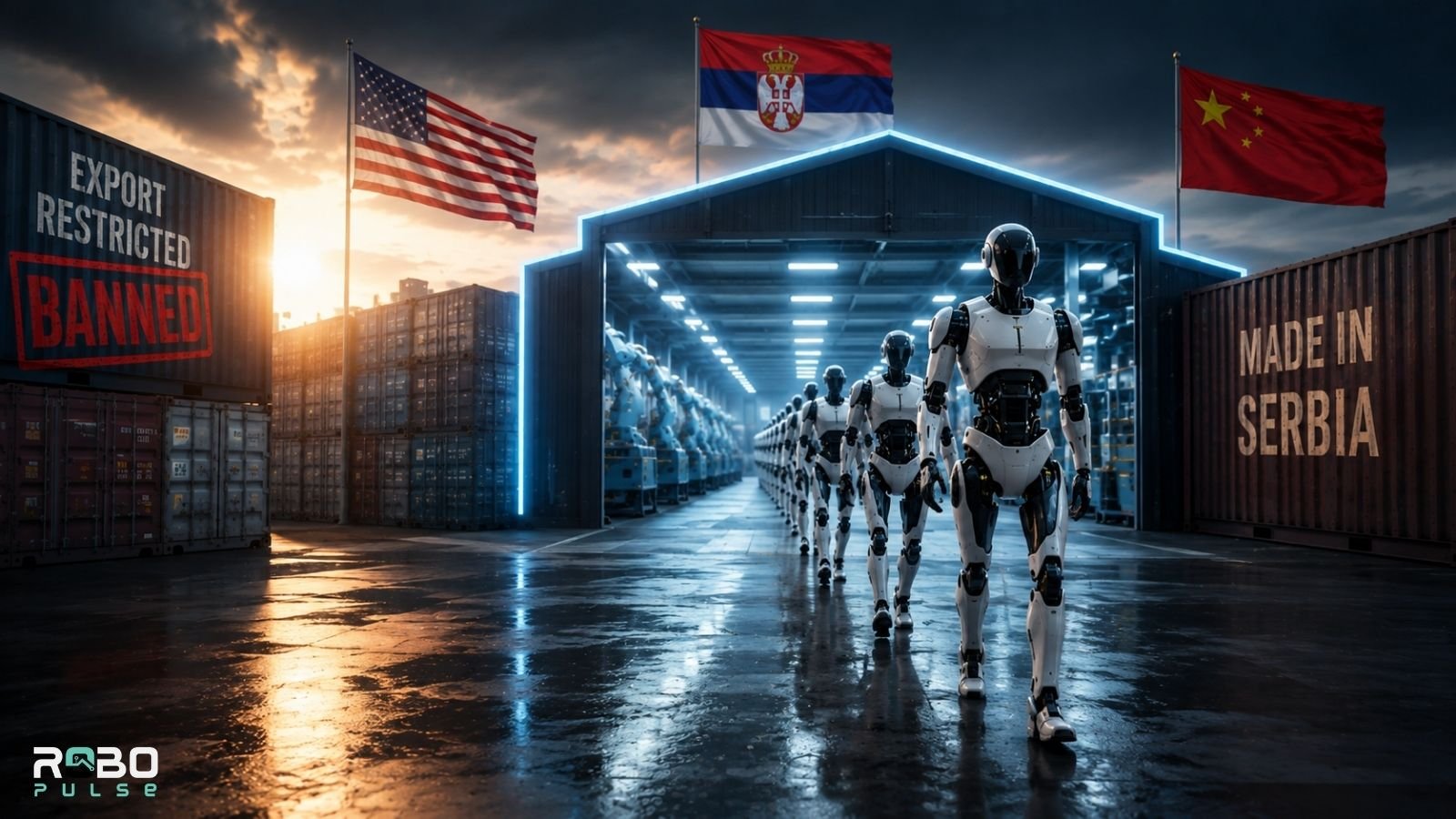
A humanoid robot kicked a penalty shot at Serbia’s president on August 29. A quadruped carried a man across a factory floor. The applause covered up the real story: a small Balkan country just became the pressure valve for a US-China robotics standoff that moved faster than regulators expected.
What happened at the Sabac robot factory
Washington banned imports of foreign-made advanced robots on July 29. The ban covers humanoids and robot dogs. Regulators cited surveillance risk, not trade. Cameras and sensors inside a home robot could let a foreign government watch American households, the FCC’s published notice warned.
Twenty-nine days later, a joint venture between AGIBOT and Minth Group opened a mass-production line in Sabac, western Serbia. President Aleksandar Vucic says the plant will eventually build more than 5,000 robots a year. That timing is not a coincidence. A company found a side door the moment the front one closed.
What does “assembly” actually mean at the Sabac factory?
Most coverage skated past the detail that matters most: nobody knows how much of these robots Serbia actually builds versus simply assembles. RFE/RL asked Belgrade and the Chinese partners what “assembly” involves at Sabac. Neither side answered.
That silence might be the entire business model. Serbia holds preferential trade terms with the EU under the bloc’s origin rules. If Brussels ever restricts Chinese robots the way Washington just did, a robot finished in Sabac could carry a “Made in Serbia” label and enter the European market anyway.
Antonia Hmaidi, who researches China’s tech sector at a Berlin think tank, said the project could deepen risks the EU already faces. MERICS has tracked similar workarounds in solar panels, EVs, and steel. AGIBOT Europe’s CEO William Shi says the company chose Serbia for its stable business environment. That phrase reads differently once you notice what a stable customs loophole is worth.
How fast did civilian robots reach Serbia’s military?
Buried near the bottom of most reports: Vucic announced Serbia’s army would field Chinese-made robots within 15 days of the factory opening. Armed ones. “You’ll see them not only walking, but using weapons,” he said.
A civilian supply chain fed a national army within two weeks of the assembly line switching on. Washington and Brussels are still debating vacuum cleaners and home surveillance. Serbia just showed that the same hardware slides into weapons deployment with almost no pause between the two.
Altynay Junusova, also with MERICS, has pushed this exact point. Even ordinary household robots raise unresolved questions about which sensors get to move through homes and workplaces, and under what rules. Sabac suggests those questions arrived too late for the military use case.
Why China’s humanoid dominance makes this bigger than one factory
China built about 12,800 humanoid robots in 2025. That’s roughly 90 percent of global output. AGIBOT only launched in 2023, yet it topped the medal table at Beijing’s World Humanoid Robot Games less than a week before the Sabac opening. China’s rental market for humanoids has scaled just as fast, which tells you how quickly domestic supply is outrunning domestic demand.
This isn’t a scrappy startup chasing a loophole. It’s the category leader testing whether trade geography can outmaneuver a security ban faster than regulators can close the gap.
Price is part of the story too. Unitree already ships a humanoid directly to individual buyers for under $14,000, no factory contract required. Tesla is still promising a redesigned Optimus at scale. Figure’s BMW deployment runs on a billed-hourly model, not a purchase price. Against that field, a government-backed factory turning out 5,000 units a year is a different kind of competitor — one built for volume and geopolitics, not retail.
Sabac’s demo day also hints at real capability, not just optics. A robot that can land a penalty kick or box a round needs genuine range of motion in its joints — engineers measure that as degrees of freedom, and it’s a rough proxy for how close a platform sits to real physical work versus demo tricks.
What to watch next
The US ban assumed a robot’s nationality never changes after the factory that designs it. Serbia just tested a different theory: nationality is whatever the last country to touch the box says it is.
Watch what the EU does next. That decision will show whether “assembled in” becomes the next workaround for hardware categories far beyond humanoids.